[Most Recent Entries] [Calendar View]
Friday, July 6th, 2018
- ASRock Shows Off B450 Lineup: Something For Everyone
- AMD B450 At Computex: ASRock Invite Mentions B450 Chipset on Display
- The AMD 2nd Gen Ryzen Deep Dive: The 2700X, 2700, 2600X, and 2600 Tested
- The ASRock X370 Gaming-ITX/ac Motherboard Review
- AMD Preps New Ryzen 2000-Series CPUs: 45W Ryzen 7 2700E & Ryzen 5 2600E
- Two New 35W Raven Ridge Parts: AMD Athlon 200GE and Athlon Pro 200GE
- AMD Launches Ryzen Pro with Vega: Mobile APUs and Desktop APUs
- AMD Launches Ryzen 3 2200GE & Ryzen 5 2400GE 35 W APUs
- The MSI B350 Tomahawk Motherboard Review: Gaming On a Budget
- GIGABYTE Aorus PCIe x16 M.2: For Four NVMe Drives, X399 Compatible
- Plextor Demonstrates 4-Way M9Pe Extreme SSD Solution: Up to 6.5 GB/s
- Marvell Launches New SSD Controllers And RAID-Capable NVMe Switch
- Kingston at CES 2018: A 6.4 TB U.2 Enterprise SSD with Four M.2 Behind a PEX Chip
- ASRock at CES 2018: Ultra Quad M.2 PCIe Card
- MSI Demos Prototype Hybrid Storage Card: M.2 & 2.5” SATA on a PCIe Card
- Arm's Cortex-A76 CPU Unveiled: Taking Aim at the Top for 7nm
- Samsung Foundry Roadmap: EUV-Based 7LPP for 2018, 3 nm Incoming
- Samsung’s 8LPP Process Technology Qualified, Ready for Production
- Samsung and TSMC Roadmaps: 8 and 6 nm Added, Looking at 22ULP and 12FFC
- TSMC Details 5 nm Process Tech: Aggressive Scaling, But Thin Power and Performance Gains
- Intel Delays Mass Production of 10 nm CPUs to 2019
- TSMC Kicks Off Volume Production of 7nm Chips
- TSMC Starts to Build Fab 18: 5 nm, Volume Production in Early 2020
| Time | Event |
| 10:00a | iBuyPower Element Gaming PC Review: i7-8086K and GTX 1080 Ti Inside It has been a long while since AnandTech has reviewed full-sized systems, as most of our readers tend to build PCs for themselves. There is however quite a large contingent of PC users who buy off the shelves/website from companies like such as iBuyPower who build custom PCs. Today we are looking at a custom build using their Element chassis, which gives users a tempered glass chassis, some RGB bling, and some quite capable hardware inside with the latest Intel i7-8086K as well as an NVIDIA GeForce GTX 1080 Ti. Read on to see how it's built and how well it performs in our testing. |
| 11:00a | Multiple AMD B450-Based Motherboards Listed in Europe Ahead of Launch
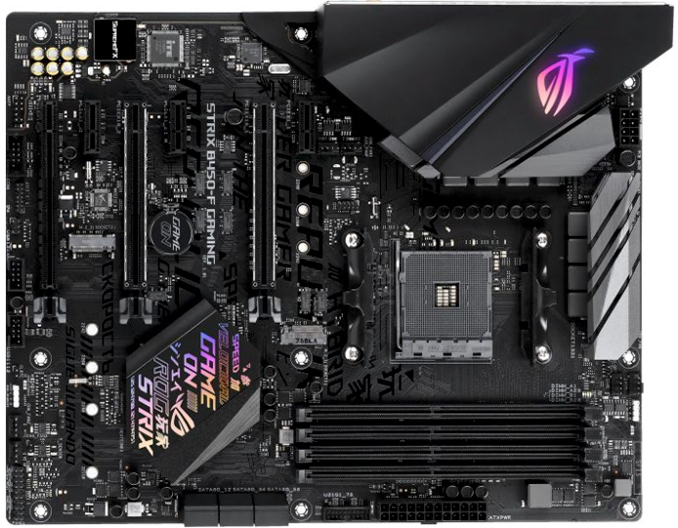
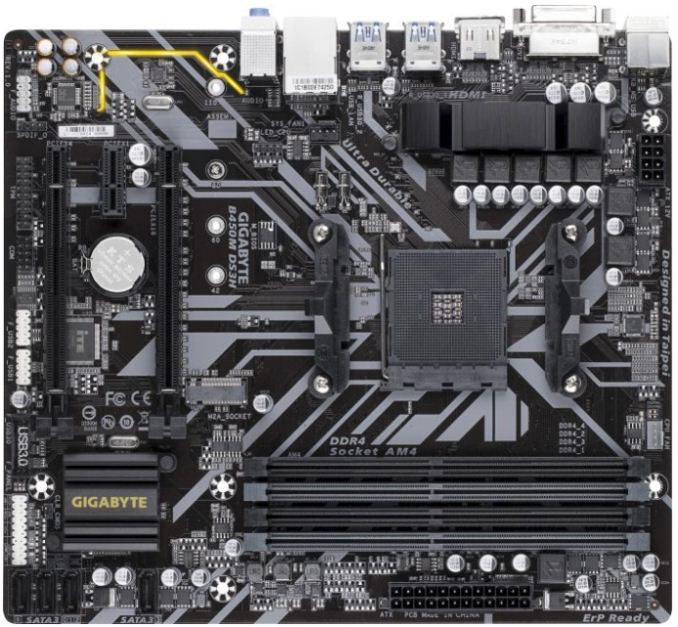
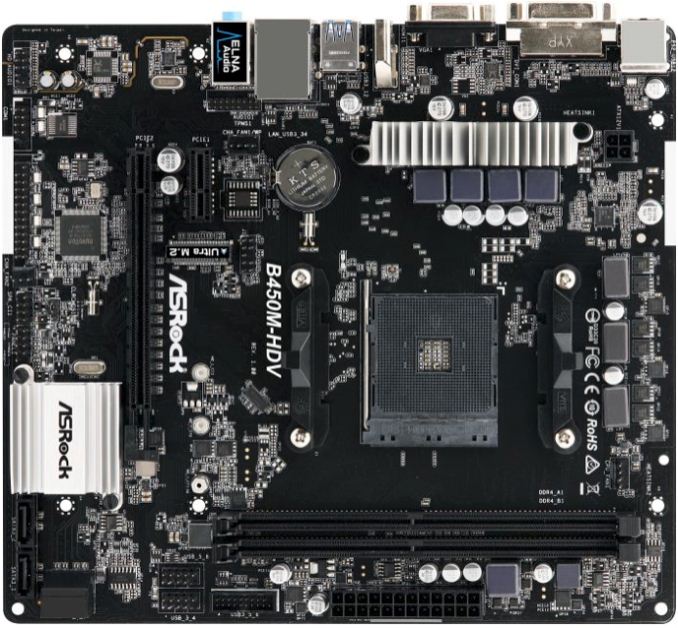
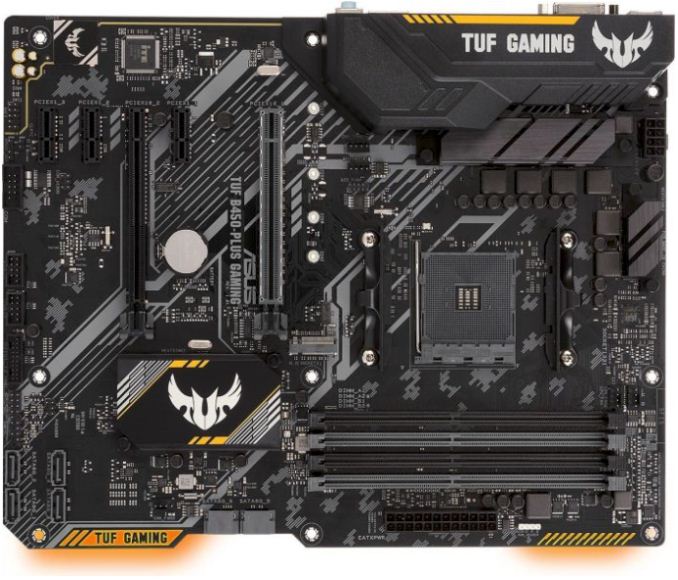
AMD still has not formally announced its B450 chipset, but it looks like everything is ready for the launch. Pre-orders and listings for B450 boards from three major motherboard manufacturers have already appears in Europe, targeting customers with different budgets. Multiple stores in Austria and Germany are taking pre-orders on AMD B450 boards from ASUS and ASRock, according to Geizhals.eu. Some stores actually list some of these motherboards as “in stock”, but they also note that the product will be ordered from their warehouse (or a distributor) after a customer order is placed. So the devices may be available to buy, but delivery will take several days. Meanwhile, the ASUS Prime B450M-A seems to be available immediately. And GIGABYTE lists one of its B450 motherboards (the B450M DS3H), but it does not seem to be available for order anywhere. One thing to note is that neither of these board makers have said boards listed on their web sites, but stores mentioned by Geizhals.eu have all the official pictures of the products that can only be obtained from manufacturers.
ASRock already demonstrated its comprehensive lineup of four B450-based motherboards at Computex a month ago. In fact, the ASRock B450M-HDV was listed as “in stock” by multiple retailers, but at press time it could not be ordered (i.e., the order pages have been removed). This product is an entry level one, it is expected to cost €72 ($84).
ASUS is apparently prepping an even broader family of AMD B450 platforms that includes at least seven models. The listed items include the ROG Strix B450-F Gaming, the ROG Strix B450-I Gaming, the TUF B450-Plus Gaming, the TUF B450M-Plus Gaming, the Prime B450M-A, the Prime B450-Plus, and the Prime B450M-K. The higher-end ROG Strix models will traditionally feature a rich I/O feature set, a programmable RGB lighting, and vast overclocking capabilities. Less expensive TUF-series products will be aimed at gamers and therefore offer similar capabilities, but without ultra-premium features (e.g., high-end VRM, RGB, etc.). Meanwhile, Prime are basic motherboards without anything excessive. Prices of ASUS’ B450-based motherboards range from €86 to €186 ($100 to $217).
General features of AMD’s B450 south bridge are more or less known despite the fact that the product has not been announced. The new chipset from AMD is expected to support CPU overclocking, six PCIe 2.0 lanes for add-in cards (in addition to 8 or 16 lanes supported by AMD’s APUs/CPUs), two USB 3.1 Gen 2 ports, two USB 3.1 Gen 1 connectors, six USB 2.0 headers, and so on. Some reports also indicate that the B450 will also support enhanced CPU boosting techniques (XFR2 Enhanced and Precision Boost Overdrive) and will be bundled with the AMD StoreMI software (re-badged Enmotus FuzeDrive software) to build hybrid storage sub-systems featuring SSDs and HDDs, but AMD yet has to confirm these. With nine AMD B450-based motherboards listed by a leading European price search engine, it is clear that numerous makers of mainboards are ready to start shipments of appropriate products (or are already shipping them). It is unknown when AMD plans to formally introduce its B450 south bridge, but it looks like the launch is imminent. Related Reading: |
| 1:00p | GIGABYTE Launches CMT4030-Series PCIe 3.0 x8 and PCIe 3.0 x16 SSD Risers
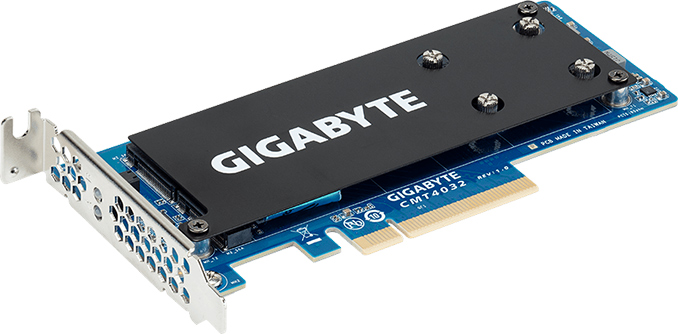
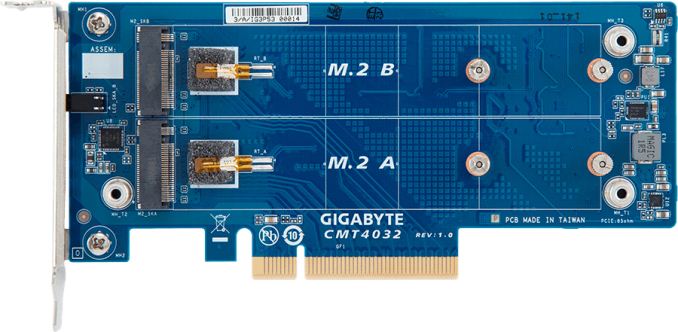
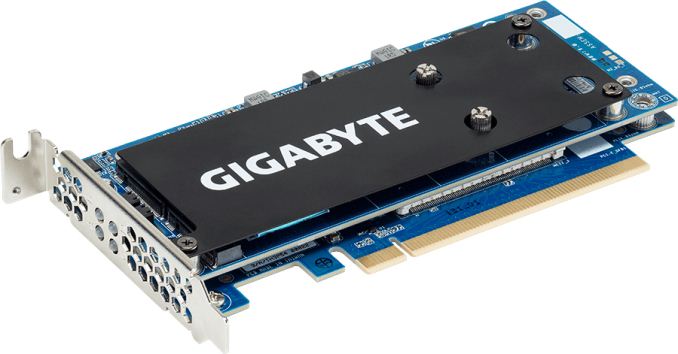
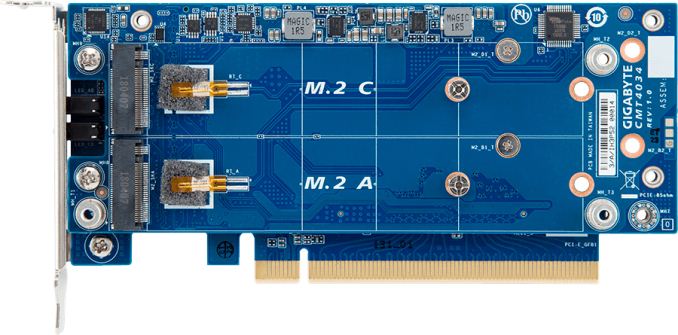
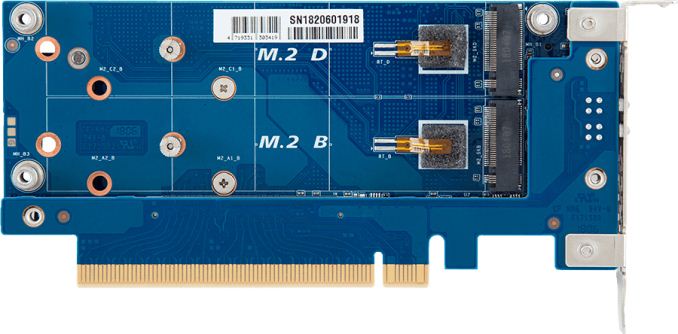
GIGABYTE B2B has launched two PCIe riser cards for M.2 SSDs designed to build ultra-fast storage sub-systems consisting of multiple M.2 drives. The CMT4030-series risers will be available through B2B channels, hence, to makers of servers, workstations, and high-end PCs rather than to DIY enthusiasts. Neither of the GIGABYTE CMT4030-series cards use any PCIe switches and therefore rely on PCIe bifurcation supported by CPU or PCH (i.e., they will not work on cheap systems that have limited PCIe bifurcation capabilities) as well as on software RAID technologies supported by the platform. Both risers support M.2-2280 and M.2-22110 drives, they are equipped with their own thermal sensors and advanced VRMs to ensure quality power supply to SSDs.
GIGABYTE’s CMT4032 is a low-profile PCIe 3.0 x8 riser card that supports two M.2 drives and comes with an aluminum heat spreader. This card may be used inside higher-end consumer systems to build high-performance storage systems featuring two SSDs as well as a 6.5 GB/s throughput.
The CMT4034 low-profile PCIe 3.0 x16 riser card carries four M.2 drives on two PCBs that also has a passive cooling system. This riser is officially aimed only at GIGABYTE’s Purley generation servers, so their work on systems based on other Intel platforms (X299, X370, etc.) is not guaranteed. As for performance, maximum throughput supported by a PCIe 3.0 x16 slot is around 15.75 GB/s.
Pricing of GIGABYTE’s CMT4032 and CMT4034 SSDs risers is unknown, but since we are dealing with B2B products, it will vary depending on volumes and negotiations. The manufacturer plans to offer its 4-way Aorus PCIe x16 M.2 SSD riser for high-end desktops at some point in the future, but details are unclear. Related Reading: |
| 2:00p | Qualcomm’s Server Team Loses VP of Technology, Centriq Future Unknown
Normally we don’t particularly comment on these sorts of transitions at big companies unless they are C-level (CEO, CTO), however the narrative surrounding Qualcomm’s Centriq product line is still one that is perceived to be in flux. Qualcomm never commented on the rumors about its plans to find a buyer for Centriq, despite Axios and Bloomberg both reporting on them, and as a result never confirmed or denied the proposition: ultimately leading others to speculate. Followed by Anand Chandrasekhar’s swift exit, again without public comment about reasons or replacement, and now another senior figure exiting the scene, brings more questions to the table than it answers. |
| 5:15p | Arm and Samsung Extend Artisan POP IP Collaboration to 7LPP and 5LPE Nodes
Arm and Samsung Foundry this week announced plans to extend their collaboration to 7LPP and 5LPE process technologies. Under the terms of the agreement, Arm will offer Samsung Foundry customers pre-designed Artisan POP IP solutions ready to be integrated into various SoCs. One of the first Artisan POP physical IP building blocks that Arm will offer for Samsung’s 7LPP and 5LPE platforms will be the Arm Cortex-A76 high-performance processor core. The two companies expect the core to run at 3 GHz or more, which is potentially higher than the target clock rate of 3 GHz announced by Arm earlier this year. The developers do not specify how high the final frequencies will be for the 7LPP and the 5LPE manufacturing processes, but keeping in mind that the latter does not explicitly promise to enable higher clocks when compared to the former, it is likely that the Cortex-A76 will run at about the same frequency in both cases. In addition to the high-performance Cortex-A76, Arm plans to offer physical implementations of its “latest processor cores featuring Arm DynamIQ technology” for the 7LPP and the 5LPE fabrication processes. The two companies do not name the processor cores, but considering the fact that we are talking about DynamIQ-capable cores, the likely candidates are the low-power Cortex-A55 as well as the high-performance Cortex-A75 (the A75 may not necessarily be popular in the 7LPP/5LPE era). The Arm Artisan physical IP offerings for Samsung’s 7LPP and 5LPE will also include high-density logic architecture, 1.8 V and 3.3 V GPIO libraries, as well as a suite of memory compilers. Meanwhile Samsung reiterated plans to offer a comprehensive suite of IP blocks for its 7LPP technology “by the first half of 2019.” Arm’s Artisan Physical IP blocks for Samsung’s 7LPP and 5LPE manufacturing technologies will be used by designers of various SoCs who do not need custom processing cores from Arm. Expect the first fruits of today’s agreement to reach the market sometimes in 2020. Related Reading: |

| << Previous Day |
2018/07/06 [Calendar] |
Next Day >> |