[Most Recent Entries] [Calendar View]
Monday, July 9th, 2018
- ASRock at CES 2018: Micro-STX DeskMini GTX PC Gets Coffee Lake
- SilverStone Introduces VT01 Mini-STX Chassis for $35
- ASRock DeskMini 110 mini-STX PC Review
- MSI Cubi 2 Plus vPro Skylake mini-STX PC Review
- ECS LIVA One Skylake mini-PC Review
- Assessing Cavium's ThunderX2: The Arm Server Dream Realized At Last
- GIGABYTE's ThunderXStation with Dual Cavium ThunderX2 Arm SoCs
- Marvell to Acquire Cavium for $5.5 Billion, Augmenting Marvell's CPU, Networking, & Security Assets
- Investigating Cavium's ThunderX: The First ARM Server SoC With Ambition
- ARM Challenging Intel in the Server Market: An Overview
- Western Digital to Use RISC-V for Controllers, Processors, Purpose-Built Platforms
- NGD Launches Catalina 2 Programmable SSDs: 16 TB - 32 TB, ARM A-53 Cores
| Time | Event | ||||||||||||||||||||||||||||||||||||||||||||||||||||||||||||
| 9:00a | The HP EX920 M.2 SSD Review: Finding the Mainstream Sweet Spot Historically, HP has not been a big player in the consumer storage market. Recently however, the HP brand has been used for several SSDs based on reference designs for Silicon Motion's SSD controllers. The HP EX920 SSD puts Silicon Motion's high-end NVMe SSD controller into a drive that is far cheaper than other flagship NVMe SSDs. The EX920 can't always match the performance of the fastest drives on the market, but it comes close enough for a much lower price. As a result, the drive has a very solid foothold as the mainstream NVMe SSD to beat. | ||||||||||||||||||||||||||||||||||||||||||||||||||||||||||||
| 10:00a | Sapphire Unveils FS-FP5V: AMD Ryzen Embedded Mini-STX Motherboard
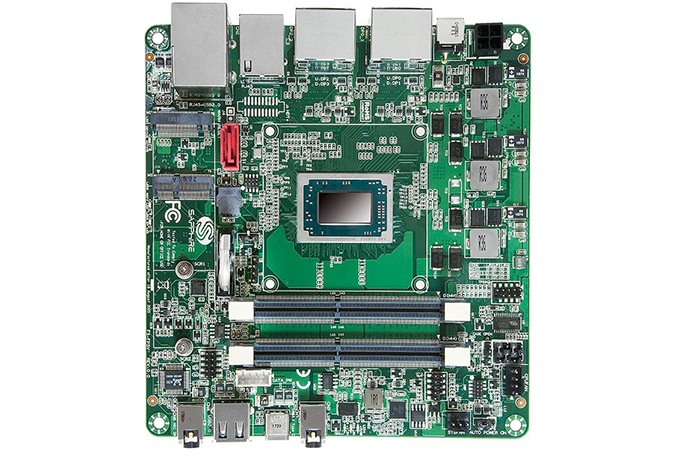
Sapphire has announced one of the world’s first platforms based on AMD’s Ryzen Embedded V1000-series APUs. The motherboard is aimed at various embedded applications that can take advantage of AMD’s latest Zen and Vega architectures and their capabilities. The FS-FP5V also happens to be the industry’s first Mini-STX motherboards to feature AMD’s processor. The Sapphire FP5V is based on AMD’s Ryzen Embedded V1000 APU featuring two or four cores with SMT clocked at 2 – 3.35 GHz base frequency, AMD’s Radeon Vega 3/8/11 iGPU, a dual-channel memory controller, and so on. Depending on requirements for performance and price, the Ryzen Embedded SoCs can feature a 12 – 25 or a 35 – 54 W TDP. AMD introduced its Ryzen Embedded chips earlier this year and will continue to sell them throughout 2028, giving adopters plenty of time to build and sell their products.
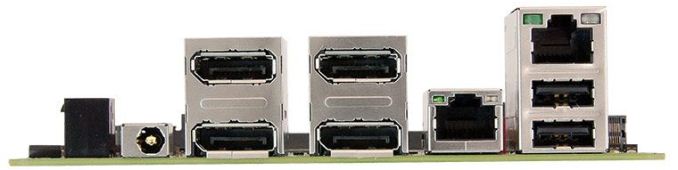
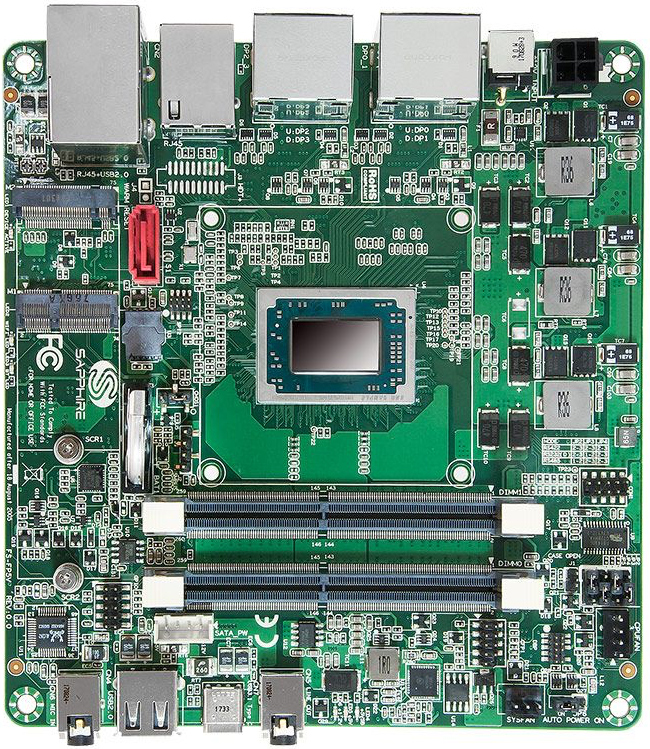
The motherboard is outfitted with two DDR4 SO-DIMMs supporting up to 32 GB of DDR4-2400 – DDR4-3200 memory, a SATA connector, an M.2-2280 slot (PCIe 3.0 x4 or SATA) for SSD, an M.2-2242 slot for a Wi-Fi module, two GbE ports (enabled by Realtek’s RTL8111G controllers), a quad-channel audio controller (ALC262), three USB 2.0 headers, one USB 3.1 Type-C connector, one RS232/422/485 module, etc. See precise specs in the table below.
The key features of Sapphire’s FP5V are of course up to four high-performance Ryzen CPU cores, AMD’s Radeon Vega iGPU with up to 704 stream processors as well as rich connectivity capabilities (e.g., four display outputs). The list of embedded applications that may require such embedded SoCs. include various gaming machines, digital signage, thin clients, medical imaging, and so on.
Sapphire’s FP5V is available for order from the company’s web site. Pricing depends on exact configurations as well as volumes.
Related Reading: Source: Sapphire (via Tom’s Hardware) | ||||||||||||||||||||||||||||||||||||||||||||||||||||||||||||
| 12:00p | Marvell Completes Acquisition of Cavium, Gets CPU, Networking & Security Assets
Marvell on Friday announced that it had completed its takeover of Cavium. The combined company will have a broad portfolio of IP and patents that promise to enable the combined company to grow as new types of compute workloads emerge in the coming years. In particular, Marvell gains processing capabilities along with a number of other assets. However the company yet has to make it as far as developing a comprehensive roadmap that takes advantage of all assets. As reported in November, Marvell had to offer approximately $5.5 billion for outstanding shares of Cavium and absorb Cavium’s debt of approximately $637.6 million, which brought the value of the transaction to over $6.1 billion. For a rather hefty sum of money, Marvell obtained a developer of ARM and MIPS-based SoCs for network, video, security, storage connectivity, server, and other applications. Essentially, the company transformed itself from a developer of storage controllers (HDD, SSD, RAID, etc.), networking and connectivity solutions into a corporation with a much greater potential. Marvell now pins a lot of hopes on such applications as AI, 5G, and Cloud & Edge computing. It is particularly noteworthy that in its letter to customers, the company even put processing ahead of storage when describing its new portfolio of products.
As for the actual merger, while the merger itself was in the planning stages well before it was even announced, in a sense the company can only now really get started on being a merged entity now that the merger has been completed. Due to regulations, companies cannot work really closely (i.e., share confidential information) before the transaction is closed. As a result, Marvell and Cavium will have to create a new roadmap from scratch in the coming months while talking to their clients and having all the required information about each other’s capabilities. Moving on to the impact on employees. With the acquisition of Cavium, Marvell’s headcount should have increased to around 7000. Meanwhile, in letters to clients and suppliers Marvell’s management said that the combined company would employ “5000+” people, roughly the same number Marvell employed before the takeover. Perhaps Marvell’s execs are too optimistic about synergies between two companies, and are planning on significant layoffs. Obviously, letting almost 30% of the staff go sounds like a rather drastic measure that is going to cost a lot a lot of money. Another explanation is that Marvell does not want certain businesses it now has, so they will be eventually sold off and the headcount will reduce to 5000+. Speaking of prospects of the merged company in general, it remains to be seen whether the “new Marvell” wants to keep all the business units, but optimize the workforce, or get rid of certain businesses. I will repeat what I said back in November: "In the coming years the expected serviceable addressable market for CPUs and specialized SoCs will grow. In particular, low-power CPUs will be needed for 5G base stations and other emerging applications. Cavium already has custom ThunderX SoCs for servers and telecom equipment, so Marvell will need to develop them further to gain in the future." What I can add to this is that compute capabilities are getting increasingly important for storage industry in general. In fact, in-storage processing looks to be gaining traction. Since Marvell announced plans to acquire Cavium, Western Digital has disclosed plans to use RISC-V cores for all of its products in the coming years and has implied that they'll be using in-storage processing. Furthermore, NGD released its second-gen Catalina SSD with in-storage processing and is gearing up to release an ASIC-based Catalina 3 later this year. Finally, with the closure of the deal, Marvell has also announced that Syed Ali (co-founder and CEO of Cavium), Brad Buss (a director of Cavium) and Dr. Edward Frank (a director of Cavium) would join Marvell’s board of directors.
Related Reading: Sources: Marvell’s Press Release, Letter to Customers, Letter to Suppliers | ||||||||||||||||||||||||||||||||||||||||||||||||||||||||||||
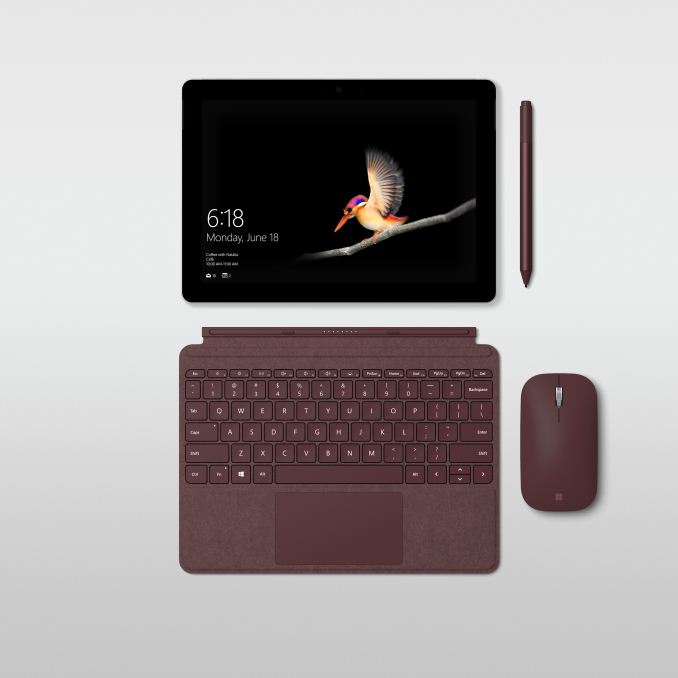
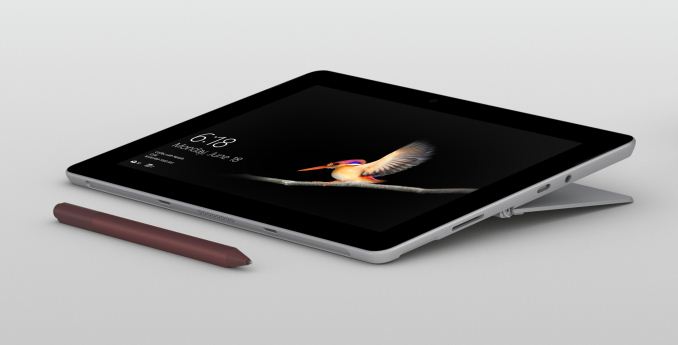
| 9:15p | Microsoft Announces The Surface Go: Smaller And Less Expensive Just over three years since the launch of the surprisingly good Surface 3, Microsoft has finally refreshed this category with a new device, now called the Surface Go. The Surface Pro series has been very successful for the company, and they’ve decided it’s time to offer an entry level Surface again. The Redmond company has been working on trying to win back the education market, so a smaller, lighter, and most importantly, less expensive Surface makes a lot of sense. The Surface Go is the thinnest and lightest Surface yet at just 8.3 mm, down from the 8.7 mm of the Surface 3, and 8.5 mm on the latest Surface Pro, but it undercuts the other models on weight significantly at 521 grams, or 1.15 lbs. That’s a full 31% lighter than the larger Surface Pro.
The display is also smaller, this time coming in at 10-inches in the now familiar 3:2 aspect ratio Microsoft has focused on, and the taller aspect ratio certainly helps on mobile devices such as this that may be used in portrait. It’s an 1800x1200 PixelSense display, with 10-point multi-touch and Surface Pen support. The screen has a reasonable 216 pixels per inch of density, which is pretty much the same as the Surface 3 back in 2015 which was 213 PPI. That’s not quite as high as the Surface Pro or iPad Pro, but should still be fairly clear. One of the biggest upgrades over the outgoing Surface 3, which was the first of the value-oriented Surface models to ship with an x86 processor, is the move from the quad-core Atom to an Intel Pentium Gold 4415Y. This is a dual-core Kaby Lake processor with four threads, and a 1.6 GHz base frequency. With a TDP of just 6W, it’s not going to be a powerhouse, but it’ll still offer solid performance for a device of this size. The low TDP also means that it can be fanless, which it is. The CPU is coupled with the Intel HD Graphics 615, which offers 24 Execution Units (EUs), although at just 850 MHz maximum boost. Still, that should offer a good jump over the Atom in the previous model. The base model comes with just 4 GB of LPDDR3-1866, and 64 GB of eMMC storage, although it will be offered in 8 GB RAM versions with 128 GB and 256 GB SSDs, which should offer much better performance.
The Surface 3 was charged with micro USB, but the Surface Go steps up to the 24-Watt magnetic Surface Connect found on the rest of the mobile Surface lineup, and it also includes a USB 3.1 Gen 1 with a Type C connector, and they’ve kept the expandable storage with MicroSD included.
Microsoft has also included an IR camera for Windows Hello login, along with a 5 MP front camera for 1080p video, and an 8 MP rear camera. For those that want to use it on the go (pun intended) there will be an LTE model available too, which makes sense with Microsoft’s push towards Always Connected PCs. Microsoft is claiming up to 9 hours of battery life which they tested doing video playback on the top end model. Microsoft is also launching a new Surface Type Cover for the smaller model, featuring the same Alcantara as its larger siblings, or as just black if you prefer that. Microsoft has also found a way to fit their full-friction hinge to the smaller Surface Go, allowing for up to 165° of movement. The new low-end Surface Go looks like a great replacement for the Surface 3, offering a way into the Surface lineup at a much more affordable price. The move to Kaby Lake will be a major boon to performance as well. Prices start at $399 for the base model, $449 for the same model with Windows 10 Pro, or $549 for 8 GB of RAM and 128 GB SSD. The 256 GB and LTE models will ship later. Pre-orders should be available soon. Source: Microsoft | ||||||||||||||||||||||||||||||||||||||||||||||||||||||||||||
| 11:00p | Samsung Begins Mass Production Of 96L 3D NAND
Samsung has started mass production of their fifth generation of 3D NAND flash memory, which they brand as V-NAND. This new generation bumps the layer count from 64 up to 96 (officially, "more than 90" layers), providing further density increases without incurring the endurance and reliability costs that came with process shrinks for planar NAND flash memory. Samsung first announced their 96L V-NAND at Flash Memory Summit in August 2017. The fifth generation V-NAND also includes performance enhancements, most significantly a Toggle DDR 4.0 interface running at 1.4Gbps, compared to the 800Mbps interface speed of Samsung's previous 3D NAND. A reduction of operating voltage from 1.8V to 1.2V offsets the extra power consumption that faster interface speed would otherwise bring. Samsung is also citing improvements to both read and program latency. Read latency did not improve from 48L to 64L, but now has been "significantly" reduced to 50μs. Program (write) latency is down about 30% to 500μs. Samsung hasn't shared many details about their process refinements, but the height of each memory cell layer has been reduced by 20%, which helps reduce the extremely high aspect ratio of the holes that need to be etched for the vertical strings of memory cells. Difficulties with high aspect ratio etching are widely believed to be the primary cause for delays that Samsung's 48L V-NAND suffered, which led to several product cancellations as Samsung's NAND development failed to keep pace with their SSD controller improvements. Samsung's transition to 64 layers was much smoother, and Samsung is claiming a 30% improvement to manufacturing productivity with the 96L process. Whether this is on a per-bit basis or a per-wafer basis, this should allow for another on-time roll out. The first 96L part in mass production is a 256Gb TLC (three bits per cell) die, which should see broad usage in the mobile and SSD markets. Larger dies will follow to fulfill the need for higher capacities with lower cost per bit, primarily in the enterprise SSD market. This will include a 1Tb QLC NAND (four bits per cell) part. | ||||||||||||||||||||||||||||||||||||||||||||||||||||||||||||



| << Previous Day |
2018/07/09 [Calendar] |
Next Day >> |