[Most Recent Entries] [Calendar View]
Thursday, August 9th, 2018
- Intel Discuss Whiskey Lake-U, Amber Lake-Y, and ‘Cascade Lake-X’
- Intel 10nm Production Update: Systems on Shelves For Holiday 2019
- Intel Delays Mass Production of 10 nm CPUs to 2019
- Intel’s Crimson Canyon NUCs with Cannon Lake CPU & Radeon dGPU Available for Pre-Order
- AKiTiO’s Thunder3 10G Adapter Now Available: TB3-to-10GbE for Sub-$300
- Aquantia’s Gamer Edition AQtion AQN-107 10 GbE NIC Available
- Aquantia to Sell Its 5G and 10G Network Cards for $59 and $69 on Black Friday
- ASUS Launches XG-C100C 10 GBase-T Adapter: Aquantia AQC107, $99
- GIGABYTE’s GC-AQC107 10G Ethernet PCIe Card Launched and Listed
| Time | Event | ||||||||||||||||||||||||||||||||||||||||||||||||||||||||||||||||||||
| 8:00a | The LG G7 Review: A Rushed Attempt? This year was a change in pace for LG, as we saw the company change its usual release plans for its “mainline” flagship device, the LG G7, which was released a couple of months later than in years prior. This gave LG an opportunity to try to raise its build-quality and to offer a well-rounded smartphone to offer a viable alternative with the current fierce competition. We run the phone through its paces and try to see if it lives up to LG's promises. | ||||||||||||||||||||||||||||||||||||||||||||||||||||||||||||||||||||
| 9:00a | AMD Launches The "Raise The Game" Bundle For Radeon RX Vega, RX 580, and RX 570
This week, AMD has launched a new “Raise The Game” promotion, offering three free games for qualified purchases of a Radeon RX Vega 64, RX Vega 56, RX 580, or RX 570. The game bundle is made up of three upcoming games: Assassin’s Creed Odyssey (10/5), Star Control: Origins (9/20), and Strange Brigade (8/28). The promotion is active now and will run to November 3rd, 2018, covering direct add-in board sales, OEMs, and system integrators. While all three games have different developers (Ubisoft, Stardock, and Rebellion, respectively), the common thread is their development ties to AMD. At E3, AMD had announced partnerships with Ubisoft and Rebellion, and on Strange Brigade in particular. And Ubisoft’s most recent efforts are highlighted in Far Cry 5 and its support for Vega and Radeon-specific hardware features, while Rebellion has Sniper Elite 4 under its belt. Meanwhile, Stardock’s Ashes of the Singularity speaks for itself in how it has pushed the envelope with modern low-level APIs like DX12 and Vulkan. Although for legal reasons no IP of the original Star Control saga has carried over, Star Control: Origins finally succeeds the series that has been surviving as a cult classic in the form of The Ur-Quan Masters. But more interestingly, another Nitrous engine title will make it to market, and one that is further removed from traditionally low-level API friendly large-scale RTS’s.
In the current backdrop is, of course, NVIDIA’s successor to the GeForce 10-series. As that speculative launch window creeps ever closer, AMD is faced with the task of maintaining competitiveness without a new generation of gaming cards of their own. Especially as the cryptocurrency mining demand has subsided from the consumer graphics market, AMD will likely look to lean on their ecosystem to keep their consumer graphics product channel moving. Meaning bundles with games, FreeSync monitors, and CPU offerings (i.e. Ryzen and Threadripper).
At this time, no other bundles are active. AMD is currently running separate "Back to School 2018" promotions. Game coupon codes must be redeemed through an AMD Rewards account before December 31, 2018. The AMD Rewards account will need to be linked to an Uplay account for Assassin’s Creed Odyssey Standard PC Edition, while Star Control and Strange Brigade will be through Steam. A full list of participating vendors and further details can be found on the bundle’s Terms and Conditions. Be sure to verify the participation of any vendors purchased from as AMD will not give codes for purchases made from non-participating sellers. | ||||||||||||||||||||||||||||||||||||||||||||||||||||||||||||||||||||
| 10:00a | Intel Preps New H310 Chipset Revision With Windows 7 Support For Coffee Lake
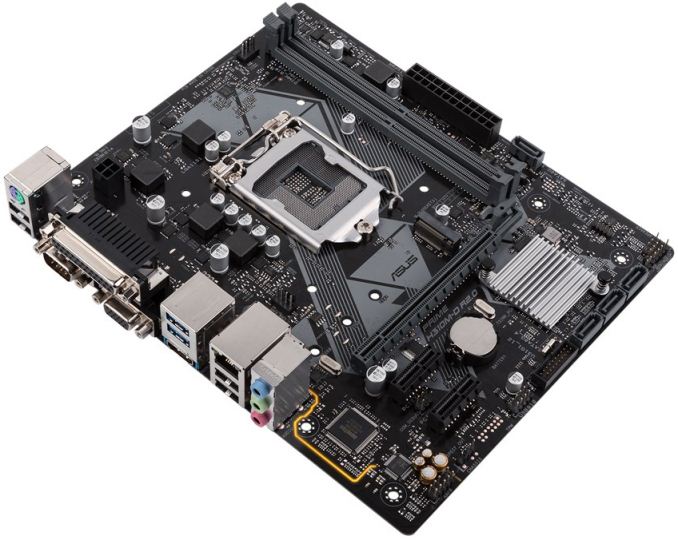
Based on some recent hardware released from motherboard vendors, it would appear that Intel is prepping a new chipset and appropriate drivers to enable Coffee Lake processors to work with Microsoft’s nine-year-old Windows 7 OS. Microsoft limited support for the latest CPUs on Windows 7 back in 2016, which is why AMD’s Ryzen as well as Intel’s Kaby Lake, Coffee Lake, and some other chips cannot work with this OS. Meanwhile, Windows 7 defiantly remains a commonly-used operating system both among businesses and individuals who cannot, or do not want to, jump to Windows 10. In a bid to satisfy demand from such users, it would appear that Intel is prepping a special version of its H310 PCH that will enable operation of its latest Coffee Lake processors on Windows 7. ASUS and GIGABYTE already list appropriate motherboards on their websites, but there are a number of catches. The new chipset is expected to be branded as the H310C or the H310 R2.0, according to a media report and information from makers of mainboards. The PCH allegedly has a new device ID, but is supposedly pin-to-pin compatible with the original H310, though this fact could not be verified at press time. The chipset will ship with Windows 7 x32/x64 drivers for Intel Management Engine Interface, Intel Rapid Storage Technology (SATA), and Intel USB 3.0 drivers. Meanwhile, motherboard makers will have to outfit their products with appropriate Windows 7-compatible drivers for audio and GbE chips they use. Unfortunately, Intel does not seem to plan releasing Windows 7 drivers for its latest iGPUs, so PCs running Intel's Coffee Lake on the H310C (H310 R2.0) and Windows 7 will have to use a discrete graphics card instead. This will naturally make systems running the long-standing OS a bit more expensive than modern PCs with iGPUs. Intel’s H310 is the company’s entry-level chipset for Coffee Lake processors, so it does not support PCIe 3.0 lanes, USB 3.1 Gen 2, Intel Optane Memory caching SSDs (not that these are supported under Windows 7 anyway), and so on. Evidently, these limitations are important for performance-minded users, so the H310C (H310 R2.0) is not going to appeal to enthusiasts who would like to keep using Windows 7 for some reason. In the meantime, special-purpose systems that need the OS (yet can take advantage of new CPUs) will adopt the platform wholeheartedly despite costs and limitations. Makers of motherboards already list their ‘Intel H310 R2.0’ badged products on their websites. ASUS has four of them, GIGABYTE also has four SKUs, Colorful is reportedly prepping two models, but does not list them just now. Both ASUS and GIGABYTE offer Windows 7 drivers with their H310 R2.0 (H310C) motherboards, which is a proof of compatibility. Meanwhile, USB 3.0 drivers that the companies ship are intended for Intel’s 200-series chipsets and older.
Driver support is of course very important to make Coffee Lake/H310C combination work on Windows 7, but there is another crucial ingredient — the Windows Update service. At present Microsoft does not issue any Windows 7 updates to systems running unsupported processors and will advise their owners to upgrade to Windows 10 instead. Therefore, to make the Coffee Lake/H310C viable for businesses, Intel will need to ensure that Microsoft supports such systems as well. Microsoft for their part has not announced anything on the matter yet, so either Intel is working on a rather one-sided plan here, or the two vendors have a bigger plan in motion to resume OS support for the new H310 revision. Since two of the world’s largest makers of motherboards already list their Intel H310 R2.0 (H310C) products on their websites, it is likely that the new platforms will hit the market shortly. It is unlikely that companies like ASUS or GIGABYTE will charge a hefty premium for Windows 7 support, after all these are entry-level motherboards. Meanwhile, what remains to be seen is whether and how Microsoft will support such platforms at all.
Related Reading: | ||||||||||||||||||||||||||||||||||||||||||||||||||||||||||||||||||||
| 10:30a | Samsung Unpacked 2018 Pt.2 - Live Blog (11am ET) We're here in New York City for Samsung's second Unpacked event of the year. This time around it's no secret what Samsung will be presenting: the Galaxy Note 9, the latest in their line of flagship phablets. Samsung has already accidentally posted an official video with some of the specifications, so in this case the cat is already out of the bag. | ||||||||||||||||||||||||||||||||||||||||||||||||||||||||||||||||||||
| 1:00p | Intel 15 Watt Whiskey Lake CPU Specs Disclosed Early: i7-8565U, i5-8265U, & i3-8145U
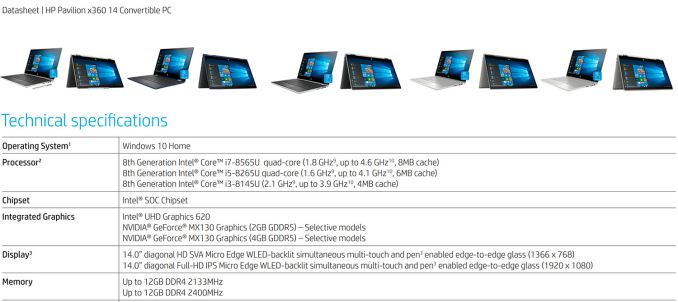
As the formal launch of Intel’s new codenamed Whiskey Lake-U processors approaches, it is seemingly inevitable that their model numbers and specifications will get published by OEMs ahead of time. This week HP has done just that, inadvertently publishing the frequencies of some of the upcoming processors, all the while ASUS and Synnex have confirmed their model numbers as well as some other specs. As it appears, Intel has managed to increase Turbo clocks of the new chips rather significantly when compared to their predecessors. Intel first announced its Whiskey Lake-U processors for mobile PCs back in April and then shed some light on these chips at Computex. According to Intel, the CPUs will belong to its 8th Generation Core family, will be made using a 14 nm process technology, and will offer a double-digit performance gains when compared to the Kaby Lake Refresh parts. It is unclear whether the Whiskey Lake-U processors have any microarchitectural improvements over their ancestors, but this week we learned that they will at least have higher Turbo frequencies. HP on Wednesday accidentally published specs of its upcoming Pavilion x360 convertible based on the Whiskey Lake-U SoC and disclosed specs of the chips it plans to use. In the meantime, ASUS and Synnex (1, 2) confirmed existence of CPUs with such model numbers. As it turns out, HP will offer three Whiskey Lake-U processors with its Pavilion x360 notebooks: the quad-core Core i7-8565U, the quad-core Core i5-8265U, as well as the dual-core Core i3-8145U. HP’s disclosure indicates that all of these SoCs feature Intel’s UHD 620 iGPU with 24 EUs, so at least on the graphics front Whiskey Lake-U will offer similar features as their predecessors. In the meantime, specs published by ASUS indicate that the new CPUs will support DDR4-2667 memory, thus offering an upgrade. If we compare alleged specs of the upcoming Whiskey Lake-U processors with comparable Kaby Lake Refresh chips, we will notice that the new SoCs do not have any advantages in terms of base frequencies, but feature massively higher turbo clocks, on the order of 500 to 700 MHz. The latter will have an impact on responsiveness of future laptops, but under prolonged heavy loads such PCs may not perform much differently than systems featuring KBL-R CPUs.
Intel traditionally does not comment on unreleased products and therefore it is impossible to verify accuracy of the specs published by HP.
Related Reading: Sources: Tom’s Hardware, Notebookcheck.net | ||||||||||||||||||||||||||||||||||||||||||||||||||||||||||||||||||||
| 1:05p | Samsung Announces The Galaxy Note 9: 4000mAh And New S-Pen
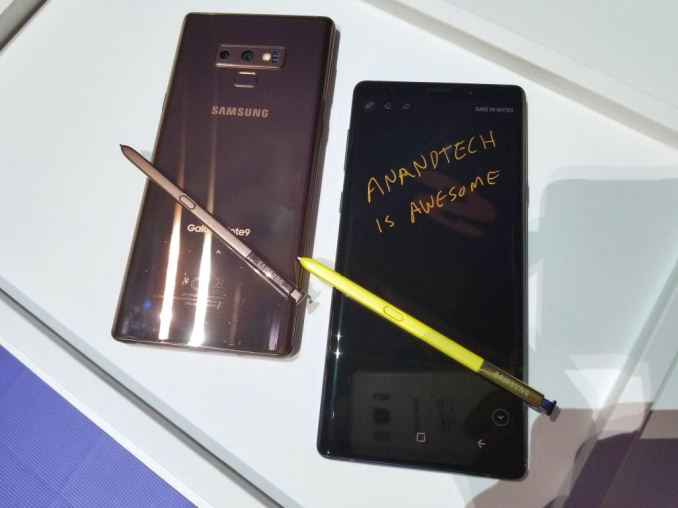
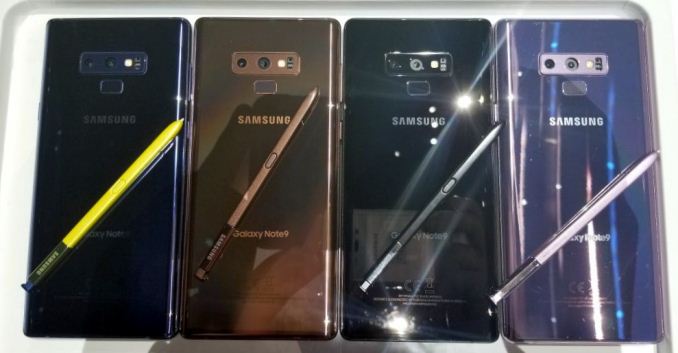
Today at the Unpacked Event at the Barclays Center in New York Samsung launched alongside a new smartwatch, the Galaxy Watch and a new home speaker, the Galaxy Home, the main subject of the show, the new Galaxy Note 9. Samsung’s marketing focus for the Note 9 focused primarily on two new improved features: An increased battery capacity, and an increase in the storage capacity of the phones. Let’s go over the specifications to see all of the new internals of the new summer flagship;
In terms of SoC, the Note9 follows in the steps of the Galaxy S9 and employs the same Snapdragon 845 and Exynos 9810. We’ve extensively covered the two new chipsets in our review of the S9 earlier in the year. The Snapdragon 845 is a fantastic chipset for 2018 – while the Exynos 9810 showed some weakness in terms of performance as well as power efficiency – showcasing a particularly large gap this year.
It’s been some time that Samsung actually talked about the internals of its Galaxy devices, so it was particularly surprising to hear an emphasis on the performance of the chipsets this year round. Gaming was one topic where Samsung pulled in outside help to promote the Note 9 – Tim Sweeney was on stage unveiling the early Android beta launch of Fortnite for Samsung Galaxy phones, as well an exclusive in-game skin for Note 9 users.
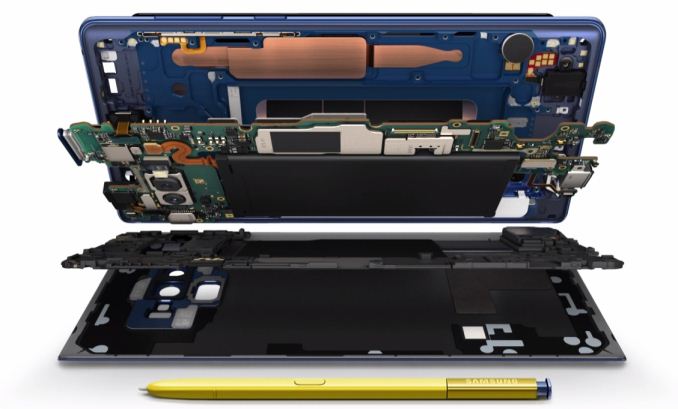
Both the Snapdragon and Exynos S9 showcased thermal throttling in 3D games, and it seems Samsung took note of this and actually introduced a new beefier thermal dissipation solution in order to better cool the SoC and maintain higher performance. The Note 9 comes in 6 GB or 8GB RAM variants, tied together with doubled base storage capacity of 128GB and with an enormous 512GB in the higher tiered variant. In terms of display, we see the same resolution as on the Note 8 and S9 – employing a 18.5:9 2960x1440 AMOLED screen. The diagonal has increased this time around to 6.4”, and indeed this has increased the footprint of the device as the width has widened 1.6mm to 76.4mm. A notable increase in comparison to the Note 8 is the Note 9’s battery capacity. Here we see a 21% increase to reach the 4000mAh mark. While this is certainly a psychologically large number, the 14% boost versus the Galaxy S9+ is still within reasonable levels of improvements, and I think Samsung’s taking a bit of a heavy-handed marketing approach here when it comes to the battery promises – especially for the Exynos variants in EMEA and SEA markets.
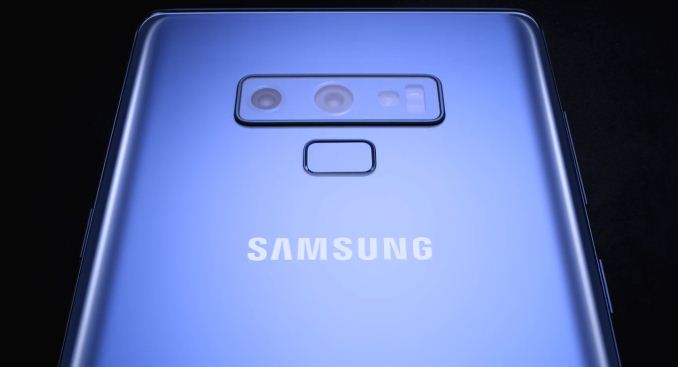
The camera of the Note 9 is the same as on the S9+ - this includes again the main 12MP sensor with 1.4µm pixel pitch with full dual-pixel PDAF layout, and a variable aperture of either f/1.5 or f/2.4. The telephoto lens also is the same with a 2x optical zoom capability. Both modules support OIS. The one point where the Note 9 promises to improve camera capture in is through the introduction of neural network based inferencing and scene recognition. The Note 9 is said to recognize 20 scenarios and apply a respective image processing such as colour temperature adjustments. Again, this is something we’ve seen in the past introduced by various vendors, but if one thing we’ve come to discover over the last few months is that the implementation can be a hit & miss – so Samsung will have to focus on getting this right. The fingerprint sensor sees the same design change as on the S9 and is now located centrally below the camera modules.
Finally the biggest feature improvement on the Note 9 is the new S-Pen: The new unit is no longer just a passive component, but now is an active remote working over Bluetooth LE and has its own little battery incorporated. The phone is said to be able to charge the S-Pen in 40 seconds for 30 minutes of usage – or when it’s actually discharged then it doesn’t limit the traditional functions which still work as passive components. In addition to the new remote functionality, the new S-Pen has a finer tip and increases the pressure sensitivity to 4096 levels. The Note 9 is now available for preorder with availability on August 24th at prices of USD $999 for the 6GB/128GB base variant and $1249 for the 8GB/512GB version. | ||||||||||||||||||||||||||||||||||||||||||||||||||||||||||||||||||||
| 3:00p | TSMC: Outbreak of Malware That Triggered Delays & Losses Caused by Software for New Tool
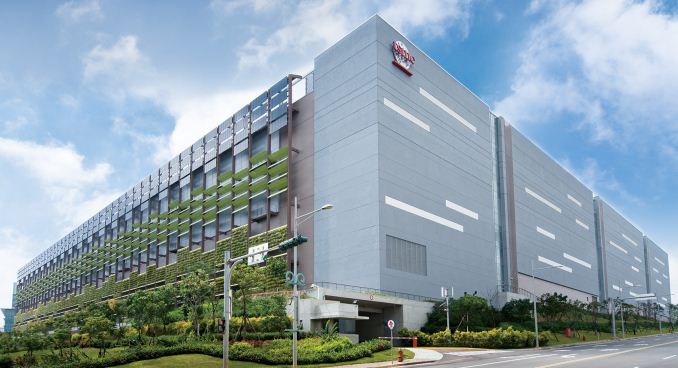
TSMC announced this week that it suffered a computer malware outbreak, resulting in a roughly 3 day outage for parts of the fab while systems were restored. As a consequence of the downtime, the fab expects certain shipments delays and additional charges. Specifically, because of the interruptions and costs, the company’s Q3 revenue and gross margin will be 2% and 1% lower than anticipated respectively. TSMC later clarified that the outbreak was caused by “misoperation” during the software installation for a new piece of equipment. What Happened?TSMC’s personnel set up a new manufacturing tool on Friday, August 3, and then installed software for the device. The machine was not isolated and confirmed to be malware-free before connecting it to TSMC’s internal network. Consequently, the introduction of a malware-infected machine to TSMC's internal production network allowed the malware to quickly spread and infect computers, production equipment, and automated materials handling systems across TSMC’s fabs. According to the chipmaker, the malware was a variant of the WannaCry ransomware cryptoworm. WannaCry, though over a year old at this point, still has the ability to propogate among any remaining unpatched systems, which is what happened here: the malware infected Windows 7-based machines “without patched software for their tool automation interface.” As a consequence, the affected equipment either crashed, or rebooted continuously, essentially being inoperable. TSMC has been stressing that not all of its tools and automated materials handling systems were affected, and that degree of infection varied by fab. The company had to shut down infected equipment and apply patches. By 2 PM Taiwan time on Monday, 80% of the impacted tools had been recovered and TSMC said that it would mend all of them by Tuesday. The ImpactSince the said tools are located across multiple fabs and are therefore are used to process wafers using a variety of process technologies for different customers, it is evident that the outbreak affected delivery schedules for many chips. As a consequence, the company had to notify its customers and reschedule their wafer delivery dates. Some of the delayed wafers will be delivered not on Q3, but in Q4, thus affecting product launch plans. None of TSMC's well-known customers are currently commenting on the matter, but this event has occured with what's widely believed to be the ramp-up periods for new chips from Apple and NVIDIA. Since at least some of TSMC’s production tools were offline for four to five days, it is evident there will be impact, though it is hard to estimate how significant it will be. What remains to be seen is how several-day outage of numerous semiconductor production tools is set to affect TSMC’s customers in general. After all, 2% of TSMC’s Q3 revenue is between $169 and $171 million and that is a lot of money. We will likely learn more about the effect of the malware outbreak in the coming months. (ed: As an aside, I find it very interesting that this entire episode was essentially happenstance, rather than some kind of targeted attack as would typically be the case. WannaCry is over a year old and is self-propagating; so as a proper worm, it goes whever it can, whenever it can. In fact with the release of patches over a year ago, WannaCry's primary function is done. So for TSMC this is the IT equivalent of stepping on a landmine from a long-forgotten war, and reinforcing the fact that advanced malware can be dangerous to the public long after it has done its job. -Ryan) Related Reading: | ||||||||||||||||||||||||||||||||||||||||||||||||||||||||||||||||||||
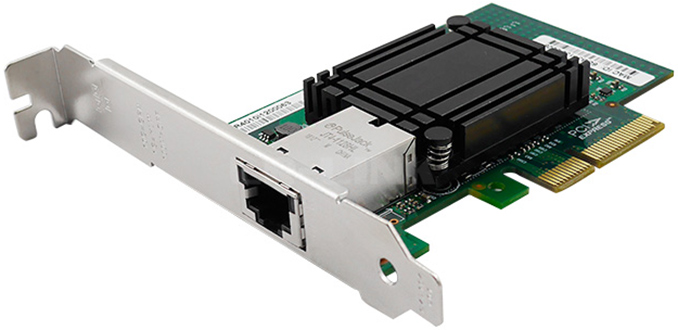
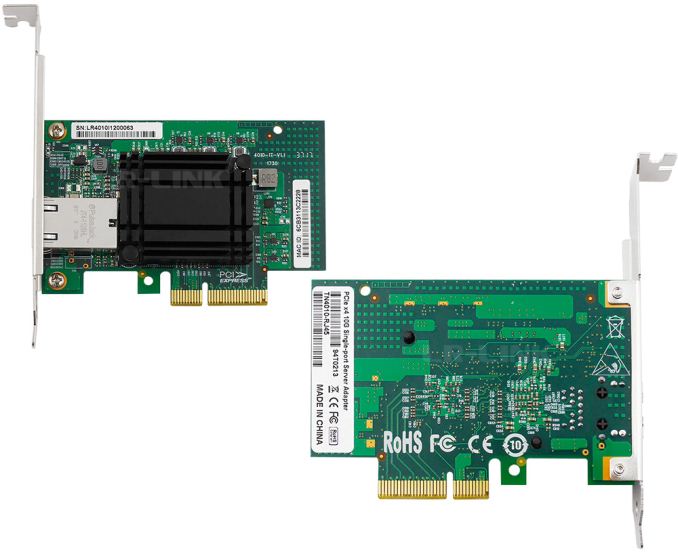
| 5:00p | LR-Link Launches New Mass-Market 10GigE NIC Based on Tehuti Networks’ Tech
LR-Link, a maker of networking solutions from China, has announced its first 10 GbE NIC, the wordy-named LREC6860BT. The new NIC is the first such retail product we've seen based on a design from Tehuti Networks, an Israel-based developer, bringing some more welcome competition to the 10GigE NIC market. LR-Link will be aiming at the (relative) mass-market for standalone NICs with this card, with the card now selling in Japan as well as online for less than $100. Under the hood, the LR-Link LREC6860BT NIC is based on Tehuti Networks’ TN4010 MAC, which is further paired with Marvell’s Alaska X 88X3310P 10 GbE transceiver. The card features a PCIe Gen 2 x4 interface as well as an RJ45 connector that supports 100M, 1G, 2.5G, 5G, and 10G speeds using Cat5e/Cat6/Cat6A cabling. The card fully supports contemporary operating systems from Apple, Microsoft, and VMware as well as various Linux distributives. Therefore, the NIC is drop-in compatible with most computers that are in use today.
The LREC6860BT is currently available from at least one retailer in Japan for ¥10,164 ($91) with VAT, which is not very high considering the fact that PC components tend to cost more in Japan than in the rest of the world. Unfortunately products from LR-Link aren't readily available from retailers outside China and Japan, but the company’s devices (including the 10 GbE NIC) can still be purchased from official stores on AliExpress, Ebay, and JD.com.
10 GbE networks are not yet widespread in SOHO environments, primarily because there are not many reasonably-priced 10 GbE switches. Meanwhile, a number of companies have released their relatively affordable 10 GbE NICs based on chips from Aquantia over the past few quarters, anticipating demand for such cards from enthusiasts. Aquantia is not the only provider of solutions for inexpensive 10 GbE cards. Tehuti Networks is considerably less known because it is focused on working with enterprise OEMs rather than with AIBs and retail. Nonetheless, having a second player in the space for cheap 10GigE/NBASE-T silicon is an important part of driving down the cost of the technology –and boosting adoption – even further. Related Reading: Source: PC Watch | ||||||||||||||||||||||||||||||||||||||||||||||||||||||||||||||||||||




| << Previous Day |
2018/08/09 [Calendar] |
Next Day >> |