[Most Recent Entries] [Calendar View]
Wednesday, August 22nd, 2018
- TSMC Kicks Off Volume Production of 7nm Chips
- Arm's Cortex-A76 CPU Unveiled: Taking Aim at the Top for 7nm
- Qualcomm Announces New X50 5G Modem, First Gigabit Class LTE Network and Router
- Qualcomm Affirms Dozens of Carrier & Manufacturer Partnerships For 5G Trials & 2019 Product Launches
- Qualcomm Announces Their First 5G mmWave Antenna Module: QTM052, Coming This Year
- Samsung Releases Exynos Modem 5100 - First Multi-Mode 5G Modem
| Time | Event | ||||||||||||||||||||||||||||||||||||||||||||||||||||||||||||||||||||||||||||||||||||||||||||||||||||||
| 7:30a | Qualcomm Begins Sampling of 7nm Next-Gen SoC
Today Qualcomm announces it has begun to sampling of its next generation Snapdragon SoC. The announcement is unusual as in the past we’ve never really had sampling announcements. Usually new silicon samples start around 4-6 months before commercial device availability. Recently, Huawei had let it slip in an official press release that the new Kirin 980 in the upcoming Mate 20 will be manufactured on a 7nm process node. Today’s announcement from Qualcomm seems to be a “me too!” shout-out response ahead of competitor's announcements over the next few weeks. The next-generation Snapdragon SoC will be manufactured on TSMC’s 7FF process node, bringing with it the associated performance and power benefits over current generation silicon. The new SoC can be paired with Qualcomm’s X50 modem in order to enable the first generation 5G smartphones next year. Qualcomm discloses we’ll see the full details of the next-generation flagship SoC and platform in the fourth quarter. Overall the only surprise in today’s news is the fact that Qualcomm is willing to talk about sampling timelines; the timing itself doesn’t seem different to what has happened in prior years, and we’ll still quite a few months away from the first commercial devices, most likely to happen in 1Q19. Related Reading | ||||||||||||||||||||||||||||||||||||||||||||||||||||||||||||||||||||||||||||||||||||||||||||||||||||||
| 8:00a | The Corsair RM850x (2018) PSU Review: Exceptional Electrical Performance In today's review we are taking a look at the new revision of Corsair's RM850x power supply. Corsair's RM series is renowned for delivering high performance and quiet operation at a reasonable price. The new revision boasts upgraded electrical efficiency, better performance, and a 10-year warranty, all without increasing the price of the series. | ||||||||||||||||||||||||||||||||||||||||||||||||||||||||||||||||||||||||||||||||||||||||||||||||||||||
| 3:50p | NVIDIA Teases GeForce RTX 2080 Performance Numbers, Announces Ansel RTX
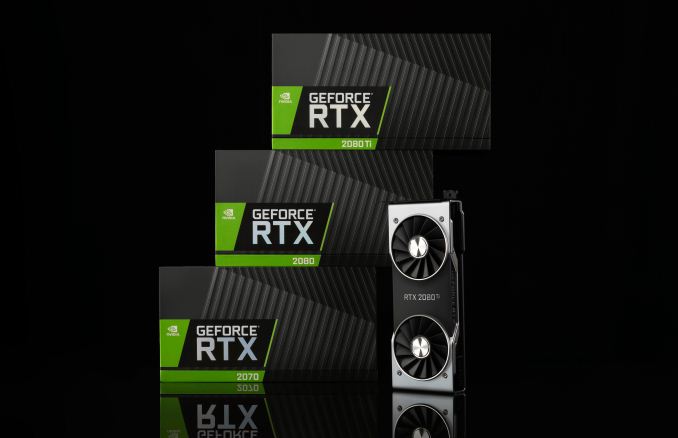
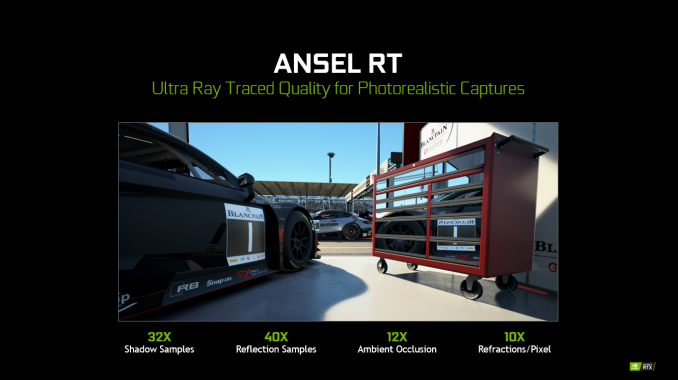
Concluding their Gamescom festivities for their newly-introduced GeForce RTX 20-series, NVIDIA has revealed a bit more about the hardware, its features, and its expected performance this evening. Tonight NVIDIA is announcing the new Ansel RTX features in GeForce Experience, as well as some game performance metrics for the GeForce RTX 2080 up against the GeForce GTX 1080. After recent hands-on demos featuring real-time raytracing, NVIDIA is offering some numbers for out-of-the-box and Deep Learning Super Sampling (DLSS) performance in traditionally rendered games.
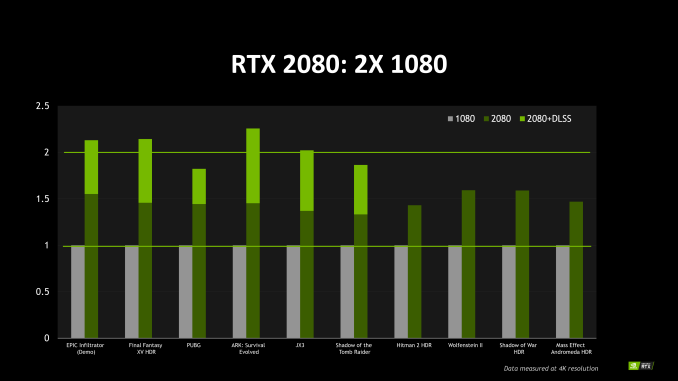
Starting with NVIDIA’s DLSS – and real-time raytracing for that matter – we already know of the supported games list. What they are disclosing today are some face-value 4K performance comparisons and results. For DLSS, for now we can only say that it uses tensor core-accelerated neural network inferencing to generate what NVIDIA is saying will be high-quality super sampling-like anti aliasing. Though for further technical information, this is a project NVIDIA has been working on for a while, and they have published some blogs and papers with some more information on some of the processes used. At any rate, the provided metrics are sparse on settings or details, and notably measurements include several games rendered in HDR (though HDR shouldn't have a performance impact).
Otherwise, NVIDIA presented a non-interactive Epic Infiltrator 4K demo that was later displayed on the floor, comparing Temporal Anti Aliasing (TAA) to DLSS, where the latter provided on-average near-identical-or-better image quality but at a lower performance cost. In this case, directly improving framerates. To be perfectly honest, I spent the entire floor time talking with NVIDIA engineers and driver/software developers, so I have no pictures of the floor demo (not that anything less than a direct screenshot will really do it justice). Ultimately, the matter of DLSS is somewhat nuanced and there isn’t much we can add at the moment.
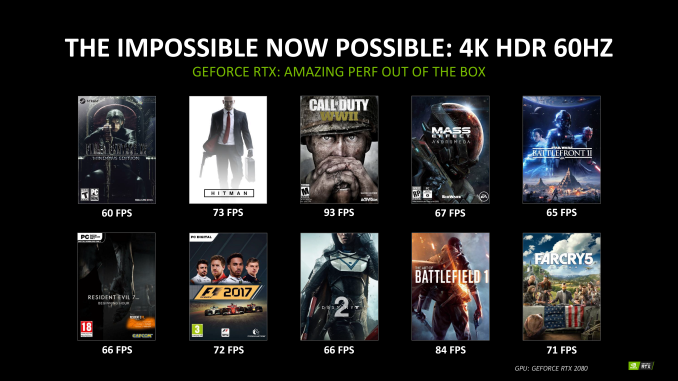
Overall, the idea is that even in traditionally rasterized games without DLSS, the GeForce RTX 2080 brings around 50% higher performance than the GeForce GTX 1080 under 4K HDR 60Hz conditions. Because this excludes real-time raytracing or DLSS, this would be tantamount to ‘out of the box’ performance. Though there were no graphics settings or driver details to go with these disclosed framerates, so I'm not sure I'd suggest reading into these numbers and bar charts one way or another. Lastly, NVIDIA announced several new features, filters, and supported games for GeForce Experience’s Ansel screenshot feature. Relating to GeForce RTX, one of the features is Ansel RT for supported ray-traced games, where a screenshot can be taken with a very high number of rays, unsuitable for real-time but not an issue for static image rendering.
Ansel RTX also leverages a similar concept to the tensor core accelerated DLSS with ‘AI Up-Res’ super resolution, which also works for games not integrated with Ansel SDK.
In terms of the GeForce RTX performance, this is more-or-less a teaser of things to come. But as always with unreleased hardware, judgement should be reserved until objective measurements and further details. We will have much more to say when the time comes. | ||||||||||||||||||||||||||||||||||||||||||||||||||||||||||||||||||||||||||||||||||||||||||||||||||||||
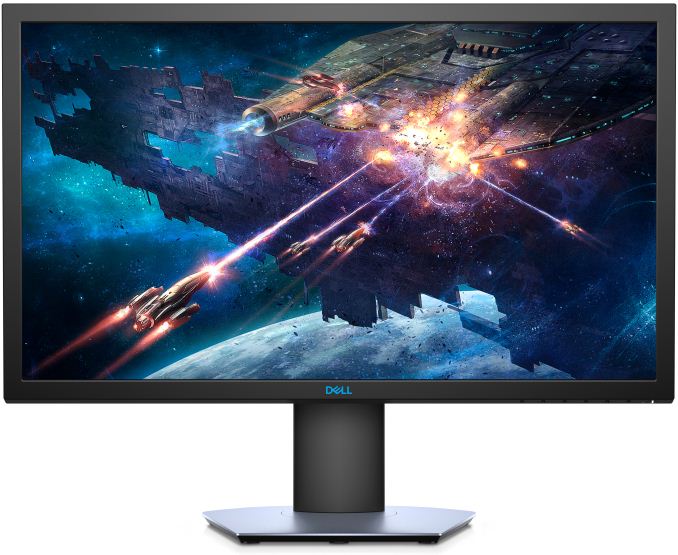
| 6:30p | Dell Launches Gaming 24 and Gaming 27 Displays: 1 ms Response, 144/155 Hz Refresh
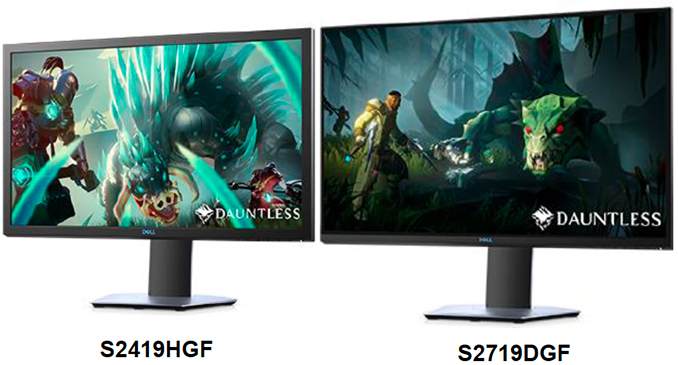
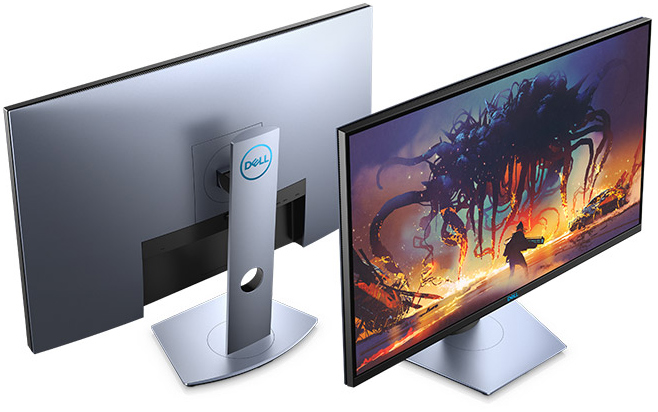
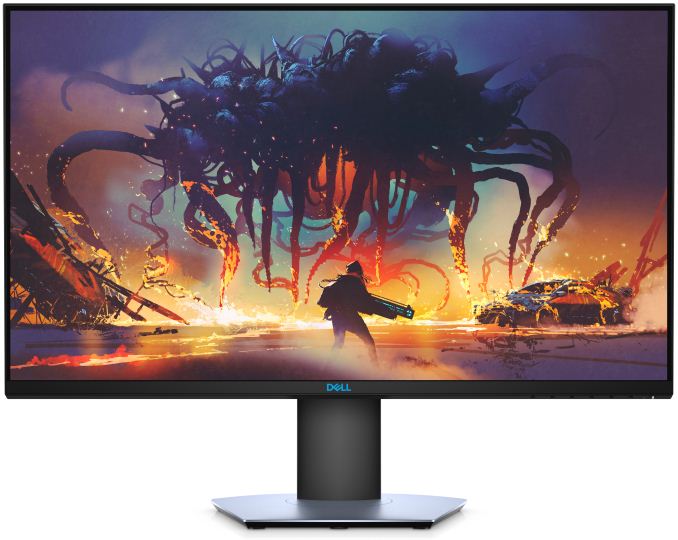
Dell has announced its new displays aimed at gamers. The new 24-inch and 27-inch Gaming-series monitors feature a 1 ms response time, an up to 155 Hz refresh rate, as well as AMD’s FreeSync dynamic refresh rate technology. The latest lineup of Dell Gaming displays includes two models: the 24-inch S2419HGF and the 27-inch S2719DGF. Both are based on TN panels that can hit 350 nits of brightness and a 1000:1 contrast ratio. Meanwhile, since we are dealing with TN technology, the monitors have typical, somewhat narrow 160/170 degree viewing angles of the tech.
The smaller monitor has a 1920×1080 resolution and a 120 Hz native refresh rate, and can be overclocked to 144 Hz. Meanwhile, the larger one has a 2560×1440 resolution and supports a 144 Hz refresh rate that can be overclocked to 155 Hz. Both monitors support FreeSync technology with a minimum refresh rate of 40 Hz.
Both monitors have HDMI and DisplayPort inputs, a dual or triple-port USB 3.0 hub, a headphone input, a line-in, and so on. And the displays also feature adjustable stands that can regulate height, tilt, swivel, and pivot.
The new Dell Gaming monitors will be available starting from August 28, 2018. The S2419HGF will cost $320, whereas the S2719DGF will be priced at $550.
Related Reading: | ||||||||||||||||||||||||||||||||||||||||||||||||||||||||||||||||||||||||||||||||||||||||||||||||||||||



| << Previous Day |
2018/08/22 [Calendar] |
Next Day >> |