[Most Recent Entries] [Calendar View]
Friday, August 24th, 2018
- Logitech Unveils G305 Mouse with Lightspeed Wireless, ‘Hero’ 12,000 DPI Sensor
- Logitech Boosts Precision of G203 Prodigy Mouse to 8000 DPI via Firmware Update
- Logitech Launches G603 ‘Lightspeed’: 12,000 DPI Hero Sensor, 1 ms Polling, 500 Hrs Battery
- Logitech Announces The Ambidextrous G900 Chaos Spectrum Gaming Mouse
- SSD Form Factors Proliferate At Flash Memory Summit 2018
- Lite-On and Tsinghua Unigroup Create $100 Million Joint Venture for SSD Operations in China
- Lite-On Announces Enterprise EPX M.2 NVMe SSDs: 3D TLC, Up to 1920 GB, 1800 MB/s
- Lite-On SSDs At FMS: New Controllers And TSV NAND Packaging
- Intel Introduces "Ruler" Server SSD Form-Factor: SFF-TA-1002 Connector, PCIe Gen 5 Ready
- AMD Files Patent Infringement Complaint Against LG, MediaTek, Sigma Designs, and Vizio
- NVIDIA Files Patent Infringement Complaints Against Qualcomm & Samsung
- Samsung Files Counter-Suit & Patent Infringement Claims Against NVIDIA & Velocity Micro
- Samsung/NVIDIA Case Update: US ITC Finds Samsung GPUs Non-Infringing
- US ITC Finds NVIDIA Guilty of Infringing Three Samsung Patents
- NVIDIA & Samsung Settle All Patent Infringement Disputes
| Time | Event | ||||||||||||||||||||||||||||||||||||||||
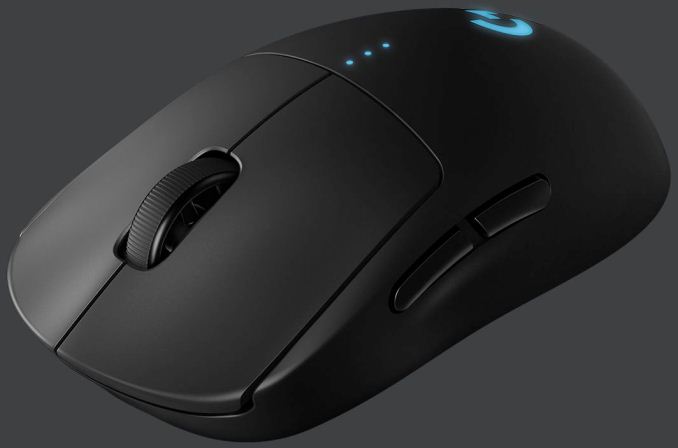
| 9:00a | Logitech Launches G Pro Wireless Gaming Mouse with 16,000 DPI Sensor
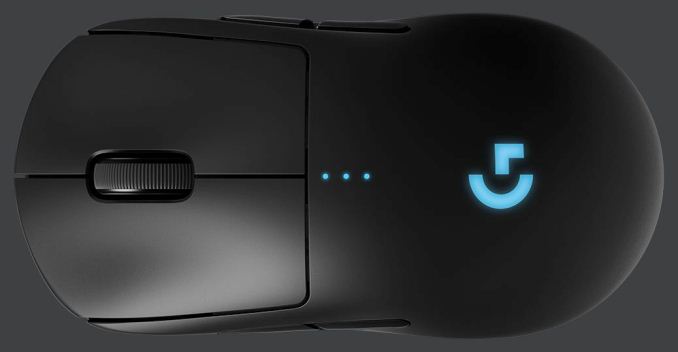
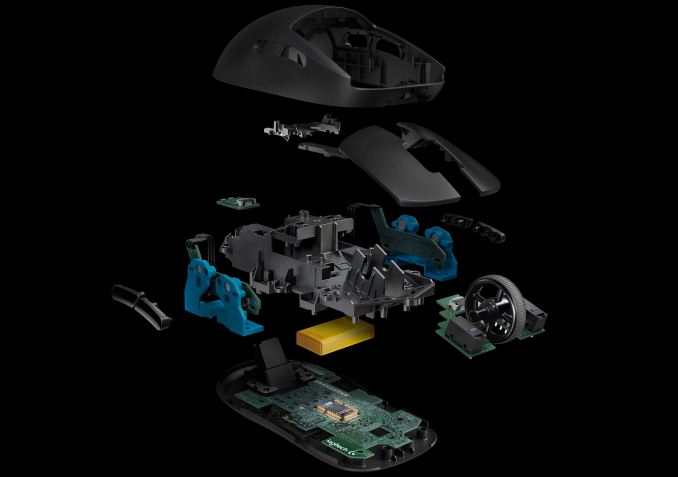
Professional gamers tend to use wired mice because of their higher polling rate and lower input lag. For many years leading makers of mice have improved their wireless mice for gamers, but those of them who play professionally still use wired devices. Logitech this week introduced its new wireless mouse that uses the company’s latest high-precision sensor along with its Lightspeed wireless technology. The Logitech G Pro wireless gaming mouse features a classic ambidextrous form factor and removable left and right-side buttons to make it easier to use for lefties. It is based on the company’s HERO (high efficiency rated optical) sensor now rated for 16,000 DPI sensitivity, over 400 inches per second speed, and up to 40G acceleration. The sensor is accompanied by Logitech’s Lightspeed wireless interconnection that cuts the input lag by optimizing internal architecture of input devices, reducing polling rate of wireless receivers to 1 ms, rising signal strength, applying a proprietary frequency hopping mechanism that uses the strongest interference-free channel, and adjusting software stack. Besides, the G Pro wireless gaming mouse is also outfitted with the company’s PowerPlay wireless power system (yet it still comes with a charging cable).
To further optimize the mouse, Logitech reduced its weight to 80 grams and placed its DPI adjustment button on the underside. In addition, following the latest trends it supports the company’s LightSync RGB lighting (which supports the Logitech Gaming Software (LGS). Logitech says that it had taken it two years to develop its G Pro wireless mouse and it had collaborated with over 50 professional gamers to create the product. The new mouse is more precise than the company’s previous mice featuring the HERO sensor, yet it maintains a very long battery life.
In addition to introducing its G Pro wireless gaming mouse, Logitech also upgraded its G Pro wired gaming mouse with the HERO 16K sensor and a new cable. Both new Logitech G Pro mice will ship shortly and will be available this month. The wireless model will cost $149.99, whereas the new wired mouse will be priced at $69.99.
Related Reading: | ||||||||||||||||||||||||||||||||||||||||
| 12:30p | Kishonti GFXBench 5.0 Aztec Ruins: OpenGL & Vulkan Benchmark Hands-On Today Kishonti have finally released their final update to GFXBench version 5.0. The update introduces the new Aztec Ruins scene in two complexity modes as well as OpenGL, Vulkan, and Metal. The new version runs on a new in-house rendering engine and introduces two new tests: Aztec Ruins (High Tier) and Aztec Ruins (Normal Tier). The scene is very much reminiscent of Tomb Raider, showcasing a jungle ruin environment, with an action-adventure like scene. We picked up some devices and profiled the new tests.
| ||||||||||||||||||||||||||||||||||||||||
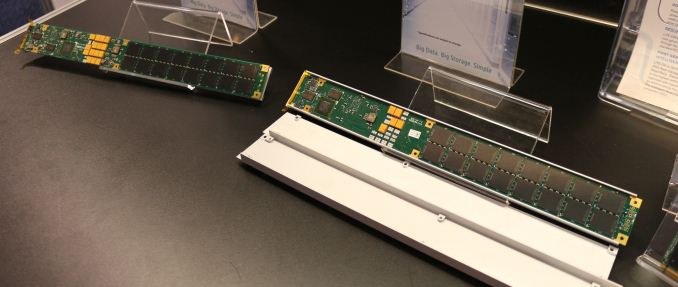
| 3:00p | Lite-On Demos Its First ‘Ruler’ EDSFF SSDs: CNEX Labs Controller, Up to 80 TB Capacity
Lite-On has demonstrated its first SSD that comes in EDSFF ‘ruler’ form factor, showing off the new drive at FMS earlier this month. The drive uses a controller from CNEX Labs and is designed primarily to enable Lite-On’s customers to start working with the new standard. As a result, Lite-On has not announced any commercial plans for the new SSDs. Lite-On’s experimental SSD comes in the EDSFF 1U Long form-factor, which is a bit surprising as most companies which demonstrated EDSFF drives at FMS experiment with the 1U Short these days. The SSD is based on an undisclosed controller from CNEX Labs, and which supports both industry-standard NVMe and the upcoming Denali software-defined interface (previously known as Open-Channel SSD). The drive carries 16 TB of Toshiba’s BICS3 3D TLC NAND memory. Meanwhile, Lite-On says that capacity of its 1U Long SSD can be increased to 80 TB when outfitted with 3D QLC NAND as the controller fully supports this type of memory. Besides, the drive carries capacitors for a power-loss protection.
The SSD maker does not disclose performance numbers for its 1U Long drive, but we know that it uses a PCIe 3.1 x4 interface with a maximum theoretical bandwidth of around 3.94 GB/s. Meanwhile we know that CNEX has controllers supporting up to 1.5 million read IOPS in its arsenal, so it is reasonable to assume that the EDSFF prototype drive that Lite-On demonstrated at FMS is rather powerful. The EDSFF 1U Long form factor brings together performance and density, so at least theoretically all kinds of Lite-On’s clients can use the experimental drives for their applications assuming that they are interested in ‘ruler’ SSDs. Since the EDSFF is still in development, it is hard to tell when commercial servers featuring the new drives will ship. Meanwhile, operators of large cloud datacenters might adopt ‘ruler’ SSDs well ahead of mainstream servers. That said, it is about time for companies like Lite-On to roll out prototypes of EDSFF SSDs. Related Reading: | ||||||||||||||||||||||||||||||||||||||||
| 7:00p | AMD Wins Patent Infringement Case Against Vizio & Others; Vizio Ordered To Cease Some TV Imports
AMD has won a round in its legal battle against makers of TVs at the United States International Trade Commission (US ITC). The Commission found that Vizio and Sigma Designs have infringed one of AMD’s patents covering fundamental aspects of modern GPUs. The ITC ordered to cease imports of some of Vizio TVs to the U.S. Back in early 2017, AMD filed a lawsuit with the US ITC against LG, MediaTek, Sigma Designs, and Vizio. The plaintiff accused the defendants of infringing three patents covering fundamental aspects of contemporary graphics processing, such unified shaders (‘133), parallel pipeline graphics system (‘506), as well as a graphics processing architecture employing unified shaders (‘454). Furthermore, the complaint referenced an in-progress patent application covering GPU architectures with unified shaders (‘967) and accused two of the said companies of infringing it as well. Meanwhile all the defendants license (or licensed) their GPU technologies from ARM and Imagination Technologies (though, as we reported back in early 2017, it looks like AMD only accuses SoCs based on ARM’s architecture of infringing its patents). Eventually, LG settled with AMD out of court. Meanwhile, MediaTek, Sigma Designs, and Vizio are still parts of the US ITC investigation. This week the Commission found that certain Vizio-branded TVs based on Sigma's SoCs infringe claims 1-5 and 8 of AMD's ’506 patent that covers a parallel pipeline graphics system. The ITC notice does not disclose which products infringe AMD's patent, nor does it list the TVs now barred from the U.S. Keeping in mind that Vizio used certain SoCs from Sigma Designs, which is about to be liquidated, it is unlikely that TVs in question are current, new models. Unfortunately, due to lack of details, it is unclear how important the win is for AMD and what are possible implications for the parties involved. Meanwhile, after issuing a cease and desist order, ITC terminated the investigation, but did not order defendants to pay any remedies.
Related Reading: Sources: ITC, Seeking Alpha, Bloomberg | ||||||||||||||||||||||||||||||||||||||||



| << Previous Day |
2018/08/24 [Calendar] |
Next Day >> |