[Most Recent Entries] [Calendar View]
Thursday, November 8th, 2018
- Samsung Starts Production of 16 Gb LPDDR4X Chips Using 2nd Gen 10nm Tech
- SK Hynix Announces 8 GB LPDDR4X-4266 DRAM Packages
- SK Hynix Updates Lineup: 8 GB LPDDR4 DRAM Packages for Mobile Devices
- Flash Memory Summit 2018, SK Hynix Keynote Live Blog: NAND Development
- SK Hynix Announces SSDs with 72-Layer 3D NAND ICs, Own Controllers
- Klevv Adds Kolors: RGB-Lit Enthusiast-Class Cras DIMMs & SSD Incoming
- KLEVV Launches NEO N500 SSDs Based on SK Hynix’s 72-Layer 3D NAND
- When using Radeon Overlay on system configurations with the latest Windows 10 October 2018 Update (1809) some users may experience intermittent instability or game crashes.
- Assassin’s Creed: Origins may experience an application crash while launching or playing the game in Windows 7.
- Wolfenstein II: The New Colossus may experience corruption when viewing lava or water.
- Strange Brigade may experience intermittent application crashes when using DX12.
- Minor corruption may be observed when launching Strange Brigade with Vulkan enabled on Windows 7 system configurations.
- An application hang may occur in Strange Brigade on multi GPU enabled systems with both V-Sync enabled in game and Radeon FreeSync enabled on Windows 7 operating system.
- Radeon Overlay may not show up when toggled in multi GPU system configurations in Strange Brigade with Vulkan enabled.
| Time | Event | ||||||||||||||||||||||||||||||||||||||||||||||||||||||||||||||||||||||||||||||||||||||||||||||
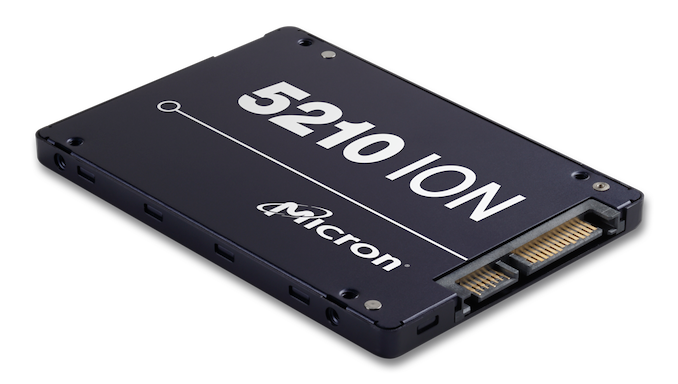
| 8:00a | Micron Announces Broad Availability Of 5210 ION QLC SSD
Micron's 5210 ION enterprise SATA SSD was announced in May as the first shipping SSD with four bit per cell (QLC) NAND flash memory, but until now it has only been available to Micron's largest customers and partners. Starting this week, the 5210 ION is getting a broad release that will include sales through online retailers. This means that we finally have concrete detailed specifications and prices for the 5210. As originally announced, the 5210 ION is a fairly straightforward adaptation of the 5200 series TLC-based enterprise SATA SSDs to use Micron's new QLC NAND. The controller and most of the firmware are the same, and the change in flash memory brings lower cost, write endurance and performance. We now have a clear idea of just how big an impact the switch to QLC NAND makes on those specifications.
Micron's primary goal with the 5210 ION is to expand the market for their enterprise SSDs. Micron does expect some customers to replace some of their TLC-based enterprise SSDs with QLC drives like the 5210 ION, but they're more interested in going after the remaining market for 10k RPM hard drives. Micron believes that with the 5210 they finally have a SSD that is cost-competitive with high-end hard drives, while offering higher performance, density, and power efficiency. Write speeds are the biggest weakness of QLC NAND, but even the smallest, slowest 5210 model can sustain sequential writes at least as fast as a 10k RPM hard drive. However, the 5210 has already proven to have broader appeal, and Micron has some large customers that are deploying it as replacements for 7200RPM hard drives or client TLC SSDs that were being used in datacenters. With a price similar to consumer TLC drives but firmware tuned for enterprise workloads, the 2TB 5210 is being rolled out to replace 1TB consumer SSDs in service with a major streaming media CDN. Serving up streaming video is an appropriately read-heavy, mostly sequential workload that allows the 5210 to saturate the SATA link as well as any drive, but with more consistent latency than client/consumer SSDs offer. Micron also cites a system builder of servers for machine learning is migrating from 8+TB 7200 RPM to the 8TB Micron 5210 ION for storing the massive datasets involved. The 5210 is quite a bit more expensive than the hard drives, but the hard drives have been a serious bottleneck. The higher performance of the 5210 allows these systems to perform tasks like image classification 8x faster, greatly improving the utilization of the expensive compute hardware in those machines and lowering the total cost of ownership. Machine learning can be an extremely read-heavy workload for inference tasks when a large model is consulted repeatedly and only occasionally updated. Write Endurance Gets ComplicatedWith the 5210 ION, Micron has adopted a workload-dependent write endurance rating system. The same drive can be rated for anywhere from 0.05 drive writes per day up to 0.8 drive writes per day depending on how much of the data written is sequential vs random, and whether it is small 4kB random writes or larger block sizes. By contrast, their Crucial P1 consumer QLC SSD still gets a single number rating of 0.1 DWPD. By giving a wide range of endurance ratings, Micron avoids having to label the 5210 with a single conservative rating that would make it look particularly fragile compared to TLC-based SSDs. It also encourages their customers to be more aware of the details of their workload when shopping for storage. A gradual increase in that kind of awareness has been an important enabler for the transition from MLC to TLC, and is the main reason for the decline of enterprise SSDs with 10+ DWPD endurance ratings. (Micron claims that last year, 75% of all enterprise SSDs sold were rated for 1 DWPD or less, and that percentage will continue to grow.)
The patterns in the write endurance ratings are not completely uniform across the product line. All three capacities top out at 0.8 DWPD for 100% sequential 128kB writes, and are rated for 0.2 DWPD for 16kB random writes. When random writes of 4kB or 8kB are involved, the larger models have lower DWPD ratings than the 2TB model, possibly reflecting differences in how the flash translation layer is tuned for different drive capacities. The worst case is for 100% 4kB random writes, where the 2TB model is still rated for 0.2 DWPD but the 8TB model is rated for just 0.05 DWPD—the larger drive can't actually handle more total TB of 4k random writes. Micron is pitching the 5210 as best suited for workloads that are at least 70% sequential for their writes, which yields endurance ratings of at least 0.27–0.56 DWPD depending on drive capacity. There are plenty of datacenter workloads that fall within this range, and in particular, workloads that hard drives (10k or 7200 RPM) offer sufficient performance for are probably already heavily sequential. While Micron has announced general availability this week, distributors like CDW are not expecting stock for another week or two but are listing their prices for pre-orders. CDW currently lists the 5210 ION for 21-24 cents per GB, compared to 25-28 cents per GB for the TLC-based 5200 ECO. Bulk pricing should be significantly lower, and retail pricing may also drop below 20 cents per GB when supplies improve. | ||||||||||||||||||||||||||||||||||||||||||||||||||||||||||||||||||||||||||||||||||||||||||||||
| 9:00a | The Crucial P1 1TB SSD Review: The Other Consumer QLC SSD The Crucial P1 is the second consumer SSD with QLC NAND to hit the market, and the first consumer NVMe drive that Crucial has released. It is fundamentally similar to the Intel SSD 660p, but Micron has made some different tradeoffs with their custom firmware that make it worth consideration. | ||||||||||||||||||||||||||||||||||||||||||||||||||||||||||||||||||||||||||||||||||||||||||||||
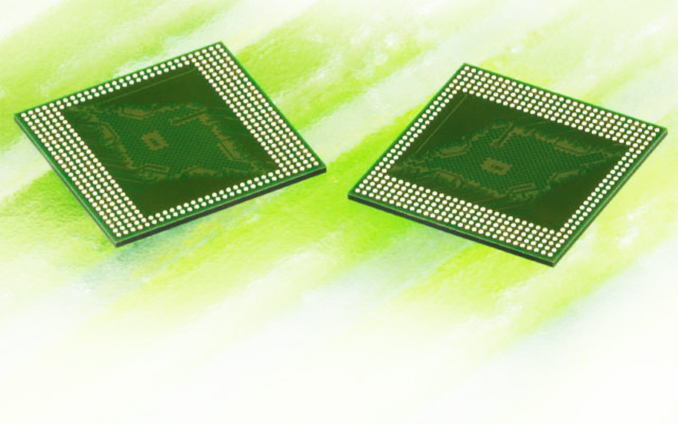
| 11:00a | Micron Kicks Off Mass Production of 12 Gb LPDDR4X DRAM Chips
Micron this week announced that it had started mass production of its first LPDDR4X memory devices using its second-generation 10 nm-class process technology. The new memory devices offer standard LPDDR4X data transfer rates of up to 4.266 Gbps per pin and consumes less power than earlier LPDDR4 chips. Micron’s LPDDR4X devices are made using the company’s 1Y-nm fabrication tech and feature a 12 Gb capacity. The manufacturer says that its LPDDR4X memory chips consume 10% less power when compared to its LPDDR4-4266 products; this is because they feature a lower output driver voltage (I/O VDDQ), which the LPDDR4X standard reduces by 45%, from 1.1 V to 0.6 V. Micron’s 12 Gb (1.5 GB) LPDDR4X devices feature a slightly lower capacity than competing 16 Gb (2 GB) LPDDR4X offerings, but they are also cheaper to manufacture. As a result, Micron can offer lower-cost quad-die 64-bit LPDDR4X-4266 packages with a 48 Gb (6 GB) capacity and a 34.1 GB/s bandwidth than some of its competitors. The 12 Gb LPDDR4X DRAM is Micron’s first product to be manufactured using the company’s second-generation 10 nm-class process technology, so expect Micron to launch more DRAMs that are made using the same tech and therefore feature lower power consumption and higher frequency potential when compared to existing products. Like other makers of DRAM, Micron usually does not announce products before it ships the first batch. Therefore, at least one customer of Micron may have already received its LPDDR4X DRAM devices. Related Reading: Source: Micron | ||||||||||||||||||||||||||||||||||||||||||||||||||||||||||||||||||||||||||||||||||||||||||||||
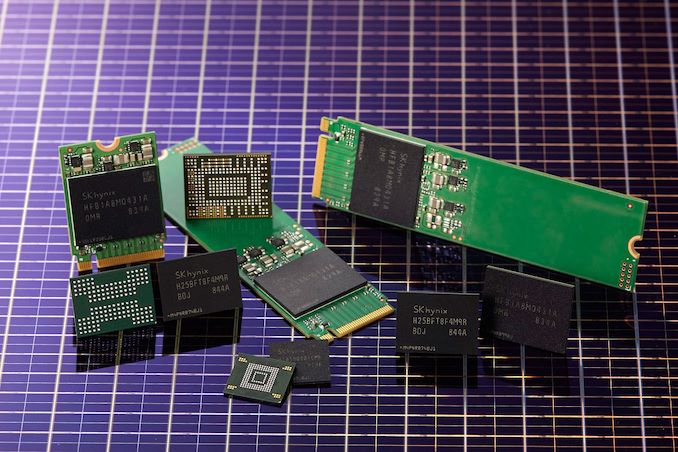
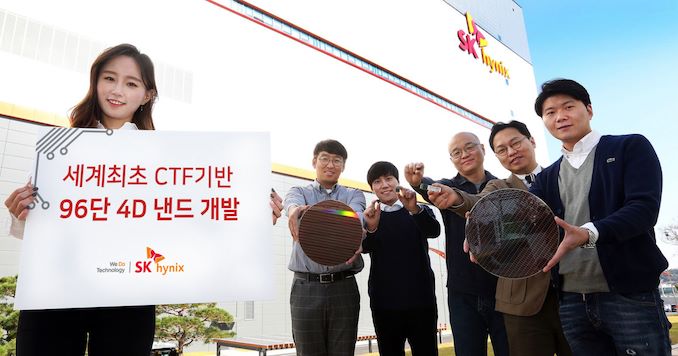
| 1:00p | SK Hynix Launches 96-Layer 3D NAND and Discloses QLC Plans
SK Hynix this week officially launched its new 96-layer 3D NAND flash memory chips, which feature a new architecture and a faster interface. The NAND has already been qualified for SSDs, with first 1 TB consumer models launching shortly and enterprise-grade solutions following on later. What is noteworthy is that these drives are going to be based on SK Hynix’s own controllers. In addition, SK Hynix will eventually offer UFS 3.0-based mobile storage devices featuring the same memory. SK Hynix’s 3D-V5 NAND Memory About to Hit Mass ProductionInitially available in a 512 Gb capacity, SK Hynix’s new 96-layer 3D TLC NAND memory devices are based on a charge trap flash (CTF) design with a peripheral circuits under cells (PUC) architecture. Officially the company has started referring to these devices as “4D NAND” (as announced back at Flash Memory Summit in August), though the technology is not fundamentally different from current 3D NAND architectures. The new 3D-V5 devices use a 1.2 Gbps Toggle 3.0 I/O interface, which is faster than SK Hynix’s 72L 3D-V4 generation products. Meanwhile the chip also features a 64 KB page size (the smallest area of the flash memory that can be written in a single operation) and an 18 MB block size (the smallest area of the flash memory that can be erased in a single operation), which will further speed up performance of the new 3D-V5 devices compared to its predecessors.
SK Hynix says that the increased number of layers and its PUC architecture makes its 96-layer 512 Gb 3D NAND devices around 30% smaller versus their similar 72-layer 512 Gb 3D NAND devices. Furthermore, it can now produce wafers containing 49% more bits than before (assuming the same yield), albeit at the cost of extra process steps. Speaking of production, the company hopes to kick off “the early stage of mass production” this year. At least some of the new chips will be made at the company’s recently built M15 fab. 1 Tb 96L 3D TLC and 3D QLC NAND Chips IncomingAfter SK Hynix refines the mass production of its 96L 3D TLC NAND chips, the company will move on to the next stage. Sometime next year the company plans to roll out 96L 3D NAND chips with a 1 Tb (128 GB) capacity, with both TLC and QLC variants planned. Consumer, Enterprise SSDs Incoming, UFS 3.0 Storage PlannedSK Hynix has already validated its 96L 512 Gb 3D TLC NAND for SSDs. The company plans to release 1 TB client SSDs featuring the memory and its own controllers/firmware “within this year”. Meanwhile, enterprise-grade drives based on the same memory are due in the second half of 2019.
In addition to SSDs, SK Hynix intends to release UFS 3.0-based 96L 512 Gb 3D TLC NAND chips in the first half of next year. These will be the company’s first UFS 3.0-supporting devices and will enable it to address various high-end smartphones. Related Reading: Source: SK Hynix | ||||||||||||||||||||||||||||||||||||||||||||||||||||||||||||||||||||||||||||||||||||||||||||||
| 10:30p | AMD Releases Radeon Software Adrenalin Edition 18.11.1
Today, AMD released Radeon Software Adrenalin Edition 18.11.1, bringing zero-day game support and performance improvements ahead of Hitman 2 (11/13/18), Fallout 76 (11/14/18), and Battlefield V Early Access (11/15/18). As a low-key game-oriented driver, 18.11.1 also includes a few bugfixes for issues affecting Assassin's Creed: Origins, Wolfenstein II, and Strange Brigade. As the year comes to a close though, we should expect to hear about more wide-ranging driver developments with the annual Radeon Software major feature update. In terms of 18.11.1 improvements for Hitman 2, AMD cited up to 3% more 1080p performance on the Radeon RX 580 than 18.10.2. Meanwhile, for Battlefield V Early Access at 1080p AMD is touting up to an 8% uplift on the Radeon RX Vega 64 and 9% uplift on the RX 580, compared to 18.10.2. To be clear, while the latter title is releasing in full on the 20th, those who pre-ordered Battlefield V Deluxe Edition receive early access starting on the 15th.
In any case, Battlefield V is not just the latest entry of the popular and high-profile FPS series, but is arguably the flagship game for upcoming real-time raytracing effects via DirectX Raytracing (DXR), something which NVIDIA is strongly pushing with their new GeForce RTX cards. Though with EA refering to an "early release of DXR will be available in an upcoming patch, near the Battlefield V Deluxe Edition release window," it's not clear when DXR support will arrive. For now, only NVIDIA RTX cards support hardware accelerated DXR, but AMD is working on drivers to support hardware acceleration on their own cards. Either way, EA's recommended system specs for DXR are pushing much beefier CPUs. Moving on to the bugfixes, 18.11.1 resolves the following issues: In terms of documented open issues, 18.11.1 lists the following: 18.11.1 does not apply to APUs. The updated drivers for AMD’s desktop, mobile, and integrated GPUs are available through the Radeon Settings tab or online at the AMD driver download page. More information on these updates and further issues can be found in the Radeon Software Adrenalin Edition 18.11.1 release notes. | ||||||||||||||||||||||||||||||||||||||||||||||||||||||||||||||||||||||||||||||||||||||||||||||


| << Previous Day |
2018/11/08 [Calendar] |
Next Day >> |