[Most Recent Entries] [Calendar View]
Friday, February 8th, 2019
- HDMI 2.1 Nears Release: Club3D Announces Ultra-High Speed 48G Cable
- HDMI Forum Demonstrates HDMI 2.1 VRR Capabilities on Samsung TV
- HDMI 2.1 Specification Released: Variable Refresh, Dynamic HDR, & More In 2018
- HDMI 2.1 Announced: Supports 8Kp60, Dynamic HDR, New Color Spaces, New 48G Cable
- Intel Officially Launches Bean Canyon NUCs with Coffee Lake-U Processors
- Intel’s Crimson Canyon NUCs with Cannon Lake CPU & Radeon dGPU Available for Pre-Order
- The Intel NUC8i7HVK (Hades Canyon) Review: Kaby Lake-G Benchmarked
- Intel NUC8i7HVK (Hades Canyon) Gaming Performance - A Second Look
- The Intel Skull Canyon NUC6i7KYK mini-PC Review
| Time | Event |
| 9:00a | Best CPUs for Gaming: Q1 2019 Sometimes choosing a CPU is hard. So we've got you covered. In our CPU Guides, we give you our pick of some of the best processors available, supplying data from our reviews. Our Best CPUs for Gaming guide targets most of the common system-build price points that typically pair a beefy graphics card with a capable processor, with the best models being suitable for streaming and encoding on the fly. |
| 11:00a | Xilinx Introduces HDMI 2.1 IP with 8K Support
Xilinx this week introduced a comprehensive HDMI 2.1 IP subsystem for its various cores. The IP subsustem supports resolutions of up to 8K along with other features of the HDMI 2.1 spec, such as high refresh rates and HDR. The subsystem is now ready for licensing by Xilinx chip customers. Xilinx’s HDMI 2.1 design features the company’s high-speed I/O transceivers that support HDMI 2.1’s data rates (presumably up to 48 Gbps) along with appropriate processing capabilities. The HDMI 2.1 subsystem can be combined with Xilinx’s decoders/encoders for various codecs supporting up to 8K resolutions. The HDMI 2.1 subsystem enables developers of chips for various applications (including professional AV equipment, cameras, media players, monitors, projectors, KVM, digital signage) to build highly-integrated SoCs that can transmit, receive and process up to 8K video as well as support a “complete” HDMI 2.1 interface. In their turn, such SoCs will replace expensive custom, non-integrated HDMI 2.1 implementations that tend to use multiple chips. Unfortunately, Xilinx is a bit light on the details on which HDMI 2.1 features its IP core actually supports. The company confirms an 8K (7680×4320) resolution and implies on “higher frame rates and high dynamic range” along with HDMI 2.1 data rates, but does not detail exact numbers. According to HDMI Forum, companies can use HDMI 2.1 branding to designate products that support certain HDMI 2.1 features, but not necessarily all of them. Therefore, it remains to be seen which capabilities Xilinx’s IP core actually supports. "Today's professional AV and broadcast markets continue to demand higher resolution, higher frame rates and high dynamic range, to deliver more immersive viewing experiences," said Ramesh Iyer, director of marketing, Pro AV and Broadcast market, Xilinx. "Our customers can now implement the complete HDMI 2.1 interface on-chip, creating highly-integrated designs that can natively handle 8K processing. And customers can combine this functionality with 8K lightweight mezzanine codecs for 8K over IP streaming, reducing real-estate, power consumption and BOM costs." Related Reading: Source: Xilinx |
| 1:00p | SMIC To Start 14nm Mass Production in H1 2019
Reports have emerged this week that SMIC, the largest foundry in China, is set to start mass production using its in-house developed 14 nm FinFET manufacturing technology in the first half of this year. Notably, this comes at least a couple of quarters earlier than was initially expected, indicating that SMIC is apparently ahead of schedule. Meanwhile the company is already working on its post-14nm processes, as development of its 10 nm and EUV-enabled 7 nm fabrication processes are currently underway. |
| 3:00p | Akasa's Turing: A Passively-Cooled Chassis for Intel’s Bean Canyon NUC
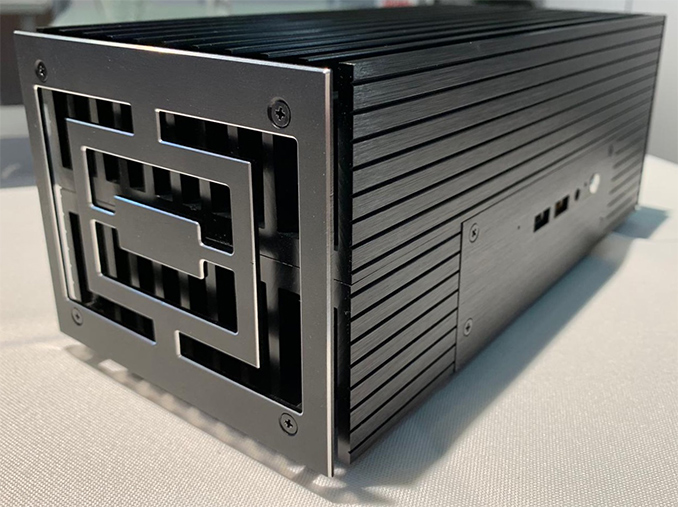
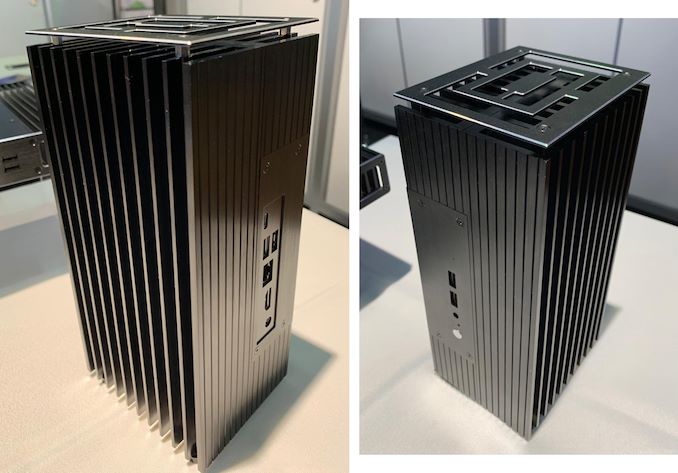
Akasa is prepping an aftermarket chassis for Intel’s 8th Gen "Bean Canyon: NUC systems. The Turing chassis will allow Intel’s NUC 8 ultra-compact form-factor (UCFF) computers to be converted to fanless systems, eliminating the noise that they produce. Intel's Bean Canyon NUC systems are based on the company's 8th Gen Core i3/i5/i8 processors, which offer two or four cores as well as Iris Plus Graphics 655 (GT3e) iGPU. Theu are designed for users who need better graphics performance in a very compact form-factor. Apart from a 28 W CPU, Bean Canyon PCs also pack up to 32 GB of DDR4 memory, an M.2-2280 PCIe 3.0 x4 or SATA SSD, a 2.5-inch storage device, a Thunderbolt 3 controller to plug in an external graphics or storage sub-system, a 802.11ac Wi-Fi solution, and just about everything else that one comes to expect from an UCFF PC. Needless to say, the compact system packs a lot of heat, and as a result it uses a blower-based cooler in order to keep it in check However Akasa has decided to do one better, and is putting together a chassis for Bean Canyon that allows the NUC to be converted into a passive, silent system.
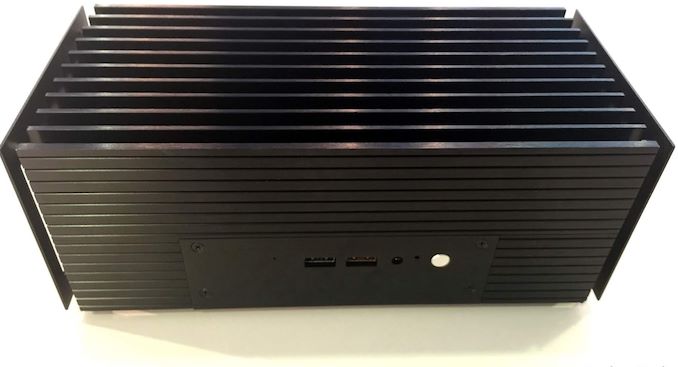
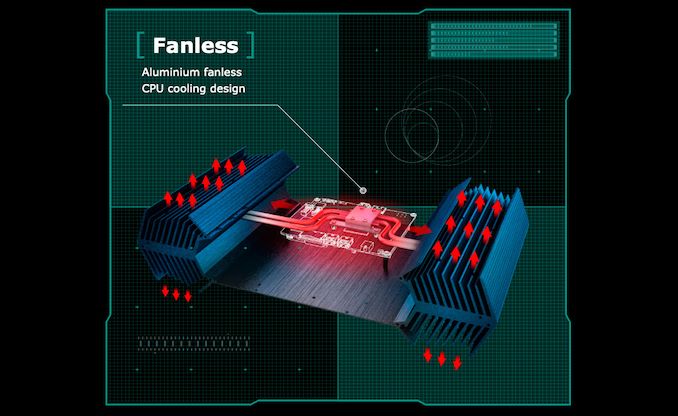
Akasa is already known for its Galactico chassis (its scheme is depicted below) for Intel’s Skull Canyon NUC aimed at users seeking for UCFF gaming PCs. Based on the pictures of the Turing case published by FanlessTech, the upcoming chassis for Intel's Bean Canyon uses the same principle as its predecessor: it has a large CPU heat exchanger featuring multiple heat pipes that transfer heat from the processor to massive radiators. While the Galactico features two aluminum radiators located on the sides of the chassis, the Turing features an additional radiator above the CPU as well.
Quite naturally, Akasa’s Turing and Galactico chassis make Intel’s NUC systems considerably larger than they originally are, but they eliminate all the noises that these PCs produce. Furthermore, they retain all the I/O ports that the computers have, including GbE, USB Type-A/Type-C, TB3, HDMI, DP, audio, microSD, and even antennae fitting holes.
According to FanlessTech, Akasa will launch its Turing chassis shortly. Pricing is uknown, but it is likely that it will be comparable to a ~$200 MSRP of the Galactico. Related Reading: Source: FanlessTech |

| << Previous Day |
2019/02/08 [Calendar] |
Next Day >> |