[Most Recent Entries] [Calendar View]
Tuesday, March 19th, 2019
- AMD at CES 2019: Ryzen Mobile 3000-Series Launched, 2nd Gen Mobile at 15W and 35W, and Chromebooks
- AMD Launches Ryzen 7 2800H & Ryzen 5 2600H APUs for High-Performance Laptops
- Lenovo Lists ThinkPad E485/E585: AMD’s Ryzen Mobile Land in Business PCs
- Dell Launches AMD Ryzen-Based Inspiron 13 7000 2-in-1 Convertible, Starts at $700
- Acer Unveils Nitro 5: 15.6-inch Gaming Laptop with AMD Ryzen Mobile & Radeon RX560
| Time | Event | ||||||||||||||||||||||||||||||||||||||||||||||||||||||||||||||||||||||||||||||
| 12:30a | Quick Note: NVIDIA’s “Einstein” Architecture Was A Real Project
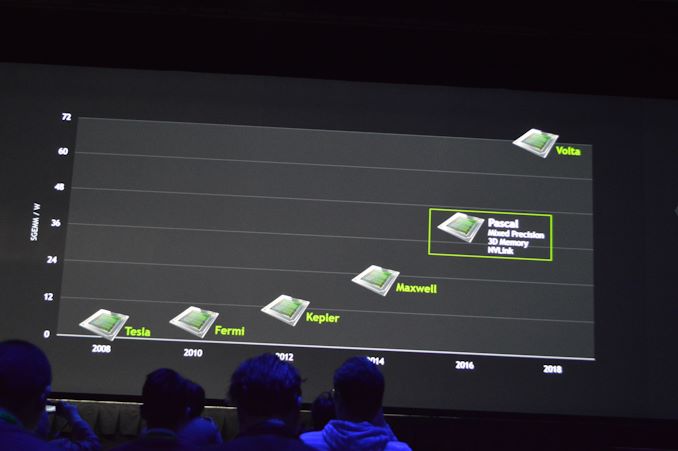
While it was never an official NVIDIA codename as far as roadmaps go, the name “Einstein” came up in rumors a few times earlier this decade. At the time, Einstein was rumored to be the architecture that would follow Maxwell in the NVIDIA lineup. And while we sadly didn’t find out anything new about NVIDIA’s future roadmap at this year’s show – or any sign of Ampere or other 7nm chips – I did inadvertently find out that the rumors about Einstein were true. At least, from a certain point of view. While talking with NVIDIA’s research group this morning about some of their latest projects (more on this a bit later this week when I have the time), the group was talking about past research projects. And, as it turns out, one of those former research projects was Einstein.
Rather than just being a baseless rumor, Einstein was in fact a real project at NVIDIA. However rather than being an architecture, per-se, it was a research GPU that the NVIDIA research group was working on. And although this research project didn’t bear fruit under the Einstein name, it did under another name that is far more well-known: Volta. So while this means we can scratch Einstein off of the list of names for potential future NVIDIA architectures, the project itself was real, and it was actually a big success for NVIDIA. As Einstein morphed into what became the Volta architecture, it has become the cornerstone of what are now all of NVIDIA’s current-generation GPUs for servers and clients. This includes both regular Volta and it’s graphics-enhanced derivative, Turing. | ||||||||||||||||||||||||||||||||||||||||||||||||||||||||||||||||||||||||||||||
| 10:30a | Western Digital: Over Half of Data Center HDDs Will Use SMR by 2023
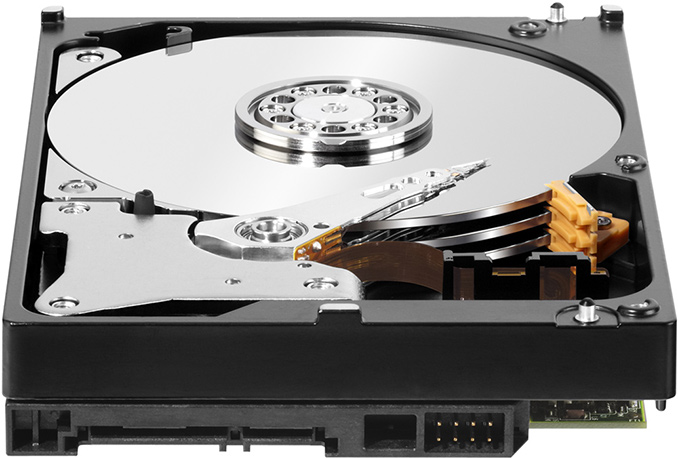
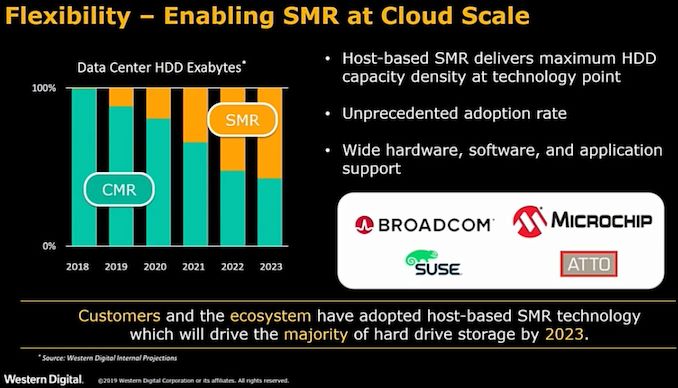
Western Digital said at OCP Global Summit last week that over half of hard drives for data centers will use shingled magnetic recording (SMR) technology in 2023. At present Western Digital is the only supplier of SMR HDDs managed by hosts, but the technology is gaining support by hardware, software, and applications. SMR technology to boost capacity of hard drives fairly easily but at the cost of some performance trade-offs due to the read-modify-write cycle introduced by shingled tracks. Since operators of datacenters are interested in maximizing their storage capacities, they are inclined to invest in software that can mitigate peculiarities of SMR. As a result, several years after Western Digital introduced its first host-managed SMR HDDs, more and more companies are adopting them. Right now, the vast majority of datacenter hard drives are based on perpendicular magnetic recording technology, but WD states that in four years SMR HDDs will leave PMR drives behind.
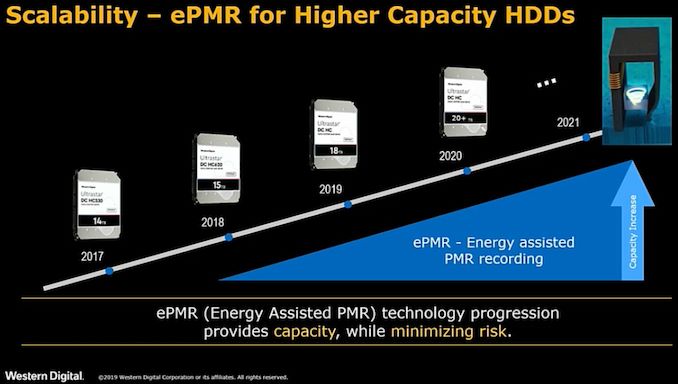
Obviously, usage of SMR will not be the only method to increase capacities of hard drives. Energy-assisted PMR technologies (e.g., MAMR, HAMR, etc.) will also be used by Western Digital. In the coming quarters the company intends to release MAMR-based HDDs featuring a 16 TB (ePMR) and 18 TB (eSMR) capacity. The company also plans to introduce 20 TB HDDs in 2020.
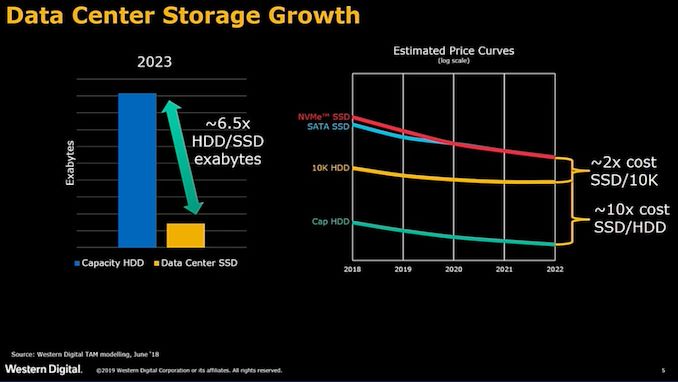
High-capacity hard drives are not going to be replaced by high-capacity SSDs any time soon, according to Western Digital. HDDs will continue to cost significantly less than SSDs on per-TB basis. Therefore, they will be used to store 6.5 times more data than datacenter SSDs in 2023.
Related Reading: | ||||||||||||||||||||||||||||||||||||||||||||||||||||||||||||||||||||||||||||||
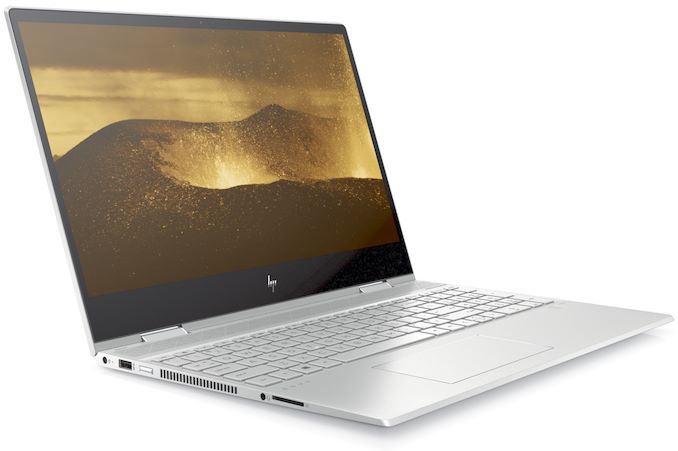
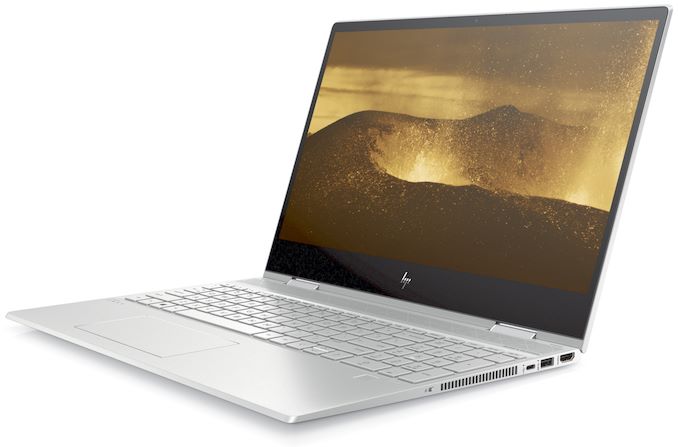
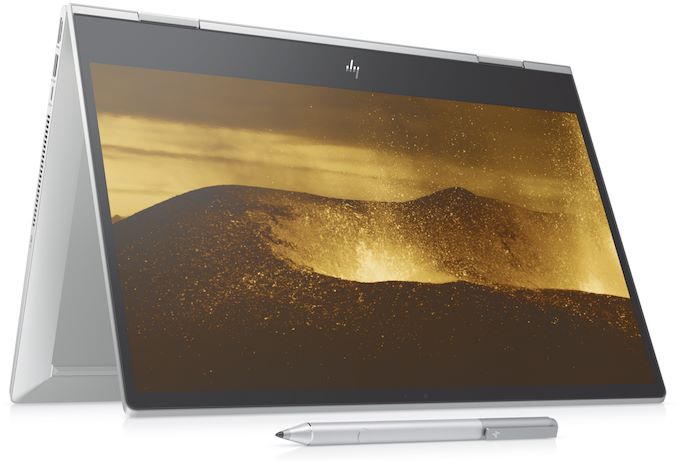
| 11:00a | HP Reveals Envy x360 15 Laptops with AMD's Latest Ryzen APUs
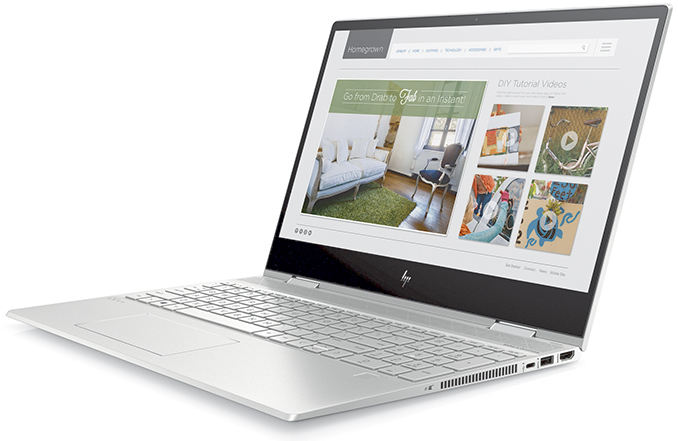
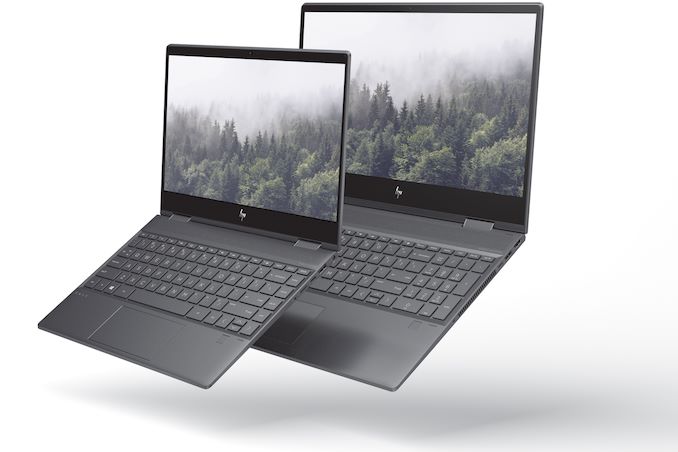
HP on Tuesday introduced its new 15.6-inch convertible notebooks based on AMD’s Ryzen Mobile 3000-series APUs. The new HP Envy x360 15 are positioned as inexpensive 15.6-inch-class laptops for productivity applications. In addition, the company announced its new Intel-based HP Envy x360 15 PCs. HP’s AMD Ryzen 3000 and Intel Core i5/i7-based Envy x360 15 convertibles use exactly the same sand-blasted anodized aluminum chassis and thus have the same dimensions (17 mm z-height) and weight (~ 2 kilograms). The only visual difference between AMD and Intel-powered Envy x360 15 PCs is the color: the former features HP’s Nightfall Black finish, whereas the latter features HP’s Natural Silver finish. Overall the new 15.6-inch Envy x360 convertible laptops feature a 28% smaller bezel when compared to the previous generation according to the manufacturer. Meanwhile, all the HP Envy x360 15 machines introduced today also use the same 15.6-inch Full-HD IPS touch-enabled display panel featuring a WLED backlighting.
Inside the new AMD-based HP Envy x360 15 convertible laptops are AMD’s quad-core Ryzen 5 3500U or Ryzen 7 3700U processors with integrated Radeon RX Vega 8/10 graphics. The APUs are accompanied by 8 GB or single-channel DDR4-2400 memory as well as a 256 GB NVMe/PCIe M.2 SSD. As for Intel-powered Envy x360 15, they use Core i5-8265U or Core i7-8565U CPUs.
As far as connectivity is concerned, everything looks rather standard: the systems feature a 802.11ac + Bluetooth 5.0/4.2 controller from Intel or Realtek, one USB 3.1 Gen 1 Type-C connector (with DP 1.4), two USB 3.1 Gen 1 Type-A ports, an HDMI output, a 3.5-mm audio connector for headsets, an SD card reader, and so on. The new Envy x360 15 also has an HD webcam with a dual array microphone and a kill switch, a fingerprint reader, Bang & Olufsen-baged stereo speakers, and a full-sized keyboard.
When it comes to battery life, HP claims that its AMD Ryzen Mobile-powered Envy x360 15 convertibles offer exactly the same battery life as Intel-based machines: up to 13 hours of mixed usage when equipped with a 55.67 Wh battery.
HP will start sales of its Envy x360 15 convertible notebooks with AMD Ryzen Mobile inside this April. Pricing will start at $799.99. By contrast, a system featuring Intel’s Core i5-8265U with a generally similar configuration will cost $869.99.
Related Reading Source: HP | ||||||||||||||||||||||||||||||||||||||||||||||||||||||||||||||||||||||||||||||
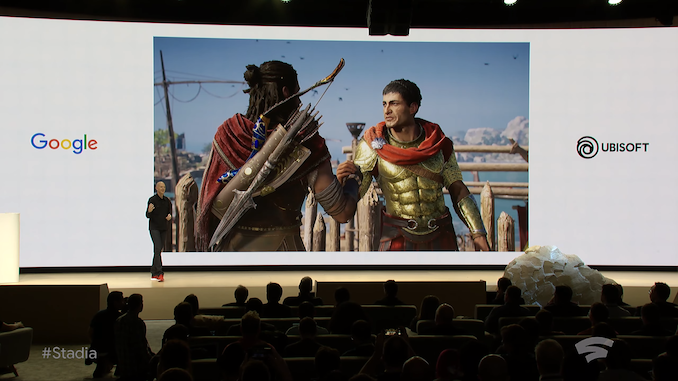
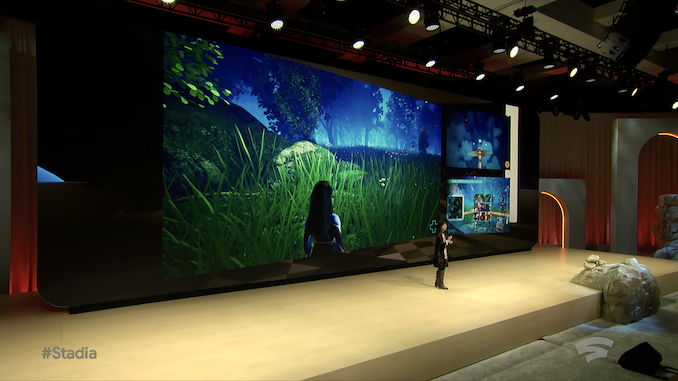
| 1:12p | Google Announces Stadia: A Game Streaming Service Today at GDC, Google announced its new video game streaming service. The new service will be called Stadia. This builds on the information earlier this year that AMD was powering Project Stream (as was then called) with Radeon Pro GPUs, and Google is a primary partner using AMD’s next generation CPUs and GPUs.
Stadia is being advertised as the central community for gamers, creators, and developers. The idea is that people can play a wide array of games regardless of the hardware at hand. Back in October, Google debuted the technology showcasing a top-end AAA gaming title running at 60 FPS. Google wants a single place where gamers and YouTube creators can get together – no current gaming platform, according to Google, does this.
Ultimately Google wants to stream straight to the Google browser. Google worked with leading publishers and developers to help build the system infrastructure. Google is one of a few companies with enough content delivery networks around the world to ensure that frame rates are kept high with super low latency.
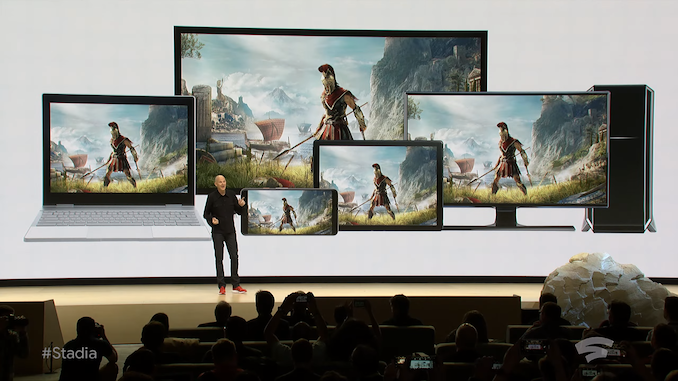
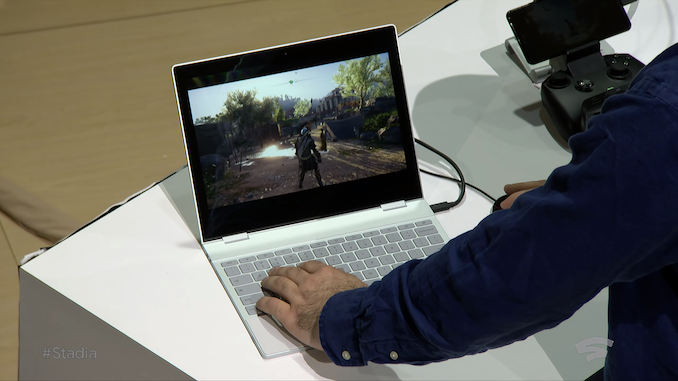
Users will be able to watch a video about a game, and instantly hit ‘Play Now’ and start playing the game in under five seconds without any download and lag. The idea is that a single code base can be enjoyed at any stream. At launch, desktop, laptop, TV, tablets, and phones will be supported. With Stadia, the datacenter is platform. No hardware acceleration is required on the device. The experience can be transferred between devices, such as chromebook to smartphone.
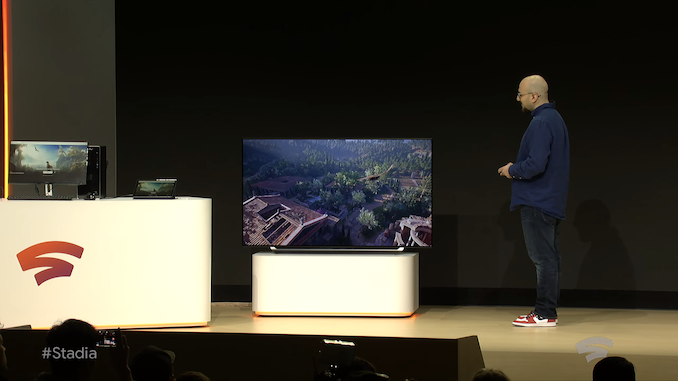
One of the highlights of Google’s demonstration of Stadia was the platform working on Google-enabled TVs.
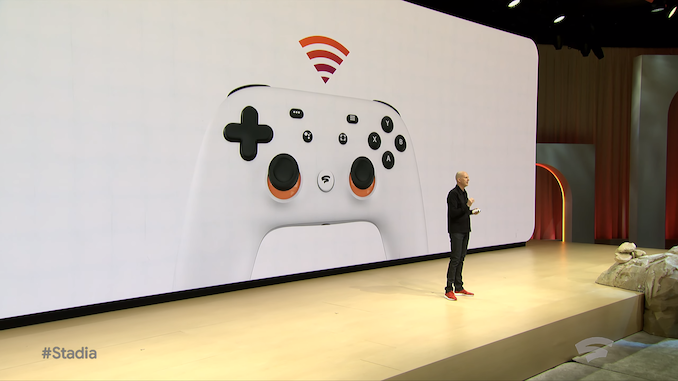
The platform allows users to have any USB connected controller, or mouse and keyboard. Google will also be releasing its own Stadia Controller, available in three colors – white, black, and light blue. The controller connects via Wi-Fi straight into the cloud, and also which device is being run (it’s unclear how this works).
The controller has two new buttons. The first allows saving and sharing the experience out to YouTube. The second is Google Assistant, using the integrated microphone in the controller. This allows game developers to integrate Google Assistant into their games. It also allows users to ask Google when they need help in a game - and the assistant will look for a guide to help. Stadia uses the same datacenter infrastructure already in place at Google. There are 7500+ edge nodes allows for compute resources being closer to players for lower latency. Custom designed, purpose built hardware powers the experience. Interconnected racks have sufficient compute and memory for the most demanding games. The technology has been in development inside Google for years.
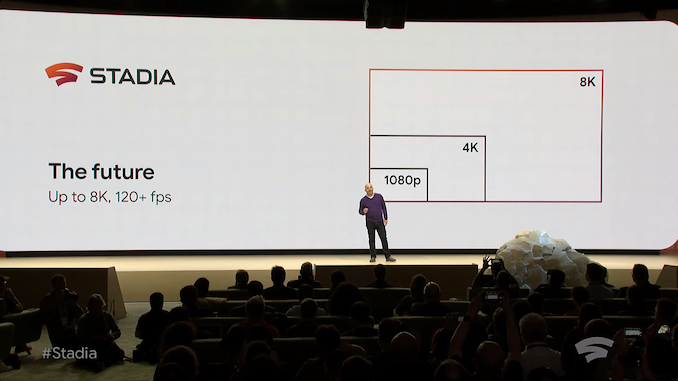
At launch, resolutions will be supported up to 4K 60 fps with HDR and surround sound. Future plans for up to 8K streaming at 120 fps are planned. The platform has been built to scale to support this. While playing, the stream is duplicated in 4K for direct upload – you get rendering quality video rather than what you capture locally. The platform is instance based, so Google can scale when needed. Game developers no longer have to worry about building to a specific hardware performance – the datacenter can scale as required.
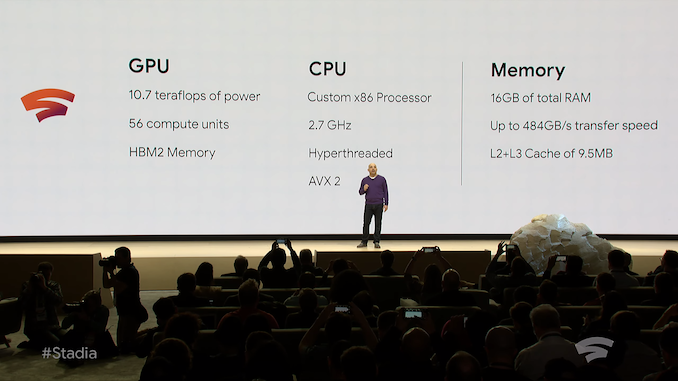
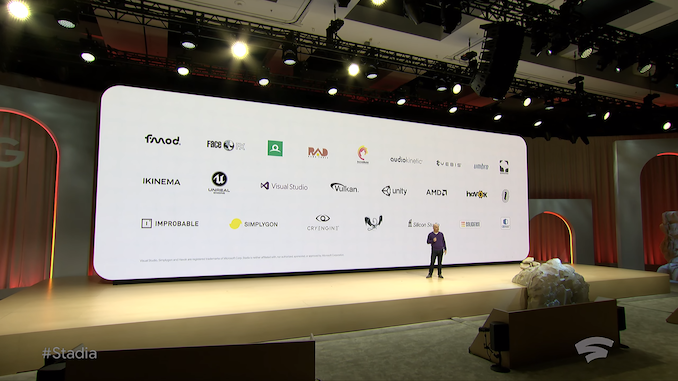
Custom GPU with AMD, with 10 TF of power, with a custom CPU with AVX2 support. Combined they create a single instance per person. Uses Linux and Vulkan, with full Unreal and Unity support. Havok engine support as well. Tool companies are onboard. (When Google says custom CPU and custom GPU - this could be early hardware of AMD's upcoming generations of technology, put into a custom core configuration / TDP. We're likely looking at a Zen 2 based CPU, based on AVX2 support listed, and a Radeon Instinct based GPU with tweaked settings specifically for Google.)
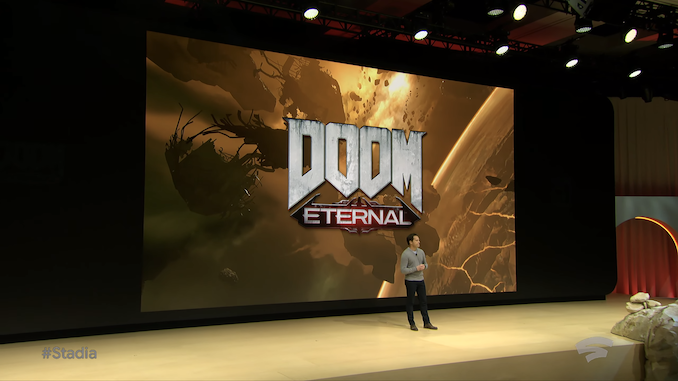
One of the first games supported will be Doom Eternal from id Software, which will support 4K with HDR at 60 fps. Every user will get a single GPU with no other users.
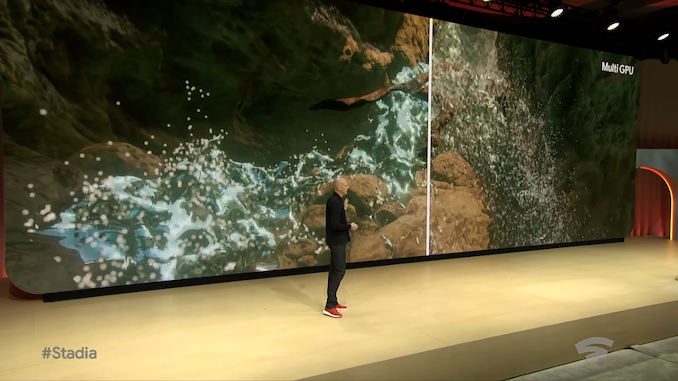
UL Benchmarks (3DMark) has been working with Google to help benchmark the systems and measure the power of the infrastructure. Developers if required can use multiple GPUs, it appears. Multiplayer is also supported, at least between different Stadia players. Distributed physics becomes possible, which means up to 1000 players in Battle Royale titles. There’s also the advantage, according to Google, of getting around hackers and cheaters.
Developers can support multi-platform multiplayer, and transfer save files between platforms. Game developers have already been working on MP demos with destructive environments using real-time rigid body physics, allowing for perfect synchronization.
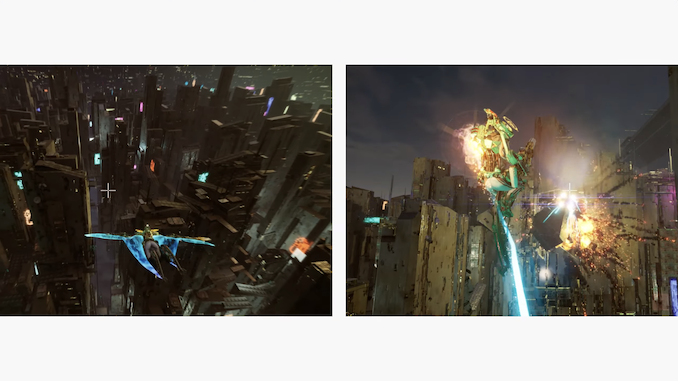
Google also points out that split-screen gaming has not been a priority recently because of rendering two scenes at once. With Stadia, that problem disappears, as each player will be powered by a separate instance, reviving the idea of local co-op and squad based gaming. This also allows for multiple cameras for a single player to navigate a single map, for better tactics in certain types of games. Google says that this ability allows developers to create new types of games.
Built on Google’s platform, Stadia will also support machine learning. For developers that want to take advantage, they can incorporate Google and third-party libraries to help improve games over time and enhance the experience both on a per-user level and on a local/global scale.
The other focus on Stadia is the interaction with YouTube. Google points out that gaming has been a fundamental part of YouTube since its exception, and it is Google’s goal to help creators interact with (and monetize) their audience. The idea is that creators can directly livestream from Stadia, as well as play with creators through Stadia. ‘Crowd Play’ will allow users to play directly into the server instance with the creator – it acts like a lobby, so players will sit in line to play with their favorite creator. For example, the NBA2K above shows 'join this game (3rd in line)'. Google states that any link from any location can act as a launch point for a title. This means that developers do not have to be limited to a single game store – games can be launched from almost anywhere, as long as the user is in an up to date Chrome browser. Google is also set to put extensive parental controls into the mix.
Google will be creating an entity called ‘Stadia Games and Entertainment’, headed up by Jade Raymond, enabling first party studios to use Stadia. Other partner studios will also work through the new division as outreach in order to enable game development on Stadia. Developers who want to create for Stadia should go to stadia.dev to sign up for tools and resources. Stadia Partners for distributers. Stadia.com will be the hub for gamers. Stadia will launch in 2019, in the US, Canada, UK, and most of Europe. No word on pricing yet, but Google will be announcing more in the Summer.
| ||||||||||||||||||||||||||||||||||||||||||||||||||||||||||||||||||||||||||||||
| 2:00p | SilverStone EP14: A Miniature USB-C Hub with HDMI, USB-A, 100 W Power
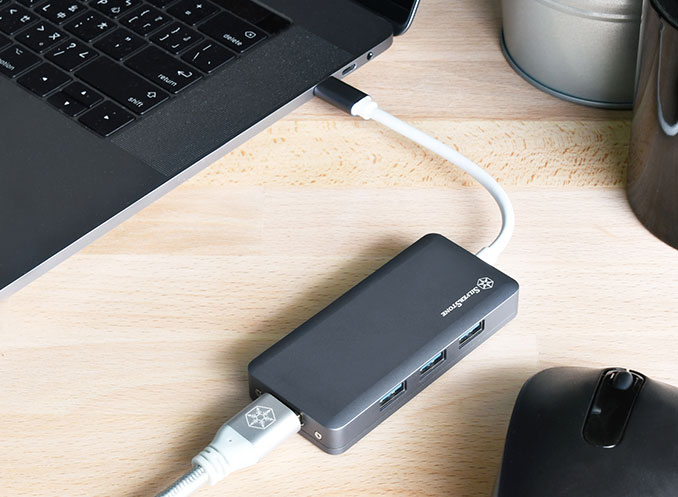
With hundreds of different USB Type-C adapters and docks on the market, manufacturers are trying hard to make theirs more attractive. To that end, they now tend to design rather interesting products addressing focused use cases. SilverStone has introduced its new compact USB-C dock that has three USB-A ports, a display output, and can pass through up to 100 W of power to charge a laptop and/or devices connected to the USB-A ports, a rare feature for small docks. | ||||||||||||||||||||||||||||||||||||||||||||||||||||||||||||||||||||||||||||||
| 5:45p | Apple Upgrades iMac and iMac Pro: More Cores, More Graphics, More Memory
Apple has introduced its updated iMac all-in-one desktop computers to use Intel's latest generation processors with up to eight cores plus AMD’s latest Pro graphics, and its iMac Pro to be equipped with more memory and a faster GPU. Since Apple upgrades its iMac product line every couple of years or so, the company has every right to claim that its top-of-the-range AIO PCs are now up to twice faster than their predecessors. | ||||||||||||||||||||||||||||||||||||||||||||||||||||||||||||||||||||||||||||||



| << Previous Day |
2019/03/19 [Calendar] |
Next Day >> |