[Most Recent Entries] [Calendar View]
Wednesday, August 7th, 2019
- Nintendo Announces New Version of Switch with Longer Battery Life
- Update: Nintendo Reveals Handheld-Only Switch Lite, With a New NVIDIA SoC
- Razer Enters The Smartphone Arena With The Razer Phone
- New 8K OLED Displays for Tablets and Laptops: 8.3 and 13.3 Inches
- Western Digital Starts Shipments of Client SSDs Based on 96-Layer BICS4 3D NAND
- Western Digital: 96-Layer 3D NAND Progressing Well, Shipping to Retail Customers
- Western Digital Begins to Sample QLC BiCS4: 1.33 Tbit 96-Layer 3D NAND
- Western Digital Announces Client NVMe SSDs With New In-House Controllers
- Western Digital: Nearly All NAND Capacities Resumed Normal Operations
- HGST Ultrastar SN200 Accelerator: 7.68 TB Capacity, 6.1 GB/s Read Speed, 1.2M IOPS
- Western Digital Starts Shipments of Client SSDs Based on 96-Layer BICS4 3D NAND
- Western Digital: 96-Layer 3D NAND Progressing Well, Shipping to Retail Customers
- Western Digital Begins to Sample QLC BiCS4: 1.33 Tbit 96-Layer 3D NAND
- Western Digital Announces Client NVMe SSDs With New In-House Controllers
- Western Digital: Nearly All NAND Capacities Resumed Normal Operations
| Time | Event | |||||||||||||||||||||||||||||||||||||||||||||||||||||||||||||||||||||||||||||||||||||||||||||||||||||||||||||||||||||||||||||
| 11:00a | Sharp to Supply IGZO Displays to Nintendo
In a surprising move, one of Sharp’s top executives revealed that the company will supply its IGZO displays to Nintendo. Usage of IGZO screens promises to reduce power consumption of Nintendo’s game consoles, though it is unclear which model will get a new type of LCD first. Katsuaki Nomura, an executive vice president of Sharp, told the Wall Street Journal that the company would supply its IGZO displays to Nintendo. The exec did not disclose specifications of the panel or which of Nintendo’s consoles will get IGZO displays first. The game console maker is about to release a handheld-only version of its Switch game console as well as a new version of the fully-fledged Switch. Both new devices could benefit of Sharp’s IGZO displays because of their lower power consumption and potentially higher image quality, but it remains to be seen whether Nintendo decides to shift both of its upcoming game consoles to a new type of LCDs. The upcoming versions of Nintendo’s Switch promise considerably longer battery life when compared to existing Switch consoles while using similar batteries. One of the key reasons why the new units feature lower power consumption is believed to be a new SoC from NVIDIA. Sharp and Nintendo have a long history of working together as the former designed auto stereoscopic display for the latter's 3DS console. Related Reading: Source: Wall Street Journal | |||||||||||||||||||||||||||||||||||||||||||||||||||||||||||||||||||||||||||||||||||||||||||||||||||||||||||||||||||||||||||||
| 1:00p | Western Digital Unveils Ultrastar DC SN640 SSDs: Up to 30.72 TB Capacity
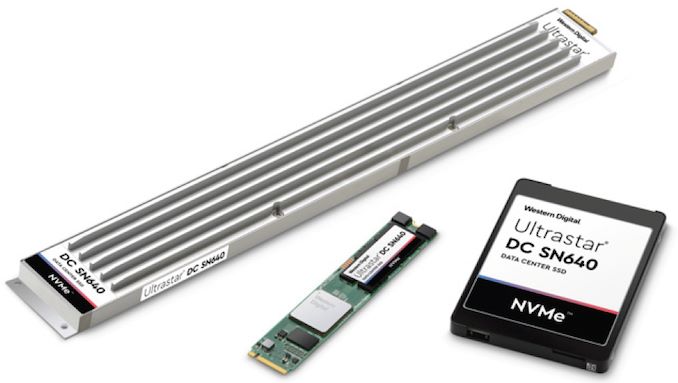
Western Digital has announced its new family of enterprise SSDs aimed at mixed-use-case workloads. The new drives use in-house developed components and come in EDSFF E1.L, U.2, and M.2-22110 form-factors offering capacities of up to 30.72 TB. Based on controllers developed by Western Digital internally as well as 96-layer BICS4 3D TLC NAND, the Ultrastar DC SN640 SSDs are aimed at performance-demanding business-critical mixed-workload applications, including SQL Server, MySQL, VMware vSAN, Microsoft Azure Stack HCI solutions, virtual desktops, and other. When it comes to feature set, the drives support power loss protection, AES-256 data encryption, Instant Secure Erase, signed firmware downloads, and other technologies. Depending on target applications, Western Digital will offer its Ultrastar DC SN640 in three form-factors. For those who need maximum performance and capacity, the manufacturer will offer SSDs in EDSFF E1.L form-factor that will offer capacities of up to 30.72 TB as well as up to 720K random read IOPS. For blade servers running virtual desktops and similar software the maker will offer U.2 SSDs featuring up to 7.68 TB capacities. For space-constrained and OCP environments, the Ultrastar DC SN640 drives will be available in M.2-22110 form-factor as well as capacities of up to 3.84 TB. Considering the workloads, the new SSDs offer tunable endurance of 0.8 or 2 DWPD over five years. As far as performance is concerned, the Ultrastar DC SN640 6.4 TB U.2 SSD is rated for up to 3.2 GB/s sequential read speeds, up to 2.14 GB/s sequential write speeds, up to 480K random read IOPS, and up to 120K random write IOPS.
Samples of Western Digital’s Ultrastar DC SN640 SSDs are now available to the company’s customers and will ship commercially later. Related Reading: Source: Western Digital | |||||||||||||||||||||||||||||||||||||||||||||||||||||||||||||||||||||||||||||||||||||||||||||||||||||||||||||||||||||||||||||
| 2:00p | Western Digital Reveals Ultrastar DC SN340 SSDs for Read Intensive Workloads
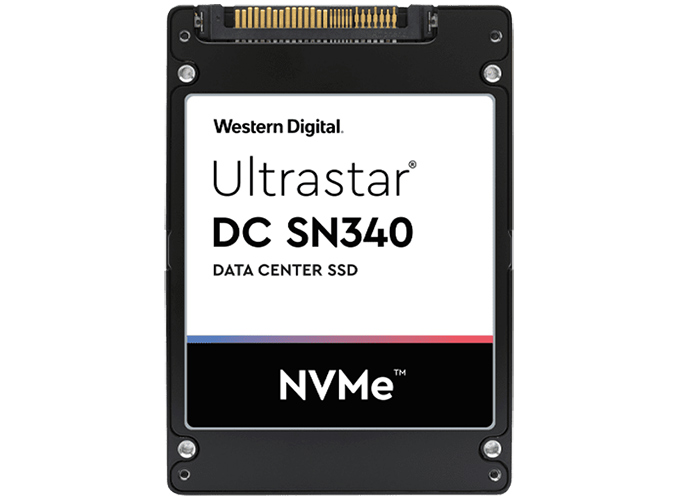
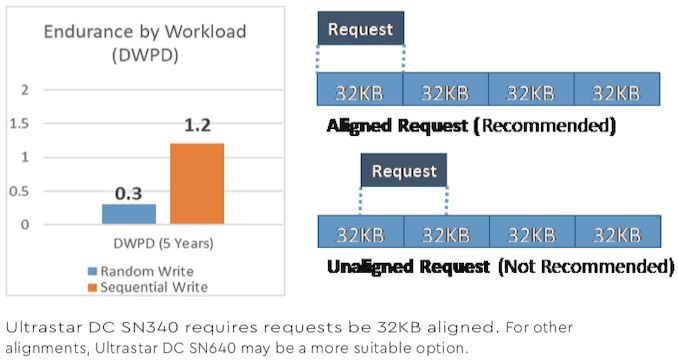
Western Digital has introduced its new accelerator drives designed for very read-intensive workloads. The key feature of the Ultrastar DC SN340 Very Read Intensive (VRI) SSDs is their low read latency which is important for write-once read many applications, such as video-on-demand services, distributed databases, and emerging AI/ML workloads. Nowadays video streaming providers use 1 TB SATA SSDs that offer a ratio of IOPS to bandwidth that satisfies their needs in terms of numbers of parallel users/streams (RIOPS). In a bid to optimize power, costs, and the number of racks in their datacenters while still meeting their requirements, VOD services need higher-capacity drives with higher performance and specific functionality. Western Digital believes that VRI SSDs is a type of devices that will satisfy requirements of the aforementioned (and many other read-intensive) workloads. Carrying 3.84 or 7.68 TB of usable capacity, Western Digital’s Ultrastar DC SN340 U.2 drives optimized for write-once read many workloads are based on the company’s proprietary controller as well as 96-layer BiCS4 3D TLC NAND. With up to 3.3 GB/s sequential read speed, up to 1.5 GB/s write speed, up to 420K random read IOPS, and a 6.5 W maximum power consumption, the Ultrastar DC SN320 are substantially faster and more power efficient than SATA SSDs used by various VOD companies today. One key thing to note about the Ultrastar DC SN340 is that it requires all requests to be 32 KB aligned to guarantee consistent performance and appropriate endurance, so these drives are not for everyone. This is a result of the drive's Flash Translation Layer (FTL) managing data with a coarser granularity, which significantly reduces the size of the indirection tables and allows the drive to operate with less DRAM than the usual 1GB per 1TB ratio.
In addition to video streaming services, VRI SSDs can be used for other write-once read many applications. Distributed No-SQL Databases (Apache Cassandra, MongoDB, etc.) that sequentially write in append mode and avoid overwrites can benefit from such drives and their low read latency. Furthermore, various AI and ML applications that use training while performing loads of reads also take advantage of VRI drives.
Western Digital does not disclose when it plans to start volume production of its Ultrastar DC SN340 VRI SSDs, but it is logical to assume that when its customers learn how to better use such drives, these products will be made available. Related Reading: Source: Western Digital | |||||||||||||||||||||||||||||||||||||||||||||||||||||||||||||||||||||||||||||||||||||||||||||||||||||||||||||||||||||||||||||
| 4:15p | Samsung Announces Galaxy Note10 & Note10+: A Redesign With Feature Disparity It’s that time of the year again. We’ve made it past the first half of 2019 and all vendors have released their initial flagship devices for the year. Samsung was amongst the first to usher in the new generation with the Galaxy S10, S10+ and S10e, and as has been traditional for many years, it’s now time for a refresh of Samsung’s second flagship lineup - the Galaxy Note. Today Samsung is unveiling two new devices: the new Galaxy Note10 and Note10+, marking a significant departure from its usual Note device formula. | |||||||||||||||||||||||||||||||||||||||||||||||||||||||||||||||||||||||||||||||||||||||||||||||||||||||||||||||||||||||||||||
| 4:55p | The AMD 2nd Gen EPYC "Rome" Launch Live Blog The second – and arguably largest – shoe in the Zen 2 launch is dropping today: AMD’s EPYC 7002-series “Rome” processor. Based on all the things that made 3rd gen Ryzen great just a month ago, now AMD is doing it bigger and better. With up to 64 cores, AMD will be striking right at the heart of Intel’s server CPU business; and they just might be able to do it. | |||||||||||||||||||||||||||||||||||||||||||||||||||||||||||||||||||||||||||||||||||||||||||||||||||||||||||||||||||||||||||||
| 7:00p | AMD Rome Second Generation EPYC Review: 2x 64-core Benchmarked If you examine the CPU industry and ask where the big money is, you have to look at the server and datacenter market. Ever since the Opteron days, AMD's marketshare has been rounded to zero percent, and with its first generation of EPYC processors using its new Zen microarchitecture, that number skipped up a small handful of points, but everyone has been waiting with bated breath for the second swing at the ball. AMD's Rome platform solves the concerns that first gen Naples had, plus this CPU family is designed to do many things: a new CPU microarchitecture on 7nm, offer up to 64 cores, offer 128 lanes of PCIe 4.0, offer 8 memory channels, and offer a unified memory architecture based on chiplets. Today marks the launch of Rome, and we have some of our own data to share on its performance. | |||||||||||||||||||||||||||||||||||||||||||||||||||||||||||||||||||||||||||||||||||||||||||||||||||||||||||||||||||||||||||||

| << Previous Day |
2019/08/07 [Calendar] |
Next Day >> |