[Most Recent Entries] [Calendar View]
Thursday, February 13th, 2020
- AnandTech Year In Review 2019: Flagship Mobile
- Samsung Announces The Galaxy Z Flip: Foldable Phone With Glass
- Samsung Announces The Galaxy S20, S20+ and S20 Ultra: 120Hz, 5G, Huge Batteries, Crazy Cameras and $$$
- First with Snapdragon 865: ZTE Unveils Axon 10s Pro w/ 5G, 6.47-Inch AMOLED, 12 GB LPDDR5
- Motorola’s $1500 Foldable Razr to Ship Early February: Pre-Orders Soon
- Microsoft Ends Support for Windows 10 Mobile
| Time | Event | ||||||||||||||||||||||||||||||||||||||||||||||||||||||||||||||||||||||||||||||||||||||||||||||||||||||||||||||||||||||||||||||||||||||||||||
| 5:00a | Broadcom Announces BCM4389 Wi-Fi 6E Client Chipset
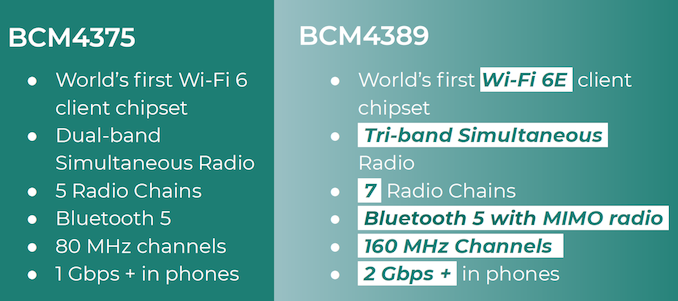
The Wi-Fi Alliance announced the new Wi-Fi 6E terminology for 802.11ax operation in the 6 GHz band last month. At CES 2020, Broadcom announced a number of Wi-Fi 6E access point solutions. Today, Broadcom is announcing the BCM4389 client Wi-Fi 6E chipset. Consumers can expect to see the chipset in the next generation of high-end smartphones. We have already covered the advantages of Wi-Fi 6E in terms of lower latency, higher throughput, and the availability of more number of 160 MHz channels in our coverage of the Wi-Fi Alliance announcement at CES. The BCM4389 builds upon Broadcom's success with the BCM4375, which happens to be the currently leading client Wi-Fi 6 chipset in the smartphone market. In addition to the new 6 GHz support with tri-band simultaneous operation and 160 MHz channel support, the BCM4389 also brings in additional power efficiency, thanks to its 16nm process technology and architectural improvements.
The BCM4375 is a 28nm chipset with 2x2 2.4 GHz and 2x2 5 GHz support, while the new BCM4389 adds 2x2 6 GHz to the mix. The scanning radio accounts for the additional radio chain. Gallery: Broadcom BCM4389 - Benefits
      The Bluetooth 5.0 functionality has also received a boost with MIMO support. Broadcom claims that the new implementation can reduce pairing time by a factor of 2 and also alleviate glitching issues when connected to Wi-Fi at the same time (compared to the BCM4375). The icing on the cake is that the MIMO support works with implicit beamforming ensuring that legacy Bluetooth devices stand to benefit too. Silicon vendors like Broadcom and Qualcomm have been finding it relative straightforward to add 6 GHz support to their existing 802.11ax product lines. Qualcomm has not yet publicly announced Wi-Fi 6E products, though they did talk a lot about being ready for it at their Wi-Fi 6 Day last year. Broadcom, though, seems to have taken the lead with public announcements. Thanks to silicon availability, device vendors should be able to easily push out Wi-Fi 6E support in their products once the FCC clearance is in place. For consumers, the power efficiency improvements along with tri-band simultaneous operation should be very welcome news. | ||||||||||||||||||||||||||||||||||||||||||||||||||||||||||||||||||||||||||||||||||||||||||||||||||||||||||||||||||||||||||||||||||||||||||||
| 10:00a | ASUS ROG Huracan G21: A Small PC with 8-core and RTX 2080
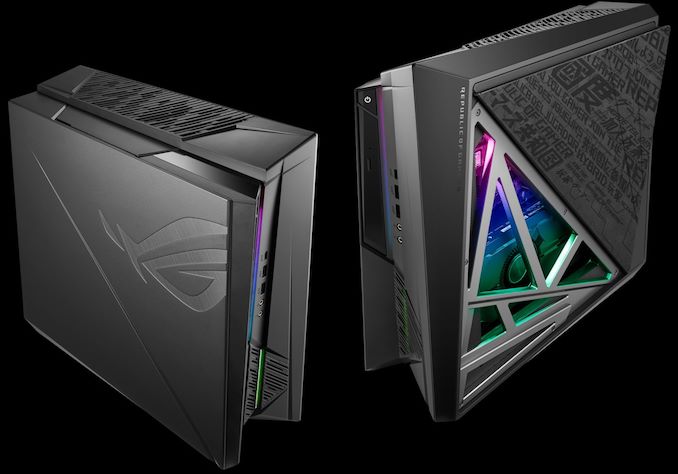
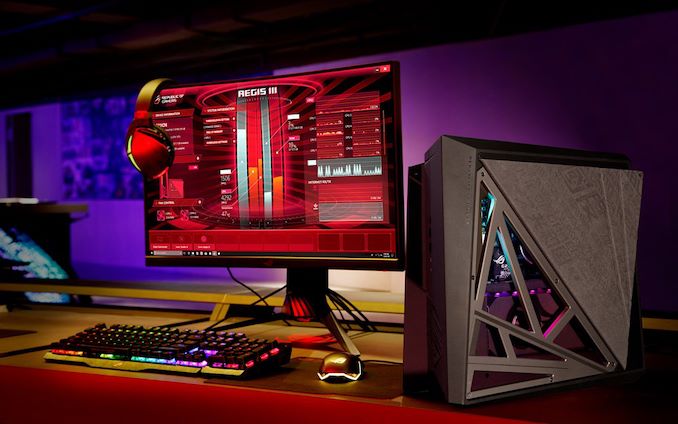
ASUS this week updated its compact ROG Huracan G21 gaming system. The new enthusiast-class machine retains a stylish miniature case that allows easy access to components, but offers more CPU and GPU choices and provides considerably higher performance than before. The futuristic chassis of the ASUS ROG Huracan G21 measures 129.9×372.4×366.1 mm, which is clearly smaller than a traditional tower desktop. ASUS engineers have managed to pack the machine with everything that its bigger brothers have to offer, including Intel’s eight-core Core i9-9900K CPU, NVIDIA’s GeForce RTX 2080, up to 32 GB of RAM, an M.2-2280 PCIe 3.0 x4 SSD, two 2.5-inch SSDs/HDDs, one 3.5-inch HDD, and even a DVD drive (possibly, to install older games). See general specifications in the table below.
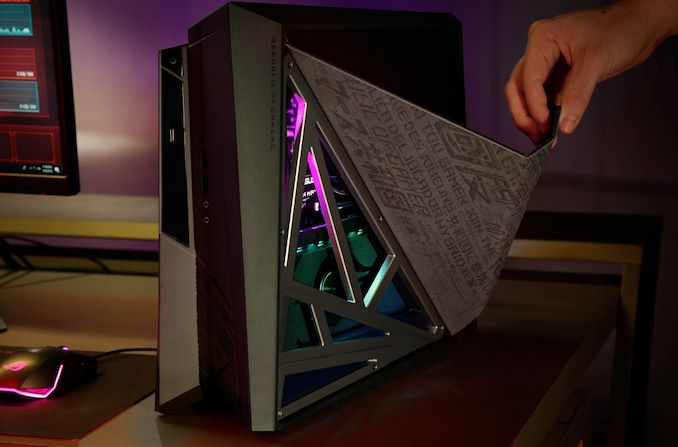
As mentioned above, the chassis allow owners of the ROG Huracan G21 to upgrade the system hassle free. Furthermore, ASUS equipped its ‘baby’ gaming PC with a very well-thought cooling system with multiple inlets, so no component is going to overheat. In fact, the ROG Huracan has a special magnetically attached foldable panel on its side that can be easily opened to further improve thermal and actual performance. Speaking of performance, it is necessary to note that the PC comes with the ASUS ROG Aegis III application that enables easier performance tuning and monitoring of components.
Reasserting its ‘enthusiast-class’ pedigree, the ROG Huracan G21 features a robust set of I/O capabilities, including multiple USB 3.1 Gen 1/2 Type-A/Type-C connectors, Intel’s I219-V GbE adapter, Intel’s Wireless-AC 9560 Wi-Fi 5 solution, various display outputs (depending on the graphics card), and an audio subsystem equipped with the ESS Sabre DAC and offering analog and S/P DIF connectors for a 5.1 speaker system.
To make the ROG Huracan system look as good as it performs and enable owners to customize its looks, it also has multiple RGB LEDs that can be controlled using ASUS’ Aura Sync software. So far, ASUS only lists the 2020 ROG Huracan G21CX computers on its website, so expect the machine to show up shortly. Availability will vary from region to region, but it is reasonable to expect ASUS to launch the systems across the world more or less at the same time. Related Reading | ||||||||||||||||||||||||||||||||||||||||||||||||||||||||||||||||||||||||||||||||||||||||||||||||||||||||||||||||||||||||||||||||||||||||||||
| 11:00a | Andy Rubin’s Essential Smartphone Company to Shut Down
Essential, a company founded by Andy Rubin with an aim to create easy-to-use devices tailored for the most important needs, this week announced its cease of operations. Andy Rubin, the man who headed creation of Google’s Android operating system, founded Essential back in 2015. It took the company two years to develop and build its first Essential PH-1 smartphone that came in a titanium body with a ceramic back, featured a minimalistic iPhone 5-like design, had a large edge-to-edge display with a raindrop camera for selfies, and ran ‘pure’ Android without any fancy UI. The handset looked rather innovative in 2017, but all of its main features (except expensive materials) appeared months later on cheaper or more popular devices, so the product lost a substantial part of its appeal. As a consequence, sales of the PH-1 were negligible.
After the company launched its first handset, it promised to release more hardware and software products, including a smart home assistant, a variety of accessories for the PH-1, and even its own operating system. Eventually, only a 360-degree camera, and a 3.5-mm audio jack adapter emerged on the market.
Back in October, the company introduced its Project Gem mobile experience, which involved a small smartphone with basic functionality, which was supposed to turn the company around, or at least attract new investors. Apparently, Essential does not have ‘a path’ to finish development of Gem, which is why (at least officially) it has to close its doors. (This means they had 'no avenue to deliver the product to consumers'.)
The statement from the company reads as follows:
Essential will cease offering updated Android OS to its PH-1 customers starting immediately and its February 3 security update is the last one for the PH-1 to be released by the company. Also, Essential will shut down Newton Mail service on April 30, 2020. Fans of the device who know how to build software, will be able to get prebuilt of the PH-1 vendor image and everything else needed to keep hacking the smartphone on Essential’s github. Related ReadingSources: Essential | ||||||||||||||||||||||||||||||||||||||||||||||||||||||||||||||||||||||||||||||||||||||||||||||||||||||||||||||||||||||||||||||||||||||||||||
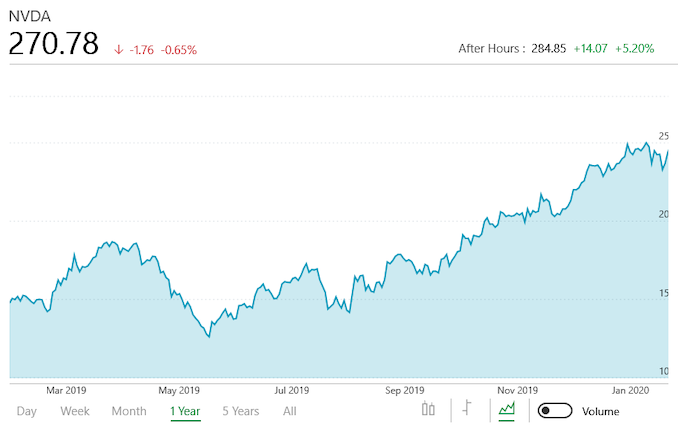
| 9:45p | NVIDIA Releases Q4 FY2020 Earnings: A Strong Quarter Closes Our A Weaker Year
Always punctual but moving at their own pace, NVIDIA this afternoon wrapped up their 2020 fiscal year with the release of their earnings for both Q4 and the year. For the last quarter of their fiscal year, NVIDIA booked just over $3.1B in revenue with a profit of $950M, marking a strong end to a weaker fiscal year. On which note, for the year NVIDIA will close the books on $10.9B in revenue, for a net income a hair under $2.8B.
Beating analyst expectations, NVIDIA closed their year on a relative high note. The $3.1B in revenue they booked was their best quarter in more than a year, blasting past a particular weak Q4’FY19 for a 44% jump in revenue, and even edging out the traditionally strong Q3. Similarly, the quarter was one of the most profitable for the company in quite some time, beating Q4’FY19’s net income by 68%, and leaving the company just a few percent short of claiming a full billion dollars in net income for the quarter. This profitability is reflected in NVIDIA’s gross margin as well. At 64.9% for the quarter it’s the highest margins NVIDIA has attained in over a year, beating both Q3 and last year’s Q4. And while there’s no strict limitation for gross margins, it’s worth noting that these kinds of margins are close to some of Intel’s best in previous years, which is often used as a barometer for the overall strength of a major chip company.
Breaking down their revenue by segment, the big surprise here in NVIDIA’s earnings is data center revenue. At $968M for the quarter, it’s the best showing from NVIDIA’s data center operations since the inception of the current reporting structure, shooting well past the previous record. According to NVIDIA, the company is seeing a surge in demand for AI hardware, which has been a lucrative and rather profitable venture for NVIDIA over the last several years. This growth comes after data center spending (and AI-related spending in general) plateaued a bit over the past year, as it seems hyperscalers and other data center operators have ramped up their overall buying for 2020. Otherwise gaming remained NVIDIA’s single biggest segment. Like the quarter overall, gaming revenue is up significantly year-over-year, with NVIDIA booking over $500M more than in Q4’FY19. But it’s a bit of a mixed bag overall, as revenue did drop versus the previous quarter, and NVIDIA is well off their Q4’FY18 performance. Ultimately, data center revenue proved to be NVIDIA’s trump card here, helping to cover for any weakness in gaming revenue.
As for the complete, fiscal year 2020 picture, NVIDIA’s Q4 has helped to prop up what has been a profitable but overall weaker year for the company. The $10.9B in revenue that NVIDIA booked for the year is down 7% from the previous year. And net income fell even more sharply, dropping by 32% to $2.976B on the year. The year-over-year drop has been influenced by several factors, but arguably the biggest is the crypto hangover, which really only ended a bit earlier this year. So the first half or so of the year for NVIDIA is marked by distributors still trying to get rid of excess inventory, as well as the fact that compared to the unbounded spending on crypto gear in NVIDIA’s FY 2019, anything more normal pales in comparison. Coupled with that has been the previously mentioned softness in the data center market, which while not nearly as dramatic as the crypto hangover, saw much of FY2020 data center spending underperforming FY2019 at similar points.
There had been some concern that the datacenter market had reached saturation – at least for the current generation of products – but following Q4 at least, it looks like that’s not the case. Overall NVIDIA closes out the year up 2% on data center revenue, with the strong Q4 pulling data center revenues up. Gaming doesn’t fare quite so well, as more exposed to the hangover, NVIDIA still end the fiscal year down 12% in gaming revenue versus FY2019. The big winner here on a pure percentage basis is actually automotive, which was up 9% year-over-year, followed by NVIDIA’s trusty professional visualization group, which was up 7%. The upshot here, at least, is that NVIDIA has long desired to further diversify its business so that it isn’t quite so reliant on gaming revenue, and that’s certainly where FY2020 has taken them. Finally, looking ahead to FY2020 and Q1, NVIDIA is seemingly projecting with a bit of caution. The company expects to book $3B in revenue, with a gross margin of 65.0%. The wildcard factor here is the ongoing COVID-19 (coronavirus) outbreak, which along with getting trade shows like Mobile World Congress canceled, could also hurt overall tech spending in China. Officially, NVIDIA has knocked $100M off of their Q1 projections, though this is ultimately a rough estimate as no one is quite sure what to expect. According to the company, China accounts for around 30% of their gaming sales – which is still NVIDIA’s largest segment – so if the COVID-19 outbreak hurts Chinese spending, NVIDIA is likely to feel it in their gaming revenues. | ||||||||||||||||||||||||||||||||||||||||||||||||||||||||||||||||||||||||||||||||||||||||||||||||||||||||||||||||||||||||||||||||||||||||||||





| << Previous Day |
2020/02/13 [Calendar] |
Next Day >> |