[Most Recent Entries] [Calendar View]
Tuesday, August 4th, 2020
| Time | Event | ||||||||||||||||||||||||||||||||||||||||||||||||||||||||||||||||||||||||
| 7:00a | Netgear Launches WAX610 AX1800 Wi-Fi 6 Access Point for SMBs
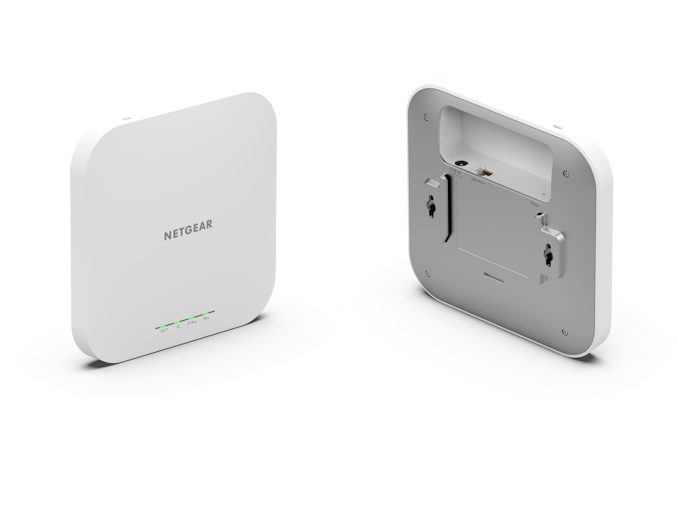
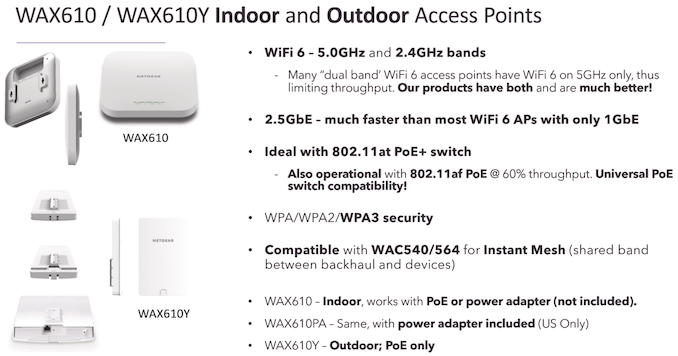
Wi-Fi 6 deployment in the consumer market has achieved critical mass, with almost all modern smartphones and notebooks equipped with support for 802.11ax technology. As expected, we are starting to see the small-business and enterprise access points (APs) moving to support this technology. While vendors such as Aruba Networks, Ruckus Wireless, and others already have Wi-Fi 6 SMB / SME-focused Wi-Fi 6 APs in the market, Netgear is launching their first set of Wi-Fi 6 products targeting this segment today - the AX1800 WAX610, and its outdoor counterpart, the WAX610Y. Unlike previous Wi-Fi technology upgrades, the move to Wi-Fi 6 brings in the need for some underlying infrastructure changes - support for NBASE-T and PoE+ (802.3at). Some high-performance Wi-Fi 6 APs even require PoE++ (802.3bt) support. Netgear's WAX610 and WAX610Y can be powered using 802.3at and use a 2.5Gbps RJ-45 port for wired backhaul / power delivery. The focus in SMB products is more on stability compared to peak performance. Consumers in this space also want the ability to support a large number of concurrent client devices - high-density deployments - much more than what is usually handled by consumer Wi-Fi routers. Some SMBs also have to make do with non-dedicated IT staff, and external management capabilities as well as ease of setup / installation also plays a role in some scenarios. Netgear claims that the WAX610/WAX610Y's feature set aims at tackling these aspects. The AX1800 (2x2 802.11ax with 1200 Mbps in the 5 GHz band and 600 Mbps in the 2.4 GHz band) APs utilize a Qualcomm chipset. Based on the performance specifications, we do not have 160 MHz support, and Negear also mentioned the absence of uplink OFDMA support. The former is not really important for SMB APs - at least, not without Wi-Fi 6E which brings extended spectrum and the possibility of availing multiple contiguous 160MHz chunks without interference / DFS. In terms of security, Netgear is offering WPA3 support (as mandated by the IEEE Wi-Fi 6 specifications), as well as support for up to 8 SSIDs with a separate VLAN for each SSID. A number of SMB Wi-Fi 6 APs currently in the market use a 1Gbps wired port, but, Netgear has equipped their two new models with a 2.5Gbps LAN port. While most deployments would use the wired port for backhaul, Netgear has also provided mesh support, enabling the WAX models to mesh over Wi-Fi with other Netgear APs such as the WAC610 / WAC610Y / WAC540 / WAC564. The maximum power consumption for the WAX610 over PoE is rated at 15.3W, while the WAX610Y consumers 16.1W - enabling 802.3at-capable switches to power them easily. The APs will also function with 802.3af (traditional PoE), but ends up getting limited to 60% of its peak performance capabilities. The APs are part of Netgear's Insight-capable portfolio - allowing optional cloud-based management access. This is a boon for part-time IT folks as well as resellers wanting to provide value-added services.
I have quite not been sold on the Insight-type cloud-based management scheme for SMB equipment (irrespective of the vendor offering it). However, the value offered to folks who are not dedicated solely to IT maintenance in an organization is undeniable. Now, the increasing prominence of work-from-home culture will bring additional pain-points to solve, and Insight-type cloud-based management can definitely play a role. For example, enabling seamless VPN and/or the ability to securely extend a WLAN from an office location to an employee's home (for scenarios where mobile devices needs to be in the company network for certain applications) are some challenges that IT administrators might want to solve in a user-friendly way moving forward. Cloud-based management solutions can definitely be of help in those scenarios. The WAX610 and WAX610Y are Insight-capable (not Insight-only), and expose more functionality for local management compared to what is available over the app / using the cloud. Pricing ranges from $180 (base indoor model without a power adapter) to $250 (outdoor model). Compared to SMB offerings from vendors such as Engenius and ZyXEL (Engenius EWS357AP @ $184 and the ZyXEL NWA110AX @ $200, both AX1800 PoE+ APs without 2.5Gbps LAN), these are very competitive price points in terms of the features offered. | ||||||||||||||||||||||||||||||||||||||||||||||||||||||||||||||||||||||||
| 8:00a | Microchip Announces Flashtec NVMe 3108 Enterprise SSD Controller
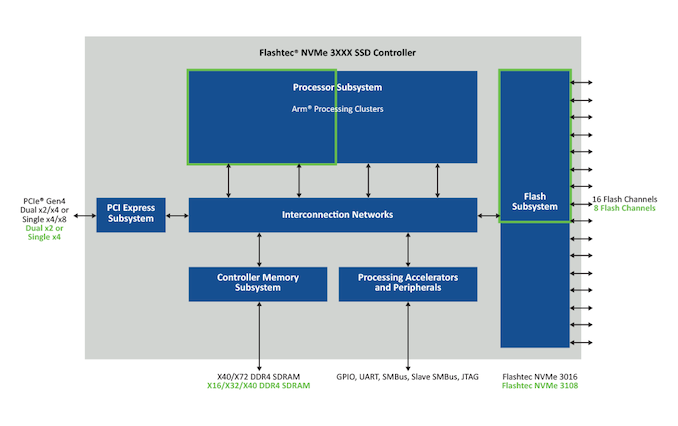
Microchip is announcing their first PCIe 4.0-capable SSD controller for low-power and entry-level enterprise SSDs. The new Flashtec NVMe 3108 is the smaller 8-channel derivative of the 16-channel Flashtec 3016, first announced two years ago. The 3016 has since moved from sampling to mass production, and as a derivative based on the same architecture, the new 3108 is expected to make that same transition much more quickly: sampling now, and production sometime in the first half of next year. The Flashtec NVMe 3108 isn't quite literally a 3016 sliced in half, but that was more or less the starting point for developing the 3108. In discussing how the 3016 and 3108 differ, Microchip opened up a bit more about their controller architecture in general, and how their PCIe 4.0 generation 3xxx controllers are different from the earlier PCI 3.0 based Flashtec NVMe 2xxx controllers. First and least surprising, both the 3016 and 3108 are built on a 16nm FinFET process, which is what almost all PCIe 4.0 SSD controllers are adopting.
The external IO interfaces of the Flashtec NVMe 3108 are mostly cut in half relative to the NVMe 3016: 4 rather than 8 lanes of PCIe, 8 rather than 16 channels for interfacing with the NAND flash. The DDR4 DRAM interface on the 3108 can operate as a 16-bit, 32-bit or 40-bit (32+8 bit ECC) bus, while the 3016 uses either a 40-bit (32+8) or 72-bit (64+8) bus width. All together, these changes lead to a drastically lowered pin count, allowing the 3108 controller to use a package small enough to fit on a M.2 SSD. There's also some significant die space and power savings. The 3108 runs its DDR4 interface a bit slower than its larger sibling (2400 MHz instead of 3200 MHz), but supports the same NAND interface speeds up to 1200 MT/s — a huge improvement over the 533 MT/s supported by the previous generation Flashtec controllers. This allows the 3108 to hit sequential read speeds of over 6 GB/s and random read speeds of 1M IOPS when paired with sufficiently fast flash memory. This isn't quite saturating what a PCIe 4 x4 link is capable of, but is competitive with other PCIe gen4 enterprise SSD solutions that have been announced such as the Samsung PM9A3 (6.5GB/s, 900k IOPS) or the 16-channel Kioxia CD6 (6.2GB/s, 1M IOPS). The Flashtec NVMe 3108 includes fewer processor cores than the 3016, but still more than necessary for implementing basic SSD functionality. Microchip has designed the 3108 and the 3016 with spare processing power to accommodate computational storage use cases. This generation switched from Tensilica CPU cores to Arm cores, making for a more familiar development environment for customers developing firmware for these SSD controllers. Microchip says some customers are even running Linux on a subset of the controller's Arm cores. Two major features of the Flashtec NVMe 3016 are outright missing on the 3108. The smaller controller doesn't include the compression accelerator hardware from the 3016, so it is not as well suited for computational storage duty along those lines. The 3108 also lacks the expansion port of the 3016. The larger chip's expansion port is intended to allow two SSD controllers to pair up and be used as a 32-channel controller, since Microchip is no longer producing a monolithic 32-channel version of their controllers. This expansion port is unneeded on the 3108 since they already have a 16-channel solution that is simpler and likely faster and more efficient than a dual-chip 8+8 channel setup would be. (Competitors in the enterprise SSD controller space have also used dual-controller designs, such as Marvell's dual-chip 16-channel solution. Silicon Motion has taken an in-between strategy, designing a single-chip 16-channel controller that is internally organized much like a combination of two 8-channel controllers.) Aside from those features, the 3108 checks all the same boxes as the 3016: support for cryptographically verified firmware, dual-port PCIe, virtualization. Customers building SSDs with the 3108 should be able to implement the full range of NVMe 1.4 features and probably anything coming in NVMe 2.0, though not everyone will be including all of those optional features in their firmware. Microchip's customers for Flashtec SSD controllers include numerous SSD vendors as well as some hyperscale cloud service providers who design their own SSDs. Each of these has their own firmware development and QA processes and few are particularly open about their long-term roadmaps, so it's hard to say when we'll start seeing final products using the new Flashtec NVMe 3108 controller. Most of our hands-on experience with Flashtec SSD controllers has come from Memblaze's PBlaze5 family, which was jointly developed with Micron and related to their 9xxx series SSDs. Memblaze just announced new models using the 2108 controller, so their 3108-based drives are probably over a year away. | ||||||||||||||||||||||||||||||||||||||||||||||||||||||||||||||||||||||||
| 10:05a | AMD Zen now at 6W TDP: Dual Core for Education
At the low-end of AMD’s portfolio, the company uses Athlon Gold and Silver naming for parts that offer fewer cores and lower power consumption. These parts are still based on Zen or Zen+ microarchitecture, paired with a small amount of Vega graphics, indicating that this market is best served with something that is at a low-cost to manufacture but still of sufficient performance for the markets intended. Sitting below those Athlons, two new APUs have popped up in some new Lenovo education-focused designs today. The two new processors dispense with the Athlon naming, as AMD gets right into it – the AMD 3015e and 3020e use the same lower case ‘e’ ending we last saw on a product line in 2011, indicating the super low power that these processors are rated for. These processors are given a TDP of 6W with two cores and Vega 3 graphics, traditionally what we see in low cost laptops but sufficient for education-style designs. The silicon these new processors are based on, we believe, is AMD’s Dali silicon. It is the smallest of all AMD’s Zen APU silicon offerings, already in the market as AMD Athlon Mobile. These new parts come in below those specifications.
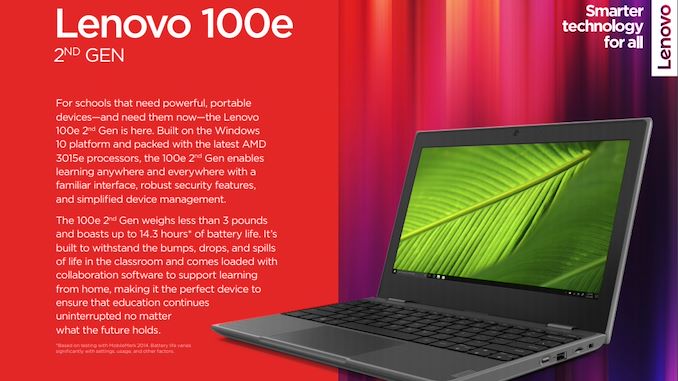
If the set-up looks a bit odd, well, it is. The 3015e has simultaneous multi-threading but a much lower GPU frequency and DDR4 support compared to the 3020e. This might be the trade-off at the 6W power mode. Lenovo is set to use the new AMD 3015e in two of its new education designs. The Lenovo 100e 2nd Gen will use this new chip, Windows 10, Wi-Fi 6, 64 GB eMMC, 4 GB DDR4, an 11.6-inch 13x7 display (250 nits), but offer a hard wearing design suitable for bumps and scrapes as well as ~12 hours of battery life, with quick charging providing 80% power in an hour.
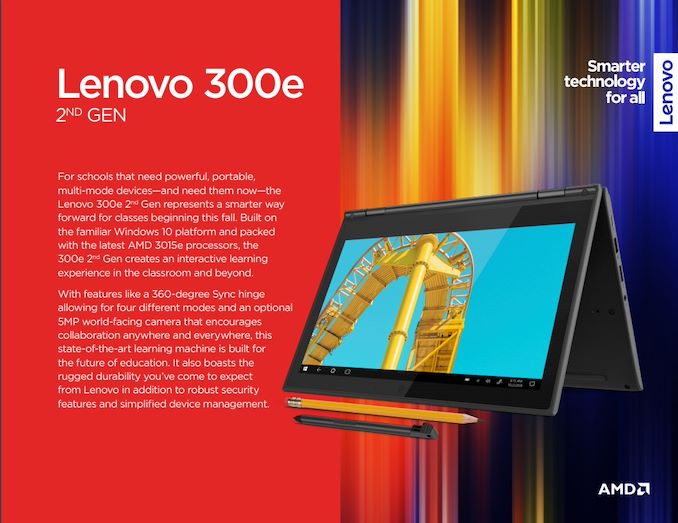
The Lenovo 300e 2nd Gen is a similar build but offers a 360-degree hinge, pen support, with an optional 128 GB SSD. Battery is 42 Wh, rated at ~12 hours. The 100e will start at $219 and the 300e will start at $299, available from September. Both devices have a variety of student-focused software options focusing on teaching and security. Related Reading | ||||||||||||||||||||||||||||||||||||||||||||||||||||||||||||||||||||||||
| 10:30a | The Z490 Mini-ITX Showdown: GIGABYTE's Z490I Aorus Ultra and MSI's MEG Z490I Unify Reviewed The mini-ITX form factor is as popular as ever, with a handful of options already available for Intel's new LGA1200 socket. Over the years motherboard vendors have been perfecting their small form factor models designed to offer all of the performance of the larger-sized models, but with a smaller desktop footprint. Of these, two of the most desirable models based on features and pricing from all the mini-ITX models on the Z490 chipset are the GIGABYTE Z490I Aorus Ultra and MSI MEG Z490I Unify. Offering dual PCIe 3.0 x4 M.2 slots, 2.5 GbE Ethernet ports, and integrated Wi-Fi 6 radios, both GIGABYTE and MSI's motherboards are designed to address the high end of the market. And with both boards going for the same price as well, it's easy to see why these Z490 boards have become such worthy adversaries. | ||||||||||||||||||||||||||||||||||||||||||||||||||||||||||||||||||||||||
| << Previous Day |
2020/08/04 [Calendar] |
Next Day >> |