[Most Recent Entries] [Calendar View]
Thursday, August 6th, 2020
- GIGABYTE’s 4U 10x NVIDIA A100 New G492 Servers Announced
- GIGABYTE Launches R161-Series Overclocking Servers: 1U, Core X, Liquid Cooling
- GIGABYTE Launches Two 4U NVIDIA Tesla GPU Servers: High Density for Deep Learning
- GIGABYTE's G190-G30: a 1U Server with Four Volta and NVLink
- GIGABYTE Server Shows Two-Phase Immersion Liquid Cooling on a 2U GPU G250-S88 using 3M Novec
- Intel ME Bringup guides + (flash) tooling + samples for various platforms
- Kabylake (Purley Platform) BIOS Reference Code and Sample Code + Initialization code (some of it as exported git repos with full history)
- Intel CEFDK (Consumer Electronics Firmware Development Kit (Bootloader stuff)) SOURCES
- Silicon / FSP source code packages for various platforms
- Various Intel Development and Debugging Tools
- Simics Simulation for Rocket Lake S and potentially other platforms
- Various roadmaps and other documents
- Binaries for Camera drivers Intel made for SpaceX
- Schematics, Docs, Tools + Firmware for the unreleased Tiger Lake platform
- (very horrible) Kabylake FDK training videos
- Intel Trace Hub + decoder files for various Intel ME versions
- Elkhart Lake Silicon Reference and Platform Sample Code
- Some Verilog stuff for various Xeon Platforms, unsure what it is exactly.
- Debug BIOS/TXE builds for various Platforms
- Bootguard SDK (encrypted zip)
- Intel Snowridge / Snowfish Process Simulator ADK
- Various schematics
- Intel Marketing Material Templates (InDesign)
| Time | Event |
| 7:00a | MediaTek Announces T700 5G Modem Powering Intel PCs Successfully Certified
Last year, Intel and MediaTek had announced a partnership with the goal of developing a 5G modem that would be used in future next-generation PC platforms. The move followed Intel's sale of their own cellular modem divison to Apple for $1B. Today, MediaTek and Intel are announcing the name of the modem, the MediaTek T700 modem, and that the product has passed important milestones in development, having finished the hardware design phase and having been sucessfully certified and tested in real-world 5G SA (Standalone) network calls. It's also been announced that Intel is advancing with platform system integration on their part, and readying co-engineering resources and support for OEM partners in order to develop end-products with the Intel and MediaTek platforms.
The MediaTek's T700 modem supports sub-6GHz NSA and SA networks, with future generations planned with mmWave connectivity. The two companies re-iterate their goal of shipping the first laptops with the 5G modem solutions in early 2021. Related Reading: |
| 10:00a | GIGABYTE Updates 4-GPU 2U G242 Server with Rome and PCIe4 for Ampere
As we wait for the big server juggernaut to support PCIe 4.0, a number of OEMs are busy creating AMD EPYC versions to fill that demand for high-speed connectivity. To date there have been two main drivers for PCIe 4.0: high-bandwidth flash storage servers, and high performance CPU-to-GPU acceleration, as seen with the DGX A100. As the new Ampere GPUs roll out in PCIe form, OEMs are set to update their portfolio with new PCIe 4.0-enabled GPU compute servers, including GIGABYTE, with the new G242-Z11.
One of the key elements to a GPU server is enabling airflow through the chassis to provide sufficient cooling for as many 300W accelerators as can fit, not to mention the CPU side of the equation and any additional networking that is required. GIGABYTE has had some good success with its multi-GPU server offerings, and so naturally updating its PCIe 3.0 platform to Rome with PCIe 4.0 was the next step.
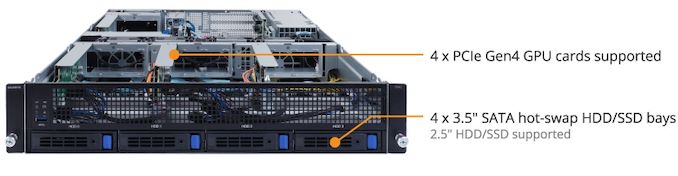
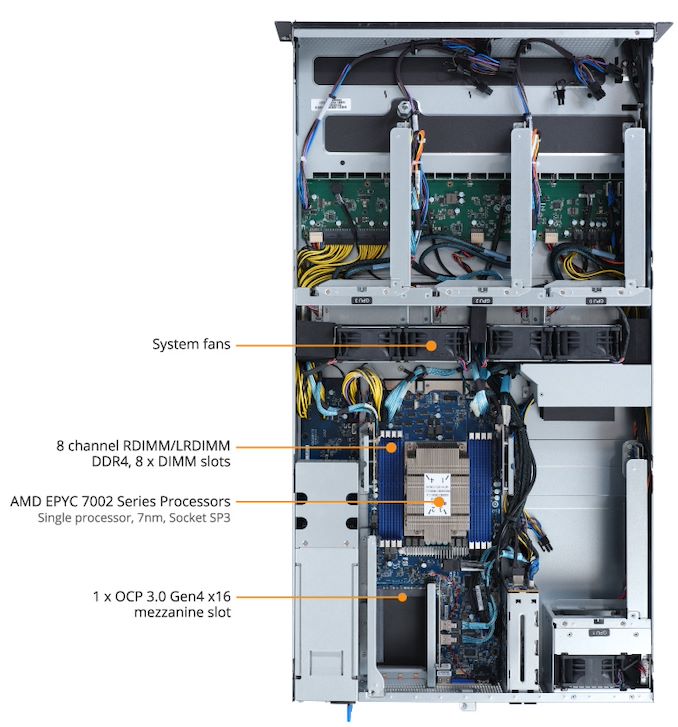
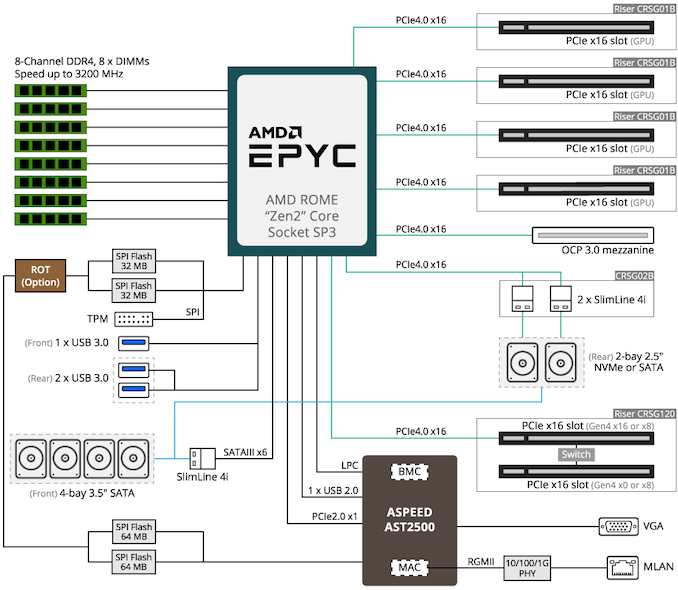
The G242-Z11 is a 2U rackmount server that supports four PCIe 4.0 cards with a full x16 link to each. That includes the new A100 Ampere GPUs, as well as AMD MI50 GPUs and networking cards. The system supports any AMD Rome EPYC processor, even the 280W 7H12 built for high-performance tasks, and also has support for up to 2 TB of DDR4-3200 across eight channels with the MZ12-HD3 motherboard.
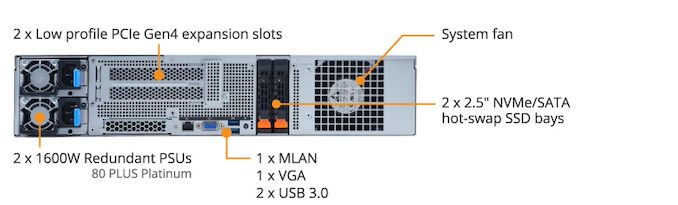
With these sorts of builds, it is often the periphery that helps assist integration into current infrastructure, and on top of the four PCIe 4.0 accelerators, the G242-Z11 supports two low profile half-length cards and one OCP 3.0 mezzanine card for other features, such as networking. The G242-Z11 also has support for four 3.5-inch SATA pays at the front, and two NVMe/SATA SSD bays in the rear. Power comes from dual 1600W 80 PLUS Platinum power supplies. Remote management is controlled through the AMI MegaRAC SP-X solution, which includes GIGABYTE proprietary server remote management software platform. The new G242-Z11 will be available from September. Interested parties should contact their local GIGABYTE rep for pricing information. Source: GIGABYTE Related Reading
|
| 12:00p | The Next Step in SSD Evolution: NVMe Zoned Namespaces Explained In June we saw an update to the NVMe standard. The update defines a software interface to assist in actually reading and writing to the drives in a way to which SSDs and NAND flash actually works. |
| 8:45p | Intel Suffers Apparent Data Breach, 20GB of IP and Documents Leaked on to Internet
Intel today became the apparent victim of a massive internal data breach, as roughly 20 GB of various Intel documents and tools have begun showing up in a data cache uploaded to the wider internet. With materials seemingly spanning over a decade, the breach reportedly includes everything from Intel presentation templates to BIOS code and debugging tools, and would represent one of the biggest intellectual property leaks from a chipmaker in years. Released by Till Kottmann, a Swiss software engineer and open security advocate, Kottmann has stated that this is the first of several planned Intel IP releases, calling this first release the “Intel exconfidential Lake Platform Release”. According to tweets posted by Kottmann, he received the material from an anonymous source who breached Intel earlier this year. Meanwhile, ZDNet reports that Kottmann is a regular figure in IP leaks, and has published a number of other tech company leaks before. Responding to this leak, Intel this afternoon has issued a brief statement to the press acknowledging the leak, and stating that they believe it came form the Intel Resource and Design Center, a secure Intel repository for third party partners to access various confidential documents and schematics.
While AnandTech has not validated the contents of the data cache, I’ve heard from one source who has seen it that there are signed NDA documents in there mentioning an Intel partner. So while Intel may be right about the source of the data, the actual breach may have occurred with a partner rather than the actual Intel repository, or in concert with a breach of Intel’s repository. Overall, Kottmann claims that the leak has a wide collection of various Intel confidential and NDA’d documents and tools, including: Thus far, while no one has reported finding anything quite as sensitive as Intel CPU or GPU design schematics – which is consistent with the claim that it originated from Intel's Resource and Design Center. None the less, the material in the leak looks to be quite valuable, and potentially damaging in the long run. Firmware blobs are particularly interesting, as while these would need to be reverse engineered to extract useful information out of them, they could potentially contain significant information that hasn’t otherwise been shared before. Otherwise, in a bit of situational irony, this leak is likely to cast doubt upon all future Intel leaks. The inclusion of the company’s presentation templates, while not particularly damaging to Intel, would mean that it’s now trivial to generate fake but accurate-looking Intel roadmaps and presentations. These kinds of materials are already regularly faked, but now it’s easier than ever to do so. Ultimately with no reason to doubt Kottmann’s claims, it would seem that this just the start of a run of leaks for Intel. And while the company will no doubt be doing everything possible to stop the process, whether they have any legal power to do so remains to be seen. |



| << Previous Day |
2020/08/06 [Calendar] |
Next Day >> |