[Most Recent Entries] [Calendar View]
Wednesday, September 2nd, 2020
- Nimbus Data’s New ExaDrive NL: 64 TB of Enterprise Grade QLC in 3.5-inch
- Crucial Launches X6 Portable SSD, Updates X8 with 2TB Model: QLC Drives for the Budget-Conscious
- The Samsung 870 QVO (1TB & 4TB) SSD Review: QLC Refreshed
- Enmotus MiDrive: Rethinking SLC Caching For QLC SSDs
- Western Digital Begins Shipments of 96-Layer 3D QLC-Based SSDs, Retail Products
- Intel’s 11th Gen Core Tiger Lake SoC Detailed: SuperFin, Willow Cove and Xe-LP
- Intel Schedules Tiger Lake Architecture Presentation For August 13th, Launch on September 2nd
- Hot Chips 2020 Live Blog: Intel's Tiger Lake Mobile CPU (12:30pm PT)
- Intel Thunderbolt 4 Update: Controllers and Tiger Lake in 2020
- I Ran Off with Intel’s Tiger Lake Wafer. Who Wants a Die Shot?
| Time | Event |
| 7:00a | TeamGroup Previews New 15.36 TB Consumer SATA SSD, for $3990
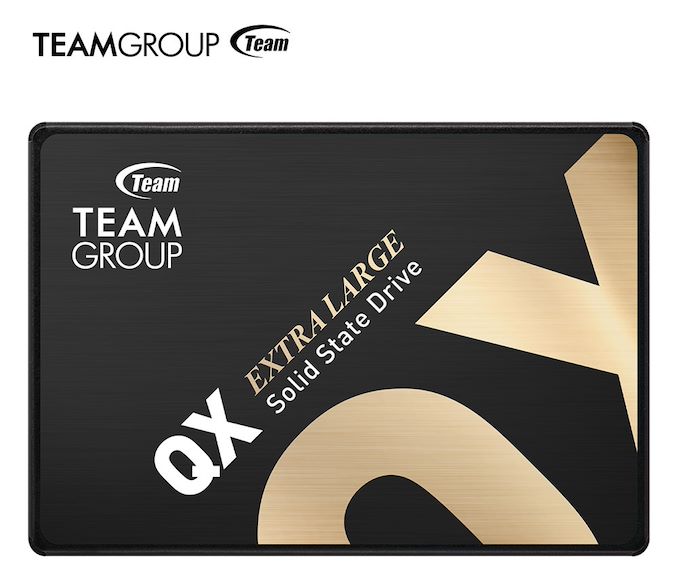
The two main angles that most SSD storage seems to be moving towards is performance or capacity. On the capacity front, we are starting to see the first 8 TB consumer drives coming to the market in a variety of formats. Always willing to jump ahead of the competition, TeamGroup has announced its new QX ‘Extra Large’ SSD coming in at 15.36 TB. This new SSD is equipped with 3D QLC flash NAND, allowing it to hit the high capacity. The 2.5-inch drive has an SLC cache mode ahead of the DRAM buffer, which allows the drive to reach 560 MB/s reads and 480 MB/s writes according to the press release. The drive is rated under warranty for 2560 Terabytes Written, which comes down to 0.15 drive writes per day if the warranty is three years – TeamGroup has not specified any exact warranty at this time. At any rate, even with full sequential write speed, it would take around 60-70 days of continuous writes to go through that warranty.
Nothing else from TeamGroup’s press release seems out of the ordinary for a standard SATA SSD. We’ve reached out to ask exactly what SSD controller or NAND is under the hood, as these weren’t provided. There’s also no mention of IOPS. TeamGroup claims this drive is aimed at the consumer market, which it is only by virtue of it lacking a number of premium enterprise features. The price however is decidedly non-consumer: an eye-watering $3990 per drive, and the drives seem to be only made-to-order by OEM or SI clients. That’s $260 per TB of SATA SSD. It’s worth noting that we discussed the NimbusData NL drive last week, which is also a high-capacity SATA SSD but geared up to the enterprise market. The 16 TB version of that drive is only $2900, a lot cheaper than this. The flip side of that is the 3.5-inch form factor of the NimbusData NL, compared to 2.5-inch (likely 15mm) for TeamGroup. In the end, I’m of the opinion that TeamGroup is unlikely to sell many of these, except to niche customer bases, or laptop deployments perhaps – both of which are unlikely to be too keen on the ‘consumer’ designation. Related Reading |
| 11:00a | 3DFabric: The Home for TSMC’s 2.5D and 3D Stacking Roadmap Interposers. EMIB. Foveros. Die-to-die stacking. ODI. AIB.TSVs. All these words and acronyms have one overriding feature – they are all involved in how two bits of silicon physically connect to each other. At the simple level, two chips can be connected through the printed circuit board – this is cheap but doesn’t allow for great bandwidth. Above this simple implementation, there are a variety of ways to connect multiple chiplets together, and TSMC has a number of these technologies. In order to unify all the different names it gives to its variants of its 2.5D and 3D packaging, TSMC has introduced its new overriding brand: 3DFabric. |
| 11:56a | Intel Launches Tiger Lake: A Live Blog (Noon ET, 9am PT) Intel is about to launch Tiger Lake. Follow along with our Live Blog! |
| 12:45p | Intel Launches 11th Gen Core Tiger Lake: Up to 4.8 GHz at 50 W, 2x GPU with Xe, New Branding In August, Intel ran one of its rare Architecture Days where the company went into some detail about its upcoming Tiger Lake processor. This included target markets, core counts, graphics counts, a look into some of the new acceleration features, and a promise of a product launch later in the year. That product launch is now here, and Intel is providing Tiger Lake with speeds and feeds, providing detail and expected benchmark performance for Intel’s next generation of notebook-class devices. |
| 1:00p | Schenker VIA 14: 14-inch Tiger Lake Magnesium Notebook, with 28W Version Inbound
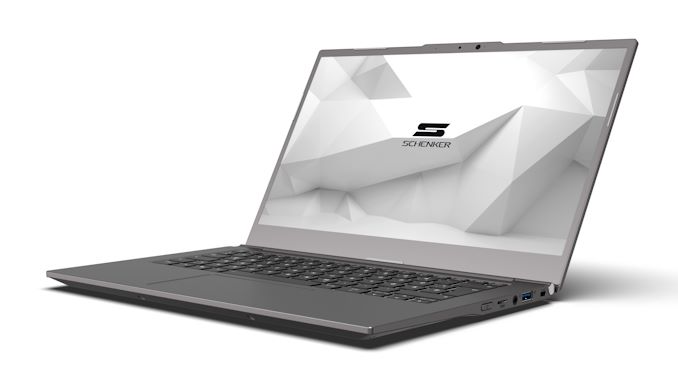
With Intel lifting the lid on its new Tiger Lake mobile processors today, a number of vendors are announcing their upcoming notebooks. Schenker Technologies, a German brand known in Europe for its Xtreme Mobile Gaming (XMG) line of products and custom Clevo implementations, is one of the first to describe an upcoming 11th Gen Intel Tiger Lake portable notebook as part of its VIA line. With a lightweight magnesium chassis, the VIA 14 uses up to a Core i7, a 73 Wh battery, and a one watt display to give 14+ hours of battery life. The key thing to note about Tiger Lake is the increase in both CPU and GPU performance compared to the previous generation Intel notebook processors. We still have four cores, but the Tiger Lake cores can now boost a lot higher due to Intel’s improved 10nm SuperFin process (which you can read about here). Tiger Lake is Intel’s first product with its new Xe-LP graphics design as well, promising 2x the graphics performance of the last generation. The goal with these processors is to enable a nice and comfortable experience in a range of designs from ultra-premium to the run-of-the-mill.
The Schenker VIA 14 sits in that ultra-premium market. Using a lightweight magnesium chassis, the kind that we only ever see on the expensive end of the market, the VIA 14 is claiming only a 1.1 kg (2.4 lbs) weight despite also putting a 73 Wh battery inside. Personally I find this a bit mind blowing, if I’m honest. A 73 watt-hour battery in a 1.1 kg notebook is insane, and they are also claiming a 90% charge in 90 minutes. Not only that, but there’s also one of Intel’s approved low-power one-watt displays, enabling 14+ hours of active battery life according to the press release when at 150 nits. Tiger Lake also enables PCIe 4.0 storage, native Thunderbolt 4, and Schenker will also support an optional LTE modem for business customers. Despite being lightweight, the big battery means the notebook is 16.5 mm, but with a 14-inch display is still very portable. The ports with the VIA 14 include a HDMI 2.0b connection, a USB 4.0/Thunderbolt 4 Type-C with DisplayPort 1.4b support, two USB-A 3.2 ports, a microSD card reader and a combination headphone jack. Native connectivity is through Wi-Fi 6, and as mentioned, an LTE add-on is supported. For storage, the VIA 14 has support for two M.2 SSDs, one at PCIe 4.0 and the other at PCIe 3.0. Memory is DDR4-3200, with 8 GB coming pre-soldered and an 8 GB SO-DIMM module coming as standard, however up to 40 GB total memory can be supported. The 14-inch display has a maximum brightness of 300 nits and provides 98% coverage – Schenker says the special ‘one-watt’ display applies when running at 150 nits. The display also opens to a 180-degree hinge. Prices for the VIA 14 will start at €1,246.75 (that includes 16% VAT) at the end of October. The base model features the Core i7-1165G7, 8 GB DDR4, and a 250 GB Samsung 860 Evo SSD, and models with the Core i5-1135G7 will follow later. Schenker also included a preview of what is to come, simply stating that a version with a 28 W Tiger Lake processor paired with an NVIDIA graphics card will be ‘coming soon’. Related Reading |


| << Previous Day |
2020/09/02 [Calendar] |
Next Day >> |