[Most Recent Entries] [Calendar View]
Monday, January 4th, 2021
- TSMC and Graphcore Prepare for AI Acceleration on 3nm
- SambaNova Breaks Cover: $450M AI Startup with 8-Socket AI
- NUVIA Completes Series B Funding Round: $240M
- 342 Transistors for Every Person In the World: Cerebras 2nd Gen Wafer Scale Engine Teased
- NVIDIA Announces A100 80GB: Ampere Gets HBM2E Memory Upgrade
- Testing The World's Best APUs: Desktop AMD Ryzen 4750G,4650G, and 4350G
- AMD Zen 3 Ryzen Deep Dive Review: 5950X, 5900X, 5800X and 5600X Tested
- The GIGABYTE B550I Aorus Pro AX Motherboard Review: All The Small Things
- Best AMD Motherboards: December 2020
- ASRock First For B450 Ryzen 5000 Support: Beta BIOSes Now Available
| Time | Event |
| 8:00a | LG’s Latest Flex-OLED Display: Curved for Gaming, Flat for TV
Ever since LG displayed its first rollable OLED TV at CES 2019, and perhaps even before then, the vision of these flexible displays was that they could encompass any curved surface to provide a display with a vivid color profile in line with state-of-the-art OLED technology. At the time, this meant watches and other such wearables, but as LG has promoted these flexible displays a lot for TV, it made sense that at some point they would come up with a curved display for gaming. The trick is to make it work for both TV and gaming. One of the first announcements for this year’s remote CES show is that LG’s latest flexible display is a 48-inch model that can be used flat for regular TV viewing, or as a 1000R curved display for gaming. This means that in both viewing modes, the display aims to offer a uniform viewing distance with comparable depth and quality, even with a curvature radius of 1000mm. This is a tighter curvature than a lot of gaming displays currently on the market, such as 1200R to 2000R models, and those only serve the curved display gaming community. LG doesn’t state what the resolution is, however they do confirm that the display has a variable refresh rate range from 40 Hz to 120 Hz, along with a supposed 0.1 millisecond response time. Combined with this, the display implements LG’s CSO technology, which enables the display to vibrate to create sound, rather than have external speakers. This is down to a new thin film ‘exciter’ (the bit that actually vibrates), which LG states that they’ve managed to reduce down from a thickness of 9mm to 0.6mm. The display also has a low-blue-light mode to reduce eye strain. As often with these promotions for CES, we expect LG to be around 3-9 months from actually launching the product commercially. LG did not go into detail about how the display transitions from curved to flat, for example, and nor did they mention price. Leading edge features like this will likely come at a premium. Interested in more of the latest industry news? Check out our CES 2021 trade show landing page!
|
| 9:00a | Intel Core i9-10850K Review: The Real Intel Flagship When a company like Intel creates a CPU design, the process of manufacturing brings about variation on the quality of the product. Some cores will only reach a certain frequency, while others have surprisingly good voltage characteristics. Two goals of processor design are minimizing this variance, but also shifting the peak higher, all while controlling how much of the silicon is actually useable. This is part of the magic of ‘binning’, the process of filtering the silicon into different ‘bins’ for applicability to a given product. It is through this process that the Core i9-10850K exists, albeit reluctantly. |
| 9:30a | Qualcomm Announces Snapdragon 480 - First 5G Low-end SoC
Today Qualcomm is making a big step towards enabling wide-spread adoption of 5G through the announcements of the new Snapdragon 480 low-end 5G SoC. The company had already alluded a few months ago that it would be releasing a Snapdragon 400-series design with 5G compatibility, bringing the new connectivity standard to the lowest-cost devices of the market, targeting the very high volume $250 price range. |
| 12:00p | Graphcore Series E Funding: $710m Total, $440m Cash-in-Hand
For those that aren’t following the AI industry, one of the key metrics to observe for a number of these AI semiconductor startups is the amount of funding they are able to generate. While funding is no explicit guarantee of success, it does indicate perhaps how much faith the venture capitalists (as well as OEMs and other silicon vendors) have in the technology. One of the most well-funded ventures in this space is Graphcore, and the company just announced its latest Series E funding round of $222 million, taking it to $710m total across the five rounds.
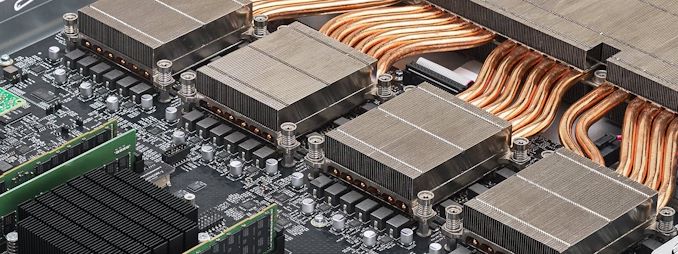
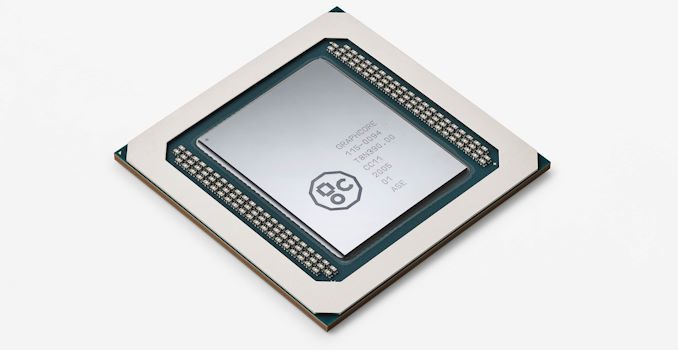
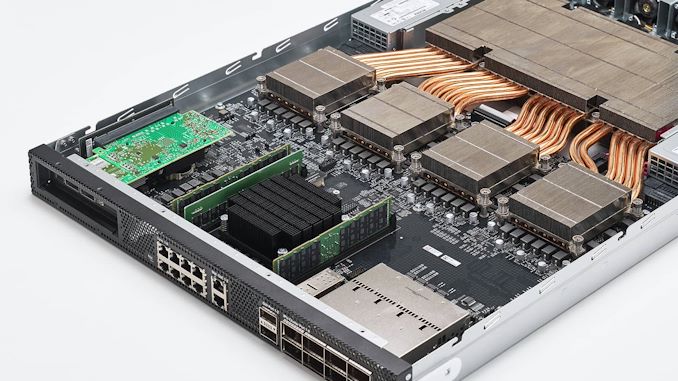
Graphcore, based in Bristol UK, is already on its second generation product, launching the Colossus MK2 GC200 in 2020. This chip contains 60 billion transistors, 900MB of built-in memory, is manufactured on TSMC’s N7 node at 823 mm2, and can achieve 250 TFLOPs of AI compute. Graphcore bundles four of them into a 1U chassis along with an Arm-based control chip and a crazy amount of networking to enable a network containing up to 64000 chips. Customers can order this IPU-M2000 unit, or 16 of them in a dedicated rack. Graphcore also provides the POPLAR software stack, with direct support for PyTorch, TensorFlow, ONNX, and PaddlePaddle machine learning frameworks. The latest $222m Series E funding round was led by Ontario Teachers’ Pensions Plan Board (what?), with additional funds managed by Fidelity International and Schroders as new investors. Previous investors also participated, including Baillie Gifford and Draper Esprit. With the latest round of funding bringing the total up to $710m, this would put Graphcore at #2 in terms of AI Chip pure-play startups. This is just behind the $850m invested into Chinese semiconductor startup Horizon Robotics, founded by a CEO Yu Kai a Baidu veteran, of which the latest $150m round finished in December. SambaNova is #3 with $456m, and Nuvia has $293m. The latest round of funding brings Graphcore’s valuation to $2.77 billion.
With Graphcore’s first generation product, the company aligned with Dell to provide server units featuring eight add-in PCIe cards, each with two of its first generation IPUs. The company is claiming that the newest second generation MK2 is rolling out to more customers even during COVID times, especially to academic research such as UMass, Oxford, and ICL. Official details on its corporate customers seem somewhat thin, beyond an official tie-in with Microsoft, however Graphcore has said that they are currently working with hyperscalers and financial service companies. This is perhaps why Graphcore also stating that it has $440m cash-in-hand is quite important. As every startup has an effective burn rate of capital, this should be sufficient for the company to also go out to enable more customers, as well as develop next generation products. Graphcore has already announced through TSMC that it is already scoping TSMC’s 3nm process for a future product line. Graphcore is also a member of the recently formed MLCommons, the governing body behind MLPerf, and expects to participate with its first submissions on MK2 in Q2 this year. Source: Graphcore Related Reading |
| 2:00p | The ASRock Rack B550D4-4L, a B550 Motherboard with BMC
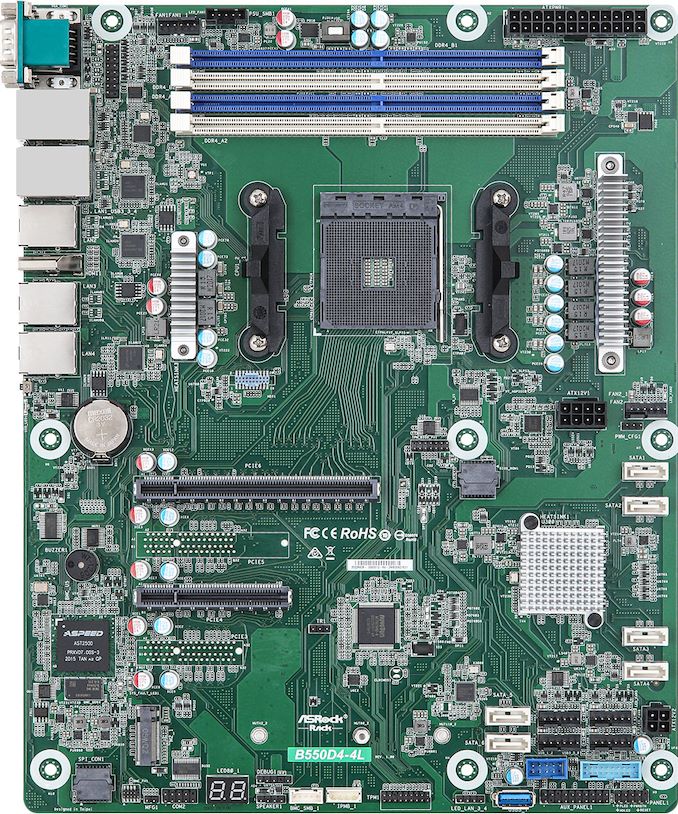
ASRock Rack, the professional arm of ASRock, has launched an interesting B550 model which is aimed at the server and workstation market, but uses the mid-range chipset. The ASRock Rack B550D4-4L benefits from support for AMD's latest Ryzen 5000 series of processors, with a BMC controller, support for up to 128 GB of non-ECC DDR4-3200 memory, and includes a single PCIe 3.0 M.2 slot from the chipset. The main feature on the ASRock Rack B550D-4L, which other B550 models do not have, is the inclusion of an ASPEED AST2500 BMC controller, which adds IPMI configuration access across a network. A Realtek RTL8211E provides connectivity for the IPMI management, and it also includes four more Intel i210 Gigabit Ethernet controllers with RJ45 ports on the rear. Also present on the rear panel is a pair of USB 3.2 G2 Type-A and two USB 3.2 G1 Type-A ports, with a single HDMI output for integrated graphics, a D-sub output for the BMC controller, and a DB9 serial port. Designed for use in a server and workstation environment, the ASRock Rack B550D4-4L uses a transposed AM4 PGA1331 socket with four memory slots located horizontally along the top. The memory slots allow for up to 128 GB of ECC and non-ECC UDIMM DDR4-3200 memory, while for storage, the board includes a single PCIe 3.0 x4 M.2 slot with support for SATA drives too. For conventional storage drives, ASRock Rack also includes four SATA ports powered by the B550 chipset, which supports RAID 0, 1, and 10 arrays, while an ASMedia ASM1061 chip controls another two ports.
The board uses a simplistic design, with a green PCB, which is typical of server-grade and workstation models. Towards the center of the B550D4-4L is a full-length PCIe 4.0 x16 slot, with a half-length PCIe slot that runs in Gen4 x4 mode with a Ryzen 5000 processor installed. This board technically supports Ryzen 5000 (Gen 4), Ryzen 4000G APUs (Gen 3), and Ryzen 3000 CPUs (Gen 3), along with all Pro counterparts, but ASRock doesn't go into detail about how the PCIe is split with the other processors. Located around the PCB is plenty of connectivity with a BMC_SMB header, a TPM header, a PMBus connector, as well as six 6-pin fan headers. It uses a conventional 24-pin 12 V ATX power input for power to the motherboard, with a single 8-pin 12 V EPS connector for the CPU. There is also a two-digit debug display for monitoring POST codes. Although the ASRock B550D-4L will fit conventional chassis with its ATX size, it's primarily designed for 1U chassis and professional use cases such as server and workstation systems. ASRock hasn't unveiled any information about when it can be expected to launch at retail. Related Reading |
 LG Display 48-inch Bendable Cinematic Sound OLED at CES 2021_575px.jpg)

_575px.jpg)
_thumb.jpg)
_thumb.jpg)
_thumb.jpg)
_thumb.jpg)
| << Previous Day |
2021/01/04 [Calendar] |
Next Day >> |