[Most Recent Entries] [Calendar View]
Tuesday, January 5th, 2021
- ASUS PN50 Mini-PC, with Ryzen Mobile 4000 APUs, Coming September
- ASUS Announces ROG Phone III - 144Hz S865+ Monster
- The ASUS ROG Strix B550-F Gaming Wi-Fi Motherboard Review: Premium Value
- ASUS ROG Maximus XII Hero Wi-Fi Review: The Tale of Two Motherboards
- ASUS Launches An Old GPU: The NVIDIA GT 710 with Four 4K HDMI Ports
- ASUS Launches ROG Strix XG27WQ Curved 165Hz Monitor: FreeSync Premium Pro Certified
- Talking Snapdragon: An Interview with Cristano Amon, President of Qualcomm
- Fireside Interview on 5G with Cristano Amon and Alex Katouzian, Qualcomm
- Qualcomm Tech Summit 2020: Interview with Alex Katouzian
- Qualcomm Details The Snapdragon 888: 3rd Gen 5G & Cortex-X1 on 5nm
- Qualcomm Discloses Snapdragon 888 Benchmarks: Promising Performance
- Qualcomm Announces Snapdragon 480 - First 5G Low-end SoC
| Time | Event |
| 5:45a | Cost Increases and Tariffs: ASUS to Increase MSRP on Graphics Cards and Motherboards
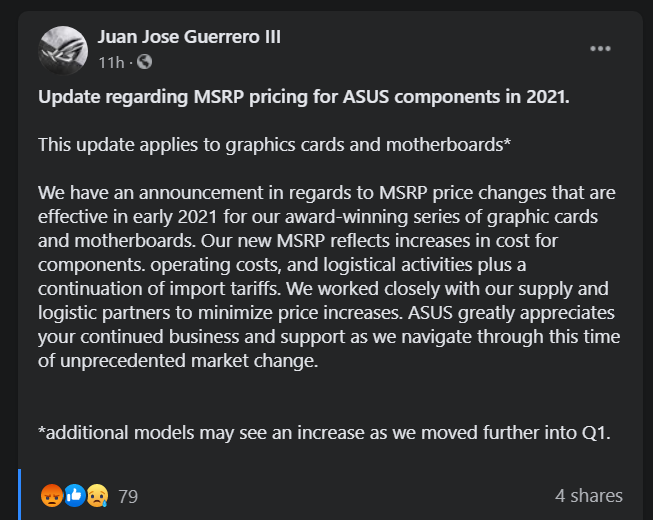
It is fairly easy to state that 2020 has had a deep effect on the supply chain mechanics of creating electronics and electronic components. Not only have there been logistical challenges in meeting regular levels of production, but the increase in demand due to work-from-home measures is putting additional strain up and down the ecosystem. On top of this, continued volatility with regards to trade and tariffs have been leaving more questions unanswered as to how companies involved in the results of all of this should engineer their operations. To that end, ASUS has put out a statement through its public Facebook group stating that it will be increasing MSRP on components, with graphics cards and motherboards being highlighted as the initial targets, with more to potentially follow. The reasons for this are described in the post, made by long-time ASUS employee Juan Jose Guerrero III, are due to ‘increases in cost for components, operating costs, and logistical activities plus a continuation of import tariffs’. Guerrero goes on to say that ASUS ‘worked closely with our supply logistic partners to minimise price increases’.
The exact scale of the price increases will be borne through the next few weeks, as the price adjustments work their way through the supply chain to distributors and finally retailers. ASUS is a large scale production house for both AIB graphics cards and motherboards, and can often deal with economies of scale, so the fact that the company has chosen to be open about its MSRP increases should indicate that other similar businesses might have changes coming soon, if not already applied, given that the issue of component costs, logistics, and import tariffs are industry wide and not just limited to one company. ASUS highlights that these are two initial product lines, and ‘additional models may see an increase as we move further into Q1’. Should an exact price differential list be made public, we will share it. Source: ASUS PC DIY Group (Facebook) Related Reading |
| 8:00a | Zotac ZBOX CI662 nano Fanless mini-PC Review: Second Stab at Silencing Succeeds Zotac is one of the major players in the SFF PC space, having marketed ultra-compact form-factor machines even before the NUCs took off. The growth in that segment has broadened the available market for their mini-PCs, allowing them to experiment with a wide variety of models for different use-cases. The passively-cooled SFF systems from Zotac are marketed under the 'C-series' tag. These 'nano' units used to adopt a NUC form-factor (100mm x 100mm) with similar chassis dimensions, which provided performance and thermal efficiency commensurate with their size. Starting with the Kaby Lake-Refresh series, the company started adopting a larger form factor and added some platform features. We had reviewed the Zotac ZBOX CI660 nano in that generation in early 2019. Today, we are taking a look at the Comet Lake-U-based follow-up - the Zotac ZBOX CI662 nano. |
| 10:00a | Intel Begins End-of-Life Plan For Coffee Lake 300-Series Chipsets
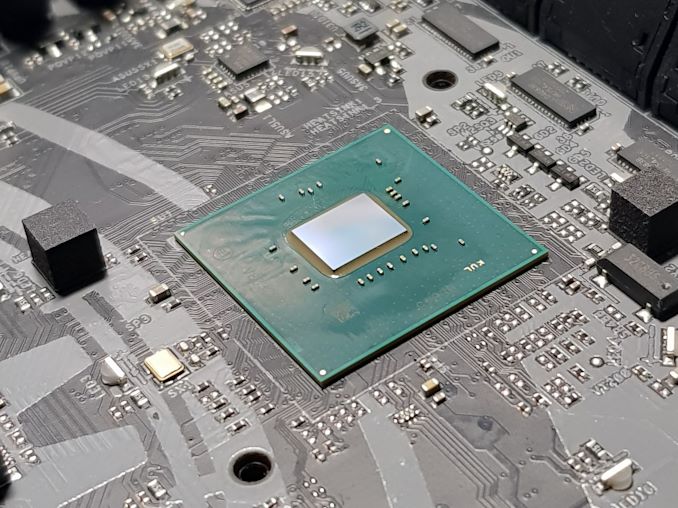
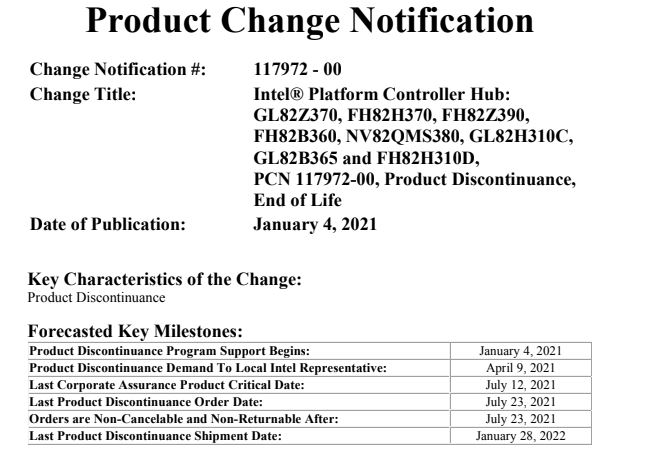
Intel has begun plans to discontinue its 300-series chipsets, including the higher-end Z390, Z370 chipsets, as well as its longer life B and H series chipsets. The 300-series chipsets are based on the second revision of Intel's LGA1151 socket designed for its Coffee Lake processors. In 2017, to complement the launch of its 8th generation Core i7, i5, i3, Pentium, and Celeron Coffee Lake processors, Intel unveiled its 300-series chipsets. This includes the Z390, Z370, B365, and H310 chipsets. The most notable processors for the 300-series are the Core i7-8700K and Core i9-9900K, with these chips serving as Intel's flagship desktop processors from the end of 2017 up through the spring of 2020. But Coffee Lake's time on the market is getting ready to sunset, and thus so are the chipsets that support it.
Outlining its discontinuance plan until the last shipping date expected on or before January 28th 2022, Intel advises its customers to make its final orders by July 23rd 2021. Perhaps one of the most critical elements of the end of life plan is the H310 chipset. This is a chipset designed for longevity with three variations, including H310 and H310D based on 14 nm and the H310C built on 22 nm. It could be that the H310 chipset wasn't as popular as expected, especially compared to the H81 chipset, which lasted over 7 years before it was discontinued. The Intel 300-series chipset has since been replaced by the 400-series desktop chipset, including Z490, W480, H470, B460, and Q470. These chipsets introduced support for Intel's Comet Lake (10th gen Core) processors, and their associated LGA 1200 socket. There have also been many rumors circulating that Intel's latest 500-series chipsets will be announced during CES, with Intel finally offering PCIe 4.0 with its new 14 nm Rocket Lake processors are expected towards the end of Q1. Related Reading |
| 10:15a | Qualcomm Appoints Cristiano Amon to CEO, Effective June 30th 2021
Throughout the industry wide push towards 5G, Qualcomm has been at the forefront of making the most noise about 5G technology. The company has developed patents and technologies that cover both infrastructure and end-points, and the face of that business in recent years has been Cristano Amon. In his position as President, Cristiano has championed the use of the latest generation of wireless connectivity technologies, and has been a key architect of how the company has driven the deployment of 5G involving Qualcomm solutions. Today it has been announced that Cristiano Amon has been voted by the Qualcomm Board of Directors to succeed current CEO Stephen Mollenkopf, 52, upon his retirement later this year. Mollenkopf has been with Qualcomm for 26 years, taking the job as CEO in 2014. Qualcomm’s business falls into three distinct categories: wireless products, patent licensing, and strategic investment. As president, Cristiano has headed the wireless product and semiconductor division through the development, deployment, and execution of Qualcomm’s worldwide 5G infrastructure initiatives as well as modems, processors, and new markets such as automotive, IoT, and the RF front-end. In his new role, the other divisions will come into his purview. Amon, 50, joined Qualcomm in 1995 as an engineer and has worked up through the semiconductor side company, steering development of Qualcomm’s productization as well as its M&A, and Amon has served as President since January 2018.
2021 comes at a key time for Qualcomm, especially as 5G is gaining traction in key markets and the differential deployment of the two major 5G technologies (sub 6 GHz and mmWave) has become a technological sticking point for both infrastructure and product design. The current global climate has made this difficult, but Qualcomm is pushing ahead with wireless providers to assist in seamless transitions, with roadmaps for each region of the world scaling out over several years. The company recently surged ahead announcing a high-end smartphone processor (Snapdragon 888) as well as the first entry-level 5G SoC (Snapdragon 480) this week, both of which will be in a number of handsets by the end of year covering device price ranges from $200 to over $1000. Over the past few years during Mollenkopf’s tenure, alongside +170% stock value growth, Qualcomm has weathered a number of legal disputes, such as with Europe, Apple and the FTC, regarding its business models. In 2018, Qualcomm was the target of a takeover by Broadcom, which would have valued the combined company at $117 billion, but was both rejected by Qualcomm and blocked by US regulators due to national security concerns. Amon takes the role with targets that include shipping 500 million mobile SoCs with 5G in 2021.
At this time Qualcomm has not stated if Amon’s direct position will be filled, or by whom, although the company has several months to make that decision. Here at AnandTech we have interviewed Cristiano on a couple of occasions [1,2], as well as SVP/GM of Mobile Technologies, Alex Katouzian [3], who leads the Mobile division. With backgrounds in engineering, through our discussions with both Cristano and Alex, it is clear how much the underlying technology behind the products has been a key driver of what makes them excited about the direction the company is taking. We hope to get an opportunity to quiz Cristiano later in the year about his intended direction for Qualcomm as he takes the helm. Source: Qualcomm Related Reading |
| 9:50p | Jim Keller Becomes CTO at Tenstorrent: "The Most Promising Architecture Out There" It is high praise when someone like Jim Keller says that your company ‘has made impressive progress, and has the most promising architecture out there’. That praise means twice as much if Keller actually joins the company. Today Tenstorrent is announcing that Jim Keller, compute architect extraordinaire, has joined the company as its Chief Technology Officer, President, and joins the company board. |




| << Previous Day |
2021/01/05 [Calendar] |
Next Day >> |