[Most Recent Entries] [Calendar View]
Tuesday, January 19th, 2021
| Time | Event | ||||||||||||||||||||||||||||||||||||||||||||||||||||||||||||||||||||||||||||||||||
| 9:30a | Qualcomm Announces Snapdragon 870: An 865++?
Today Qualcomm is making a rather unexpected SoC announcement in the form of the new Snapdragon 870. The chip is a rather odd release in Qualcomm’s chipset line-up in that this is actually a part derived from last year’s Snapdragon 865 series, with the new model being a new silicon bin that ups the clock frequencies for a small boost in performance, even though it’s getting a model name that would indicate more substantial changes (of which there aren’t). | ||||||||||||||||||||||||||||||||||||||||||||||||||||||||||||||||||||||||||||||||||
| 10:00a | Samsung Introduces 870 EVO SATA SSDs: 128L TLC With an Updated Controller
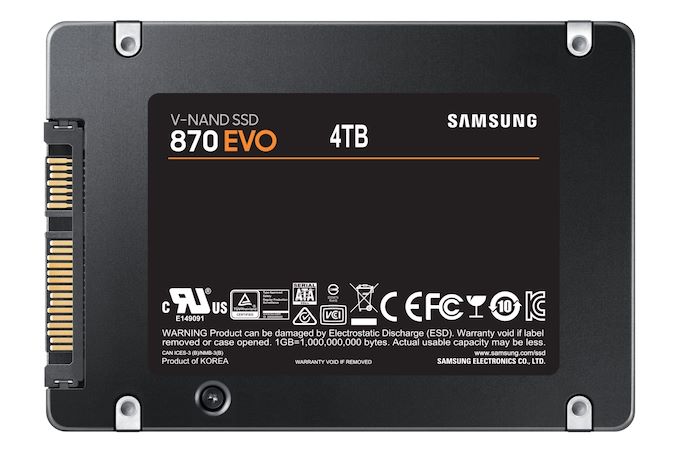
Samsung is launching the latest iteration of their mainstream consumer TLC-based SATA SSDs. The new 870 EVO brings the same generational updates to Samsung's 3D NAND and SSD controller that we saw with last year's 870 QVO. The updated EVO SATA SSD arrives three years after the launch of the Samsung 860 EVO and 860 PRO. The 870 EVO uses the same sixth-generation Samsung V-NAND (3D NAND) that debuted in the high-end 980 PRO NVMe SSD. Officially, this is "1xx layers", but all signs point to it being 128L 3D NAND. This may sound unimpressive when Micron and SK hynix have already announced their 176-layer 3D NAND, but Samsung's NAND manufacturing process is arguably more advanced: they're still able to manufacture all 128L in one batch, while the competition have all long since adopted string stacking to split the process into two batches (eg. two groups of 88 layers). The 870 EVO uses the same Samsung MKX controller we first saw with the 870 QVO. Samsung still hasn't shared what's improved with this generation of controller, but we get a bit of a hint from the fact that they claim the 870 EVO offers a 38% improvement to queue depth 1 random read latency compared to the 860 EVO. Since Samsung has previously shared that their 128L 3D TLC only offers a 10% improvement in raw read latency, it looks like the updated controller may be a bigger factor in the drive's overall performance increase. Either way, a 38% improvement in one of the few performance metrics that SATA SSDs have any room to improve on is a bold claim.
Samsung didn't give us the full detailed spec sheet, but among the basic specifications there are no surprises. Peak throughput is as usual limited by the SATA interface. Write endurance is still 0.3 drive writes per day with a five year warranty. The capacity options still run from 250GB to 4TB. Launch MSRPs are substantially higher than current street prices for the 860 EVO and are well into NVMe price territory, but we expect the 870 EVO's prices to come down fairly soon given the overall state of the market with a bit of an oversupply for NAND flash memory. We don't have a full review of the 870 EVO ready today because the timing is rather awkward. It's a bit cheeky of Samsung to launch this drive just two business days after the end of CES, and with only a week of advance notice. We also hadn't started running SATA drives through our new 2021 SSD test suite, so the past several days have kept our new testbeds busy testing the 870 EVO and various other SATA drives to compare against. Preliminary results show that the 870 EVO improves performance across the board for our AnandTech Storage Bench trace tests, though with slight increases in power consumption. Samsung's claim of 38% better QD1 random read performance also looks to be an exaggeration, but we'll be back later this week with a full analysis of the test results. We also haven't heard any new official information from Samsung about an 870 PRO to round out this generation of SATA drives, but they did mention an 870 PRO in passing in a newsletter last fall. Since their consumer NVMe line has switched over to using TLC NAND for the 980 PRO, there's some uncertainty whether an 870 PRO will continue using MLC NAND. If it does, that will be the first appearance of 128L MLC from Samsung. | ||||||||||||||||||||||||||||||||||||||||||||||||||||||||||||||||||||||||||||||||||
| 10:15a | The Intel Z590 Motherboard Overview: 50+ Motherboards Detailed At the start of 2021, Intel has unveiled its latest desktop platform, designed primarily for its Rocket Lake 11th generation processors. Intel is officially moving to PCIe 4.0, with the top SKU Core i9-11900K supposedly offering a large jump in IPC performance compared to the previous generation. The new chipset moves to double bandwidth to the CPU, allowing for more hardware to make the most of the chipset at once. It also moves to DDR4-3200 support, a new peak in a product line that was previously on DDR4-2933. The new Z590 chipset is Intel's flagship, designed for Rocket Lake, but offering backward compatibility with Comet Lake processors. We take a closer look at the large variety of new motherboards set to come to market. | ||||||||||||||||||||||||||||||||||||||||||||||||||||||||||||||||||||||||||||||||||
| << Previous Day |
2021/01/19 [Calendar] |
Next Day >> |