[Most Recent Entries] [Calendar View]
Tuesday, March 16th, 2021
- First AMD B550 With Thunderbolt 4: The ASUS ProArt B550-Creator
- Lenovo Introduces The ThinkVision P40w: 40-inch Thunderbolt 4 Display With Intel AMT
- Intel's Maple Ridge (JHL8540) Thunderbolt 4 Controller Now Shipping
- New Second Gen EVE V 2-in-1: Tiger Lake 3840x2400 with Thunderbolt 4
- Intel Thunderbolt 4 Update: Controllers and Tiger Lake in 2020
| Time | Event |
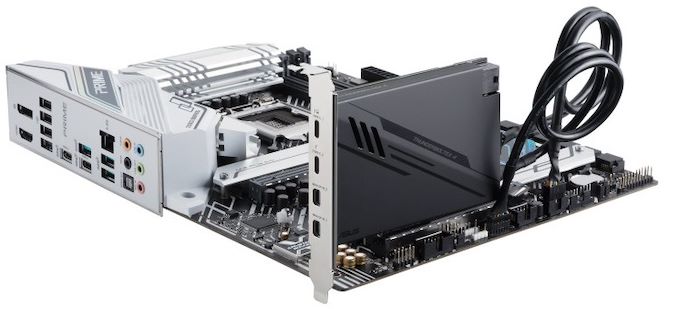
| 8:00a | ASUS Reveals ThunderboltEX 4 Expansion Card, Dual Type-C & Mini-DP
Back in December, we reported that Intel's Maple Ridge Thunderbolt 4 controller was shipping to customers. We can now report that ASUS has unveiled a Thunderbolt 4 expansion card, the ASUS ThunderboltEX 4. It includes support for 100 W quick charging, includes a 40 Gbps bi-directional switch, and can support up to 8K ultra HD resolutions. Since the launch of Intel's Z590 chipset on socket LGA1200, we've seen some of the more premium models featuring Intel's latest Maple Ridge Thunderbolt 4 controllers. This is primarily a feature we see on models looking to add functionality for content creators. Native Thunderbolt 4 is built into Intel Tiger Lake. Still, for motherboards without Thunderbolt capabilities, the ASUS ThunderboltEX 4 add-on card allows users to add Intel's latest Maple Ridge controller into existing systems. ASUS hasn't unveiled a full list of technical specifications at the time of writing. Still, we cross-referenced the specifications we do know with Intel's JHL8540 Maple Ridge TB4 controller, and they match. The accessories include everything needed to get the ThunderboltEX 4 operational, which means users will require a PCIe 3.0 x4 (or PCIe 4.0 x2) and USB 2.0 motherboard header available, as well as a 6-pin PCIe 12 V ATX power cable free from the power supply.
Adding not just one port but a total of four, the ASUS ThunderboltEX 4 includes two Type-C and two mini-DisplayPort inputs, which allow for up to five devices to be daisy-chained. This includes up to three devices and two Thunderbolt monitors, or four devices and one monitor. The top Type-C port includes support for 100 Watt quick charging and can even power a compatible notebook, with the second Type-C port offering up to 27 Watts of quick charging capability. We should also note that the ThunderboltEX 4 can accommodate monitors with resolutions up to 8K due to conforming to DisplayPort 1.4. At the time of writing, ASUS hasn't specified when the ThunderboltEX 4 expansion card will be available, nor how much it will cost. Source: ASUS Related Reading |
| 9:00a | AMD Ryzen Pro 5000 Mobile: Zen 3 comes to Commercial Notebooks
Alongside every launch of AMD’s consumer processors, the commercial offerings for business come along a few months after. Today we see the commercial launch of the Ryzen 5000 Mobile series, named Ryzen Pro 5000 Mobile. These are built on the same Cezanne processor design, but with the added sprinkling of Pro level features required by commercial customers for widescale deployment, security, and stability. Alongside the increased performance from the previous generation, these new parts include the security updates in Zen 3 such as Shadow Stacks, Pro-level features such as DASH, and guaranteed silicon and imaging support. |
| 10:10a | NVIDIA Fumbles, Releases GeForce RTX 3060 Driver Without Anti-Mining Throttle
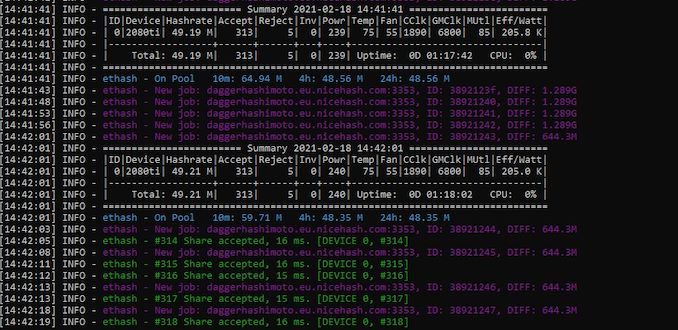
In an effort to partially mitigate the market chaos that has come from the cryptocurrency mining boom over the last 6 months, last month NVIDIA very publicly introduced a mining throttling mechanism for its then-new GeForce RTX 3060 cards. By throttling the performance of Ethereum mining on these cards to half their native rate, it would ideally keep miners from immediately snapping up any (and every) RTX 3060 card in search for a profit, leaving more available for NVIDIA’s gaming customers. Essentially a software security/DRM system, the success of NVIDIA’s effort would hinge largely on ensuring the underlying throttling mechanism remain undefeated – an effort that has significantly fumbled after NVIDIA accidentally released a driver without the complete throttling code. As part of the development of their upcoming Release 470 driver branch, last week NVIDIA released driver 470.05 to developers and Windows Insiders. Among other things, this development driver enabled CUDA support on the Windows Subsystem for Linux 2 (WSL2) for the first time. Unfortunately, this driver didn’t include the complete throttling code for Ethereum, and as a result it’s possible to use the driver to mine the cryptocoin on RTX 3060 cards at their full (native) rate. The news was initially broken by HardwareLuxx and ComputerBase, who had the driver and were able to confirm that they were no longer getting throttled with the new driver. NVIDIA in turn has since confirmed the matter as well, sending a statement out to various members of the press that “A developer driver inadvertently included code used for internal development which removes the hash rate limiter on RTX 3060 in some configurations. The driver has been removed.” Unfortunately, this is a prime, real-world example of how software security (and DRM-like systems) are only as strong as their weakest link – in this case NVIDIA’s driver team. NVIDIA security mechanisms rely on signature checks for the BIOS and drivers to prevent bypassing the throttling mechanism, but since this is a signed, legitimate NVIDIA driver to begin with, it is readily accepted by the card. And since the driver doesn’t have a timebomb on it, the genie is out of the bottle, as it were. Windows cryptominers should be able to use the driver with RTX 3060 cards indefinitely, and since the driver was widely released there’s no possibility to preventing its re-distribution. The silver(ish) lining to this otherwise bad news is that it could have been even worse for NVIDIA. This driver was for Windows and not for Linux, with the latter being the preferred platform for industrial miners. Furthermore there are apparently other mining-checks in the driver that do still work (e.g. checking the PCIe link width), so NVIDIA’s anti-Ethereum throttle for the RTX 3060 is not completely broken. It has, however, had a massive chunk taken out of it with this driver release. All of which means that the ongoing chip crunch has just become all that more severe for gamers and other video card buyers. With an unthrottled RTX 3060 able to pull in around $5/day in profit, the card risks being a reasonably attractive offering for miners looking to make a quick buck. |
| 11:00a | Intel Launches Rocket Lake 11th Gen Core i9, Core i7, and Core i5 In the myriad of news and early reviews, Intel is today officially launching its 11th Generation Core family of desktop processors, also known as Rocket Lake, built on Intel’s most advanced 14nm process node technology. This new product family will form the basis of Intel’s premium desktop portfolio for most of 2021, if not longer, and features processors with up to eight cores. Highlights include the new microarchitecture, Cypress Cove, and the Xe-LP graphics design, both of which are redesigns of Intel’s 10nm mobile products. These parts also include Intel’s first PCIe 4.0 offering on the desktop, new AVX-512 for desktop, better memory support, support for resizable BAR, new overclocking features, and enhanced multimedia acceleration. |
| 11:45a | Qualcomm Completes Acquisition of NUVIA: Immediate focus on Laptops (Updated)
Today Qualcomm is announcing that the company has completed the acquisition of NUVIA, a start-up company consisting of industry veterans who were behind the creation of Apple’s high-performance CPU cores, and who were aiming to disrupt the server market with a new high-performance core called “Phoenix”. |
| 6:00p | Micron Abandons 3D XPoint Memory Technology
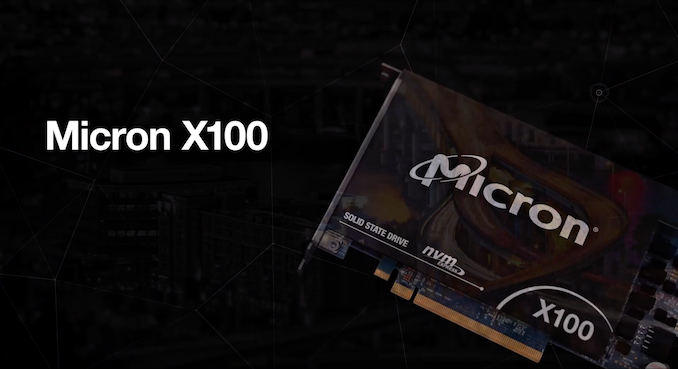
In a sudden but perhaps not too surprising announcement, Micron has stated that they are ceasing all R&D of 3D XPoint memory technology. Intel and Micron co-developed 3D XPoint memory, revealed in 2015 as a non-volatile memory technology with higher performance and endurance than NAND flash memory. Intel has been responsible for almost all of the commercial volume of 3D XPoint-based products, under their Optane brand for both NVMe SSDs and persistent memory modules in the DIMM form factor. Micron in 2016 announced their QuantX brand for 3D XPoint products, but never shipped anything under that brand. Their first and only real product based on 3D XPoint was the X100 high-end enterprise SSD which saw very limited release to close partners. Micron has now decided that further work to commercialize 3D XPoint memory isn't worth the investment.
Micron currently owns the only fab equipped to mass-produce 3D XPoint memory: the Lehi, Utah fab that was formerly the home of the Intel-Micron flash and 3D XPoint joint venture IMFT. Intel and Micron began splitting up their partnership in 2018, first parting ways for 3D NAND flash memory development, followed by dissolving the 3D XPoint partnership after completing development on the second generation 3D XPoint. In 2019, Micron exercised their rights to buy out Intel's share of the IMFT fab, leaving Micron as the sole owner of the fab and Intel in the position of buying 3D XPoint wafers from Micron to use in Optane products. Intel's Optane products have not been enough to fully utilize the capacity of that fab, and Micron's non-GAAP operating profits have been taking a hit of over $400 million per year in underutilization charges.
Micron is now putting that 3D XPoint fab up for sale, and is currently engaged in discussions with several potential buyers. Intel is the most obvious potential buyer, having recently begun the long process of selling their NAND flash and flash-based SSD business to SK hynix while keeping their Optane products. Intel has already moved their 3D XPoint R&D to Rio Rancho, NM but has not built up any 3D XPoint mass production capacity of their own; buying the Lehi, UT fab would save them the trouble of equipping eg. their NAND fab in Dalian, China to also manufacture 3D XPoint. However, Intel is not guaranteed to be the buyer of the Lehi, UT fab. They've doubtless had opportunities to do so before as Intel and Micron unwound their partnership. Micron states that the Lehi, UT fab could be used to produce analog or logic ICs, not just memory—and that converting it to large-scale manufacturing of DRAM or NAND flash memory would not be as appealing to Micron as simply expanding capacity at their other existing fabs. With widespread semiconductor shortages affecting almost all corners of the industry, this fab is likely to sell quickly even if the buyer needs to put substantial effort into retooling. Micron does not have a direct replacement lined up for 3D XPoint memory technology, but continues R&D into new memory and storage technologies. Micron's announcement is emphasizing a pivot toward developing memory products that will use the Compute Express Link (CXL) interface, which promises to be a vendor-neutral interface for DRAM and non-volatile memories such as 3D XPoint. Related Reading: |
_575px.jpg)
_thumb.jpg)
_575px_thumb.jpg)
_thumb.jpg)
_575px_thumb.jpg)
_thumb.jpg)
_575px_thumb.jpg)



| << Previous Day |
2021/03/16 [Calendar] |
Next Day >> |