[Most Recent Entries] [Calendar View]
Monday, April 5th, 2021
- Intel Rocket Lake (14nm) Review: Core i9-11900K, Core i7-11700K, and Core i5-11600K
- DDR5 Memory Specifications Released: Setting the Stage for DDR5-6400 And Beyond
- PNY Unveils XLR8 Gaming Epic-X RGB DDR4-3200 Memory
- GeIL Unveils Orion Series Memory, Up to DDR4-4000 with 32 GB Memory Modules
- TeamGroup Announces Intentions for DDR5, ELITE DDR5-5200 in 2021
| Time | Event | ||||||||||||||||||||||||||||||||
| 7:00a | LG Calls it Quits, To Close Mobile Phone Business
This morning, LG issued a press release that announced the board of directors had decided to close down the conglomerate’s mobile phone business. The news is unfortunate, however isn’t too surprising given the mobile division had been accruing continuous operational losses over the last 6 years, greatly denting the company’s financials.
LG had been one of the major mobile pioneers in the feature phone market, and also a larger player in the early 2010’s with many notable earlier successes such as the LG G2 or the G3. Unfortunately in the following years, the company had been struck hard by chains of hardware disadvantages, ranging from the Snapdragon 810/808 generation in the G4, a failed attempt at hardware modularity in the G5. LG had also suffered issues over several generations in their OLED display attempts, plagued by lower quality panels with image quality issues, or power efficiency deficits compared to other alternatives in the market who used Samsung Display OLED panels. At one point, LG had plans to deploy their own in-house design “Nuclun” SoCs into their mobile devices, announcing their partnership with Intel Custom Foundry to produce a leading-edge design on Intel’s 10nm process node. Unfortunately, the project burned to the ground along with Intel’s 10nm struggles, with the chips never seeing the light of day. LG’s latest device attempts in the form of the V60 and the VELVET were actually greater leaps for the company’s designs as well as executions, however all coming too late, with a continuing problem of availability of the devices, as LG still ran with an availability model of working closely with carriers and releasing devices only in markets where carriers decided they were interested in supporting that device. The company will be winding down its mobile business through July 31st, refocusing its resources into other divisions of the conglomerate. | ||||||||||||||||||||||||||||||||
| 8:00a | G.Skill Announces DDR4-5333 Memory Kits for Intel Rocket Lake
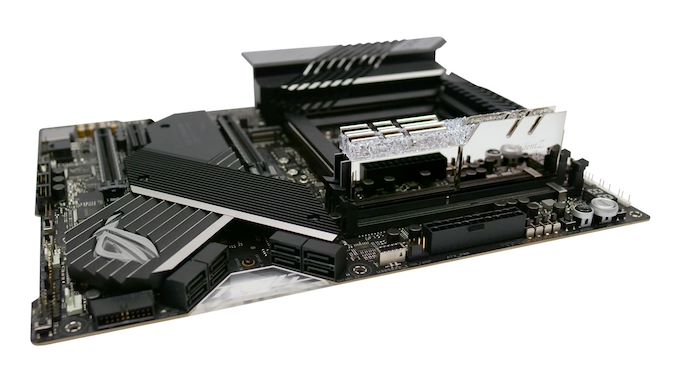
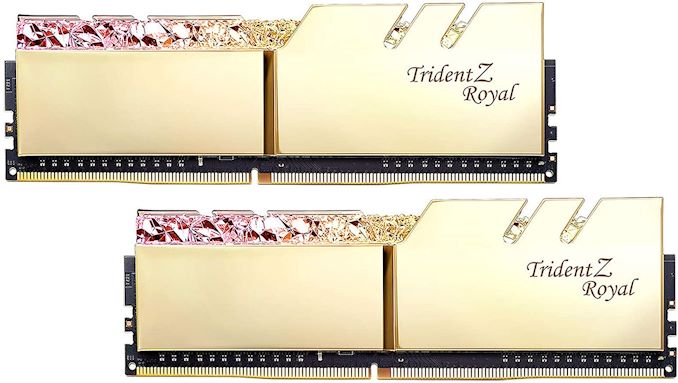
Designed with a focus on Intel's latest 11th generation Rocket Lake processors and the new memory controller ratios, G.Skill has announced a wave of new memory kits designed to squeeze as much performance out of the platform. The new memory kits for Z590 and Rocket Lake feature speeds of up to DDR4-5333. They will be made available across multiple lines of its range, including the premium Trident Z Royal, Trident Z RGB, and the more affordable Ripjaw V series. With memory performance and control getting some extra features with Intel's 11th gen desktop, the Z590 chipset with Rocket Lake processors now supports geared memory ratios between the memory controller and the DRAM data rates. The ability of Intel's memory controller in a 1:1 gear ratio can vary, certainly under ambient cooling methods, and not all of Intel's silicon can handle such high frequencies. This is where the gear ratio option becomes beneficial, taking some of the strain off the memory controller and allowing for high frequencies, with G.Skill capitalizing on this with its new memory kits up to DDR4-5333.
The new G.Skill memory kits designed for Intel's Z590 (with Rocket Lake) start from DDR4-4266 with CL19 ratings, with two available capacities: dual-channel 32 GB (2x16) and 64 GB (2x32) kits. Also set to be available include DDR4-4400 kits with CL17 and CL18 latencies, including an operating voltage of 1.50 V in both the 32 GB and 16 GB kits. Moving up, there's one kit of DDR4-4600 with CL20 with a total capacity of 64 GB (2 x 32 GB) and three different flavors of DDR4-4800; CL17 and CL18 with 2 x 8 GB kits, and CL20 with 2 x 16 GB. There's one 32 GB (2 x 16 GB) kit at DDR4-5066 with CL19 and an operating voltage of 1.6 V, with one kit maxing out at DDR4-5333 and CL21 latencies, with 2 x 8 GB memory sticks.
G.Skill has announced that its new Rocket Lake and Z590 kits have been validated on the ASUS ROG Strix Z590-E Gaming WIFI, the ASUS ROG Maximus XIII Apex, and MSI's MEG Z590I Unify motherboards with an Intel Core i9-11900K processor. G.Skill also stated that its DDR4-4800 CL17 16 GB (2 x 8 GB) kit uses Samsung B-die memory chips but didn't specify if this was the case across its range. At the time of writing, G.Skill hasn't given us any pricing, but they are expected to launch in Q2 2021. With memory prices set to rise throughout the year, these kits aren't likely to be cheap. The G.Skill Trident Z Royal and Trident Z RGB will likely feature at the higher end of the pricing spectrum, with its Ripjaw Z series sitting as its entry point. Related Reading | ||||||||||||||||||||||||||||||||
| << Previous Day |
2021/04/05 [Calendar] |
Next Day >> |