[Most Recent Entries] [Calendar View]
Monday, June 14th, 2021
| Time | Event | |||||||||||||||||||||
| 12:30p | Sponsored Post: Keep Your App’s Memory Safe with Arm Memory Tagging Extension (MTE)
Subtle memory bugs, including buffer overruns and pointer errors, create ticking time bombs inside your applications. Malicious actors can exploit these bugs to execute unauthorized code, take over systems to add them to malware botnets, or simply cause applications and systems to crash. The notorious Morris Worm of 1988 was one of the earliest examples of a malicious application exploiting a buffer overflow. Announcements of memory safety issues creating potential exploits arrive with alarming frequency, either from security researchers or found loose in the wild. The impact on users can be substantial. Rogue applications can take advantage of unsafe memory in order to gain access to sniff out sensitive data, such as user credentials and passwords, enabling access to higher levels of privilege in the system. This allows bad actors to gain access to confidential data or make the system part of a larger botnet. It’s not always outside forces that cause problems – sometimes unsafe memory results in unpredictable system crashes due to memory leaks and related issues, frustrating users. It’s estimated that two-thirds of all Android vulnerabilities happen due to unsafe memory practices. Arm Memory Tagging ExtensionSoftware-based solutions, including Address Sanitizer (Asan), help mitigate these memory issues by integrating memory corruption detection into modern compilers. However, Asan requires adding software instrumentation to application code, which can significantly slow down app runtime and increase memory usage, particularly problematic in mobile and embedded systems. What’s needed is a solution to detect and minimize memory bugs with minimal impact on performance and memory use. Properly implementing a hardware-based method for detecting potentially unsafe memory usage results in smaller memory usage and better performance, while improving system reliability and security. Arm introduced its memory tagging extension as a part of the Armv8.5 instruction set. MTE is now built into Armv9 compliant CPUs recently announced by Arm, such as the Cortex-X2, Cortex-A710, and Cortex-A510. Future CPUs based on Armv9 will also integrate MTE. These all include memory tagging as a basic part of the architecture. | |||||||||||||||||||||
| 6:30p | Razer Unleashes Blade 14 Gaming Laptop: Ryzen 5000 Mobile with GeForce Graphics
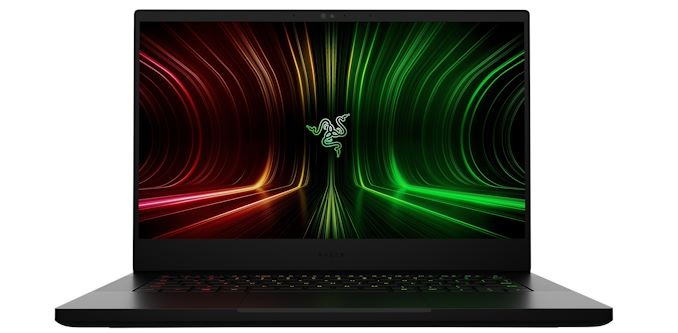
During their E3 2021 gaming event this afternoon, Razer has launched the latest variant of its popular Blade 14 gaming laptop. For the first time, Razer is using an AMD processor to power its latest Blade 14 thin gaming laptop. Marking a milestone within the company, the Razer Blade includes plenty of features, including Wi-Fi 6E, dual USB 3.2 G2 Type-C, and multiple options with NVIDIA's GeForce RTX graphics for fine-tuning the laptop's portable gaming performance. Back in 2011, when Razer first entered the gaming laptop market, the competition between Intel and AMD in the desktop and mobile space wasn't like it is now. Since then, a lot has changed with the emergence of AMD's Ryzen architecture, and at present, it is doing very well. With Ryzen Mobile offering powerful performance and in January, it launched its Ryzen 5000 Mobile parts at CES 2021. With Razer commanding a niche market in the laptop space with all of its models designed for gaming, the latest Razer Blade 14 comes equipped with AMD's Ryzen 9 5900HX processor, with eight cores, sixteen threads, a maximum boost clock speed of 4.6 GHz, and is unlocked allowing users to apply overclocks. While the Blade 14 isn't an 'AMD Advantage' system benefiting from both AMD processor and graphics, it marks a big step for a brand typically associated specifically with Intel chips.
The AMD Ryzen powered Razer Blade 14 comes with two choices in regards to panel type. This includes the option of a 1080p 144 Hz 100% sRGB display, or a more premium 1440p 165 Hz 100% DCI-P3 display. Both panels are IPS-based and come with variable refresh rate support. For storage, the Razer Blade 14 includes a 1 TB PCIe 3.0 x4 NVMe SSD, while memory comes in the form of 16 GB of DDR4-3200. Unfortunately for buyers looking at later-life upgrades, the memory is fixed onto the motherboard, so 16 GB is all it ever will have. Buyers can select between three NVIDIA options in terms of graphics. This includes a GeForce RTX 3060 mobile GPU with 6 GB of VRAM, an RTX 3070 with 8 GB of VRAM, or an RTX 3080 also with 8 GB of VRAM. All three models have their GPUs set to 100 W TGP (total graphics power). Keeping the components cool is a vapor chamber cooling solution, and Razer is advertising up to 12-hours battery life and comes with a compact 230 W power adapter.
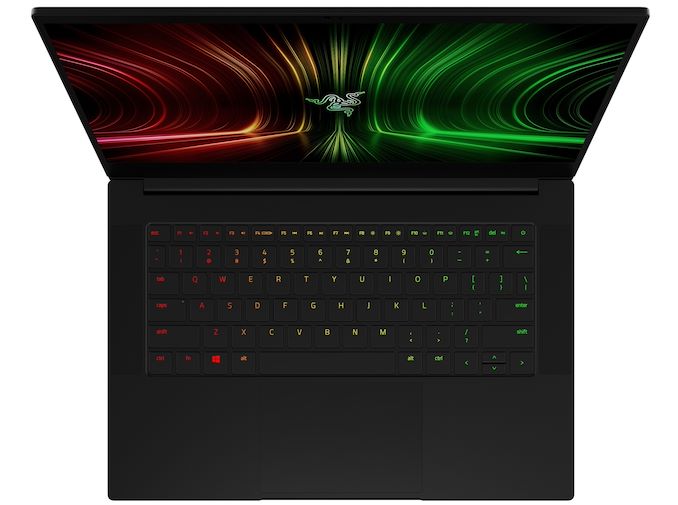
Razer is also touting the Blade 14 as the world's thinnest gaming laptop, and the dimensions make it rather sleek indeed. It's 16.8 mm thick, with a 220 mm x 319.7 mm footprint. Although Razer didn't provide us with details on the weight, the frame itself is custom CNC milled from a single block of T6 grade aluminum, commonly used for aircraft parts, and comes with a matte black anodized finish. Other design aspects include per-RGB backlit keys powered by Razer Chroma and features an N-Key rollover keyboard. The keys themselves have a 1 mm actuation, and keys can be programmed via Razer Synapse 3. Also included is a large glass precision trackpad, which is Windows Precision-capable and adapts to usage and can respond to multiple finger gestures.
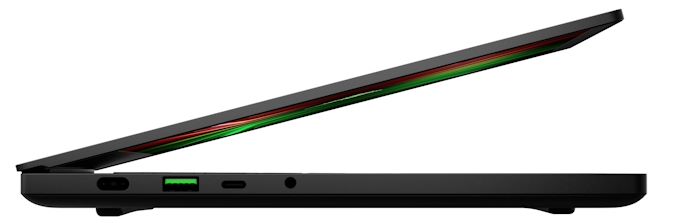
I/O connectivity include two USB 3.2 G2 Type-C ports with DP alt-mode and 100 W charging capabilities, two USB 3.2 G2 Type-A ports, one HDMI 2.1 video output, and a single 3.5 mm combo audio port. Along the top of the bezel is a Windows Hello 720p webcam and comes with THX-certified Spatial Audio with two premium speakers. The Blade 14 also comes with a Kensington lock for security on the go. The AMD Ryzen 5900HX powered Razer Blade 14 will start shipping from June 14th, with prices starting at $1799. Related Reading | |||||||||||||||||||||
| 8:15p | Razer Announces Ultra-Compact "Razer GaN" 130W USB Type-C Charger
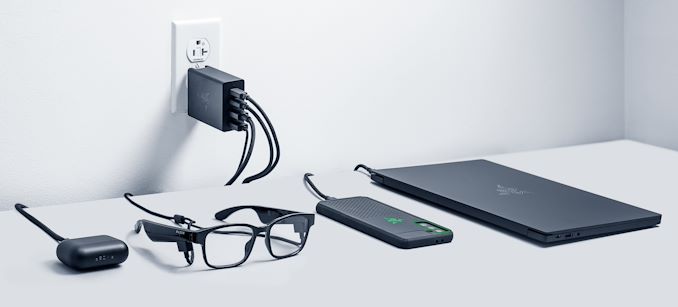
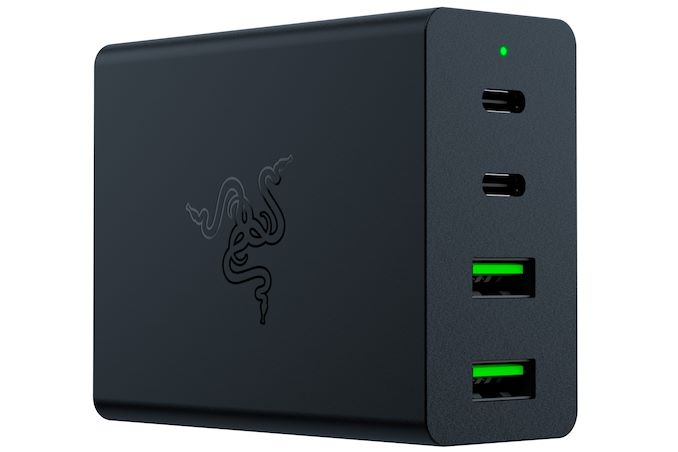
Alongside their new AMD-powered Blade 14 laptop, Razer today also used E3 2021 to announce a new, high-powered USB-C charger. The Razer GaN USB Type-C charger is a compact charging solution that is pocket-sized and can deliver up to 130 W of combined charging power across its two USB-C and two USB-A outputs. If you've ever owned one of the latest smartphones or Bluetooth 5.1 devices, it's likely to come with a USB Type-C charging port. The Type-C connector has become more popular as more and more powered devices come with Type-C. With the USB-IF announcing its specifications for the new USB-PD standard with support for up to 240 W, power supply engineers are increasingly using Gallium Nitride (GaN) semiconductors for more efficient and compact designs.
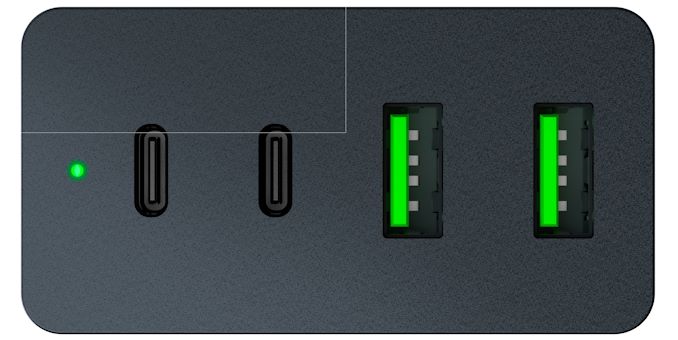
GaN by name and GaN by nature, the Razer GaN is powered by using Gallium Nitride, which has allowed Razer to cut down on the size of the charger. Razer claims that their GaN charger is small enough to fit inside a pocket, measuring 62 x 32 x 76 mm (D x W x H) in size and weighing in at 349 g. Looking at the aesthetics, the GaN includes a black plastic chassis with Razer's trademark green accent color being used in the USB Type-A ports as well as the power indicator light. And in case you're still not sure who made it, there's a Razer logo embossed onto the side as well. The Razer GaN has a foldable fork for plugging directly into a plug socket and comes supplied with global power adapters. Users can charge devices in regions such as North America, Europe, the UK, and Asia. Also included in the accessories is a 2 meter USB cable, although Razer didn't specify Type-C or Type-A.
In terms of charging ports, the Razer GaN has two Type-C outputs and two Type-A outputs. Each pair of outputs are on a shared power plane, allowing the charger to power several devices at once, though at a reduced rate if used with multiple high-powered devices. This works out to the two Type-C ports sharing 100 W of capacity, while the two Type-A ports share another 18 W. And since this is a universal power supply, the Razer GaN can charge everything from phone and tablets to Razer Blade laptops, Apple MacBooks, as well as smartwatches and Windows laptops that support Type-C charging.
The Razer GaN USB Type-C 130 W charger can be pre-ordered at the Razer Store from the 14th of June, with shipping of stock expected within 30 days of the date. Though don't mistake the diminutive size of the charger for a diminutive price tag; the charger carries an MSRP of $180. | |||||||||||||||||||||

 - 2_575px.jpg)
 Gaming - 4_thumb.jpg)
 - 1_thumb.jpg)
 - 10_575px_thumb.jpg)
 - 11_575px_thumb.jpg)
 - 12_575px_thumb.jpg)
 - 13_575px_thumb.jpg)


_thumb.jpg)
_thumb.jpg)
_thumb.jpg)
| << Previous Day |
2021/06/14 [Calendar] |
Next Day >> |