[Most Recent Entries] [Calendar View]
Wednesday, July 14th, 2021
- Russia’s Elbrus 8CB Microarchitecture: 8-core VLIW on TSMC 28nm
- Intel to Create RISC-V Development Platform with SiFive P550 Cores on 7nm in 2022
- Intel Licenses SiFive’s Portfolio for Intel Foundry Services on 7nm
- SiFive Announces First RISC-V OoO CPU Core: The U8-Series Processor IP
- SiFive Unveils Freedom Platforms for RISC-V-Based Semi-Custom Chips
- Western Digital Rolls-Out Two New SweRV RISC-V Cores For Microcontrollers
| Time | Event |
| 8:00a | EVGA Teases an AMD X570 Dark Edition: For Ryzen 5000 Enthusiasts
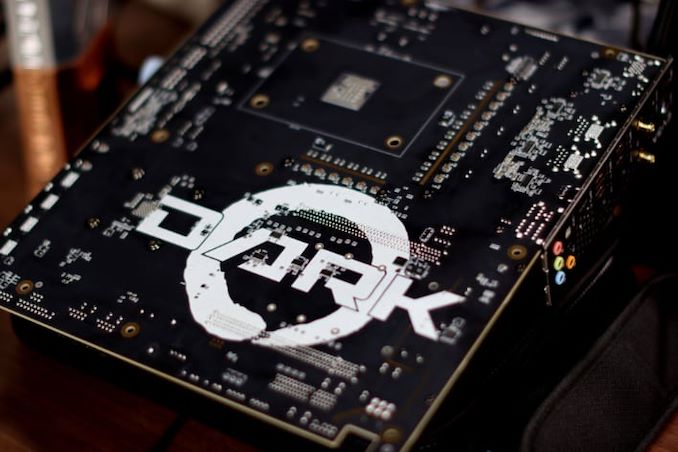
Legendary overclocker Vince "KINGPIN" Lucido, part of EVGA's in-house design team, posted to his Facebook page an image that has caused a bit of a stir. The post is captioned 'The red pill', with an image of the appears to be the rear of an EVGA Dark series motherboard using AMD's famous Zen logo. This points to a potential AMD Ryzen version of its board, and this would be the first AMD-based EVGA motherboard since back in days of AMD's Athlon 64 processors. Most recently, EVGA has made hardware parts for two primary vendors: motherboards for Intel and graphics cards for NVIDIA. So making something AMD again is quite a shock. EVGA's Dark series of motherboards typically cater towards enthusiasts and overclockers, with premium controller sets and a wide variety of features designed for pushing silicon to the limit. Dissecting the teased image posted by Vince Lucido on Facebook, we can see the EVGA X570 or X570S Dark series motherboard will feature one 24-pin 12 V ATX motherboard power input two 12 V EPS ATX CPU power inputs, and two full-length PCIe 4.0 slots. Looking at what memory support the board might have, the rear of the board looks to only feature two memory slots, which is common on Dark series models, with two or more PCIe 4.0 M.2 slots likely to be a feature. Glancing the rear of the power delivery, there does look to be at least 14 power stages, with given the pedigree and status of EVGA's Dark series models, it could easily be a 16-phase monster. At the moment, EVGA hasn't officially said anything about the launch of the EVGA X570/X570S Dark, but we expect an announcement in due course, hopefully with pricing and expected availability. Related Reading |
| 9:00a | AMD Threadripper Pro Review: An Upgrade Over Regular Threadripper? Since the launch of AMD’s Threadripper Pro platform, the desire to see what eight channels of memory brings to compute over the regular quad-channel Threadripper has been an intriguing prospect. Threadripper Pro is effectively a faster version of AMD’s EPYC, limited for single CPU workstation use, but also heralds a full 280 W TDP to match the frequencies of the standard Threadripper line. There is a 37% price premium from Threadripper to Threadripper Pro, which allows for ECC memory support, double the PCIe lanes, and double the memory bandwidth. In this review, we’re comparing every member of both platforms that is commercially available. |
| 12:05p | Russia To Build RISC-V Processors for Laptops: 8-core, 2 GHz, 12nm, 2025
Russian outlet Vedomosti.ru today is reporting that the conglomerate Rostec, a Russian state-backed corporation specializing in investment in technology, has penned a deal with server company Yadro and silicon design company Syntacore to develop RISC-V processors for computers, laptops, and servers. Initial reports are suggesting that Syntacore will develop a powerful enough RISC-V design to power government and education systems by 2025. The cost of the project is reported to be around 30 billion rubles ($400m), with that the organizers of the project plan to sell 60,000 systems based around new processors containing RISC-V cores as the main processing cores. The reports state that the goal is to build an 8-core processor, running at 2 GHz, using a 12-nanometer process, which presumably means GlobalFoundries but at this point it is unclear. Out of the project funding, two-thirds will be provided by ‘anchor customers’ (such as Rostec and subsidiaries), while the final third will come from the federal budget. The systems these processors will go into will operate initially at Russia’s Ministry of Education and Science, as well as the Ministry of Health.
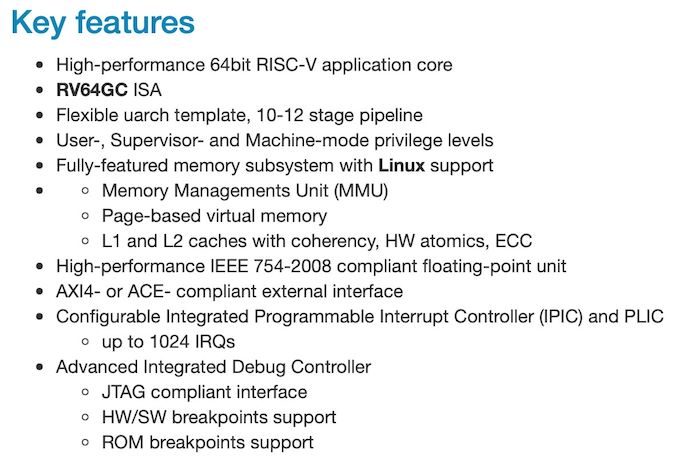
Syntacore already develops its own core with the RISC-V architecture, rather than licensing a design. There have been questions as to whether any current RISC-V design is powerful enough to be used in a day-to-day work machine suitable for administrative services, however with the recent news that Canonical is enabling Ubuntu/Linux on some of SiFive’s RISC-V designs, chances are that by 2025 there will be a sufficient number of software options to choose from should the Russian processor adhere to any specifications required. That being said, it is not uncommon for non-standard processors in places like Russia or China to use older customized forks of Linux to suit the needs of the businesses using the hardware. Sintakor’s documentation states that their highest performance 64-bit core already supports Linux.
This news is an interesting development given that Russia has multiple home-grown CPU prospects in the works already, such as the Elbrus 2000 family of processors that run a custom VLIW instruction set with binary translation for Intel x86 and x86-64; these processors already offer 8-core and multi-socket systems running on Linux. Development on Elbrus is still ongoing with Rostec in the mix, and the project seems focused on high-powered implementations in desktop to server use. In contrast, the new RISC-V development seems to be targeting low-powered implementations for desktop and laptop use. Russia also has Baikal processors using the MIPS32 ISA, built by a Russian supercomputer company. It will be interesting to see how this story develops: $400m should be sufficient to build a processor and instruct system design at this level, which puts the question on how well the project will execute. Sources: @torgeek, Vedomosti.ru Related Reading
|


| << Previous Day |
2021/07/14 [Calendar] |
Next Day >> |