[Most Recent Entries] [Calendar View]
Wednesday, October 27th, 2021
| Time | Event |
| 12:00p | Intel 12th Gen Core Alder Lake for Desktops: Top SKUs Only, Coming November 4th Over the past few months, Intel has been drip-feeding information about its next-generation processor family. Alder Lake, commercially known as Intel’s 12th Generation Core architecture, is officially being announced today for a November 4th launch. Alder Lake contains Intel’s latest generation high-performance cores combined with new high-efficiency cores for a new hybrid design, along with updates to Windows 11 to improve performance with the new heterogeneous layout. Only the six high-performance K and KF processor variants are coming this side of the New Year, with the rest due for Q1. We have specifications, details, and insights ahead of the product reviews on November 4th. |
| 3:25p | Intel's Aurora Supercomputer Now Expected to Exceed 2 ExaFLOPS Performance
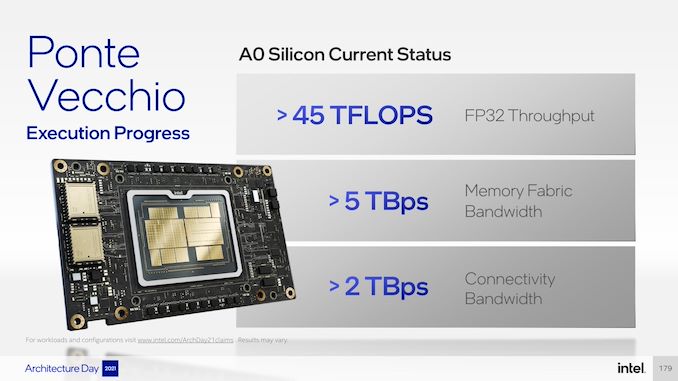
As part of Intel’s 2021 Innovation event, the company offered a brief update on the Aurora supercomputer, which Intel is building for Argonne National Laboratory. The first of the US’s two under-construction exascale supercomputers, Aurora and its critical processors are finally coming together, allowing Intel to finally narrow its performance projections. As it turns out, the 1-and-change exaFLOPS system is going to be more like a 2 exaFLOPS system – Aurora’s performance is coming in high enough that Intel now expects the system to exceed 2 exaFLOPS of double precision compute performance. Planned to be the first of the US’s two public exascale systems, the Aurora supercomputer has been through a tumultuous development process. The contract was initially awarded to Intel and Cray back in 2015 for a pre-exascale system based on Intel’s Xeon Phi accelerators, a plan that went out the window when Intel discontinued Xeon Phi development. In its place, the Aurora contract was renegotiated to become an exascale system based on a combination of Intel’s Xeon CPUs and what became their Ponte Vecchio Xe-HPC GPUs. Since then, Intel has been working down to the wire on getting the necessary silicon built in order to make a delivery window that’s already shifted from 2020 to 2021 to 2022(ish), going as far as fabbing parts of Ponte Vecchio on rival TSMC’s 5nm process. But there is finally light at the end of the tunnel, it would seem. As Intel pushes to complete the system, its performance is coming in ahead of expectations. According to the chip company, they now expect that the assembled supercomputer will be able to deliver over 2 exaFLOPS of double precision (FP64) performance. The system previously didn’t have a specific performance figure attached to it, beyond the fact that it would be over 1 exaFLOPS in FP64 throughput.
This higher performance figure for Aurora comes courtesy of Ponte Vecchio, which according to CEO Pat Gelsinger is overdelivering on performance. Gelsinger hasn’t gone into additional detail in how Ponte Vecchio is overdelivering, but given that IPC and overall efficiency tends to be relatively easy to nail down during simulations, the most likely candidate here is that Ponte Vecchio’s is clocking higher than Intel’s previous projections. Ponte Vecchio is one of the first HPC chips (and the first Intel GPU) built on TSMC’s N5 process, so there have been a lot of unknowns going into this project. For Intel, this is no doubt a welcome bit of good luck for a project that has seen many hurdles. The repeated delays have already allowed rival AMD to get the honors of delivering the first exascale system with Frontier, which is currently being installed and is expected to offer 1.5 exaFLOPS in performance. So while Intel no longer gets to be first, once Aurora does come online next year, it will be the faster of the two systems. |
| 4:40p | European Union Regulators Open Probe Into NVIDIA-Arm Acquisition
Following an extended period of regulatory uncertainly regarding NVIDIA’s planned acquisition of Arm, the European Union executive branch, the European Commission, has announced that they have opened up a formal probe into the deal. Citing concerns about competition and the importance of Arm’s IP, the Commission has kicked off a 90 day review process for the merger to determine if those concerns are warranted, and thus whether the merger should be modified or blocked entirely. Given the 90 day window, the Commission has until March 15th of 2022 to publish a decision. At a high level, the EC’s concerns hinge around the fact that Arm is an IP supplier for both NVIDIA and its competitors. Which has led the EC to be concerned about whether NVIDIA would use its ownership of Arm to limit or otherwise degrade competitors’ access to Arm’s IP. This is seen as an especially concerning scenario given the breadth of device categories that Arm chips are in – everything from toasters to datacenters. As well, the EC will also be examining whether the merger could lead to NVIDIA prioritizing the R&D of IP that NVIDIA makes heavy use of (e.g. datacenter CPUs) to the detriment of other types of IP that are used by other customers. It is worth noting that this is going to be a slightly different kind of review than usual for the EC. Since NVIDIA and Arm aren’t competitors – something even the EC notes – this isn’t a typical competitive merger. Instead, the investigation is going to be all about the downstream effects of a major supplier also becoming a competitor. Overall, the need for a review is not terribly surprising. Given the scope of the $40 billion deal, the number of Arm customers (pretty much everyone), and the number of countries involved (pretty much everyone again), there was always a good chance that the deal could be investigated by one or more nations. Still, the EC’s investigation means that, even if approved, the deal will almost certainly not close by March as previously planned. "Semiconductors are everywhere in products and devices that we use everyday as well as in infrastructure such as datacentres. Whilst Arm and NVIDIA do not directly compete, Arm's IP is an important input in products competing with those of NVIDIA, for example in datacentres, automotive and in Internet of Things. Our analysis shows that the acquisition of Arm by NVIDIA could lead to restricted or degraded access to Arm's IP, with distortive effects in many markets where semiconductors are used. Our investigation aims to ensure that companies active in Europe continue having effective access to the technology that is necessary to produce state-of-the-art semiconductor products at competitive prices."
-Executive Vice-President Margrethe Vestager |

| << Previous Day |
2021/10/27 [Calendar] |
Next Day >> |