[Most Recent Entries] [Calendar View]
Thursday, January 5th, 2023
| Time | Event | ||||||||||||||||||||||||||||||||||||||||||||||||||||||||||||
| 7:00a | CES 2023: AMD Instinct MI300 Data Center APU Silicon In Hand - 146B Transistors, Shipping H2’23
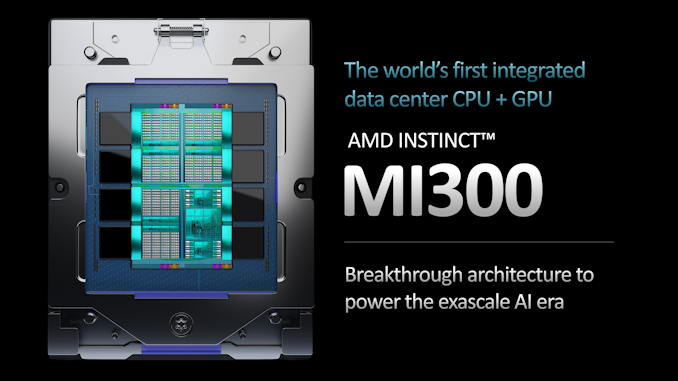
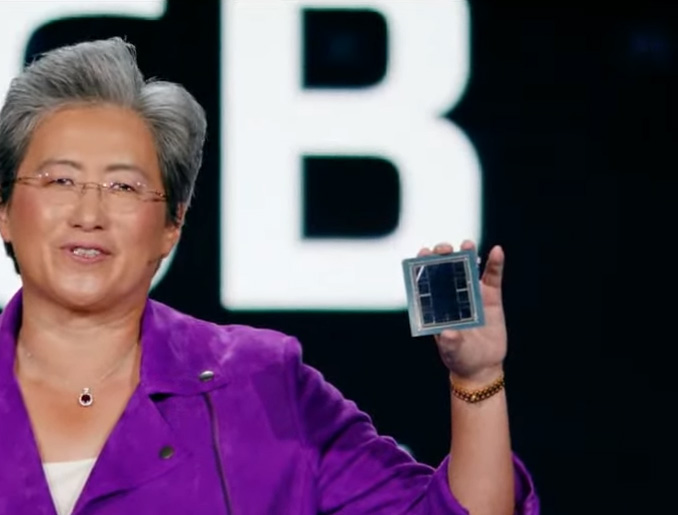
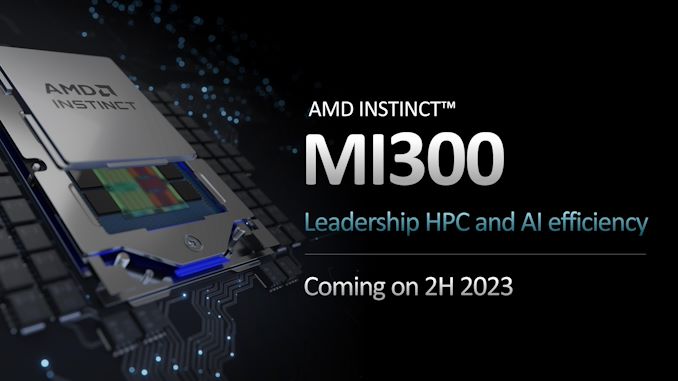
Alongside AMD’s widely expected client product announcements this evening for desktop CPUs, mobile CPUs, and mobile GPUs, AMD’s CEO Dr. Lisa Su also had a surprise up her sleeve for the large crowd gathered for her prime CES keynote: a sneak peak at MI300, AMD’s next-generation data center APU that is currently under development. With silicon literally in hand, the quick teaser laid out the basic specifications of the part, along with reiterating AMD’s intentions of taking leadership in the HPC market. First unveiled by AMD during their 2022 Financial Analyst Day back in June of 2022, MI300 is AMD’s first shot at building a true data center/HPC-class APU, combining the best of AMD’s CPU and GPU technologies. As was laid out at the time, MI300 would be a disaggregated design, using multiple chiplets built on TSMC’s 5nm process, and using 3D die stacking to place them over a base die, all of which in turn will be paired with on-package HBM memory to maximize AMD’s available memory bandwidth. AMD for its part is no stranger to combining the abilities of its CPUs and GPUs – one only needs to look at their laptop CPUs/APUs – but to date they’ve never done so on a large scale. AMD’s current best-in-class HPC hardware is to combine the discrete AMD Instinct MI250X (a GPU-only product) with AMD’s EPYC CPUs, which is exactly what’s been done for the Frontier supercomputer and other HPC projects. MI300, in turn, is the next step in the process, bringing the two processor types together on to a single package, and not just wiring them up in an MCM fashion, but going the full chiplet route with TSV stacked dies to enable extremely high bandwidth connections between the various parts.
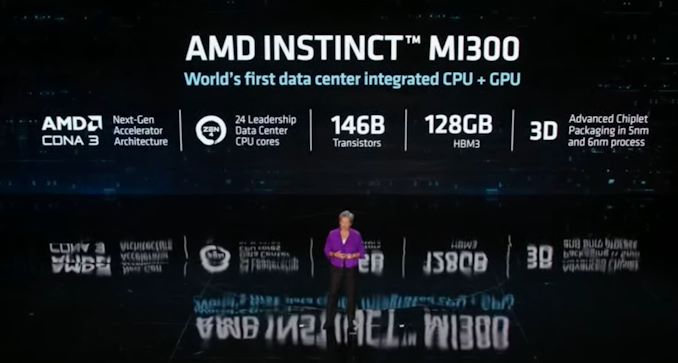
The key point of tonight’s reveal was to show off the MI300 silicon, which has reached initial production and is now in AMD’s labs for bring-up. AMD had previously promised a 2023 launch for the MI300, and having the silicon back from the fabs and assembled is a strong sign that AMD is on track to make that delivery date. Along with a chance to see the titanic chip in person (or at least, over a video stream), the brief teaser from Dr. Su also offered a few new tantalizing details about the hardware. At 146 billion transistors, MI300 is the biggest and most complex chip AMD has ever built – and easily so. Though we can only compare it to current chip designs, this is significantly more transistors than either Intel’s 100B transistor Xeon Max GPU (Ponte Vecchio), or NVIDIA’s 80B transistor GH100 GPU. Though in fairness to both, AMD is stuffing both a GPU and a CPU into this part.
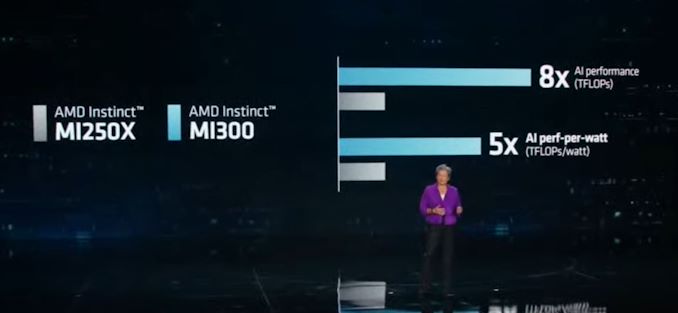
The CPU side of the MI300 has been confirmed to use 24 of AMD’s Zen 4 CPU cores, finally giving us a basic idea of what to expect with regards to CPU throughput. Meanwhile the GPU side is (still) using an undisclosed number of CDNA 3 architecture CUs. All of this, in turn, is paired with 128GB of HBM3 memory. According to AMD, MI300 is comprised of 9 5nm chiplets, sitting on top of 4 6nm chiplets. The 5nm chiplets are undoubtedly the compute logic chipets – i.e. the CPU and GPU chiplets – though a precise breakdown of what’s what is not available. A reasonable guess at this point would be 3 CPU chiplets (8 Zen 4 cores each) paired with possibly 6 GPU chiplets; though there's still some cache chiplets unaccounted for. Meanwhile, taking AMD’s “on top of” statement literally, the 6nm chiplets would then be the base dies all of this sits on top of. Based on AMD’s renders, it looks like there’s 8 HBM3 memory stacks in play, which implies around 5TB/second of memory bandwidth, if not more. With regards to performance expectations, AMD isn’t saying anything new at this time. Previous claims were for a >5x improvement in AI performance-per-watt versus the MI250X, and an overall >8x improvement in AI training performance, and this is still what AMD is claiming as of CES.
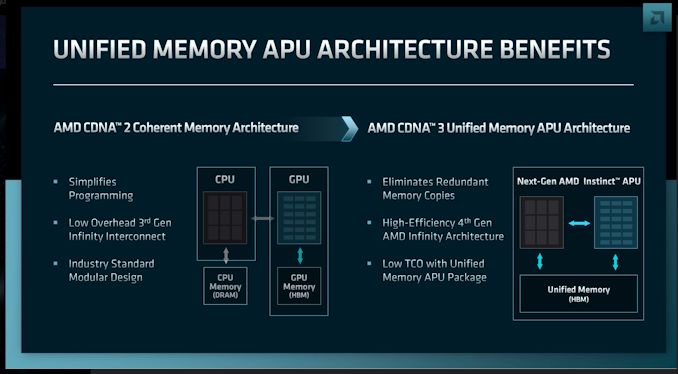
The key advantage of AMD’s design, besides the operational simplicity of putting CPU cores and GPU cores on the same design, is that it will allow both processor types to share a high-speed, low-latency unified memory space. This would make it fast and easy to pass data between the CPU and GPU cores, letting each handle the aspects of computing that they do best. As well, it would significantly simplify HPC programming at a socket level by giving both processor types direct access to the same memory pool – not just a unified virtual memory space with copies to hide the physical differences, but a truly shared and physically unified memory space.
When it launches in the later half of 2023, AMD’s MI300 is expected to be going up against a few competing products. The most notable of which is likely NVIDIA’s Grace Hopper superchip, which combines an NVIDIA Armv9 Grace CPU with a Hopper GPU. NVIDIA has not gone for quite the same level of integration as AMD is, which arguably makes MI300 a more ambitious project, though NVIDIA’s decision to maintain a split memory pool is not without merit (e.g. capacity). Meanwhile, AMD’[s schedule would have them coming in well ahead of arch rival Intel’s Falcon Shores XPU, which isn’t due until 2024. Expect to hear a great deal more from AMD about Instinct MI300 in the coming months, as the company will be eager to show off their most ambitious processor to date.
Gallery: AMD CES 2023 Instinct MI300 Slides
    | ||||||||||||||||||||||||||||||||||||||||||||||||||||||||||||
| 11:00a | CES 2023: IOGEAR Introduces USB-C Docking Solutions and Matrix KVM
IOGEAR has been servicing the computer accessories market with docks and KVMs for more than a couple of decades now. In addition to the generic use-cases, the company creates products that target niche segments with feature sets that are not available in products from other vendors. At CES 2023, IOGEAR is taking the wraps off a number of USB-C docks slated to get introduced over the next couple of quarters. Docking SolutionsThe three new products in this category fall under two categories - the first two utilize Display Link chips along with traditional USB-C Alt Mode support, while the third one uses the Intel Goshen Ridge Thunderbolt controller for 8K support in addition to the usual array of ports found in regular Thunderbolt 4 / USB4 docks. The following table summarizes the essential aspects of the three new products.
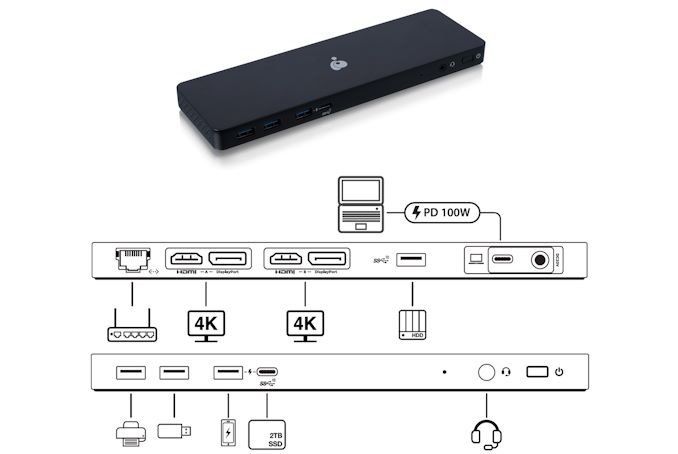
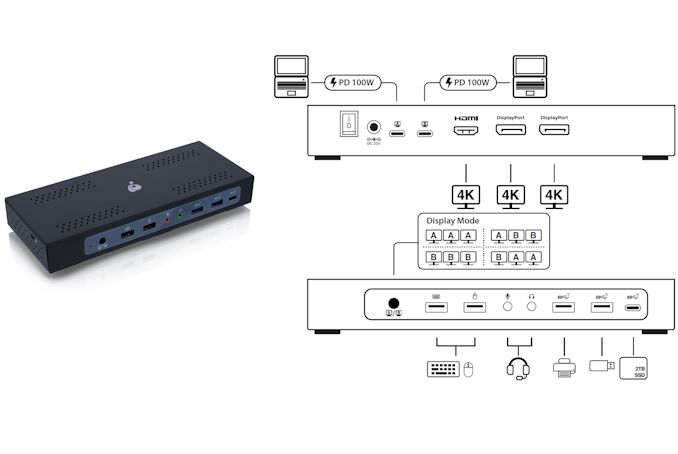
The Dock Pro Universal Dual View Docking Station is a premium DisplayLink-based dock capable of driving up to two 4Kp60 displays, with a choice of HDMI or DisplayPort for each.
The dock also includes host power delivery support, and the distribution of ports is presented above. The Dock Pro Duo USB-C Docking Station is ostensibly a USB-C dock, but it incorporates features typically found in KVMs. It allows two systems to be simultaneously connected to the dock, and a push button in front to cycle between one of four display modes as show in the picture below.
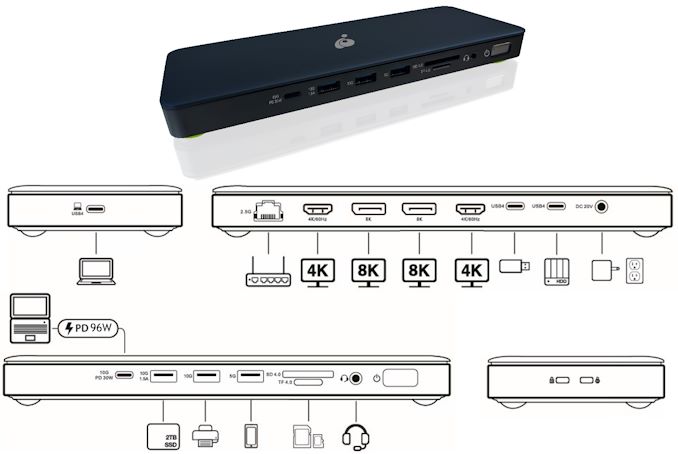
The push button configures one of the two hosts to the DisplayLink chain (that is behind the two DisplayPort outputs). All the peripheral ports are seen by the host connected to that chain. At the same time, the HDMI port is kept active using the Alt Mode display output from the other host. Hot keys are available to cycle through the display modes to enable easy multi-tasking. This is an innovative combination of docking and KVM that I haven't seen from other vendors yet. Finally, we have the flagship USB4 / Thunderbolt 4 dock - the Dock Pro USB4 8K Triple View. It incorporates all the bells and whistles one might want from a TB4 dock, including downstream USB4 ports and 8K support.
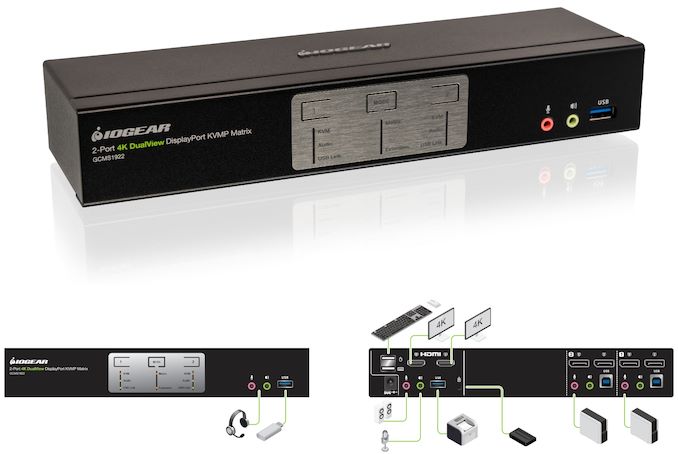
Surprisingly, the pricing is quite reasonable at $300 - possibly kept that way by avoiding Thunderbolt certification. This product could appeal to a different audience compared to the Plugable TBT4-UDZ despite similar pricing, thanks to the availability of downstream ports. However, the product is slated to ship only towards the end of the quarter. KVM SolutionsIOGEAR is also announcing the GCMS1922 2-port 4K Dual View DisplayPort Matrix KVMP with USB 3.0 Hub and Audio. Such KVMs with 4Kp60 support have typically been priced upwards of $500. This is no exception with a $530 MSRP. However, for this pricing, IOGEAR is incorporating a number of interesting features. The KVM can operate in either matrix or extension mode, with one computer driving both display outputs in the latter, and each host driving one display in the former. In the matrix mode, the KVM also supports crossover switching via movement of the mouse pointer (in addition to the regular physical button on the KVM and hotkeys). Audio mixing support (i.e, keeping the audio output of a 'disconnected' host also active) is available too, allowing the monitoring of notifications from both computers without having to switch sources.
The KVM provides two USB 3.2 Gen 1 and two USB 2.0 Type-A ports for downstream peripherals in addition to separate audio jacks for the speaker and microphone. It must be noted that the display outputs are HDMI, while the inputs are DisplayPort. The KVM switch is slated to become available later this quarter. In addition to these upcoming products, IOGEAR is also demonstrating the KeyMander Nexus Gaming KVM and the MECHLITE NANO compact USB / wireless keyboard at the show. These products were introduced into the market last year. | ||||||||||||||||||||||||||||||||||||||||||||||||||||||||||||


| << Previous Day |
2023/01/05 [Calendar] |
Next Day >> |