Add this feed to your friends list for news aggregation, or view this feed's syndication information.
LJ.Rossia.org makes no claim to the content supplied through this journal account. Articles are retrieved via a public feed supplied by the site for this purpose.
| Friday, May 23rd, 2014 | |
| LJ.Rossia.org makes no claim to the content supplied through this journal account. Articles are retrieved via a public feed supplied by the site for this purpose. | |
| 10:49 pm | London studio apartment, circa 2014 As demand for every square inch of space within London keeps rising in the unrelenting property gold rush, the city's realtors have had to find creative ways of packaging the ever-declining scraps of space remaining for non-oligarchs, in a fashion allowing the tenants to maintain their state of denial and tell themselves that the London lifestyle, for all its constraints, is still brilliant. Case in point: this is apparently now a “studio flat” in London. And for £130 a week, it, and with it a slice of the London life, can be yours. 
 </p>
The flat itself is located in Earl's Court; if the name sounds familiar it's because, a few decades ago, it was known as “kangaroo valley”, and full of cheap houses inhabited by Australian backpackers. Now, of course, the only Australians you'd find there would be well-heeled legal or financial professionals. Even with the high dollar, your average cashed-up bogan would struggle to find somewhere to hang their boxing kangaroo flag up in the area.
</p> </p>
The flat itself is located in Earl's Court; if the name sounds familiar it's because, a few decades ago, it was known as “kangaroo valley”, and full of cheap houses inhabited by Australian backpackers. Now, of course, the only Australians you'd find there would be well-heeled legal or financial professionals. Even with the high dollar, your average cashed-up bogan would struggle to find somewhere to hang their boxing kangaroo flag up in the area.
</p>This phenomenon doesn't seem to show any signs of letting up; as long as London has its glamour (in the original mythological sense of the word, bewitching otherwise rational people into taking leave of their senses), as long as the world's oligarchs and princelings need a pied à terre in town and there are wealthy people in unstable places looking for somewhere safe to stash their wealth, the prices of land in London will keep rising. Meanwhile, for the UK's most active industries, Dubai-on-Thames is the only game in town, meaning that there will have to be some way of accommodating the non-super-rich within the constraints of the white-hot housing bubble. Of course, other places would suggest things like rent control or social housing, but that would be socialism, and socialism is wrong, so that's out of the question. So, assuming that the price per square foot of London real estate will keep rising, the London lifestyle will become, shall we say, increasingly space-efficient. The first thing to disappear will be collections of physical media. Granted, this has already started, with the rise of digital media and the decline of physical formats; the space crunch, however, will accelerate it. When all you need is a Kindle and an iPod (or maybe not even one of those; a broadband connection and either a Spotify subscription or a high tolerance for ads will do), shelves of books, records and DVDs become an expensive luxury. (Doubly so if the overheated property market compels one to pack and move regularly.) On the other hand, they could become a status symbol for those who can afford the luxury; we may see high-flying professionals and trust-fund kids lining their London Fields pads with EXPEDIT bookcases full of vinyl records, like something a DJ in 1990s East Berlin might have, just to show that they can. The shrinking size of modern technology will also help. We've seen hi-fi systems shrink from furniture to shelf-sized devices to ridiculously small plastic boxes. Desktop computers have gone from enormous under-desk towers to hockey-puck-sized devices; if those are still too large, a Raspberry Pi will browse the web just fine; or with a laptop, one can do away with a desk altogether and just use them on the sofa or the fold-away dining table. Televisions, meanwhile, can go away; an iPad held at arm's length will fill the same amount of one's field the roommates one's sharing with to make ends meet. Other parts of the average urban house will also shrink. Kitchens are already shrinking to kitchenettes, and may soon be replaced with just a bench with a microwave and an electric kettle (or, if that's still too much space, just an electric coffee maker); or not even that; at some point, it becomes more affordable to order takeaway every day than to rent the extra space to prepare anything more complicated than a mug of instant noodles. Adam Smith would undoubtedly have approved of such an efficient division of labour. Meanwhile, bathrooms with actual baths are a relative rarity, but there remain untapped potential efficiencies in how closely one can pack a toilet, a sink and a shower cubicle. (As space rises in price, perhaps architects will take hints from the designers of sleeper train carriages and introduce folding multipurpose units.) Meanwhile, bedrooms will see a revival of bunk beds (especially for those less-affluent renters obliged to share). Clothing, too, takes up space, which is where technology can help; dirt-shedding and odour-neutralising nanotechnological materials may some day make having multiple changes of clothing less necessary. Of course, if demand for a space in London continues to outstrip supply, shaving bits of space off here and there will not be enough, and one may soon see reconfigurable living spaces, along the lines of Gary Chang's famous Hong Kong apartment; all the various sleeping, eating and entertainment modules on sliding rails, with niches to store one's Kindle, iPad and three changes of clothing, allowing one to live a modern metropolitan aspirational-professional lifestyle in the most efficient of spaces. |
| Wednesday, May 21st, 2014 | |
| LJ.Rossia.org makes no claim to the content supplied through this journal account. Articles are retrieved via a public feed supplied by the site for this purpose. | |
| 5:22 pm | Virtual Free Range
The enclosures are built to provide a comfortable and healthy home. Omni-directional treadmills provide livestock with the freedom to move freely in the virtual world. Each enclosure has independently filtered air to keep communicable diseases and parasites from spreading throughout the facility. The birds are fed a diverse, organic free range diet. The small and lightweight Animal-Computer Interfaces are designed to fit comfortably and allow chickens a full range of motion. The design of our facilities allows them to be located anywhere, even in urban centers. It is even possible to retrofit an empty office building. After all, Second Livestock is modeled on human activities such as the layout of the common corporate office. A networked grid of cubicles with internet access is not far removed from the enclosures we build for our chickens. However, our chickens likely get more exercise while on the job.Second Livestock is, of course, not (yet) an actual product, but a social experiment by an associate professor from Iowa State University, intended more to start a discussion about the social implications of technology. |
| Monday, May 19th, 2014 | |
| LJ.Rossia.org makes no claim to the content supplied through this journal account. Articles are retrieved via a public feed supplied by the site for this purpose. | |
| 1:24 am | Slowdive, Hoxton Bar and Kitchen, 18/5/2014 Tonight, I went to Hoxton Bar and Kitchen, for a gig celebrating the tenth birthday of local shoegaze night/label Sonic Cathedral (who formed a few months before I moved to the UK). The lineup consisted of Mark Gardiner (of Ride), Ulrich Schnauss and a mystery headliner. It was rumoured, and soon after that a pretty much open secret, who the headliner was: the gig was one night before the publicly announced (and quickly sold out) Slowdive show at the much larger Village Underground, and word started getting around that the returning shoegaze legends would be playing a warm-up gig the night before. The rumours turned out to be true, and the resulting gig even better than already high expectations. Mark Gardiner played first; it was just him with a 12-string acoustic guitar and loop pedal, playing a few Ride songs and some more recent material. He got an enthusiastic reception. Afterward, the lights went down and Ulrich Schnauss and another musician took to the stage, controlling a table of synthesisers and mixers, accompanied by video projections of crystals, nighttime journeys, modern architecture and very large machinery in motion. Schnauss played some new material from an upcoming album, and this material seems to have a more electronic sound, for want of a better word. Finally, after a few roadies placed the boards of guitar pedals on the stage, Slowdive went on, and started their set with their eponymous song, which was followed up Avalyn. Most of the set was comprised of songs from their EPs and Souvlaki, with one track (Catch The Breeze) from their debut album and two (Blue Skied An' Clear and Crazy For You) from Pygmalion. Their take on Crazy For You was one of the big surprises of the set; the original is a languid, evanescent number, drifting in and out as if made of gossamer. Their live version was a faster and more intense version, propelled by waves of processed guitars and driving percussion. It was, in a sense, as if Souvlaki-era Slowdive were playing a cover of Pygmalion-era Slowdive and adding their own interpretation to it. (And, in a sense, they were; Pygmalion was, in some ways, a work in progress; the band were fatally dropped by their label before they could play it live. Now, two decades on, they've seamlessly picked up where they left off.) The other surprise was their cover of Syd Barrett's Golden Hair, which they had never played live. Their rendition developed on the version they recorded but was considerably richer, seeming to build on where the bands that have come along in the two decades since (such as Mogwai, iLiKETRAiNS and Explosions In The Sky, to name three) have taken the loosely defined genre; the dynamics seemed that much more glorious. 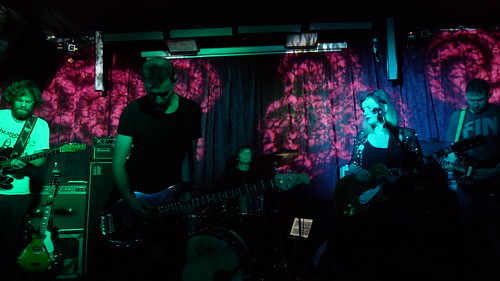 Slowdive were impressive. Not just impressive in the sense of competently playing some old favourites and hitting that sweet spot of nostalgia (though the show certainly did achieve that), or good for a band who reformed after some 19 years, but impressive by the standards one might judge any band. If one didn't know that this was their first gig since 1995, one would never have guessed; there was a freshness and vitality to the performance. (As one who spent much of 1998 or so listening to Souvlaki on repeat and then scouring the internet for MP3s of out-of-print early EPs (then deleted and generally disdained, not fitting into the grunge/Britpop narrative), I of course cannot hear Slowdive with the ears of one unfamiliar with their work, but can speculate that my younger self, from the moment before he heard their recordings, would have been blown away.) In any case, this will undoubtedly rank highly in my gigs of 2014. |
| Thursday, May 15th, 2014 | |
| LJ.Rossia.org makes no claim to the content supplied through this journal account. Articles are retrieved via a public feed supplied by the site for this purpose. | |
| 9:22 am | OKComrade There's a new dating service for those who find Guardian Soulmates too right-wing: OKComrade aims to pair up Communists, anarchists, socialists, syndicalists, People's Front of Judaea and others on the radical left seeking a partner to share the struggle with: It's high time for lefties to have a dating site of our own. Christians, Muslims, Jews, and atheists have long had their own matchmaking sites, but those searching for a politically suited partner have had less luck. Mainstream dating sites take ideology into account, but taboos against talking politics mean that major differences can be hidden for months or even years.Given the history of vehement internecine conflict on the radical left (didn't the Stalinists and Trotskyists in the Spanish Civil War expend more energy on killing each other than on fighting the Fascists?), it'll be interesting how stable the relationships OKComrade produces are compared to more bourgeois, liberal-reformist dating sites. |
| Sunday, May 11th, 2014 | |
| LJ.Rossia.org makes no claim to the content supplied through this journal account. Articles are retrieved via a public feed supplied by the site for this purpose. | |
| 2:07 am | The geopolitics of Conchita Wurst The results of Eurovision 2014 are in, and, as reported here, the big winner was Austria's Conchita Wurst, a bearded drag performer, with a resolute and melodramatic torch song titled Rise Like A Phoenix. Wurst (whose real name is Tom Neuwirth) won a runaway victory, with 290 points and a string of 12s, including ones from countries who might otherwise haver found a bearded drag performer too transgressive. The runner-up was the Netherlands, 52 points behind with a rather nice piece of slow-burning Americana. 2014 was arguably the most geopolitically charged Eurovision Song Contest in years, if not decades; the kitschy music equivalent of the World Chess Championship of 1972, in that, within its formalised, tightly circumscribed arena, the tensions of an active geopolitical fault line manifested themselves. As back then, the fault line was between the West and Russia, only the ideologies and alignments were different. One thing that was evident was a collapse of Russia's public image at Eurovision; no longer were they another country in friendly competition; they were the enemy, the face of oppression. Their performers (two teenaged girls who, to be fair, probably had little to do with the invasion of Crimea or anti-gay laws) were booed, as was their announcer during the voting, or the few instances of other countries, mostly former Soviet satellite states, giving Russia douze points. Also telling were the low scores which Russia got; whereas in the past, states bordering Russia or containing large Russian-speaking populations (as most former Soviet republics did, thanks to Stalin's population transfer programmes) could be counted on to give Mother Russia a solid vote, this largely seemed to collapse. This seems to support reports of a schism between ethnic Russian minorities in countries such as the Baltic states and the state of Russia, with many Russian-speaking citizens of other countries deciding that their feelings for their linguistic homeland don't translate into loyalty to an aggressive authoritarian regime. An obvious proximate cause of this collapse was the Ukrainian crisis; within days of the end of the Sochi Winter Olympics, Russia annexing the Crimea and making threatening noises at the rest of Ukraine (and some to say Finland, the Baltic States or even Alaska may be next in the hungry Red Bear's sight). Finally, the half-hearted pretence that Russia was a democracy (albeit a managed one, like, you know, Singapore or someone) and a member in good standing of the community of peaceful, cooperative nations was discarded for good, and a more brutal, Hobbesian order asserted itself for all to see. And no longer shackled by the need to feign liberalism or tolerance, Russia has been moving as rapidly at home as it has abroad; just this week, a law requiring bloggers to register with the government has been passed. Russia's anti-gay laws, and the tacitly state-sanctioned persecution of gay Russians by vigilante groups had already been on the radar, particularly in the context of Eurovision (which, whilst not specifically a gay event, has always had a strong gay following, because camp). The disproportionately harsh prosecution of Pussy Riot, whilst attracting less criticism in more conservative countries, didn't do Russia any favours either, and the gradual closing down of opposition media and occasional unsolved murders of journalists did not make for an optimistic mood. Recently, these elements have been converging to form an image not of a country struggling with democracy and pluralism, but one governed by an ideology which holds these ideas in contempt as signs of weakness, a country where closing itself off against the outside world. The ideology of Putin's Russia is what they call the Russkaya ideya (Russian Idea), or sometimes “Eurasianism” or “National Bolshevism”; explicitly anti-liberal, mystical rather than rationalistic, strongly authoritarian and hostile to foreign influences. The ideology is new, though it is synthesised from a strain of absolutism that has existed in Russia, in one form or another, since the time of the Czars: the State being at the centre of things (the “unique state-government civilisation” that is Russia, according to its ideologues), and all power flowing from it. Even the Russian Orthodox Church, with its enhanced influence in the new order, is subordinate to the state; in Russia, God serves the Czar. It is not clear whether, had Russia kept its troops within its borders, paid lip service to liberalism and pluralism and not said anything about gays and “traditional values”, Conchita Wurst would have won, certainly by such a large margin; her song was good, in a Bond-theme sort of way, but not overwhelmingly superior to everything else. The Netherlands' entry (which came second), for example, was quite good, and there was a sentimental case for giving the gong to Sweden, it being the 40th anniversary of ABBA winning and all. (Sweden's entry was in the good-but-not-memorable Eurovision standard basket, which, geopolitics notwithstanding, might well have sufficed.) Undoubtedly some of the douze points Austria got were a vote not so much for the music but for what it represented and, perhaps more importantly, against what an endorsement of it represented a rejection of. With liberalism as anathema to this new cult of Holy Russia, Eurovision has been in its sights for a while; Russian legislators have condemned it since last year, and there are calls to set up a rival one, one with firmly enforced “traditional values”. (This wouldn't be the first time something similar happened; during the Cold War, the Warsaw Pact countries briefly attempted to run a song contest to rival Eurovision; it was held in Poland, and was by all accounts a ramshackle affair. Interestingly, neutral Finland participated in both Eurovision and it.) In any case, Conchita Wurst's resounding victory will probably do little to calm the situation, but is likely to embolden those in Russia calling for restrictions on such foreign imports. (Their proposed solution, to omit the offending song in Russia, would be forbidden under EBU rules; some years ago, Lebanon ended up dropping out of Eurovision because the rules did not permit it to ban its citizens from voting for Israel.) It would be unsurprising if Russia (and perhaps some politically dependent states like Belarus) are notably absent from next year's contest, and the new cultural iron curtain becomes slightly more opaque. Another interesting consequence may be that of Russia ending up owning a certain type of reactionary conservatism, making it less palatable abroad, and forcing conservatives in eastern Europe to choose between siding with the Great Bear across the border or siding with the gays and feminists within their own borders, establishing a geopolitical schism much like the Cold War one, only this time with elements of the Right rather than the Left being beholden to Moscow. We are already seeing admiration for Putin from the envious beta-males of the populist Right, from UKIP in Britain to teabaggers in America; if Russia succeeds in establishing a “Conservative International“ (along the lines of Stalin's Comintern) and drawing like-minded reactionaries and authoritarians abroad into its orbit, we may soon see Alexander Dugin's books on Eurasianism (in English translation, from a state-run publishing house in Moscow) alongside the Ayn Rand, Ludwig von Mises and Bill O'Reilly that fill the reading lists of the right-wing fringe. |
| Saturday, May 10th, 2014 | |
| LJ.Rossia.org makes no claim to the content supplied through this journal account. Articles are retrieved via a public feed supplied by the site for this purpose. | |
| 6:43 pm | Eurovision 2014 liveblog Well, that time of year is upon us again; that's right, it's the Eurovision final, this time coming from Copenhagen, and presented by Kaspar Juul from Borgen. Eurovision is, paradoxically, a bigger thing in Australia than the UK; some of that is undoubtedly due to there having been mass immigration from continental Europe to Australia in the mid-20th century, and an infrastructure of ethnic broadcasting set up during Australia's progressive era, which ended up priming the public to better get Europe. In contrast, in the UK, Europe seems paradoxically further away, being something that one feels obliged to put some distance—as much as possible, really—between oneself and. The UK is technically part of Europe but half resents its place there (as a glance at any British tabloid newspaper will show) and in any case feels a bit above all those ridiculous garlic-eaters across the Channel and their daft customs. In that there may be a sense of insecurity; the continent is perhaps regarded much as the class beneath one's own is, as something which one is at risk of being categorised in by observers if one doesn't do a good enough job of distinguishing oneself from it. Were I in Melbourne, I would probably be at a Eurovision party. (Actually, were I in Melbourne, I would probably be asleep, and going to a Eurovision party some 18 hours later, but I digress.) In the UK, I have only been to one Eurovision party over the past almost ten years here, and that was a somewhat sedate affair compared with the ones back home, with more filling out of scorecards. One won't find any respectable local pub airing Eurovision on their big screen, and the handful of bars that do sell tickets, hire performers to hype the crowd up and otherwise double down on the kitsch, to the point where the activities in the pub drown out the actual contest on TV. I am told that this is not the case on the Continent; that you can't throw a currywurst in Berlin without hitting a Kneipe that's showing Eurovision. However, being neither on the continent nor in possession of sufficient articles of sequinned clothing, here I am on a sofa in North London with an iPad and a laptop, watching it and liveblogging about it. This post will be updated as things happen. 20:03: And here come the BMX Ninjas. 20:14: And here's Kaspar. And was that an inflatable boxing kangaroo being waved above the audience? 20:19: Ukraine's entry sounds like the filler from a Mariah Carey album in the early 90s, or an off-brand Whitney Houston substitute. Meanwhile, neighbouring Belarus's effort seems to be syncopated R&B from deep in the Uncanny Valley. 20:34: Azerbaijan seem to be quite into visual effects. Their intro video was an interesting use of light painting, and the background projections were pretty nifty (though the gothic cathedral graphics didn't look very typically Azeri). The song, a tasteful piano ballad that almost survived the belted vocals, seemed to have been sourced from Scandinavian songwriters. Was that Skögafoss in Iceland's intro video? Anyway, their number was fun; colourful costumes and a lot of energy. Slightly trite subject matter, but that all goes with the territory. 20:36: Norway had a tattooed dude singing a morose yet soporific number in a minor key; a bit of a downer, and I suspect it won't do spectacularly well, but I could be wrong. Romania seem to have entered the usual Eurodance ballad, with 90s rave synth presets galore and gratuitous high-note hitting. Their intro video was clever; reflections of fireworks on water to form the Romanian flag. 20:41: Armenia going from generic piano-balladry to NIN-lite industrial-glitch with cinematic strings. 20:44: And Montenegro brings a Slavic take on My Heart Will Go On, right down to the tin whistle. The projection-mapped sparkles from the rollerblader's skates are aa nice touch, though. I wonder whether they're added to the broadcast or actually appear under the glass floor? 20:47: And here's Poland's answer, whose gist seems to be “Slavic girls are hot”. They even sing the third verse in English for those whose Polish isn't too good. Inauthentic folk costumes and a Missy Elliott-styled backing track. 20:51: Here comes Greece, with its London-raised rapper toasting over a fairly standard Eurodance backing. Also, a trampoline. 21:01: And here is Austria's entry, fronted by bearded drag performer Conchita Wurst; whose presence caused the Russians to demand a boycott or the right to ban Austria from their broadcast. I'm guessing that they didn't get it, given that Russia's still in the running. Lebanon famously had to pull out some years ago as they couldn't get their demand to ban their citizens for voting for Israel. Mind you, Russia is not Lebanon; it'll be interesting to see if this very camp and distinctly non-straight performance will be aired in Russia; the EBU may have to slap the Russian state broadcaster's wrist if they don't. Anyway, Austria's performance was a classic torch song; poignant and melodramatic. Meanwhile, neighbouring Germany has three ladies with a double bass and an accordion. The singer is another soul/gospel belter in the Carey/Houston vein. 21:13: Sweden seems to be in with a chance; a somewhat conservative choice, but well executed. Conservatism, however, is not a chance one can make against France this year; they've eschewed the customary white-gowned-lady-and-grand-piano in favour of three zany dudes clowning around and rapping (in French) about being unable to grow a moustache, over a nicely varied dance beat. Whether that puts them behind or ahead of the hipster zeitgeist is up for debate. And more twins, this time from Russia, this time female and with hair tied together. The set they're standing on looks like a temporary bridge (possibly a reference to the annexation of the Crimea?); anyway, I suspect that they might do as badly, through no fault of their own, as Britain did in the wake of the Iraq War. 21:18: Italy probably wins the most-appetising-intro-video award. Their song, meanwhile, is vaguely rock-styled, in a slightly 1980s way. Lots of white jeans and flying-V guitars; and golden laurel leaves.
21:28 Slovenia's entry seems fairly generic, in that off-brand-Roxette-knockoff vein that is part of the Eurovision formula, though the singer plays her own flute. Finland has a band that look like what 21:40 Switzerland are in the running for the most-innovative-intro-video gong. Their actual song was a sort of quasi-Mumfordian dance-pop. Hungary, meanwhile, has a half-American singer whose father was a soul singer who worked with Lou Reed. This guy can sing. And then the chorus breaks into 1990s-vintage jungle beats. 21:42: Malta are doing Uplifting Soulful Folk. Great Cthulhu help us. 21:50 Denmark get points for the song title (Cliché Love Song) and for the use of forced perspective in the intro video. The song itself stays in the pop formalism, winking through the fourth wall; it's self-aware kitsch. It doesn't come anywhere near the realms of the sublime that Eurovision touches at its best, but then again, this year hasn't so far been a good year for that; no monster metal, Romanian vampire opera or other heavy weirdness. 21:53 The Netherlands have a tasteful piece of slow-burning Americana. It's pleasant and not overwrought, and thus probably won't do well. Nonetheless, in terms of songcraft, it is a particularly nice example. 21:55 San Marino? Ah, San Marino; one of those weird tiny European enclave-states. Anyway, their song is pretty standard Eurovision fare. 21:57: And here comes the United Kingdom's entry; the intro video, of course, was made of Routemasters. The song, meanwhile, is a welcome improvement on the usual half-arsed fare Britain sends in. We might just finish in the top half of the rankings after all. 22:12: And, in the break, the Danish sense of humour manifests itself, in a humorous ditty, embodying every Eurovision cliché, about the number 12 (the maximum score a country can get), which kept segueing into a song about China, for some obscure in-joke-related reason. This was followed by a contribution from Malta's Junior Eurovision champion, an 11-year-old whose voice is, unfortunately, not quite as melodious as it is powerful. 22:45: Anyway, the votes are starting to trickle in. First in is Azerbaijan. Austria and Poland got 1 and 2 respectively; seems sexuality, either homo- or hetero-, aren't vote-winners over there. Russia bagged 12, followed by Ukraine, unsurprisingly; when Russia's douze points was announced, boos could be heard. Austria made up for it with 12 from Greece. </p> |
| Tuesday, April 29th, 2014 | |
| LJ.Rossia.org makes no claim to the content supplied through this journal account. Articles are retrieved via a public feed supplied by the site for this purpose. | |
| 6:29 pm | Artisanal bread vs. economic rationalism The impeccably economically rational minds in Australia's Productivity Commission has denounced artisanal food producers, “international style” bakeries and small winemakers as a drag on Australia's productivity and economic efficiency: “Bakery product manufacturing is likely to have contributed to lower measures (or productivity),” the commission says ... “Lifestyle considerations, tax arrangements, and alternative sources of income may have reduced the incentive for small wine-makers to leave the industry.” If one looks at it from a certain perspective, they have a point. Certainly, spending $5 on a loaf of artisanal bread when a $1 loaf of Tip-Top will provide the same amount of calories is an expensive frippery which isn't doing Australia any favours when competing in the Global Race that one keeps hearing about. After all, while we're demanding the money and leisure time to savour a sourdough ciabatta washed down with a nice glass of cab sav, the developing world has billions of people who are willing to work 90-hour weeks on a bowl of gruel a day and be grateful for it. That's to say nothing about the establishments in which these decadent luxuries are consumed. Taking up valuable space all over inner urban areas, these squander resources on quirky décor, and not only neglect but actively sabotage their throughput by encouraging the patrons to linger, rather than quickly getting and consuming their food and going back to productive work. Replace them all with McDonald's-style drive-throughs and not only would Australia's workers be able to get more work done, but, paying less for their lunch, could do so for more competitive wages. Think of all the extra iron ore we could load onto ships, and the higher profits remaining at the end of the day. But why stop there? While pointing out the grotesque inefficiencies of small-scale foodstuffs and gratuitous luxuries (and, implicitly, wages high enough to create demand for such fripperies) drives a point home, it misses the broader point implied in such economic-rationalist (or, as they call them these days, neoliberal) critiques, that of what Australians should and shouldn't be doing. Australia, it would seem, has one core business: digging Australian ore and coal up and shipping it out; it's the one thing we do better than anyone else in the world, and everything else that doesn't tie into that or its support industries is superfluous, and thus, by definition, a drag on the national economy. (With the exception of cricket, of course; panem et circenses, as they said in Rome.) If you divert resources to baking artisanal bread, or, say, building cars or televisions (which the Chinese can do far more efficiently), those are resources which cannot be used for digging up every lump of coal that can be sold. Another example: if you go to any of the aforementioned inner-city cafés with their inefficient ciabattas and fairtrade flat whites, you are likely to find several people in their 20s and 30s with fashionable hairstyles and MacBooks; some of them will be working on mobile games or social websites, editing short films, writing novels, mashing up phat beats, or doing other things atypical of the inhabitants of a mining colony. Given the high Australian dollar (due to the world wanting our iron ore and coal, which we can't dig up fast enough), it makes no economic sense for anyone in Australia to be doing these things, given that similarly fashionably attired MacBook owners in Berlin or Brooklyn could do the job for less (that's to say nothing of the DJs and designers of Beijing or Bangalore). Nonetheless, the young and hip in this mining colony maintain the pretense of being part of a “Creative Class”, one of limited economic purpose and often importing its symbols and touchstones, from trucker caps to taco trucks, from bars named after parts of Barcelona to the very idea of using bicycles to get by (itself a pretentious, and un-Australian, affectation according to a significant segment of the population). Meanwhile, tonnes of iron ore remain tragically unmined and unsold. So the question posed by the critique seems to be: perhaps it's time for us to, as our heroic Prime Minister would put it, stick to our knitting, put aside all these foreign lifestyle pretensions and concentrate on what we do best: digging stuff up and shipping it out. After all, we all want to live in an efficient, dynamic economy, don't we? Those who don't fit in with the country's business, who can't find a job as a minerals engineer or contract lawyer, can try their luck with the US visa system or see if they can wangle a European passport through where their grandparents came from. Of course, that's one point of view; that from the top of the pyramid, from where everything is a resource to be managed efficiently (which is to say, profitably), and the profits are to make their way to the top of the pyramid, unmolested by the little people's economically irrational desires for artisanal nutrition, or the notion that Australia might be a complex society rather than, as that other metaphor used by the current government goes, a team with a single national focus. But increasingly, this is the point of view which counts. |
| Friday, April 11th, 2014 | |
| LJ.Rossia.org makes no claim to the content supplied through this journal account. Articles are retrieved via a public feed supplied by the site for this purpose. | |
| 12:12 am | Hypergentrification, the cultural Big Bang and the death of cool Alex Proud, who previously wrote about the Shoreditch-modelled gentrification and sanitisation of the down-at-heel parts of London, has a new article about the end state of this process of gentrification and the future of hyper-gentrified London, a homogeneously rich, clean, and dull, place, with all the edginess and excitement of Geneva or central Paris, a city of "joyless Michelin starred restaurants and shops selling £3,000 chandeliers": Two decades on and you can play a nostalgic little game where you remind yourself what groups London’s inner neighbourhoods were known for 20 years ago. Hampstead: intellectuals; Islington: media trendies; Camden: bohemians, goths and punks; Fulham: thick poshos who couldn’t afford Chelsea; Notting Hill: cool kids; Chelsea: rich people. Now, every single one of these is just rich people. If you want to own a house (or often just a flat) in these places, you need a six figure salary or you can forget it. And, for anyone normal, that means working in finance. Inner Paris is a fairytale for wealthy people in their fifties (and outer Paris looks like Stalingrad with ethnic strife) while Geneva has dispensed with the poor altogether. As a result, both cities are safe, pretty and rather boring places to live – and soon London will be too.The article is a fine rant, dripping with bons mots like “Bitcoins for oligarchs”, “like Jay-Z as reimagined by someone who works at Goldman Sachs”, and “the bastard offspring of Kirstie Allsopp and Ayn Rand”; the prognosis is not hopeful for London either: In the short term, our city’s young creative class will continue to move further and further out. Is New Cross the new Peckham? Is Walthamstow the new Dalston? But there are limits to this: there’s not much of a vibe in Ruislip and there never will be; really, the cool inner suburb ship sailed in 2005. So, when you’re stuck out amongst the pebble-dashed semis of Zone 4, miles from a centre that’s mainly chain shops, boutiques for the tacky rich and restaurants you can’t afford or even book, you might start wondering if the World’s Greatest City (TM) really is for you. Then maybe you’ll visit friends, somewhere like Bristol or Newcastle or Leeds or Glasgow. And maybe you’ll discover that there you can buy a house that’s walking distance to a centre full of shops that cater to you, restaurants that want your custom and pubs and clubs whose prices wouldn’t make someone in Gstaad blanch... Perhaps London’s craven fealty to the ghastly rich will finally accomplish what no government policy ever has – it will rejuvenate our provincial cities.Though chances are, the cities with fast links to London will end up hypergentrified as well; Brighton (or “London-by-the-sea”, as some call it) is well on the way to going there, and some speculate that places like Margate (one hour from London along a partly high-speed railway, and already sprouting vintage shops and a modern art gallery amongst the everyday-is-like-Sunday shabbiness) could end up following suit. Birmingham, meanwhile, might jump from never-quite-fashionable to bourgeois luxury for the new-economy elite when HS2 arrives, allowing those who aren't fully-fledged partners to afford somewhere within an easy commute of Canary Wharf. Proud blames this state of affairs on a system rigged to pander to the beneficiaries of this state of affairs—house-flippers, buy-to-let landlords, ex-Soviet oligarchs looking for somewhere to park their wealth—at the expense of the little people to whom it is made clear that the city does not belong, and who are gradually squeezed further out, towards the periphery and beyond; who still hold onto their shrinking, expensive foothold on the precious land inside the M25, believing that it's stil worth it because of the aura of brilliance surrounding the idea of London; an aura increasingly based in nostalgic delusion, and one which can't last. Readers of the Guardian or New Statesman will have seen this story numerous times, from different angles and at different points in time, more or less the same, only with the place names moved slightly further out every year. However, part of the message here is in the medium; Proud is writing in the Daily Telegraph, a paper owned by the Barclay Brothers, long associated with the Conservative Party (it's often nicknamed the Torygraph), and one which one might imagine would be perfectly au fait with the ideals of the Thatcherite “property-owning democracy”. When the Torygraph is publishing articles bemoaning how gentrification is hollowing out and sterilising London, then perhaps it is time to be concerned. I wonder how much this is due to one of the less-often-quited corollaries of the neoliberal/market-oriented mindset of the recent few decades: the idea that anything of value is traded on a market, and everything is a convertible hard currency, this time applied to cultural capital. It used to be that cultural capital and economic capital were separate spheres, and absolutely not interconvertible. There were no cool rich kids, or those who were hid their economic capital. (The word “cool”, in fact, originated with socially and politically disenfranchised African-Americans; in its original meaning, the word didn't mean chic, fashionable or at the top of the status hierarchy, but refered to an unflappability, an unwillingness to let the constant low-level (and not so low-level) insults and aggressions of an institutionally racist and classist system be seen to get you down; as such, it was, by definition, the riches of the poor, the exclusive capital of those excluded from capital.) Fast forward to the present day; after Milton Friedman declared everything to be convertible goods in a market. Reagan and Thatcher applied this to economic goods, launching the “Big Bang” of deregulation and the 20-year economic bubble that followed. Then the Clinton/Blair era of the “Third Way” coincided with its own Big Bang, this time deregulating the cultural marketplace; starting off with Britpop and going on to Carling-sponsored landfill indie, New Rave, hipster electro (and indeed the recycling of the term “hipster”, originally meaning a habitué of the grimy jazz-and-heroin demimonde of the Beat Generation, now referring to trust fund kids in limited-edition trainers), yacht rock, chillwave and whatever. The old regulatory barriers between the mainstream and the underground were swept away as surely as the barriers between high-street and investment banks had been a decade earlier; the rise of the internet and the cultural globalisation played a part in it, though the mainstreaming of market values once seen as radical would also have had a hand. Soon everything was in a commodity available on the marketplace; 1960s guitar rock and Mod iconography was revived as Britpop, post-punk, stripped of unmarketable references to Marxism, Situationism and existentialist paperbacks and sexed up, as generic NME-cover “indie”, and we were faced with a multifaceted 80s revival that ran for longer than the 80s. Major-label pop producers used ProTools plug-ins to grunge up their protégés, giving them that authentically lo-fi “alternative” sound, while bedroom producers armed with cheap laptops and cracked software made tracks that sounded as expensively polished as anything heard in a Thatcher-era wine bar. Knowing about Joy Division or Black Flag was no longer a badge of being “hip”, as anyone with an internet connection could do the research; the new shibboleths were evanescent memes, like referencing Hall & Oates right down to the facial hair, or reviving New Jack Swing and calling it “PBR&B”, or the whole Seapunk subculture; currents one wouldn't have caught wind of in time without being connected, and whose cultural value became void once the wider world heard of them. This coincided with the dismantling of free education, the rise in income inequality, and the gentrification of “cool” areas full of the young and creative, and soon it was a good thing that having economic and social capital didn't bar one from cultural capital, because having a trust fund was increasingly a prerequisite. If Mater and Pater bought you a flat near London Fields for your 18th birthday, and if you had a reserve of money to spend while you “found yourself”, and the likelihood of being able to land an internship on a career track in the media once your Southern-fried-hog-jowls-in-katsu-curry food truck failed or you got bored of playing festivals with your respectably rated bass-guitar-and-Microkorg duo, then you had the freedom to explore and develop, and that development could take a number of forms; travelling the world's thrift shops, picking up cool records and playing them at your DJ night, spending the time you don't need to work for money getting good at playing an instrument (and recent UK research shows that people in wealthier areas tend to have better musical aptitude), or just growing a really lush beard. With the rolling back of the welfare state and the "race to the bottom" in wages, these quests for self-actualisation are once again the preserve of the gentry; it's rather hard to develop your creative voice when you're on zero-hour contracts, and spend all your time either working in shitty jobs, looking for work, or commuting from where you can afford to live. And so economic capital has colonised cultural capital, and what passes for “cool” now belongs to those with money. It's not quite like a Gavin McInnes troll-piece about the coke-addicted bankers' scions who form the Brooklyn scene or a Vice_Is_Hip parody tweet about the coolest bar in the Hamptons or the latest sartorial trends from Kuwait's hippest princelings, but those are looking less and less unbelievable. The question is, what happens in the end? Will cultural capital converge with economic capital, and “cool” be redefined to be a sort of cultural noblesse oblige, a manifestation of wealth and status, or will, as Proud suggest, the whole thing collapse into a cultural low-energy state of tidy tedium? |
| Tuesday, April 8th, 2014 | |
| LJ.Rossia.org makes no claim to the content supplied through this journal account. Articles are retrieved via a public feed supplied by the site for this purpose. | |
| 1:22 am | John McAfee speaks Gonzo drug runner turned antivirus magnate turned flamboyant oddball John McAfee does an interview at Slashdot, giving detailed advice for anyone conducting sketchy business in Central America: In order to make the most of your travels, you need to first understand that, throughout much of the Third World, there is a smoothly functioning “system” in place that has evolved over centuries. From the First World perspective it is a “corrupt” system, but that’s not a helpful word if you want to acquire the most effective attitude for dancing with it. I prefer “negotiable”. It focuses the mind on the true task at hand when dealing with officialdom and removes any unpleasant subconscious connotations. So if you can view the following tools and tips as negotiation guidelines it will help bring the necessary smile to your face when the situation requires one. Documentation is the polite word for “cash” ... Nothing irks locals more than someone who produces documentation in excess of what is expected. It ruins the system for the rest of the population. The Police begin to expect more from everyone, and the populace is then burdened beyond any sense of reasonableness. I might mention that checkpoints for any given location in most countries are set up no more than once a week, and frequent travelers reach accommodations with the authorities so that they are not unnecessarily burdened to the point that they are single-handedly putting the policeman’s children through school. The police are, by and large, honest people with hearts, and few truly abuse the system. What does happen, and it seems to work reasonably well, is that when a crime is committed, a random person who everyone believes should belong in jail is arrested. Sometimes more than one. If the person or persons, does not have an airtight alibi, such as being in attendance at some other jail during the time of the crime, or performing at a live concert with hundreds of people watching during the time of the crime, then the person, or persons, is charged and generally goes to jail. Exceptions are relatives and friends of powerful people who are never charged for anything under any circumstances, even if an entire town witnesses them engaging in any illegal act, including murder. Local judges are instructed in how to decide cases by the most powerful person in the town and it all seems to work smoothly and efficiently. What advice would you give to [Peter Norton] to get his name off the second worst software on the planet? |
| Sunday, April 6th, 2014 | |
| LJ.Rossia.org makes no claim to the content supplied through this journal account. Articles are retrieved via a public feed supplied by the site for this purpose. | |
| 12:30 pm | Western Australia Senate election 2014 Yesterday, Western Australia held its Senate byelection, after it turned out that the Senate election last year had been botched. Now the results are mostly in. The major parties did poorly, barely getting more than 50% of the vote together. The Liberal Party suffered a -5.5% swing (which is hardly unusual for a government in a byelection), and their coalition partner the Nationals only got around 3% of the vote (about 1/4 of the Palmer United Party's vote), not coming close to a Senate seat. Meanwhile, Labor also fared poorly, suffering a -4.8% swing. Some of this could be remaining uppity-sheila-hate, but it's more likely to be due to the ALP having kicked an own-goal, deciding that given that the Mining State is uniformly right-wing in tendencies and heading up their ballot paper with an ultraconservative loose cannon and former student-union comrade of Tony Abbott, who, in an address to a Christian group, said that Labor's too full of "weird lefties" and Abbott could make a great Prime Minister. Ironically, as he was at the top of the ballot paper, his seat is assured, whereas whether the ALP's second candidate, Louise Pratt, will get up is a very open question. Back to the focus group, boys... Meanwhile, among the winners of the night are the Greens; Scott Ludlam, the savvy digital-rights advocate whose seat hung on a handful of votes in the last election, is definitely in with a solid margin. This is undoubtedly partly a result of the Greens' solid campaign and partly the ALP having decided that they don't need progressives and that they should concentrate on becoming a more watered-down Liberal Party. The progressives, it seems, have taken the hint and gotten behind the Greens, and there seems to have been more of them than the ALP's wonks expected. Another winner, or at least a high-roller in the casino that is politics, is Clive Palmer's Palmer United Party, who bagged a seat for less than A$20m. Palmer's candidates are hard to find, being not so much parliamentarians as conduits of their employer's will, bound by contract to vote as the boss says. Australia seems to be on its way to having proper oligarchs, in the Russian sense of the word. There is still some question over who will get the last seat; whether the Liberals (who had three seats before the election) will win it again or whether it'll go to the ALP. The word on the street is that postal votes tend to lean right, so the Liberals might end up getting it. If I were Tony Abbott, my priority right now would be to seduce Joe Bullock into crossing the floor and either joining the Liberals or sitting as a (conservative) Independent. Given that both Abbott and Bullock are men who, in an earlier time, could well have joined the DLP, that may be a viable proposition, or at least easier than negotiating with a panoply of minor parties. |
| Saturday, March 29th, 2014 | |
| LJ.Rossia.org makes no claim to the content supplied through this journal account. Articles are retrieved via a public feed supplied by the site for this purpose. | |
| 11:59 pm | Eight Mistakes that Music Critics Make An article enumerating the eight mistakes that rock music critics make: I’ve made some mistakes along the way. We all have: it’s a learning curve, this rock-writing thing. First we imitate Christgau and Bangs, then we imitate Spin and NME, then we forget what the hell we were trying to do in the first place, then (after several hundred reviews) we find our own voice. Well, some of us do. Some bail out; others turn to writing press kits. Some stalwarts continue hyping, lying, mushmouthing, and being generally annoying. Still, I’d like to say I’ve learned from my mistakes, and that’s the purpose of this column. Here are the Eight Biggest Mistakes That Music Critics Make, intended to supplement Lankford’s own list on how we critics can bring out our inner asshole. And yes, these mistakes: I’ve made them all. In fact (for all you pomo kids out there) I believe on at least two occasions I make the mistake while writing about it, below. Keep your eyes peeled. This may sound absurd, but writers with Good Taste are inevitably the worst critics. Yes, yes, all critics have “good” taste, or at least they have faith in their own idiosyncratic eardrums. But Good Taste is something different altogether: it’s a combination of middlebrow sentiment, political correctness, multicultural blandness, and moral jitters. Fear of violence and speed and sex and cusswords are somewhere in there, too. Good Taste is what makes a critic love Lauryn Hill but fear Li’l Kim. Good Taste means putting Willie Nelson ahead of David Allen Coe in the country-music canon. The only way to be a truly discerning critic is to brave the elements: slap on albums by ANTiSEEN, Def Squad, Cyndi Lauper, Anal Cunt, Commodores, Star Death, Pink & Brown, Voivod, Johnny Paycheck, Ja Rule, Iron Maiden, Hanson, .38 Special, Blink 182, and see what you like. (Just for the record, I like all of ‘em except Ja Rule and Anal Cunt). Don’t stick to the safe critically received Beck’n'Wilco mulch or you’re gonna dull your ears too fast. Good Taste is for brainless elites. Go for bad taste first, then work your way up.(Though I emphatically disagree with his dismissal of Yo La Tengo's And Then Nothing Turned Itself Inside Out as an "ether-soaked gauzepad"; sure, it's no balls-to-the-wall rock workout, but it is in my opinion among their best albums. Hey, if you want shock and awe, buy a Skrillex album or something.) |
| Tuesday, March 25th, 2014 | |
| LJ.Rossia.org makes no claim to the content supplied through this journal account. Articles are retrieved via a public feed supplied by the site for this purpose. | |
| 5:55 pm | What's a little casual racism between mates? The Australian government announced it is scrapping a section of the Racial Discrimination Act which had been added by the Keating government in 1995; coincidentally, the one under which right-wing demagogue Andrew Bolt was successfully prosecuted for insinuating that fair-skinned Aborigines were liars and benefits cheats. In defending the government's about-face on this issue, the Attorney-General declared that "people have the right to be bigots". And while the government is, of course, firmly opposed to racism, the dog-whistle is that, as a nation, we're perfectly relaxed and comfortable with a spot of casual racism between mates, as long as it doesn't escalate into a public order offence or anything. As if to top that, a day later, PM Tony Abbott announced that Australia will be bringing back imperial honours, with those honoured being given the title Sir or Dame (based on biological gender, of course; there will be no funny buggers in Abbott's Australia), overturning one of the Whitlam government's key symbolic achievements; back-handedly, the first recipient was the immediately outgoing, and staunchly republican, governor-general, Quentin Bryce, who is hardly in a position to decline. It's not clear who will be next in line for honours, though there probably won't be a Sir Rupert Murdoch, given that he renounced his citizenship. It may well be that the editorial conference of The Australian will look like the court of Camelot by the time of the next election. So there we have it; an Australia where the sentiment "haters gonna hate" is actually enshrined in law, and the respect Australians were once obliged to show to those from different backgrounds can now go to their social superiors. On one level, this looks like a planting of the LNP's unapologetically conservative flag, and a slamming of the Overton window hard to the right; on another level, it seems almost calculated to create a lot of smoke. Which makes me wonder: is this a prologue to more substantial conservative legislation (perhaps a ban on abortion, the privatisation of the ABC, tougher censorship laws or something), or a distraction from something that's decidedly not culture-war red-meat and would give the Silent Majority of (Occasionally Casually Racist But In A Mately And Acceptable Way) Suburban Battlers little to celebrate? Like, say, harsh industrial-relations laws to go with the symbolic feudalism in the imperial honours system? |
| LJ.Rossia.org makes no claim to the content supplied through this journal account. Articles are retrieved via a public feed supplied by the site for this purpose. | |
| 1:22 am | Towards gender-neutral German The federal Justice Ministry in Germany has decreed that all state bodies should use gender-neutral language; something which is somewhat more complicated in a strongly gendered language such as German, in which it is generally impossible to mention a person without disclosing their gender: The changing nature of German is particularly noticeable at university campuses. Addressing groups of students in German has been problematic ever since universities stopped being bastions of male privilege. Should they be sehr geehrte Studenten or sehr geehrte Studentinnen? In official documents, such as job advertisements, administrators used to get around the problem with typographical hybrid forms such as Student(inn)en or StudentInnen – an unfair compromise, some say, which still treats the archetype of any profession as masculine.Some speculate that these changes will ultimately lead to the same process that stripped other Germanic languages such as English and Swedish of their gendered nouns; the process could take centuries, though gender-neutral pronouns could be adopted from existing regional German dialects such as Niederdeutsch (Low German), where nouns of all genders get the definite article de: In the long run, such solutions would prove too complicated, linguists such as Luise Pusch argue. She told the Guardian that men would eventually get so frustrated with the current compromises that they would clock on to the fundamental problem, and the German language would gradually simplify its gender articles, just as English has managed to do since the Middle Ages.This is neither the only recent proposal for modernising the German language nor the most radical: the writer Ingo Niermann suggested radically simplifying the language into what he termed "Rededeutsch", a language both comprehensible to speakers of old-fashioned German and easier to learn than English. Rededeutsch goes further than the modest proposals discussed recently, eliminating the definite article altogether, along with non-present tenses, irregular verb forms and the multitude of plural forms. While Rededeutsch is more in the spirit of artistic bricolage, or perhaps a Swiftian modest proposal, than a realistic suggestion, the debate about gender-neutral forms does highlight the fact that the languages we speak were formed in far different social circumstances, and these assumptions are carried in them. And as living language does evolve, this does take a while, often being dragged into public debate and becoming a front in the rolling culture war between progressives and conservatives. (The same, of course, happened in English some decades ago, when suggestions that words like "chairman" were problematic were met with cries of "political correctness gone mad!") Along similar lines, two years ago, the government of France deprecated the word "mademoiselle" from official use, allowing Frenchwomen to keep their marital status private when filling in forms. |
| Monday, March 24th, 2014 | |
| LJ.Rossia.org makes no claim to the content supplied through this journal account. Articles are retrieved via a public feed supplied by the site for this purpose. | |
| 9:48 pm | Global barrio chic Cross-cultural synergy of the day: ersatz Mexican-American gangsta culture seems to be popular in unusual places, such as Bangkok, where men who are civil servants and police officers by day get full-body tattoos and spend their spare time hanging tough East LA-style and bustin' rhymes about the thug life that they don't actually live in their day-to-day life. Or Brazil, where Mexican-American low-rider car culture spread via Japan, and those with the money and connections go to a lot of trouble to import the accoutrements of the lifestyle, from Dickies work pants to car parts. |
| Sunday, March 23rd, 2014 | |
| LJ.Rossia.org makes no claim to the content supplied through this journal account. Articles are retrieved via a public feed supplied by the site for this purpose. | |
| 11:28 pm | Kids these days... Alexis Petridis looks at the decline in visible youth subcultures; i.e., how, whereas a few decades ago, teenagers would differentiate themselves into subcultures, each with its style of dress, music, and other unfalsifiable badges of commitment, today's teens no longer do this: And I've had a long and fascinating conversation with historian David Fowler, author of the acclaimed book Youth Culture in Modern Britain, who has an intriguing, if controversial, theory that subcultures such as hippy and punk had very little to do with the actual teenagers who participated in them – "They were consumers … they were sort of puppets" – and were instead informed and controlled by a slightly older, university-educated generation. "Youth culture as a kind of transformative, counter-cultural philosophy, it has to be shaped by older people and invariably it's by students," he says. Today, the lack of anything equivalent to the radical student movements of the 60s that fed into both the hippy movement and punk means a lack of ideas trickling down into pop culture. But the most straightforward, prosaic theory is that, as with virtually every area of popular culture, it's been radically altered by the advent of the internet: that we now live in a world where teenagers are more interested in constructing an identity online than they are in making an outward show of their allegiances and interests. "It's not neccesarily happening on street corners any more, but it's certainly happening online," says Adams. "It's a lot easier to adopt personas online that cost you absolutely nothing apart from demonstrating certain types of arcane knowledge, what Sarah Thornton called subcultural capital. You don't have to invest in a teddy boy's drape suit or a T-shirt from Seditionaries."Of course, arcane knowledge in the age of Wikipedia and YouTube is hardly a barrier to entry, being little more than a token amount of homework; an otherwise naïve teenager with a desire to belong could do the legwork and become an expert on, say, DC Hardcore or early-80s Gothic Rock, in a Saturday afternoon, in between more official forms of schoolwork. Once you know the coordinates of a piece of cultural capital, you can own it without leaving your bedroom, and so being into obscure subcultural genres is no longer a peacock-tail, a difficult-to-falsify indicator of passing some criteria (in this case, belonging to and being accepted by a subculture). So subculture has evolved into a mélange of underground cool, commercial mainstream and utter kitsch, with veins of irony and sincerity running through it, with the map of where the mines are buried—what's in and what's out, what's genuinely cool, what's ironically cool (for several possible levels of irony), what's passé, and what was passé but is fit for semi-ironic reclamation, being passed along by word of mouth. Modern subcultures, thus, look a lot different from the fiercely committed youth tribes of the 60s/70s/80s; there are no external uniforms or fixed musical allegiances (once one outgrows Justin Bieber and/or One Direction, of course), but rather a whole wealth of the last half-century's pop-cultural paraphernalia to plunder and mash up like Noel Fielding on a meow-meow binge. What emerges tends to be more evanescent, thriving in the blogosphere, spawning a wave of YouTube videos and MP3 mixes (incidentally, the music tends to be made electronically on laptops or even phones/tablets and influenced by rap and dance music, and parties/music nights for all these subcultures are called “raves”), and, by the time the recording industry and the Urban Outfitters of this world notice, being discarded and declared dead by its creators, no longer fit for its original purpose. One example of this is the Seapunk subculture that was big a few years ago: And then there's seapunk, a movement that started out as a joke on Twitter, turned into a Facebook page, then gained traction to the point where it became a real-life scene, with a seapunk "look" that involved dyeing your hair turquoise, seapunk club nights and seapunk music. "Seapunk is the name of a mid-western club movement created by a group of turquoise-haired twentysomethings who like to drown warehouse breakbeats in a flood of sub-bass and watery Wu-Tang samples," ran one piece in style magazine Dazed And Confused. "The term was originally envisioned in a psychedelic GIF dream by Lil' Internet, but producer Fire For Effect has been responsible for turning it into a fully fledged lifestyle." Before you dismiss that as sounding like something made up by Charlie Brooker for a forthcoming series of Nathan Barley, it's perhaps worth noting that seapunk genuinely appeared to make an impact on mainstream pop: the seapunk look was variously appropriated by rapper Azealia Banks, Lady Gaga, Rihanna and Taylor Swift. In any case, I'm too late. One of seapunk's supposed core members, Zombelle, apparently declared the movement dead when pop stars started cottoning on to it, which perhaps tells you something about subcultures in 2014.Petridis' article mentions one modern subculture, though: “haul girls”, whose mode of cultural production is to make YouTube videos of clothing and accessories they have bought. Down the phone, Helina is explaining what a haul girl is to me. "Basically, you go out shopping for clothes or beauty products," she says, "then you make a haul video and show viewers on YouTube what you got. You go through the items of clothing one by one. I guess what people get out of them is not showing off, like, how much money you've got or anything, but lifestyle: you get to see how one person lives, what their taste is."Along similar lines, it may be that modern youth are not starting a subculture unless they get paid for it: 17-year-old Wayne Hayes said: “We’ve got great concepts interweaving music, drugs and politics in radical new ways that will change the world forever. “But first we need a cash injection to get our subculture through the development stage. Teenagers are hinting at something ‘really big’ possibly called ‘Snung’ which over people 30 cannot relate to on any level. 16-year-old Nikki Hollis said: “It’s not just drum machines and weird hats, it’s something altogether different involving psychic powers and colours you can hear.To be honest, “Snung” sounds like it'll decay into another form of “new rave” and/or neo-hippy psychedelia within nanoseconds of contact with the commercial sphere. |
| Wednesday, March 19th, 2014 | |
| LJ.Rossia.org makes no claim to the content supplied through this journal account. Articles are retrieved via a public feed supplied by the site for this purpose. | |
| 12:33 am | PUAs for Putin As Russia annexes Crimea and makes threatening noises towards the rest of Ukraine, many people have opinions, not least among them the Pick-Up Artist community, where the consensus is that anything that prevents Ukraine from joining the EU is good for the supply of beautiful, submissive women, uncorrupted by Western notions of equality: “If Ukraine joins the EU, the girls will vanish like cockroaches when the lights are turned on,” one wrote. “It saddens me deeply because Ukrainian girls were always much more accessible than Russian ones,” lamented another. “Joining the EU may reduce overt corruption in favour of systematised ones, but feminism will spread like wildfire and destroy all the traditionalism that lays in that land.” As of mid-March, gendered pontificating continued apace both among prominent conservatives and on Roosh’s “Ukraine Conflict Lounge” subforum. One PUA shared his thoughts on why it would be better for Crimea and East Ukraine to go to Russia: “It seems to me this will insulate Crimea from the feminism . . . that will over take Ukraine as they move towards the EU. Fat feminists, slut walks, and mass muslim immigration could be in store for the parts of Ukraine that wish to join Europe instead of Russia.” Meanwhile, Sarah Palin told Sean Hannity that the perception of Obama’s “potency” is one of “weakness.”Unsurprisingly, Vladimir Putin is seen as somewhat of an idol among such traditionalists, mostly as an exemplar of that most manly of ideals, the Alpha-Male: “Putin sees himself as a macho man who’s going to do pretty much what he wants,” said Fox News talking head Bill O’Reilly. “The president sees himself as a renaissance man who wants to accommodate.” K.T. McFarland, another Fox News analyst, tweeted, “Putin seizes countries, Obama threatens maybe to kick Russia out of the G-8 club. Bet Putin’s sorry now! Winners write history, not whiners.” Fox even published a “must-watch highlight reel of Putin doing macho things,” including karate and riding a horse shirtless.If the name Roosh sounds familiar, it's probably from his previous news appearance, failing to pick up in Denmark and bitterly blaming gender equality and “Jante Law”. There seems to be a new reactionary axis forming on the fringes: on one hand, you have the PUAs going from fedoras and subliminal crotch-pointing in bars to an almost Talibanic hostility to the very idea of unsubjugated women, and from there, to a hostility to any relations not predicated on dominance and submission. And approaching from a slightly different angle, you have the “Dark Enlightenment”, that odd offshoot of Libertarianism which contends that the Enlightenment, and the notions of democracy and human rights, were bad ideas, and longs for a return to feudalism. |
| Tuesday, March 4th, 2014 | |
| LJ.Rossia.org makes no claim to the content supplied through this journal account. Articles are retrieved via a public feed supplied by the site for this purpose. | |
| 7:06 pm | Macho Nation An article looking at the hypermasculine, testosterone-pumped vocabulary of Australian politics today, in the post-uppity-sheila age: This past week, such figurative phalluses have been flying with particular prominence, with Tony Abbott suggesting that you don’t want a wimp running border protection (it is uncertain what that says about defence minister David Johnston), The Australian asking its readers to judge who is the “better man” between General Angus Campbell and Senator Stephen Conroy, and Conroy being accused of not being able to “man up” and apologise to Campbell for accusations of a cover up. There is an element of conservative thinking that joins these dots. Professor of cognitive linguistics George Lakoff talks about the fundamental underpinnings of what he loosely defines as “conservative” and “progressive” mindsets. The conservative mindset is framed by the “strict father” model of thinking - that children learn through reward and punishment, and that the parent, particularly the father, is meant to mete out these. The idea of male, fatherly competence is central to this system of thought. It goes to the larger sense of the man as the strict, authoritative father figure, the competent provider. It goes to “adults” being “in charge”, being “fiscally responsible” and having “operations” rather than “policies”. Manliness is no longer necessarily stoic and stolid, it must also be virile and athletic, preferably with explosions. Thus, when a naval error occurs near Indonesia, it’s a “missed tackle”, it’s why the process of dealing with desperate refugees becomes Operation Sovereign Borders, which couldn’t possibly be run by a wimp. It’s why the Abbott election pitch was all about “real action”, and the response to climate change is all about “direct action”. It is why, when a young kid gets whacked in front of a nightspot, it’s a “coward punch”, somehow implying that to punch someone square in the face is an ennobling act for all concerned.(Earlier: Australia, the steroid-soaked neighbourhood bully of the Pacific.) Meanwhile, Australia's shift to conservatism in gender roles has extended even to the realm of ceremonial anachronisms, as Australia is the only Commonwealth country which has not yet passed amendments to royal succession laws favouring male heirs. And here is a take by Cathy Wilcox (who, aside from Michael Leunig, is probably progressive Australia's finest cartoonist these days). |
| Wednesday, February 26th, 2014 | |
| LJ.Rossia.org makes no claim to the content supplied through this journal account. Articles are retrieved via a public feed supplied by the site for this purpose. | |
| 1:15 pm | Facial hair transplants The latest thing in Williamsburg, the ground zero of the modern Hipster subculture and its gentrification, is facial hair transplants, for men who lack the ability to grow a luxuriant urban-woodsman beard otherwise: "I get a lot of detail-oriented people — artists, architects," the doctor said, noting that beard-centric neighborhoods such as Williamsburg, Bushwick and Park Slope have each delivered four to five clients to her practice in the past year. In addition to beardless hipsters, doctors said their clients include men who have struggled since adolescence to grow a beard, those undergoing a gender transition from female to male, men with with facial scarring and Hasidic Jews who hope to achieve denser payot, or sidelocks. A greater awareness of facial hair transplants has also fueled the popularity of the procedure, doctors said.The procedure involves transplanting follicles from the scalp to the face and costs $3000 to fill in a section or $7000 for a full beard; though given that Hipster is not a subculture for the unmoneyed, that should be no object. Perhaps, as Hipster gentrifies further, the next phase will be facial hair in naturally improbable places, as an unfalsifiable peacock-tail-like demonstration of both financial means and subcultural commitment |
| Monday, February 24th, 2014 | |
| LJ.Rossia.org makes no claim to the content supplied through this journal account. Articles are retrieved via a public feed supplied by the site for this purpose. | |
| 2:11 am | How the other 99% live in London House prices in London keep rising; London housing is, after all, a de facto reserve currency, and most sales in the "super-prime" market—places like Chelsea, Mayfair and Belgravia—are done in cash to foreign buyers, often from economically or politically troubled regions whence getting one's wealth out is a sensible idea; also, if one wants to hobnob with the world's movers and shakers, a pied a terre in London is essential. One result of this is that demand from the unimaginably rich global titans pushes the merely locally rich further out, and triggers a wave of outward-moving gentrification ending in cash-strapped working stiffs moving out to remote corners of Norfolk and spending several hours a day commuting to their London jobs, collapsing exhausted when they get home, but not before setting the alarm for 4:45 the following morning to do it all again: The "extreme commuter" appears so regularly in demographic updates these days that it will be a miracle if, like Mondeo Man and Worcester Woman before him, he doesn't become a prime target for next year's electoral pitch. A recent Radio 4 exposé of the phenomenon came crammed with horror stories of single mothers rising at 5am in the Essex hinterland to drive their offspring to the childminder's before proceeding, via train, Tube and pavement to some sweating house in Threadneedle Street or Holborn Circus. Ominously enough, there was very little in it about that search for the fulfilling rural lifestyle that we hear so much about, and a whole lot more about ground-down wage serfs forced into five- or six-hour daily round-trips by domestic circumstance or the lack of affordable housing near their place of work.While some resign themselves to the joyless grind of extreme commuting, others have found different solutions; such as living on no-frills floating slums on the Thames (the London property market's own answer to the Chinese zombie fishing trawlers), with a combination of low-wage service-industry workers, the economially desperate and a smattering the sorts of oddballs one finds drawn for one reason or another to the fringes: The room I chose had a smashed window and was open to the elements, meaning I could see my breath when I was in bed (March 2013 was to prove one of the coldest on record). The only upside was that the draft offset the fumes from the stove, lessening the dread caused by the occasional sounding of the carbon monoxide alarm. Better to be cold, I reasoned, and wake up the next day. This way of life inevitably attracts colourful characters. A few longer-term residents, some of whom had been on the boat for years, genuinely enjoyed the life of the river. They had pets, and were often heavy drinkers, chain smokers and drug users, partying until the early hours. The boats meant freedom from rules and regulations, and form-filling officialdom. Most residents bought bottled water rather than consume the drinking water that was filtered straight from the river, but one man told me it didn't bother him because he never drank water; his entire liquid intake came in a cider bottle. He once advised me to cover my food in the kitchen; not because of rats – they were dead – but because they had stuffed the ceiling full of poison and had no idea where it might fall out. Included in this group were some of the younger crowd on my boat, people who liked the communal living, sitting out on the deck in the summer with a barbecue and some beers. It was enough for them to forget the conditions. Some of them admitted that they could afford to live elsewhere. They worked full-time; one designed computer games; another was a football coach; one young woman worked for a local council. They had no plans to stay in the long term, but were saving money by tolerating the boats.Perhaps less romantically, some 289,000 families in England and Wales have taken to sharing homes with other families, in a laudable display of thrift of which George Osbourne would certainly approve. Fewer poor families selfishly demanding their own homes, after all, means more homes to be done up, sold, and left empty and "bubble-wrapped", the better to retain their investment value. Meanwhile, one person has calculated that it is cheaper to rent a place in an upmarket district of Barcelona and commute to London each day than to rent one in London. The downside, of course, is spending several hours a day on Ryanair. Finally, a Buzzfeed listicle, enumerating 14 signs you're house-hunting in London: You need to consult your Oxford English Dictionary, because £720,000 for a flat certainly isn’t your definition of “affordable”. |
| Thursday, February 20th, 2014 | |
| LJ.Rossia.org makes no claim to the content supplied through this journal account. Articles are retrieved via a public feed supplied by the site for this purpose. | |
| 11:26 pm | Tunnel Vision Song Contest On occasion of a Women In Rock mini-festival on Melbourne radio station 3CR, Mess+Noise got Ninetynine's Laura Macfarlane and the members of the all-female rock trio Dead River to interview each other: Laura: Overall I think things with gender equality in music have improved slightly but it still needs more work. There could be more female presence in the technical side of music. For instance there aren’t many female masterers still. It also varies a lot between countries. Ninetynine has played in countries and cities where being a female musician is still a novelty. Those shows always stick out in my memory because usually one female person in the audience will come up and tell you that they really appreciate seeing female musicians. Maybe they were thinking of starting their own band, but hadn’t seen a live band with women in it. It is always special to feel like maybe you have helped encourage other women in some small way. Laura: Although Ninetynine does not exclusively reference Get Smart, we do like a lot of things people relate to the name, including agent 99. She’s great. We also wanted to use a number as a band name because it can work well in countries where people don’t speak a lot of English. I think the The Shaggs would be my favourite ’60s girl group. Dead River: Despite plenty of evidence that women are capable and creative masters of their instruments and gear (PJ Harvey, Savages, Kim Gordon, to name a few), there are prevailing paternalistic attitudes that continue to undermine women in music. I’m sure many female musicians can relate to the experience of a male mixer walking on stage and adjusting her amp or telling her how to set her levels. Or being asked if you’re the ”merch girl” or “where’s your acoustic guitar?” after you’ve just lugged an entire drum kit or Orange stack through the door.Meanwhile, the members of Ninetynine have recorded a song to raise funds for protests against the East-West road tunnel, under the name “Tunnel Vision Song Contest”. It sounds like Ninetynine at their most Sonic Youth-influenced, though is a bit light on the Casiotone and chromatic percussion. |
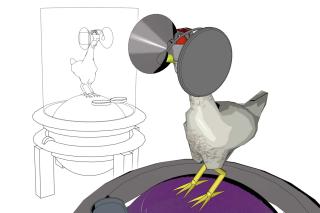
LJ.Rossia.org makes no claim to the content supplied through this journal account. Articles are retrieved via a public feed supplied by the site for this purpose.