[Most Recent Entries] [Calendar View]
Monday, August 22nd, 2016
| Time | Event | ||||||||||||||||||||||||||||||||||||||||||||||||
| 6:54a | Top 10 Most Pirated Movies of The Week – 08/22/16
Now You See Me 2 is the most downloaded movie. The data for our weekly download chart is estimated by TorrentFreak, and is for informational and educational reference only. All the movies in the list are Web-DL/Webrip/HDRip/BDrip/DVDrip unless stated otherwise. RSS feed for the weekly movie download chart.
Source: TF, for the latest info on copyright, file-sharing, torrent sites and ANONYMOUS VPN services. | ||||||||||||||||||||||||||||||||||||||||||||||||
| 8:32a | Indian Piracy Blocks Scare Torrent Users With 3-Year Prison Sentence
The blocks themselves are nothing new. For years Indian copyright holders have sought to protect their content from unauthorized online distribution. This has mainly taken the form of so-called ‘John Doe’ orders where access to sites such as The Pirate Bay or ExtraTorrent is restricted to protect copyrighted content from being freely shared. However, the warning message that’s currently presented when attempting to access blocked sites has a lot of people worried. The notice reads that the site in question has been blocked per instruction of the Government or through a court order, similar to what it said before. In addition, it adds that those who still access the content in question may face up to three years in prison and a hefty fine. “Viewing, downloading, exhibiting or duplicating an illicit copy of the contents under this URL is punishable as an offence under the laws of India, including but not limited to under Sections 63, 63-A, 65 and 65-A of the Copyright Act, 1957 which prescribe imprisonment for 3 years and also fine of up to Rs. 3,00,000/-.”  A relatively small change, but one with widespread impact it seems. Several Indian news outlets have started to warn their readership that the threat is real. India Today, for example, reports that merely downloading a torrent file or viewing a copyrighted image from a file-hosting site may land people in prison. “You don’t have to download a torrent file, and then the actual videos or other files, which might have copyright. Just accessing information under a blocked URL will land you in jail and leave your bank account poorer by Rs 3 lakh,” the news site reports. While the warning message can be interpreted in various ways, very little appears to have changed. There’s no new law that introduces higher sentences. In fact, the message clearly quotes India’s 1957 Copyright Act. In addition, there are no signs that the authorities are planning to crack down on individual file-sharers. Let alone people who merely download a torrent file, not the infringing content itself, since that’s not copyright infringement. Merely accessing a blocked site isn’t either. There is a recent court case that may have spurred the recent change though. Earlier this year the Government’s Department of Electronics and Information Technology actually intervened in one of the “John Doe” cases on behalf of the public, arguing against site-wide blocks. In this case, the High Court decided against the Government, arguing that broad blockades are warranted. Among other things, the Court found that it is the “duty of the government” to “assist in the enforcement of court orders.” In this light it could be that the Government “assisted” in updating the language of the blocking message. From the information we’ve seen thus far, the wording of the blocking notification is the only thing that has changed so far. But, considering the response from the media and public, this is already quite effective as a deterrent. Source: TF, for the latest info on copyright, file-sharing, torrent sites and ANONYMOUS VPN services. | ||||||||||||||||||||||||||||||||||||||||||||||||
| 6:38p | Cox Denies Liability for Pirating Subscribers, Appeals $25 Million Verdict
The ISP was found guilty of willful contributory copyright infringement and must pay music publisher BMG Rights Management $25 million in damages. The verdict was a massive victory for the music company and a disaster for Cox, but the case is not closed yet. After a failed motion for judgment as a matter of law earlier this month, the ISP has now informed the court that it will take the case to the U.S. Court of Appeals for the Fourth Circuit. Cox denies any wrongdoing and hopes to get a judgment in its favor at the appeals court.  Considering the gravity of the case, Cox’s move is not surprising. The liability verdict has come as a shock to the Internet provider industry, as it suggests that providers have to actively disconnect repeat infringers. At the moment, many ISPs don’t have a solid policy in place where repeat copyright infringers lose their subscription. In fact, the law doesn’t prescribe when and based on what evidence an ISP has to terminate an account. Up until now, several Internet providers argued that only a court could determine if a subscriber is a repeat infringer, but with the Cox verdict this has now become uncertain. After the appeal, which is expected to take several months at least, both Cox and BMG still have the option to take the case to the Supreme Court. Meanwhile, anti-piracy outfit Rightscorp is using the current verdict to threaten other ISPs to forward their notices. Thus far, however, this doesn’t appear to have had much effect. Source: TF, for the latest info on copyright, file-sharing, torrent sites and ANONYMOUS VPN services. | ||||||||||||||||||||||||||||||||||||||||||||||||
| 9:02p | KickassTorrents ‘Front Company’ Disappears From Web After becoming the world’s largest torrent site months before, July 20 saw KickassTorrents’ reign collapse when the organization was dismantled by US law enforcement. In addition to the site going offline, KAT’s alleged founder, Artem Vaulin, was arrested in Poland, from where the United States Government is now demanding his extradition. In a criminal complaint filed in U.S. District Court in Chicago, Vaulin is charged with conspiracy to commit criminal copyright infringement, conspiracy to commit money laundering, and two counts of criminal copyright infringement. All of these offences are naturally connected with KAT but according to US authorities, at least one other entity was closely involved. If its website was to be believed, Cryptoneat was a sizeable web company with perhaps dozens of employees. It first appeared online in 2014 and months later was updated with a very basic logo.  For non-Russian speakers the message underneath the graphic reads “With no zombies”. Over the months that followed the site had periodic updates and by August 2015 was sporting a new logo and some early indications of what its business might be. “We develop our own products. From concept to the user’s screen,” a statement read.  “Cryptoneat is a software development company crafting our own products since 2008. Our latest project is Wine scanner iOS application Wineeapp.com,” the site read in January 2016. “We support personal responsibility and involvement with no over-management standing in the way of imagination and creative thinking. Flexible schedules and smart workspace. We hold to the ergonomics cult: Herman Miller chairs, standing desks, Apple hardware and multi-monitor configurations.” Cryptoneat’s logo was developed by former architect and Ukrainian graphic artist Andrey Koval. There’s no suggestion that Koval was directly involved in Cryptoneat or KAT, but he does share the same location, Kharkiv, the second-largest city in Ukraine. Koval did not immediately respond to TorrentFreak’s requests for comment but we did manage to find a video which showcases the Cryptoneat logo he created for the company. Cryptogram from CRYPTONEAT on Vimeo. Cryptoneat operated from two URLs, .COM and .UA. In the early days following Vaulin’s arrest the sites were operational, but both have now disappeared. Perhaps not surprising given the statements made by the US Department of Justice. “During a significant part of the conspiracy, Vaulin has operated KAT under the auspices of a Ukrainian-based front company called Cryptoneat,” wrote Jared Der-Yeghiayan, a Special Agent with Homeland Security Investigations. “As of on or about June 20, 2016, Vaulin’s LinkedIn profile identifies him as the founder of Cryptoneat and lists the company’s creation date as November 2009. On Cryptoneat’s Instagram and Facebook page I have viewed pictures of Vaulin purportedly at Cryptoneat’s office.” Cryptoneat’s Facebook and Instagram accounts have since been disabled. Various LinkedIn profiles relating to Vaulin and other employees have been edited. Having previously indicated the Cryptoneat’s employees could potentially number as many as 50, the company’s main LinkedIn page now list the company’s size as “myself only.” Slowly but surely the company is disappearing from the web, with just a couple of pages now available via Google’s cache. One offers coding jobs with a competitive salary, paid vacation and holidays, health insurance, a stocked kitchen and gym fees. But now, a month following KAT’s shutdown, Cryptoneat’s online presence has taken another hit. Two days ago the site’s .COM domain ceased to function after its two-year registration period expired. 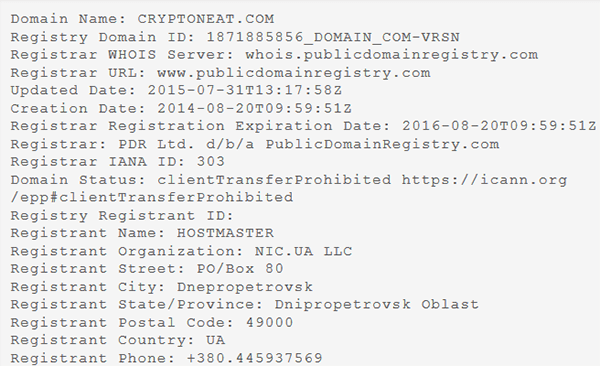 Unlike several other KickassTorrents-related domains, the US Government doesn’t appear interested in seizing Cryptoneat’s domains at this stage, even though it clearly states that the Ukraine-based company was used as a KAT front. Indeed, the Homeland Security investigation found that at least several Cryptoneat employees worked on KickassTorrents. “Many of the employees found on LinkedIn who present themselves as working for Cryptoneat are the same employees who received assignments from Vaulin in the KAT alert emails,” Special Agent Jared Der-Yeghiayan reported. Perhaps unsurprisingly, the three main individuals mentioned by Der-Yeghiayan (although not by name in the criminal complaint) have removed Cryptoneat from their resumes. Lower ranking employees have left their history in place but moved on to new jobs. Given the apparent size of the Cryptoneat operation, it’s not yet clear why the US Government has only reported one arrest thus far. It’s certainly likely that it has more cards up its sleeve but it could be a considerable length of time before those are revealed in public. Source: TF, for the latest info on copyright, file-sharing, torrent sites and ANONYMOUS VPN services. | ||||||||||||||||||||||||||||||||||||||||||||||||
 This week we have three newcomers in our chart.
  Starting a few days ago, many Indian Internet users noticed that their favorite torrent websites were blocked and displaying a rather scary message.
| << Previous Day |
2016/08/22 [Calendar] |
Next Day >> |