[Most Recent Entries] [Calendar View]
Wednesday, September 14th, 2016
| Time | Event |
| 7:18a | Steal This Show S02E02: ‘The Platform Is You’
We discuss the ongoing attempt to extradite Megaupload’s Kim Dotcom to the United States, why Creative Future is publicly dissing his organisation, and what (if anything) should come after big torrent sites. We then take another twenty minutes to discuss how decentralisation of media is contributing to the rise of the kek-worshipping alt-right. How does P2P affect political power in general? And what’s the importance of meme-creation in a distributed media environment? — Steal This Show aims to release bi-weekly episodes featuring insiders discussing copyright and file-sharing news. It complements our regular reporting by adding more room for opinion, commentary and analysis. The guests for our news discussions will vary and we’ll aim to introduce voices from different backgrounds and persuasions. In addition to news, STS will also produce features interviewing some of the great innovators and minds. Host: Jamie King Guest: Holmes Wilson Produced by Jamie King Source: TF, for the latest info on copyright, file-sharing, torrent sites and ANONYMOUS VPN services. |
| 10:36a | 10 Years in Prison For Online Pirates a Step Closer in the UK
Due to UK copyright law allowing for custodial sentences of ‘just’ two years for online offenses, anti-piracy groups such as the Federation Against Copyright Theft have chosen to pursue their own private prosecutions. These have largely taken place under legislation designed for those who have committed fraud, rather than the more appropriate offense of copyright infringement. Physical pirates (CDs, DVDs) can be jailed for up to 10 years under current legislation. During the past few years, there have been lobbying efforts for this punishment to apply both on and offline. That resulted in a UK Government announcement last year indicating that it would move to increase the maximum prison sentence for online copyright infringement to ten years. This proposal was detailed in a draft of the Digital Economy Bill published in July. If passed into law, it would amend the relevant section of the Copyright, Designs and Patents Act 1988. That likelihood increased yesterday with the 2nd Reading of the Digital Economy Bill in the House of Commons. Karen Bradley, Secretary of State for Culture, Media and Sport, was in attendance. The MP, who was appointed in July, spoke strongly in favor of strict copyright enforcement. “We will help businesses from attacks on their intellectual property. Burglars can be sentenced to ten years in prison, but the criminal gangs that are making vast sums of money through exploiting the online creations of others only face a two-year sentence. We will increase this to ten,” Bradley said. 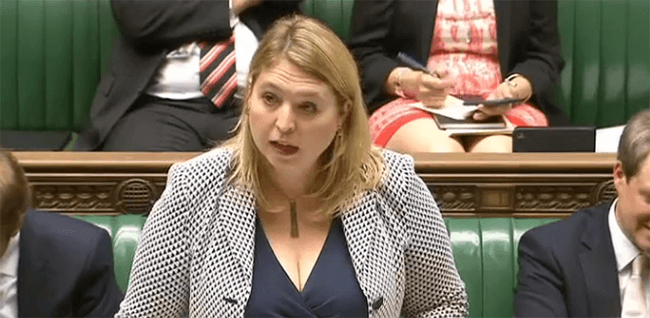 Interestingly, Bradley mentioned a convicted pirate by name. Paul Mahoney ran streaming portal FastPassTV and discussion and linking forum BedroomMedia. After being raided in 2011, the Northern Ireland-based man was sentenced to four years in jail under the Fraud Act, two more than the maximum he would’ve received under copyright legislation. “Criminals like Paul Mahoney, who profited by almost £300,000 and cost industry millions by facilitating access to illegal films on the Internet, need to be sent a clear message,” Bradley said. “We need to ensure that enforcement agencies and their partners have the right set of tools to tackle all types of piracy, which is why this clause is so important.” When the increase to ten years was first reported, some news outlets suggested that regular file-sharers could be subjected to the decade-long sentence. That was addressed in Parliament yesterday by Labour MP Thangam Debbonaire, who welcomed the move but sought assurances that the casual downloader wouldn’t be targeted. “I am pleased that clause 26 amends the current legislation on copyright to bring online criminal penalties for copyright infringement in line with off-line penalties, with a maximum of 10 years’ imprisonment. This will target anyone who infringes copyright in order to make a commercial gain,” he said. “However, I wish to stress to hon. Members and to members of the public that this is not to catch out people who download music and unwittingly download or stream something illegal. I want to make that clear in adding my support to this measure. As far as I understand it, it targets the criminals who make money from distributing music to which they do not have the rights.” Culture Secretary Karen Bradley confirmed that was indeed the case. Speaking in support of the amendment, Conservative MP John Whittingdale said he was “delighted” that online and offline penalties will be equalized but said that more still needs to be done. Unsurprisingly, given the current environment, Google was again the target. “The Conservative party manifesto stated that we would put pressure on search engines to try to prevent illegal sites from coming up at the top of a search. I know that round-table discussions have been taking place for a considerable time, but it is a matter of great concern that no significant progress has yet been made,” Whittingdale said. “In the most recent attempt to find out whether or not there had been an improvement, a Google search was made for ‘Ed Sheeran Photograph download’, with ‘Photograph’ being one of Ed Sheeran’s most recent songs. Only one of the top 10 listings involved a legal site, and the legal site was YouTube, which, of course, is owned by Google.” In response, Labour MP Dr Rupa Huq offered his thoughts on how that might be mitigated in future. “[John Whittingdale] said that Ed Sheeran’s song was available on illegal platforms. Does he agree that technology companies, and platforms such as Google and YouTube, should be compelled to list only legal sites?” Huq said. “At present the pirates are sometimes listed higher up than legal sites, and our British musicians who contribute, I believe, £4 billion annually to the economy are losing out as a consequence.” Whittingdale wasn’t convinced of Huq’s solution, but agreed that much more needs to be done. “I think it would be unrealistic to expect Google to establish whether every single site was legal or illegal. What it can do is react when illegal sites are brought to its attention,” the MP said. “[Google] does de-list, but new sites then appear immediately. There have been a vast number of complaints from rights owners about particular sites, but they should tweak their algorithms so that those sites no longer appear at the top of the search listings. Measures of that kind have been under discussion for months and months, but the problem still exists.” Whittingdale added that there may be a need to include a legal provision which would encourage service providers to establish some kind of voluntary code. “[T]here may well be a case for legislation, because we cannot allow Google and other search providers to go on allowing people access to illegal sites,” he said. The Bill will now move to Committee and Report stages, before moving to its Third Reading. It will then pass to readings in the House of Lords before undergoing amendments and the final stage of Royal Assent. Source: TF, for the latest info on copyright, file-sharing, torrent sites and ANONYMOUS VPN services. |
| 3:17p | EU Commission Proposes Mandatory Piracy Filters For Online Services
The proposal (pdf) is part of the Digital Single Market reforms, which have been in the making for several years. Despite earlier suggestions that geo-blocking would be banned for streaming portals such as Netflix, these ideas haven’t made it into the final text. Instead, it introduces a wide range of reforms that improve the position of rights holders. One of the suggestions that has a lot of people worried is Article 13, which requires online services to police pirated content. This means that online services, which deal with large volumes of user-uploaded content, must use fingerprinting and filtering mechanisms to block copyright infringing files. “The Commission proposal obliges such service providers to take appropriate and proportionate measures to ensure the protection of user-uploaded works, for example by putting in place content recognition technologies,” the commission explains. This could, for example, be similar to the Content-ID system YouTube has in place, which hasn’t been without controversy itself. While the Commission stresses that small content platforms won’t be subject to the requirement, the proposal doesn’t define what “small” means. It also fails to define what “appropriate” or “effective” content recognition systems are, creating a fair bit of uncertainty. 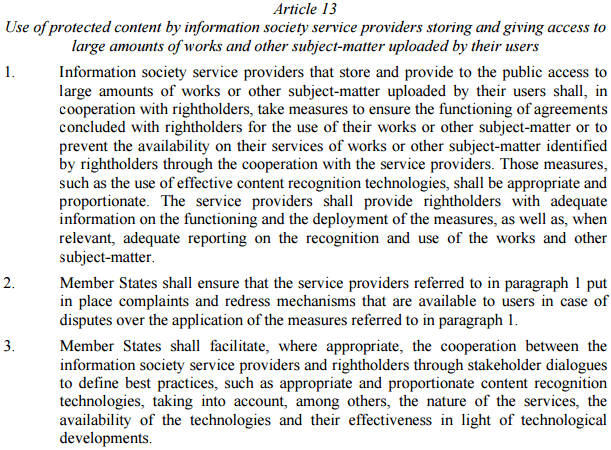 Commenting on the proposal, Digital rights group EDRi says that it will put many European companies at risk while endangering users’ right to free speech. “The text that was launched today includes a proposal to potentially filter all uploads to the Internet in Europe. The draft text would destroy users’ rights and legal certainty for European hosting companies,” EDRi notes. The Commission, however, notes that the changes are needed to reinforce the negotiating position of copyright holders, so they can sign licensing agreements with services that provide access to user uploaded content. Perhaps not surprisingly, this language is directly aligned with recent calls from various music industry organizations. Just a few month ago the BPI asked for new legislation to prevent platforms like YouTube abusing safe harbor protections in order to create “royalty havens”. With the current proposal, this wish has been partly granted. TorrentFreak spoke with Pirate Party Member of Parliament Julia Reda who is fiercely against mandatory piracy filters. “There are countless problems with this approach. First of all, Google spent upwards of $60 million on the development of ContentID. Asking every startup or community project to make the same kind of investment is ludicrous,” Reda says. Most services that deal with user-uploaded content can’t invest millions into content recognition technologies so they would have to license it from others such as YouTube, Reda adds. This will only increase the already dominant positions of the major players. In addition, she points out that automated systems often lead to overt mistakes and are poorly equipped to deal with the finer nuances of copyright. “Just because part of a copyright-protected work shows up in a video, that doesn’t mean that the new work constitutes a copyright infringement,” Reda says. “There are numerous exceptions to copyright such as parody or quotation – different in every EU country – that could justify the re-use of part of a protected work. An algorithm can’t detect that. It will take down lots of legal remixes and mashups, thus stifling freedom of expression,” she adds. A valid comment, as we witnessed ourselves just a few days ago when one of our perfectly legal videos was inaccurately flagged as a copyright infringement. YouTube aside, Reda stresses that there are many other platforms to which automated recognition systems are not well suited. Wikipedia, for example, which uses mostly Creative Commons licensed content, or services such as DeviantArt which hosts user-uploaded artwork, or MuseScore that hosts sheet music. “There is no technology available that would reliably detect copyright infringements in these formats. The Commission is asking Internet companies to do the impossible, thus endangering collaborative communities on the Internet as well as European startups,” Reda tells us. The filtering requirement is not the only plan that’s getting a lot of pushback. Another controversial proposal is the introduction of a new related right for press publications. This allows online newspapers to negotiate licences from third party services that use their texts, such as Google showing article clippings in its news section. Opponents, including several young members of the European Parliament, have dubbed the proposal a “link-tax” and are fiercely against it. “This plan would break the internet as we know it. The way people share news online today – by posting a link that includes a short snippet or image from the article – would be made illegal unless a licence had been previously agreed,” MEP Marietje Schaake says. Considering the stakes at hand, it’s expected that there will be several organized protests, similar to the “Save the Link” campaign, to stop the proposals from becoming law in their current form. Source: TF, for the latest info on copyright, file-sharing, torrent sites and ANONYMOUS VPN services. |
 Returning guest Holmes ‘I’m on a boat‘ Wilson (
 In an effort to control the prevalence of online piracy, numerous criminal actions against file-sharers and file-sharing site operators have already taken place in the UK. However, these prosecutions have not been straightforward.
 During his State of the Union address today, EU Commission President Jean-Claude Juncker announced several plans to modernize copyright law in Europe.
 | << Previous Day |
2016/09/14 [Calendar] |
Next Day >> |