[Most Recent Entries] [Calendar View]
Friday, March 6th, 2020
- Acer Launches Predator XN253QX Monitor with 240 Hz & 0.4 ms G2G Response Time
- Gone in 240 Hz: Lenovo’ Legion Y25-25 ‘Fast IPS’ Monitor w/ FreeSync at CES 2020
- Quick & Deadly: Alienware 25 (AW2521HF) 240 Hz Fast IPS Monitor Revealed
- Supersonic: ViewSonic’s Elite XG270 240 Hz IPS Monitor w/ VRR & HDR
- Need for Speed: The LG UltraGear (27GN750) 240 Hz IPS Monitor with G-Sync
- Fast & Furious: The Alienware 27 (AW2720HF) 240 Hz IPS Monitor with FreeSync
- Assassin’s Speed: Eve Technology Reveals 27-Inch QHD Monitors With 240Hz Variable Refresh
- ADATA Releases SE760 USB 3.2 Gen 2 External SSD: Up to 1000 MB/s
- Western Digital Starts Sales of WD_Black P50 USB 3.2 Gen 2x2 SSDs
- CES 2020: Patriot Demonstrates PXD External SSD w/ USB-C
- CES 2020: Patriot Goes Big on Bandwidth For New EVLVR 2 TB3 SSDs
- ADATA’s HM800 DAS: Up to 8 TB, Up to 250 MB/s, Smart TV Recording
- CES 2019: The Quintessential ADATA HC770 External HDD, with RGB
- ADATA Launches the SD700 External SSD: Dust, Water and Shock Resistant (with 3D NAND)
- ADATA SE730, SV620 and SC660 External SSDs Review
- JEDEC Updates HBM2 Memory Standard To 3.2 Gbps; Samsung's Flashbolt Memory Nears Production
- GlobalFoundries and SiFive to Design HBM2E Implementation on 12LP/12LP+
- Samsung Develops 12-Layer 3D TSV DRAM: Up to 24 GB HBM2
- SK Hynix Announces 3.6 Gbps HBM2E Memory For 2020: 1.8 TB/sec For Next-Gen Accelerators
- Samsung HBM2E ‘Flashbolt’ Memory for GPUs: 16 GB Per Stack, 3.2 Gbps
- FSP to Demonstrate T-Wings 2-in-1 Chassis at CES: Two Semi-Open PCs in One Box
- More Glass: New FSP CMT330 and CMT520 Gaming PC Cases
- InWin’s Signature Yǒng: A $4000 PC Case Designed by Customers
- CES 2019: $900 InWin 928 Chassis for Intel's 28-Core Xeon W-3175X
- CES 2019: Liquid Cooled Power Supplies from FSP, up to 1200W
- FSP Readies Cannon: a 2000 W PSU for Mining and Extreme Desktops
| Time | Event | |||||||||||||||||||||||||||||||||||||||||||||||||||||||||||||||||||||||||||||||
| 10:00a | Predators: Acer Launches 24.5 & 27-Inch Fast IPS 240 Hz Monitors
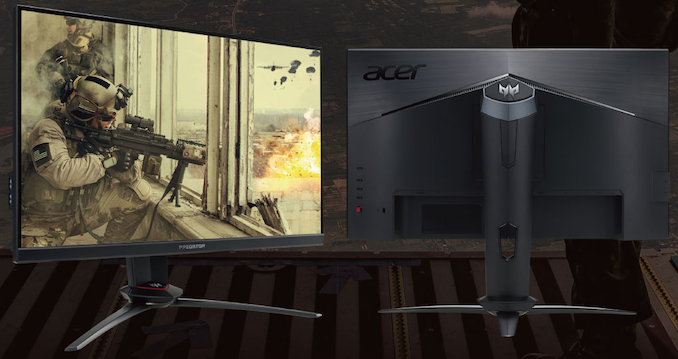
Acer Japan has unleashed the company’s first Predator displays that use Fast IPS panels, and therefore offering a 240 Hz refresh rate along with all the advantages that the IPS technology has, including rich colors, and wide viewing angles. The new 24.5-inch and 27-inch Acer Predator 240 Hz IPS LCDs also support VESA’s Adaptive-Sync technology and are Display HDR400-certified. Acer’s lineup of Fast IPS monitors currently consists of two models: the 24.5-inch Predator XB253QGXbmiiprzx as well as the 27-inch Predator XB273GXbmiiprzx (not a typo). General characteristics of the displays are similar to those of other Fast IPS-based LCDs available today, so we are talking about a 1920×1080 resolution, 400 nits peak luminance, a 1000:1 contrast ratio, 178°/178° viewing angles, a 1 ms GtG response time (which can be reduced further to 0.1 ms – 0.5 ms response time with overdrive, depending on the model), and a 240 Hz maximum refresh rate with VESA’s Adaptive-Sync technology as well as NVIDIA’s G-Sync Compatible certification on top. The LCD can display 16.78 million of colors and can reproduce 99% of the sRGB color space, just like other monitors that use the same panels. For connectivity, the new Acer Predators 240 Hz monitors have one DisplayPort 1.2a connector, two HDMI 2.0b inputs, and a quad-port USB 3.0 hub. On the audio side of things, the LCDs have 2W stereo speakers, and a headphone output. Traditionally for Acer Predator monitors aimed at esports professionals and hardcore gamers, the displays come equipped with aggressively looking stands that can adjust height, tilt, and swivel. Also the LCDs can work in portrait mode.
So far, only Acer Japan has introduced the company’s first 240 Hz Fast IPS Predator-branded displays with a plan to start selling them as early as this week, but we are not sure about intentions of Acer's divisions from other countries. The smaller 24.5-inch Predator XB253QGXbmiiprzx is expected to be priced at ¥46,000 (think about an MSRP of around $430 in the States), whereas the larger 27-inch Predator XB273GXbmiiprzx is projected to cost ¥55,000 (so, expect an MSRP of about $500 in the USA). Related Reading: | |||||||||||||||||||||||||||||||||||||||||||||||||||||||||||||||||||||||||||||||
| 2:00p | Buffalo Launches Miniature Rugged External SSD w/ USB Type-A & Type-C
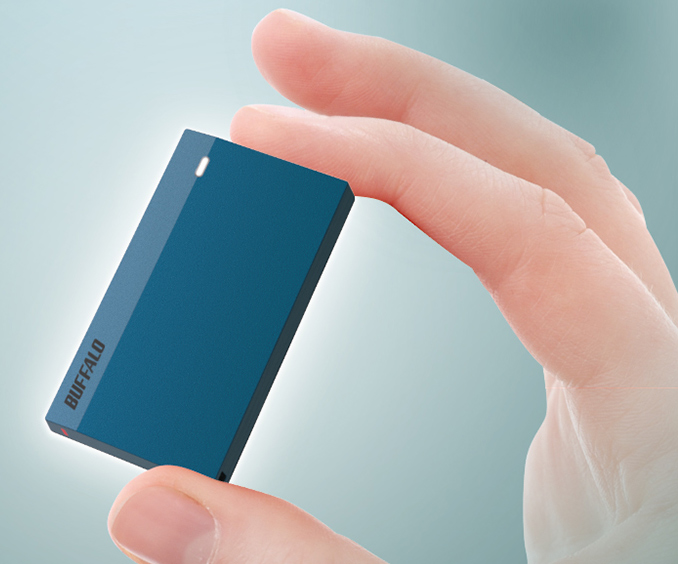
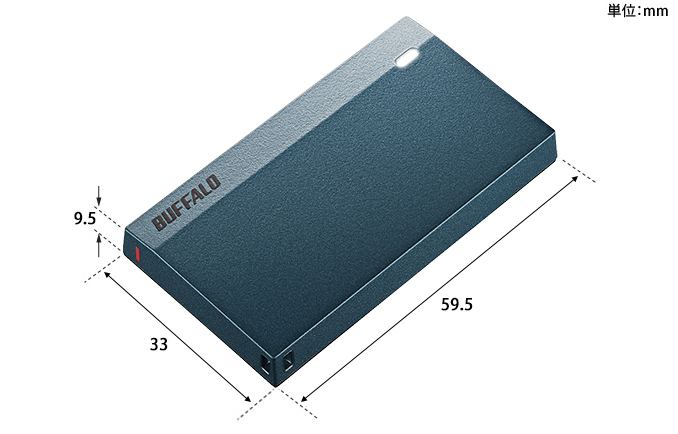
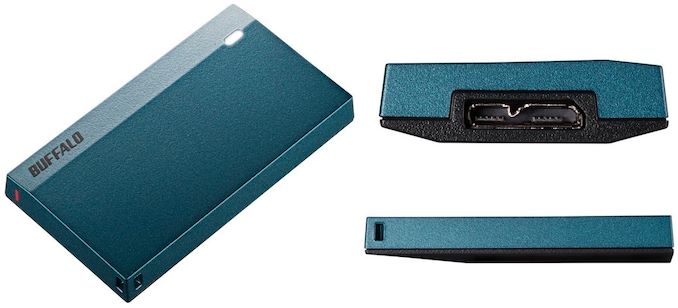
SSDs can survive drops and other kinds of hostile treatment much better than hard drives, but they can still be broken if their PCB or one of the chips gets damaged. For those who want to reduce their risk of losing their data, Buffalo has introduced its new family of SSDs — the SSD-PSMU3 — that is specifically designed to withstand drops. Unlike typical rugged devices, the new drives are rather miniature and more resemble flash drives. Buffalo’s SSD-PSMU3 series SSDs are designed to endure MIL-STD 810G 516.6 Procedure IV drop test, known as the ‘transit drop’. This means that the device was tested to survived six face drop tests, eight corner drop tests, and 12 edge drop tests from a height of around 1.2 meters, remained in working condition and suffered no physical of internal damage. The drives measure 33×9.5×59.5 mm and weigh 15 grams (dimensions and weight akin to those of a box of PEZ mints), so it should not be particularly hard to make them rugged enough to survive drops from 1.2 meters.
The SSD-PSMU3 drives feature a 120 GB, 250 GB, 480 GB, and 960 GB capacity as well as a USB 3.2 Gen 1 Micro-B interface that connects them to their hosts using a USB Type-A or a USB Type-C cable. Buffalo rates the drives for about 430 MB/s throughput, but considering the interface used, we are probably looking at something near ~400 MB/s due to overhead incurred by 8b/10b encoding.
The rugged SSDs fully support Buffalo’s SecureLock Mobile2 technology that encodes data using an AES-256 key. Meanwhile, it is unclear whether encryption is done using hardware or software. In addition, the drives support SMART function and can be used with Mimamori Signal software that predicts failures of storage components based on SMART data.
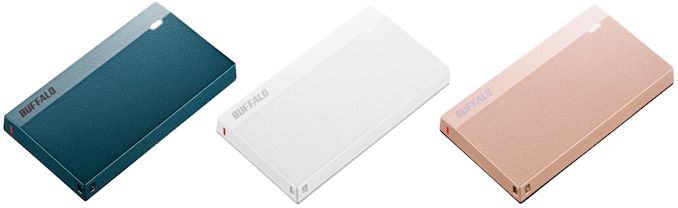
Set to be available in white, aquamarine, and pink, Buffalo’s rugged SSD-PSMU3 drives will hit the shelves in Japan starting March 4. The cheapest 120 GB drive will cost ¥5,700 ($54) without VAT, whereas the highest capacity 960 GB model will be priced at ¥22,300 ($210) without taxes. Related Reading: Source: Buffalo (via Hermitage Akihabara) | |||||||||||||||||||||||||||||||||||||||||||||||||||||||||||||||||||||||||||||||
| 3:00p | Rambus Develops HBM2E Controller & PHY: 3.2 Gbps, 1024-Bit Bus
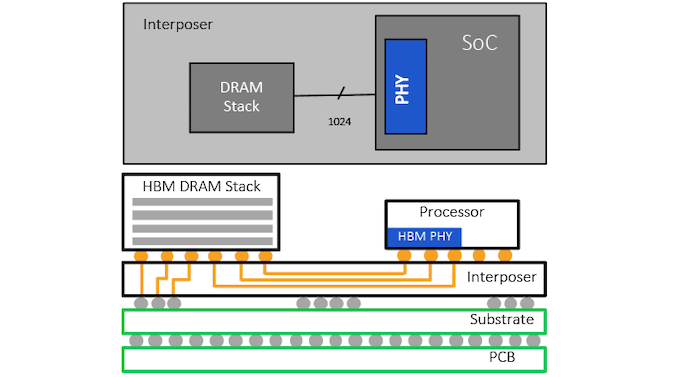
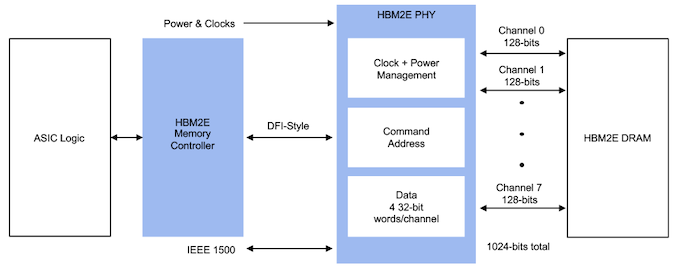
The latest enhancements to the HBM2 standard will clearly be appreciated by developers of memory bandwidth-hungry ASICs, however in order to add support of HBM2E to their designs, they are also going to need an appropriate controller as well as physical interface. For many companies developing of such IP in-house does not make financial sense, so Rambus has designed a highly-integrated HBM2E solution for licensing. The HBM2E standard supports 12-Hi DRAM stacks as well as memory devices of up to 16 Gbps, thus enabling to build up to 24 GB stacks using a 1024-bit bus. At the same time, the new specification officially supports data rates of up to 3.2 Gbps, which results in 409.6 GB/s bandwidth per stack. Rambus’s HBM2E solution includes a controller that can work with 12-Hi KGSDs (known good stack dies) as well as a verified 1024-bit PHY that supports speeds of up to 3.2 Gbps.
The Rambus HBM2E controller core (originally developed by Northwest Logic) is DFI 3.1 compatible (with appropriate extensions) and supports AXI, OCP or proprietary interfaces to connect to integrator logic. Meanwhile, the controller also supports Look-Ahead command processing (a standard way to trim latencies) as well as channel densities of up to 24 Gb. Licensees of Rambus’s HBM2E solution will get everything they need to integrate it into their designs, including source code of the controller (in a bid to synthesize it for a particular process technology) as well as fully-characterized hard macros (GDSII) of the interface. Alternatively, engineers from Rambus can help integrate the HBM2E IP support for a fee. Related Reading: Source: Rambus | |||||||||||||||||||||||||||||||||||||||||||||||||||||||||||||||||||||||||||||||
| 4:00p | FSP Details T-Wings CMT710 Open-Frame 2-in-1 Chassis
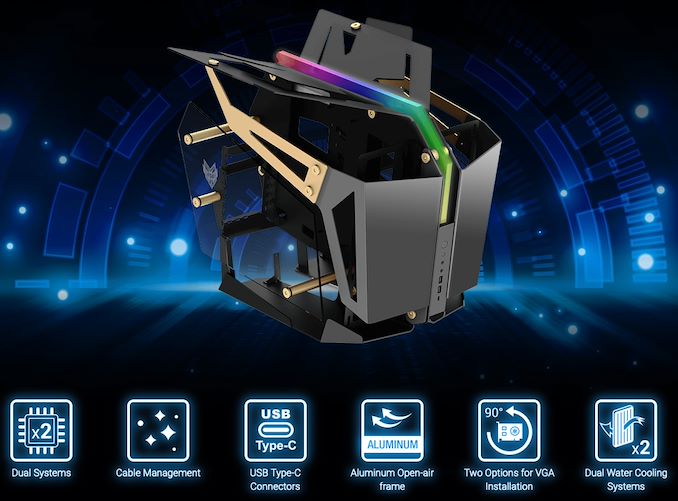
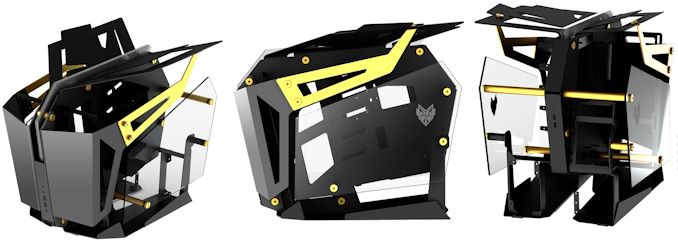
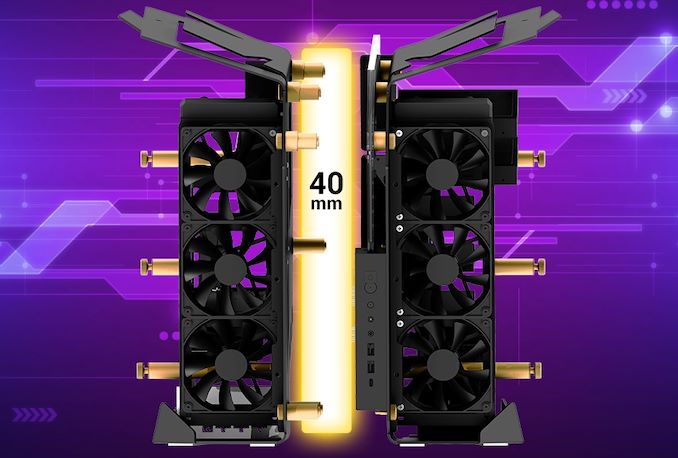
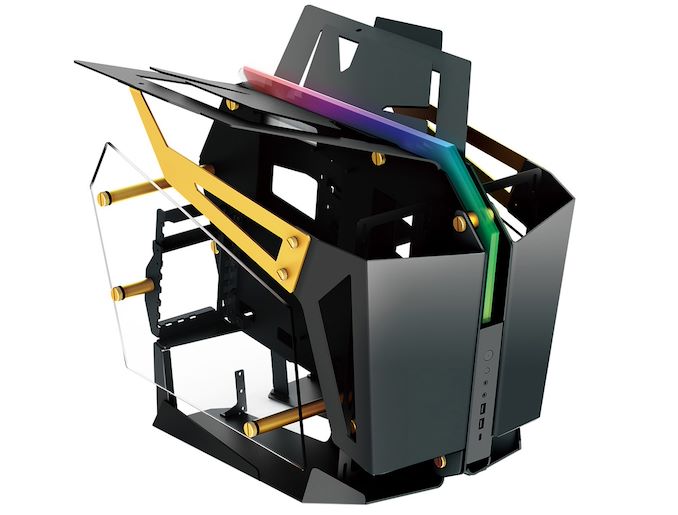
FSP has detailed its open-frame T-Wings CMT710 chassis, designed for hardcore gamers and professional game streamers that want maximum style, allowing for integration of to systems into one chassis. The new case can accommodate an E-ATX as well as an Mini-ITX motherboard at the same time, two PSUs, multiple graphics cards, and several storage drives.
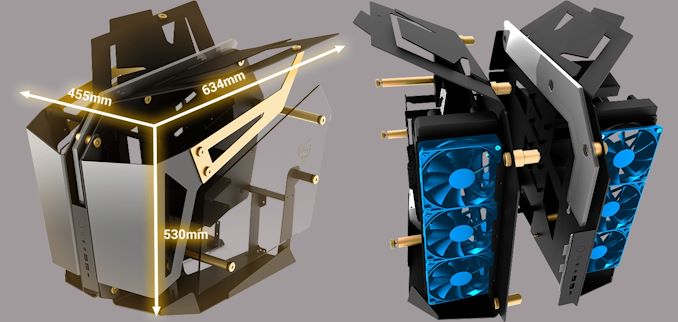
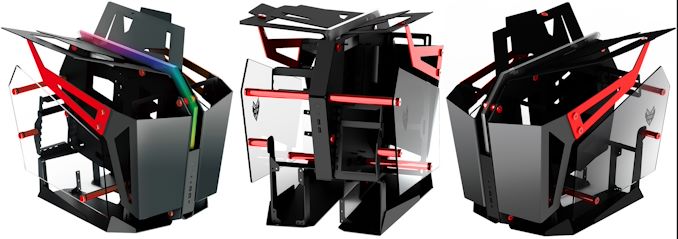
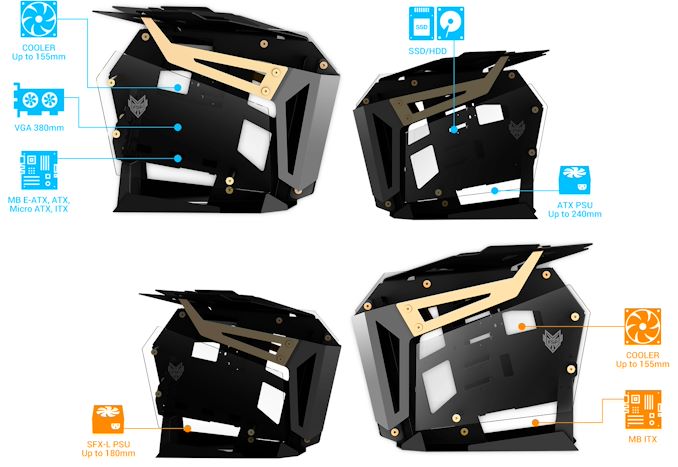
FSP’s open-frame 2-in-1 T-Wings CMT710 chassis has two open chambers semi-covered with 4-mm tempered glass panels: one for the E-ATX side, another for Mini-ITX half. Each chamber can accomodate its own PSU: an ATX one for the former, as well as an SFX/SFX-L one for the latter. The PCs can be cooled down using two liquid-cooling systems with up to 360-mm radiators that promise to provide enough cooling performance even for high-end components.
One of the interesting — and stylish — features of the T-Wings CMT710 case is its addressable RGB LED lightbar that is located between the ‘wings’, or chambers. Obviously, behavior of the RGB lightbar can be controlled using stanard software from leading motherboards vendors.
When it comes to expandability, FSP’s T-Wings CMT710 supports everything that E-ATX and Mini-ITX motherboards have to offer, such as eight expansion cards (i.e., graphics cards of up to 380-mm) for the larger platform, and two expansion cards for the smaller platform. In addition, the case can house two 3.5-inch storage bays as well as three 2.5-inch storage devices. The case also has a 40-mm space inbetween the chamber halves for cable management.
To make usage of the PCs easier in terms of accessibility, the front panel of the T-Wings CMT710 has two 3.5-mm audio connectors, one USB 3.1 Gen 2 Type-C port, and two USB 3.1 Gen 1 Type-A connectors.
FSP did not say when it plans to start selling its T-Wings CMT710 chassis, how much it is going to cost, or whether this is going to be a limited-edition product. Meanwhile, FSP does offer the chance to win the case through a lottery on their website.
Related Reading: Source: FSP | |||||||||||||||||||||||||||||||||||||||||||||||||||||||||||||||||||||||||||||||
| << Previous Day |
2020/03/06 [Calendar] |
Next Day >> |