[Most Recent Entries] [Calendar View]
Wednesday, January 17th, 2024
- Platters using new Pt-Fe alloy
- Plasmonic writer
- 7th Gen. spintronic reader
- 12nm integrated controller
| Time | Event |
| 6:00a | Seagate Unveils Mozaic 3+ HDD Platform as HAMR Readies for Volume Ramp
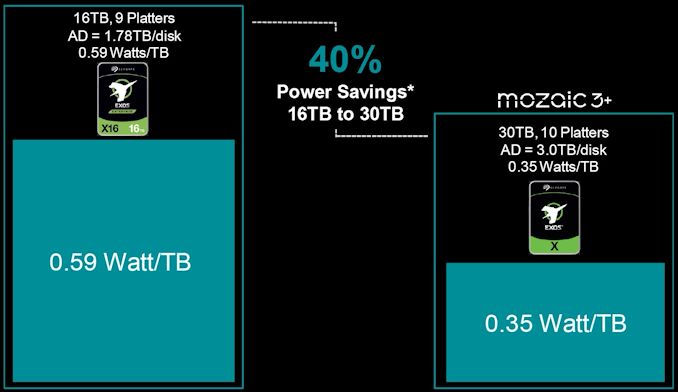
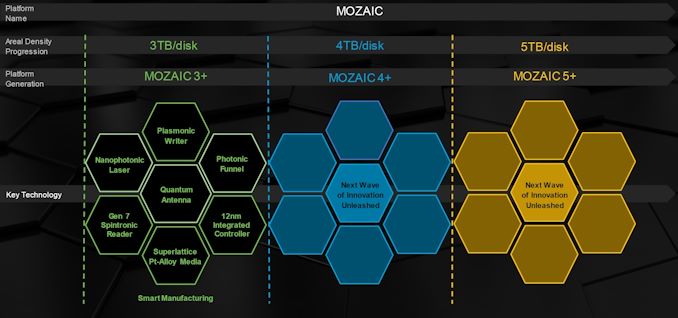
Seagate's financial reports have been indicating imminent mass production of HAMR HDDs for a few years now, and it looks like the wait for these drives to appear in retail is finally at an end. The Seagate Exos product family is getting a 30TB capacity point, thanks to the use of heat-assisted magnetic recording (HAMR) technology. The company talked to the press last week about the Mozaic 3+ platform – their first high-volume HAMR platform – and how it sets the stage for rapid areal density scaling over the next few years. Seagate's new Exos 30TB HDDs use platters with an areal density of 3TB per platter, and Seagate has plans to scale that up at a rate of up to 20% generation-over-generation in the next few years (compared to the 8% rate that CMR HDD capacities have been growing at in the last decade or so). The company indicated that volume shipments are happening this quarter to hyperscalers. Seagate is observing that the average customer upgrading from a 16TB conventional magnetic recording platform to the new 30TB+ HDDs can almost double the capacity of their server racks in the same footprint, as the new drives are drop-in replacements. This brings TCO benefits, particularly in terms of power consumption. The company is even quantifying that - the Exos X16's average power consumption of 9.44W translates to 0.59W / TB. The new Exos 30TB's equivalent number is a bit higher at 10.5W, but that translates to a 40% power savings on a per-TB basis at 0.35W / TB.
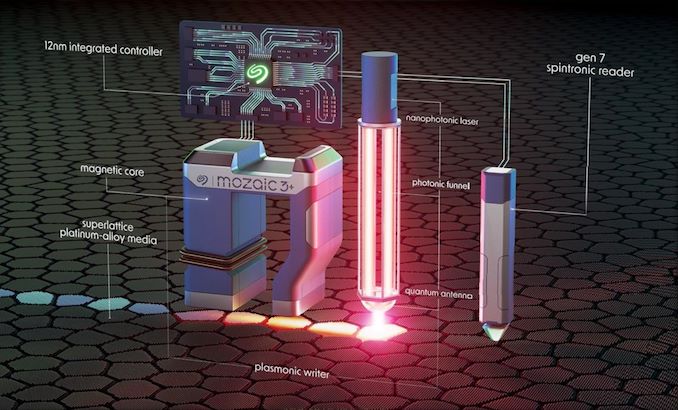
The company stressed upon the fact that HAMR needed a host of other breakthroughs grouped under the new Mozaic 3+ tag in order to achieve the areal density breakthrough enabling the new Exos family. These include: Areal density gains are primarily driven by smaller grain sizes in the magnetic media. However, legacy magnetic platter media is not stable at very small grain sizes. Along with Showa-Denko, Seagate has developed a superlattice iron-platinum structure with increased magnetic coercivity to allow for precise and stable data recording. The HAMR process requires heating up of the grain in order to alter its state, and Seagate has achieved this using a nanophotonic laser that is vertically integrated into the plasmonic writer sub-system. The reading head has also needed to evolve in order to tap into the smaller grains. All of these advancements work together thanks to a newly developed controller (built on TSMC's 12nm process) that Seagate claims to deliver 3x the performance of existing solutions.
Seagate expects the Mozaic platform to lead to 5TB/platter as early as 2028.
Areal density scaling is one of the key aspects in addressing the HDD capacity issue. One aspect that this scaling has not addressed is the IOPS/TB metric, where SSDs are in a much better place to take advantage of advancements in host interface technology. The Mozaic platform is orthogonal to currently-used HDD technologies such as dual actuators and shingled-magnetic recording. Additional benefits can be gleaned from those, but the IOPS/TB metric scaling is an aspect that needs industry-wide efforts to address to keep HDDs relevant in more application areas. Seagate works with vendors such as Showa-Denko for the platters and TDK for the recording heads. Some of the Mozaic 3+ innovations have been jointly developed with them. While the exact details of the joint development are confidential, Seagate indicated that they have a time-limited exclusive use for these technological advancements. If, and when, other HDD vendors move to HAMR, it appears that Seagate has a healthy lead to fall back on with respect to these core HAMR platform components. The company is also expecting the Mozaic 3+ technology to address use-cases as as NAS, and video / imaging markets. It is only a matter of time before HAMR moves from Exos to the IronWolf and SkyHawk families. |
| 7:00p | AMD Rolls Out Radeon RX 7900 XT Promo Pricing Opposite GeForce RTX 40 Super Launch
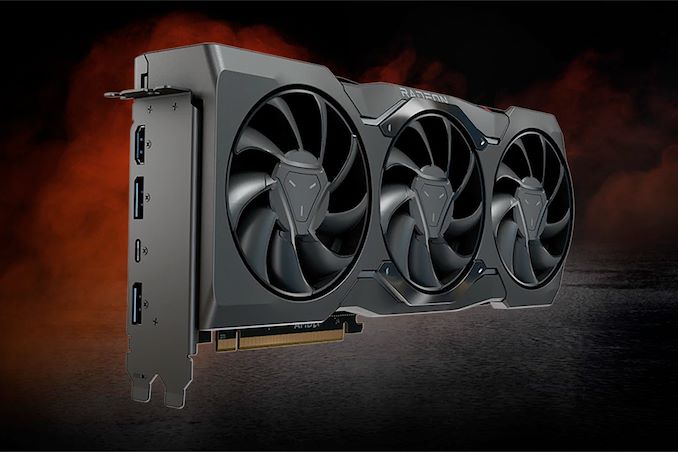
In response to the launch of NVIDIA's new GeForce RTX 40 Super video cards, AMD has announced that they are instituting new promotional pricing on a handful of their high-end video cards in order to keep pace with NVIDIA's new pricing. Kicking off what AMD is terming a special "promotional pricing" program for the quarter, AMD has been working with its retail partners to bring down the price of the Radeon RX 7900 XT to $749 (or lower), roughly $50 below its street price at the start of the month. Better still, AMD's board partners have already reduced prices further than AMD's official program/projections, and we're seeing RX 7900 XTs drop to as low as $710 in the U.S., making for a $90 drop from where prices stood a few weeks ago. Meanwhile, AMD is also technically bringing down prices on the China and OEM-only Radeon RX 7900 GRE as well. Though as this isn't available for stand-alone purchase on North American shelves, it's mostly only of relevance for OEM pre-builds (and the mark-ups they charge). Ultimately, the fact that this is "promotional pricing" should be underscored. The new pricing on the RX 7900 XT is not, at least for the moment, a permanent price cut. Meaning that AMD is leaving themselves some formal room to raise prices later on, if they choose to. Though in practice, it would be surprising to see card prices rebound – at least so long as we don't get a new crypto boom or the like. Finally, to sweeten the pot, AMD is also extending their latest game bundle offer for another few weeks. The company is offering a copy of Avatar: Frontiers of Pandora with all Radeon RX 7000 video cards (and select Ryzen 7000 CPUs) through January 30, 2024. |
| << Previous Day |
2024/01/17 [Calendar] |
Next Day >> |