Add this feed to your friends list for news aggregation, or view this feed's syndication information.
LJ.Rossia.org makes no claim to the content supplied through this journal account. Articles are retrieved via a public feed supplied by the site for this purpose.
| Thursday, April 9th, 2026 | |||||||||||||||||||
| LJ.Rossia.org makes no claim to the content supplied through this journal account. Articles are retrieved via a public feed supplied by the site for this purpose. | |||||||||||||||||||
| 6:25 am | Kocowa Secures Win Against Dramacool Pirates, U.S. Court Grants Domain Takeovers
The operators of the Asian drama and anime portal never revealed who was behind that pressure, but court records later showed it was Wavve Americas Inc., the parent company of legal Korean streaming service Kocowa. Wavve had filed a copyright lawsuit in Arizona federal court against the unknown operators of multiple Dramacool domains, hoping to take the associated sites offline permanently. Defendants Go SilentWhen Wavve eventually identified the defendants, they were scattered across Thailand, Vietnam, Pakistan, the Netherlands, and New Jersey. Kocowa identified domain operators in Thailand, Vietnam, Pakistan, the Netherlands, and New Jersey. The amended complaint named Asian C, Tommy USA, Najeeb Ullah Mirani, Baidar Bakhtand, and Dorothy Bradshaw, none appeared in court to answer the complaint. Meanwhile, some Dramacool domains remained operational. While these may include copycat sites unrelated to the original operation, the ongoing copyright infringement is a serious problem for Kocowa. To break this impasse, Wavve filed a motion for default judgment in September 2025, noting that some defendants had not only ignored the litigation but expanded their operations to new domains while the case was pending. The company did not seek any monetary compensation but simply requested an order that would allow the company to take over the Dramacool domain names. Default Judgment EnteredEarlier this week, U.S. District Judge Krissa M. Lanham granted the motion for a default judgment in full. The court found the requested injunction proportional and appropriate. “Requiring defendants stop their infringing activities will not cause any legitimate hardship. And the public interest is served in enforcing copyright law. A permanent injunction prohibiting defendants from continuing their activities is appropriate,” the order reads. The order prohibits all defendants from operating the sixteen named domain names, including watchasia.to and asianwiki.co, and also bars them from registering or owning any new piracy-linked domain names. 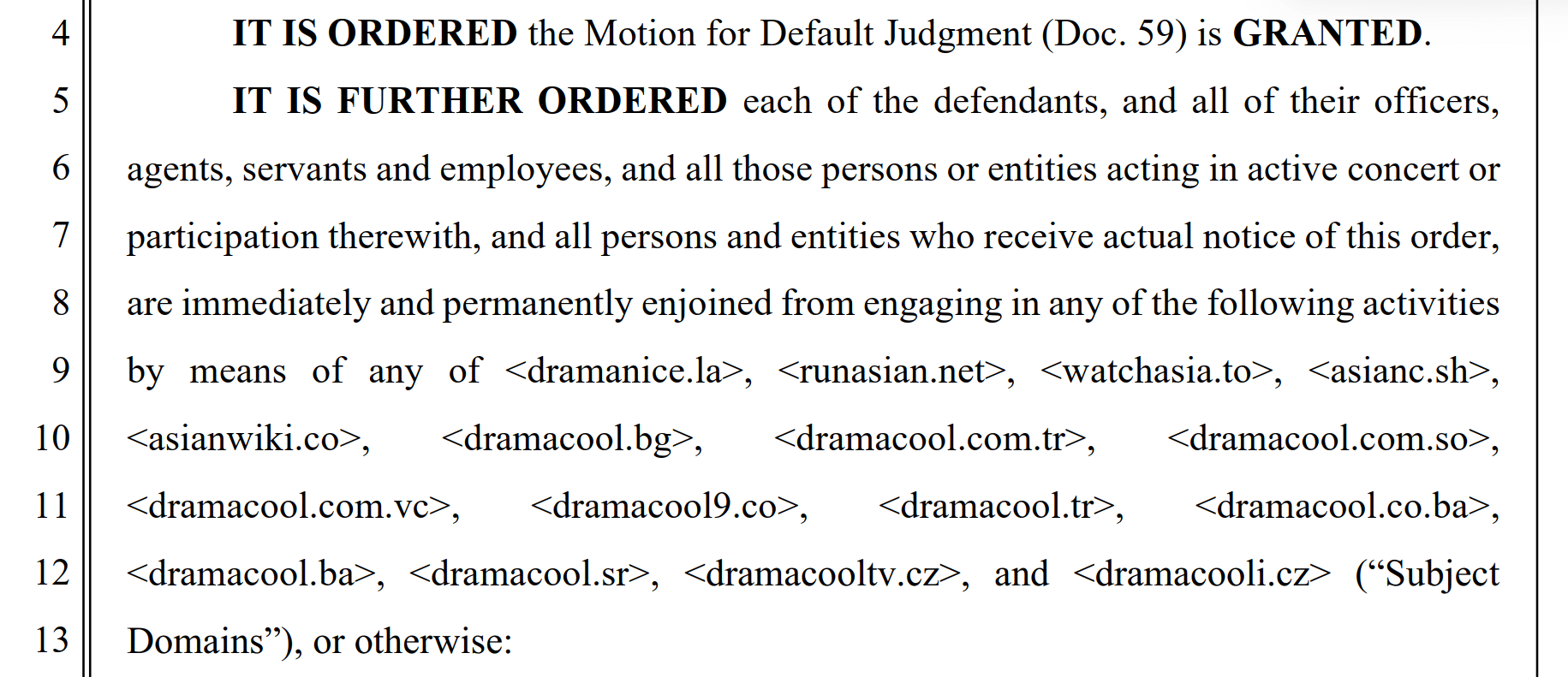 Wavve had acknowledged that an award for monetary damages would be meaningless, as the foreign pirate site operators are unresponsive. Therefore, they set all their hopes on a domain transfer order, which the court granted as well. Domain Transfers GrantedIn the order, Judge Lanham acknowledged that domain transfers are legally contested territory in copyright cases. The standard trademark statute that typically enables such transfers does not apply here, as the lawsuit did not include trademark claims. However, since none of the defendants put up a defense and because several of the associated sites remain online, the transfers were granted. This was in part justified by judgments in a number of other courts, which approved domain transfers in similar copyright cases. The order notes that domain transfers can be an appropriate remedy when there are indications that the defendants will not comply with an injunction. That is the case here, Judge Lanham concluded. “Here, defendants concealed their identities, ignored this litigation, and have an ‘established practice of evading copyright enforcement by moving their operation to new domains, even after having a judgment rendered against them’,” the order reads, “Wavve is entitled to an order transferring the domain names,” Judge Lanham adds. Dramacool Domains Still OnlineWhether Wavve can actually take control of all 16 domains remains to be seen, as not all registrars and registries may comply with U.S. court orders. Several of the original Dramacool-operated domains, including dramanice.la, runasian.net, watchasia.to, asianc.sh, and asianwiki.co, have been offline since the November 2024 shutdown. However, at least three of the named domains are still actively serving pirated content several days after the judgment was entered. Dramacool.bg, dramacool.com.tr, and dramacool.ba all remain online, redirecting visitors to functional streaming sites with full drama libraries. In closing, it is worth stressing that the permanent injunction prevents the defendants from registering new domain names for infringing purposes. However, the domain transfer order targeted at registrars and registries, is limited to the sixteen named domain names. — A copy of the default judgment order, issued by U.S. District Judge Krissa M. Lanham, is available here (pdf). The clerk’s entry of default judgment is available here (pdf). From: TF, for the latest news on copyright battles, piracy and more. | ||||||||||||||||||
| Tuesday, April 7th, 2026 | |||||||||||||||||||
| LJ.Rossia.org makes no claim to the content supplied through this journal account. Articles are retrieved via a public feed supplied by the site for this purpose. | |||||||||||||||||||
| 8:49 am | Supreme Court Wipes Piracy Liability Verdict Against Grande Communications
The record labels accused the Astound-owned ISP of not doing enough to stop pirating subscribers. Specifically, they alleged that the company failed to terminate repeat infringers. The trial lasted more than two weeks and ended in a resounding victory for the labels. A Texas federal jury found Grande liable for willful contributory copyright infringement, and the ISP was ordered to pay $47 million in damages to the record labels. The copyright infringement verdict was confirmed by the Fifth Circuit Court of Appeals, though the Fifth Circuit ordered a new trial on damages. The verdict was not the final word yet, as Grande petitioned the Supreme Court last year, urging the justices to take up the case and review the Fifth Circuit’s decision. Grande’s petition centered on the crucial question of ISP liability in cases of contributory copyright infringement. Grande framed the issue as an “exceptionally important question under the Copyright Act,” highlighting a “nationwide litigation campaign by the U.S. recording industry” to hold ISPs liable for copyright violations carried out by their customers. The central question is as follows:
Knowledge is Not IntentThe case and the questions are similar to the Cox v. Sony case, which the Supreme Court decided in favor of the Internet provider last month. In a 7-2 decision, it concluded that an ISP cannot be held contributorily liable for copyright infringement merely because it kept providing service to subscribers that were flagged for piracy. In Cox, the Supreme Court stated that contributory liability requires proof that the provider intended its service to be used for infringement. That intent can only be shown in one of two ways. Either the provider actively induced infringement, or the service is one that has no substantial non-infringing uses. “Under our precedents, a company is not liable as a copyright infringer for merely providing a service to the general public with knowledge that it will be used by some to infringe copyrights. Accordingly, we reverse,” Justice Thomas wrote in the opinion last month. The Court also directly countered the Fourth Circuit’s reasoning, which held that supplying a product with “knowledge” of future infringement was enough to establish liability. Supreme Court Sends Grande v. UMG Back to Fifth CircuitWith Cox v. Sony now settled, the Supreme Court turned its attention to Grande’s pending petition. Rather than taking up the case on the merits, the Court issued a GVR order, granting the petition, vacating the Fifth Circuit’s judgment, and remanding the case for reconsideration under the Cox standard. The order effectively removes the case from the Supreme Court docket, urging the Fifth Circuit Court of Appeals to take another look at its decision in light of the new ruling. 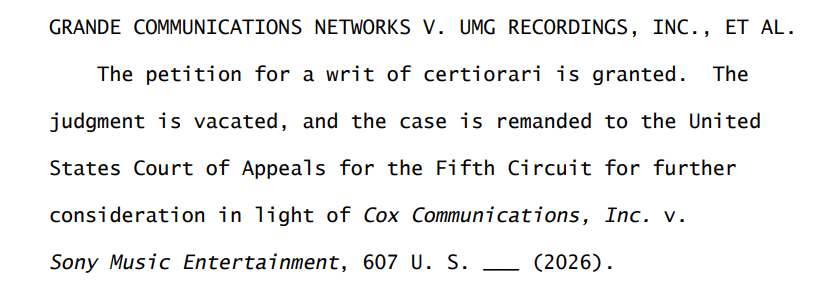 Given the similarities between the two cases, it is no surprise that the Supreme Court came to this conclusion. It is now up to the Fifth Circuit to revisit whether Grande’s conduct meets the intent threshold that was established in Cox. That is a significantly higher bar than the one applied in the original verdict, which found that continuing to provide service to known infringers was enough to establish material contribution. The music companies previously said they sent over a million copyright infringement notices, but that Grande failed to terminate even a single subscriber account in response. However, without proof of active inducement, these absolute numbers carry less weight now. Whether this translates into a win for Grande on remand remains to be seen. For now, however, the original $47 million verdict is further away than ever. This week’s GVR order is just one of the many ripple effects of the Sony ruling on other contributory infringement cases. Last week, we reported how X already asked the court to dismiss its liability battle with several music publishers. Meanwhile, the ruling will also directly impact Verizon’s repeat infringer battle with the music industry. From: TF, for the latest news on copyright battles, piracy and more. | ||||||||||||||||||
| Monday, April 6th, 2026 | |||||||||||||||||||
| LJ.Rossia.org makes no claim to the content supplied through this journal account. Articles are retrieved via a public feed supplied by the site for this purpose. | |||||||||||||||||||
| 2:41 pm | Music Publishers Ask Court to Dismiss X’s ‘Weaponized DMCA’ Antitrust Suit
The music publishers, meanwhile, were busy in a different court, asking a Texas judge to throw out X’s antitrust complaint against them with similar finality. The motion to dismiss, filed in the Northern District of Texas, argues that X’s lawsuit doesn’t hold up and the music companies want all eight counts dismissed with prejudice. A Conspiracy Built on One WordX filed its antitrust complaint in January, accusing the National Music Publishers’ Association (NMPA) and a coalition of major music publishers, including Sony, Universal, and Warner Chappell, of coordinating a “weaponized” DMCA takedown campaign to coerce X into industry-wide licensing deals. The conspiracy claim rested heavily on a pre-litigation email sent by NMPA President David Israelite to Twitter in October 2021. X alleged that Israelite threatened a “massive program” of DMCA notices on a scale “larger than any previous effort in DMCA history” if X did not agree to a partnership. 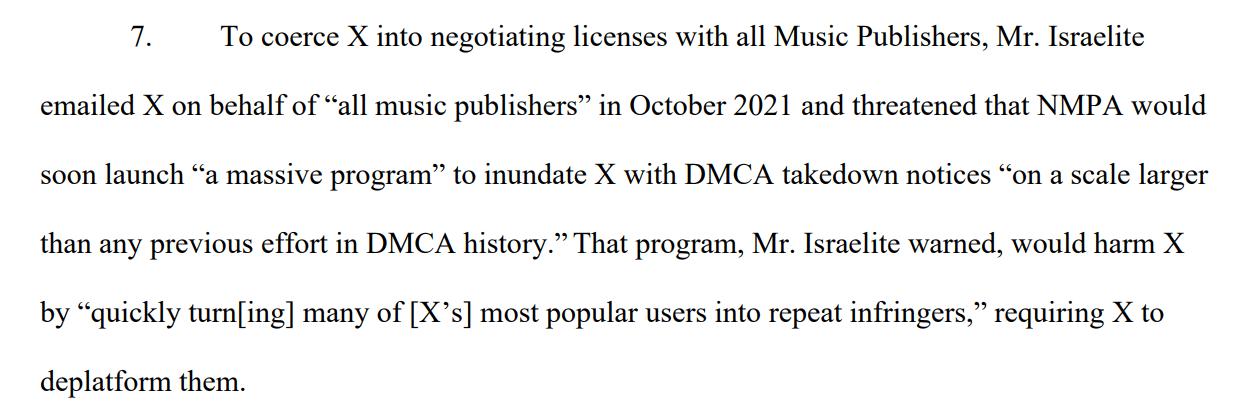 However, the publishers have now submitted the full email chain to the court, arguing that X’s complaint “selectively crops, paraphrases, and misconstrues” it. They note that the complete exchange tells a more nuanced story. In his October 6 email, Israelite warned Twitter that the NMPA was preparing a “massive program” of DMCA notices, adding that his “preference is not to go down that road, but instead to develop a partnership.” He closed by writing (emphasis added): “If you are interested in engaging in such a conversation, please let me know. If you choose not to do so, then please know we are open to starting a conversation at any point during the future process.” 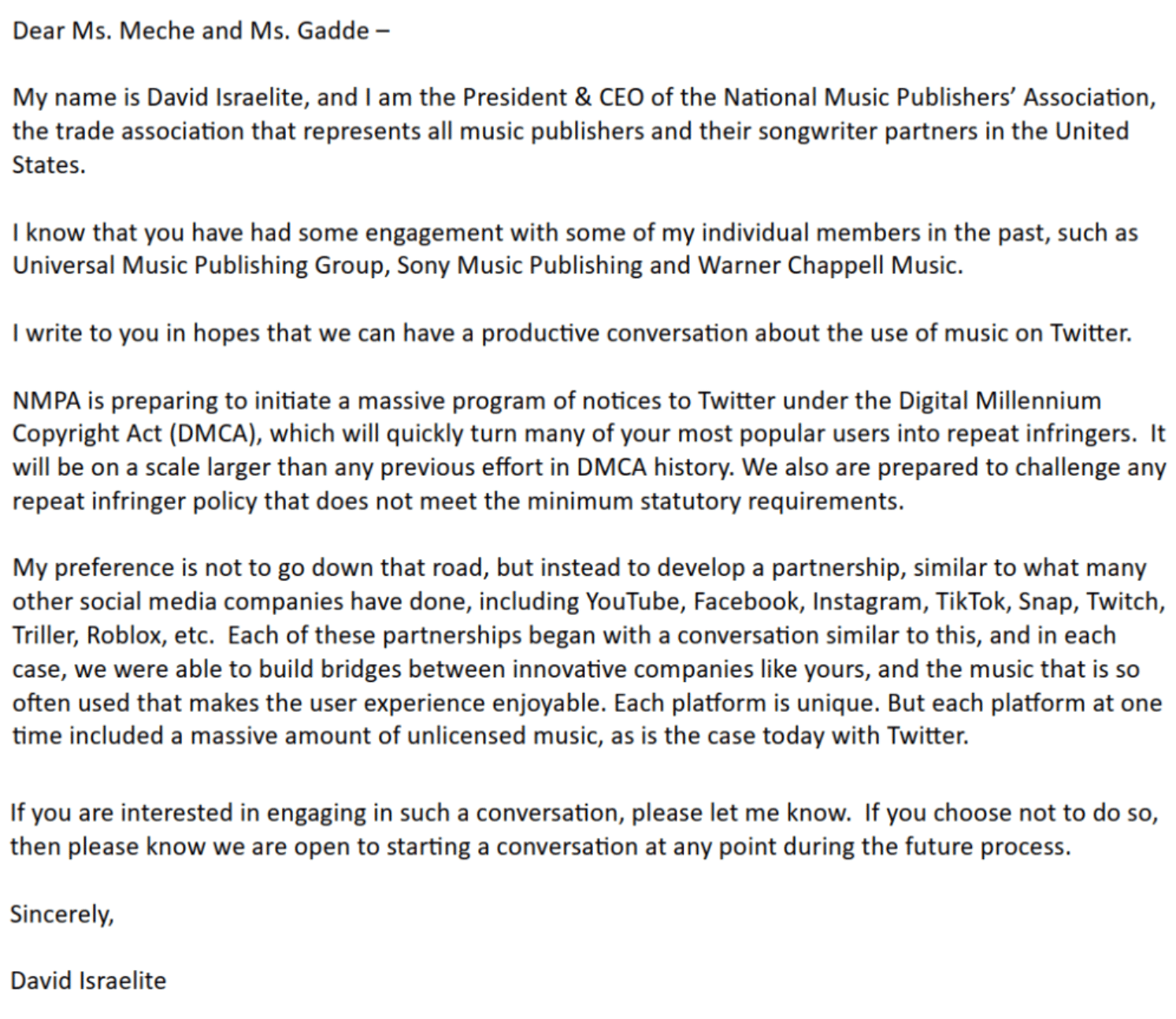 The publishers argue that X’s conspiracy theory rests almost entirely on that final word. “X argues that by using the word ‘we,’ NMPA meant that X could only deal with the Music Publishers collectively for a license and that no individual Music Publisher would negotiate separately. That inference is not only implausible, it is completely devoid of factual basis or allegation. An antitrust claim cannot rest on such a tenuous thread.” Same Judge, Same ProblemOne of the key reasons for a dismissal is the argument that there can be no antitrust injury, as X and the music publishers do not compete. The music companies argue that antitrust law requires a competitor to be involved in a refusal-to-deal claim. The argument has already succeeded once against X, in the same courthouse, before the same judge. In February, District Judge Jane Boyle dismissed X’s antitrust lawsuit against the World Federation of Advertisers with prejudice, finding that X had failed to allege antitrust injury because no competitor was involved in the alleged boycott. The publishers quote that ruling extensively and argue the present case is largely similar. “Specifically, X does not allege that any participant in the alleged conspiracy is its competitor, a necessary requirement for antitrust injury to flow from an alleged refusal to deal,” the motion states. The proposed order submitted alongside the motion has Judge Boyle’s name pre-filled. Retaliation, Not AntitrustThe music publishers take their motion to dismiss beyond simply refuting X’s claims. They also suggest that X filed the antitrust suit as leverage in the copyright infringement case the music companies filed in the Tennessee federal court. “The paucity of factual allegations supporting an antitrust claim is no accident. X’s motivation in filing suit was different: retaliation and leverage for the copyright suit the Music Publishers filed against it, which is currently pending in Tennessee federal court,” the motion notes. X argues that the music companies sent a flood of “baseless” DMCA notices, targeting over 200,000 posts and suspending 50,000 users. However, the music publishers motion counters that none of the takedown notices was objectively baseless. The Sham ExceptionThe music companies argue that their takedown campaign was a First Amendment-protected pre-litigation activity. They invoke the Noerr-Pennington doctrine, which shields things such as pre-litigation notices and cease-and-desist letters from antitrust liability. DMCA takedown notices, they argue, fall in the same category, especially since these were used as key evidence in the the copyright lawsuit currently pending in Tennessee. This type of protection does not apply if the notices themselves are “baseless” or a “sham,” which X argued is the case here. The original complaint pointed to several examples, including a takedown notice targeting a video where the non-commercial use of background music was flagged as copyright infringement. The music companies, however, counter that X does and cannot claim that any notices were baseless. This includes the background music example: this may qualify for fair use defense, but the publishers add that “infringing use of incidental background music is still infringing.” All in all, the motion to dismiss concludes that the music companies used the DMCA as Congress intended, and that it is not an antitrust violation. The complaint should therefore be dismissed with prejudice on all counts. It is now up to Judge Boyle to decide whether the antitrust case can continue or whether it should be dismissed outright. The same is true for the Nashville case, where X asked the court to completely dismiss the music companies’ copyright infringement lawsuit. — A copy of the motion to dismiss, filed April 2, 2026 at the U.S. District Court for the Northern District of Texas, is available here (pdf). The supporting memorandum can be found here (pdf). From: TF, for the latest news on copyright battles, piracy and more. | ||||||||||||||||||
| Sunday, April 5th, 2026 | |||||||||||||||||||
| LJ.Rossia.org makes no claim to the content supplied through this journal account. Articles are retrieved via a public feed supplied by the site for this purpose. | |||||||||||||||||||
| 4:25 pm | U.S. Lawmakers Work on Unified Site-Blocking Bill to Counter Online Piracy
It confirms that they can’t be held liable for pirating activities of subscribers or customers unless they actively induce copyright infringement through specific acts, or if their service has no substantial non-infringing uses. For rightsholders, however, the ruling represents a significant setback, as it makes it much harder to hold ISPs liable for pirating subscribers. Or, as Justice Sotomayor noted in her concurring Supreme Court opinion, the majority’s decision “permits ISPs to sell an internet connection to every single infringer who wants one without fear of liability and without lifting a finger to prevent infringement.” The ruling reshapes the liability landscape, giving new urgency to site-blocking efforts. Internet providers have previously opposed such legislation over liability concerns. Have those concerns been resolved by the Supreme Court? And where do the U.S. site-blocking legislative efforts stand today? A Bicameral, Bipartisan Site Blocking PushLast year, several new site-blocking proposals emerged in Congress. In January 2025, Lofgren had filed her Foreign Anti-Digital Piracy Act (FADPA) in the House. A few months later, Senator Tillis announced a draft of the Block BEARD Act, with bipartisan support from Senators Chris Coons, Marsha Blackburn, and Adam Schiff. At the time, the House and Senate efforts were not coordinated. That has changed. TorrentFreak has learned that, over the past months, Senator Tillis and Representative Lofgren have been working on a draft that would combine their separate site-blocking proposals into a single piece of legislation. The unified approach marks a significant shift from the fragmented approach of the past year. No draft text has been circulated publicly, and sources could not provide a specific timeline for introduction beyond noting it would need to happen before Tillis’s term ends in January 2027. One possibility mentioned by sources is that the legislation could be attached to an omnibus spending bill. For now, however, that remains speculative. Targeting ISPs and DNS ResolversWhile detailed specifics on the bill will have to wait until a draft is circulating, it is expected that the legislation will require both ISPs and large DNS providers to block foreign pirate sites. This is in line with Lofgren’s original FADPA bill, which specifically included DNS resolvers with more than $100 million in annual revenue. Tillis’s Block BEARD act does not mention DNS resolvers, but uses the Section 512(k)(1)(A) DMCA service provider definition, which is wide enough to capture them. The inclusion of DNS resolvers is significant, as it brings tech companies such as Google and Cloudflare into the mix. Targeting DNS resolvers is relatively novel internationally, as most site-blocking regimes do not explicitly include DNS providers. We reached out to Google and Cloudflare, requesting comment, but they did not reply before publication. However, these companies have appealed similar blocking requests elsewhere, including in France, so they likely have reservations. Notably, last year the Internet Infrastructure Coalition (I2Coalition), which represents major tech companies including Amazon, Cloudflare, and Google, launched its DNS at Risk campaign, warning the public about such DNS blocking threats. Support and OppositionRightsholder groups including the RIAA, MPA, and Creative Future have supported the site-blocking efforts, while consumer advocates have raised concerns. However, the public discourse has been relatively quiet compared to the SOPA debates in 2012. Times have changed and site blocking is much more common today than it was back then. That said, discussions, support, and critique will likely pick up when the legislation moves forward. It is notable, however, that Representative Lofgren’s leading role is a shift from her position during the SOPA debates. At the time, she was among the fiercest opponents of SOPA in 2012, warning that blocking threatened the open internet. Lofgren believes that her FADPA proposal is a “smart, targeted approach” that is mindful of due process, and respects free speech while using a narrow and targeted blocking approach. Rep. Issa’s Wild CardRunning parallel to the Tillis-Lofgren effort is a separate proposal from Representative Darrell Issa, chairman of the House Judiciary Subcommittee on Courts, Intellectual Property, and the Internet. Issa’s American Copyright Protection Act (ACPA) has been circulated in draft form for a while but has not been formally introduced. The bill takes a different procedural path. Rather than relying on standard district court jurisdiction, ACPA proposes that the Judicial Conference of the United States maintain a roster of designated judges to hear all piracy blocking cases. Whether the Tillis-Lofgren framework and Issa’s separate effort will eventually converge remains unclear. Sources indicate that, in earlier stages, these were two separate, uncoordinated tracks. Issa’s proposal also includes DNS resolvers. At the same time, it also addresses overblocking concerns directly. If a third party’s site is blocked due to an error caused by the copyright owner, the third party could request up to $250,000 in compensation from the rightsholder. The TimelineAt the time of writing, the introduction timeline for the bicameral bill is unknown. However, Senator Tillis is not running for reelection. That gives him until January 2027 to advance the legislation and also creates a hard deadline. Whether the bill surfaces as standalone legislation, gets attached to an omnibus spending package, or eventually blends with Issa’s separate ACPA proposal has yet to be seen. But it’s clear that, behind the scenes, lawmakers are still working on getting it ready. With the Cox decision reshaping the legal landscape, site-blocking efforts have gained new urgency for both ISPs, DNS providers, and rightsholders. From: TF, for the latest news on copyright battles, piracy and more. | ||||||||||||||||||
| Friday, April 3rd, 2026 | |||||||||||||||||||
| LJ.Rossia.org makes no claim to the content supplied through this journal account. Articles are retrieved via a public feed supplied by the site for this purpose. | |||||||||||||||||||
| 2:31 pm | Yout.com Hopes Supreme Court’s Cox Ruling Helps Its Case; RIAA Disagrees
To curb this trend, music companies have taken legal action against various stream-ripping services. This includes Yout.com, which is operated by the American developer Johnathan Nader. Nader is not easily defeated, however. In 2020 he took the RIAA to court in an attempt to have the site declared legal. Appeal PendingAt the end of 2022, the district court handed a win to the RIAA and dismissed the matter at an early stage. Judge Stefan Underhill concluded that Yout had failed to show that it doesn’t circumvent YouTube’s technological protection measures. As such, it could be breaking the law. That wasn’t the end though. Yout’s operator opted to appeal at the Court of Appeals for the Second Circuit, asking it to reverse the lower court’s decision. The stream-ripper’s arguments are partly supported by amicus briefs from GitHub and the EFF, both of which joined the case. On the other side of the aisle, the RIAA dug in its heels. The music group saw no reason to doubt the lower court’s position and, in its response to the appeal, found the Copyright Alliance at its side. Yout Flags Cox Supreme Court PrecedentThe Second Circuit appeal has been pending for a while, but some fresh arguments appeared this week, after the Supreme Court issued its ruling in Cox v. Sony, reversing a billion-dollar verdict against the internet service provider and narrowing the standard for contributory copyright liability. Yout’s lawyers were quick to flag the decision to the Second Circuit via a supplemental authority letter. They argued that the Supreme Court’s discussion of when a service is ‘tailored to infringement’ has bearing on Yout’s own situation. “Although Cox Communications is not an anti-circumvention case, it nonetheless may provide useful guidance to the Court in the present case as the Supreme Court discusses when a ‘service is tailored to infringement’,” Yout’s counsel wrote. 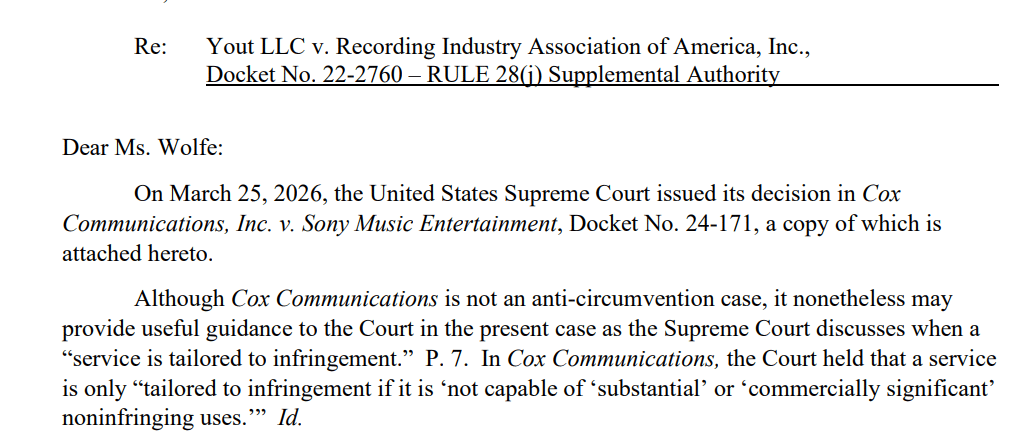 The Supreme Court held that a service that has noninfringing uses cannot be held liable, even if the operator knows that the service may be used for copyright infringement. Yout suggests the same logic should apply in its case. RIAA: Cox Does Not ApplyShortly after Yout informed the court, the RIAA sent a direct response. “Yout’s letter is not helpful to the resolution of this case,” RIAA writes. “The Cox decision addresses common law contributory liability for infringement. Yout’s complaint involves statutory anti-circumvention claims.” The distinction matters according to the RIAA, as the anti-circumvention of the DMCA (Section 1201) operates independently of the contributory liability doctrine. This means that a technology with noninfringing uses can still be prohibited under Section 1201, if it meets one of three criteria. Under 17 U.S.C. §§ 1201(a)(2) and 1201(b)(1), liability for trafficking exists if a technology or service meets any one of these three disjunctive criteria:
RIAA argues that all these criteria are met here, as Yout is designed to let users save local copies of YouTube content, its revenue model depends on that downloading functionality, and it markets itself explicitly as a stream recording tool, while borrowing the first four letters of YouTube’s name. Whether this exchange of opinions will influence the Second Circuit’s eventual decision has yet to be seen. The key issue on appeal remains whether YouTube’s rolling cipher qualifies as a technological protection measure under Section 1201 of the DMCA, and whether Yout circumvents it. — A copy of Yout’s Rule 28(j) letter is available here (pdf). The RIAA’s response can be found here (pdf). From: TF, for the latest news on copyright battles, piracy and more. | ||||||||||||||||||
| Thursday, April 2nd, 2026 | |||||||||||||||||||
| LJ.Rossia.org makes no claim to the content supplied through this journal account. Articles are retrieved via a public feed supplied by the site for this purpose. | |||||||||||||||||||
| 7:30 am | X Asks Court to Dismiss Music Piracy Lawsuit After Supreme Court’s Cox Ruling
The social media company allegedly failed to respond adequately to takedown notices and lacked a proper termination policy. The National Music Publishers Association (NMPA), for example, claimed it had sent over 300,000 formal infringement notices, many of which didn’t lead to immediate removals. “Twitter routinely ignores known repeat infringers and known infringements, refusing to take simple steps that are available to Twitter to stop these specific instances of infringement of which it is aware,” the music companies alleged. X Won the First BattleIn 2024, X scored a partial win when the court dismissed the music publishers’ direct and vicarious copyright infringement claims, and partially dismissed claims of contributory infringement. The court concluded that X can’t be held liable for making it ‘very easy’ to upload infringing material or for monetizing pirated content. Those characteristics are not exclusive to infringing material and apply to legitimate content. While this was a partial win for X, most of the contributory infringement claim remained intact, and the lawsuit was allowed to move forward on those grounds. Among other things, the music companies argued that X is liable because it willingly turned a blind eye to pirating users, especially those who have a blue checkmark. However, according to a new filing by X this week, new legal developments warrant a full dismissal now. Cox Sets the New StandardLast Friday, X informed the Tennessee federal court about the Supreme Court decision in Cox v. Sony, which was decided in favor of the ISP last week. This ruling also concerns a ‘repeat infringer’ case, and it sets a clear standard for contributory copyright infringement. Under the Supreme Court’s new standard, a service provider can only be held contributorily liable if it intended its service to be used for infringement. That intent can be shown in just two ways: the provider actively induced copyright infringement through specific acts, or the service has no substantial non-infringing uses. Nothing else qualifies. X argues that the music publishers’ surviving claim fails both tests. Social media is clearly capable of substantial non-infringing uses, and the publishers never alleged that X took specific steps to actively encourage infringement. The social media platform argues that, under the new Cox precedent, the contributory infringement claim fails as a matter of law and the entire case should be dismissed. “F the DMCA”To stress that there is a high bar for these infringement claims, X directly references some of the most damning evidence in the Cox case, which was not enough to establish liability. “Cox even expressed contempt for copyright law, writing emails with comments like ‘F the DMCA.’ Despite these facts, the Supreme Court had no trouble reversing the jury’s contributory-infringement verdict, because such facts were not ‘evidence of express promotion, marketing, and intent to promote infringement,” X notes in its filing. The comparison is somewhat ironic, as Elon Musk himself once publicly described the DMCA as a “plague on humanity”, which the music publishers cited in their original complaint as evidence of a hostile attitude toward copyright. While controversial, these statements don’t appear to matter for a contributory infringement claim, as they don’t actively induce copyright infringement. Therefore, X believes that the present case should be dismissed. “If the Supreme Court had issued this opinion three years ago, X believes this Court would have dismissed Plaintiffs’ contributory-infringement claim in its entirety. Indeed, virtually every contributory-infringement case Plaintiffs cited in opposing X’s motion to dismiss – including the Fourth Circuit case on which this Court relied – is no longer good law,” X writes. Millions at StakeX is not simply flagging the Supreme Court ruling for the record. The social media platform asks Judge Trauger for a status conference before both sides spend millions more on a case that may have already been rendered pointless. There are various motions pending while the case is heading to summary judgment, and X asks the court to reconsider whether the new Cox precedent warrants a more streamlined process. “If the Court would prefer to address these issues at summary judgment, X is prepared to do so. But both sides are now poised to spend millions of dollars in fees and expert expenses in the coming months on issues that Cox makes irrelevant as a matter of law,” X writes. X says that it plans to move for judgment on the pleadings, or alternatively, it will ask the court to reconsider its earlier motion to dismiss ruling in light of new legal reality. For now, X is proposing a hearing to find the most efficient path forward. Whatever the court decides, the legal standoff between X and the music industry will be far from over. Earlier this year, Elon Musk’s company filed a landmark antitrust complaint against the NMPA, Sony, Universal, and other major music publishers, alleging that they “weaponized” the DMCA to force licensing deals. — — A copy of X’s notice, filed earlier this week at the U.S. District Court for the Middle District of Tennessee, is available here (pdf). Update: The music companies filed a response in court, agreeing to stay the matter temporarily, until the court decides how to move forward (pdf). From: TF, for the latest news on copyright battles, piracy and more. | ||||||||||||||||||
| Wednesday, April 1st, 2026 | |||||||||||||||||||
| LJ.Rossia.org makes no claim to the content supplied through this journal account. Articles are retrieved via a public feed supplied by the site for this purpose. | |||||||||||||||||||
| 12:43 pm | Google, Cloudflare, Cisco Lose Pirate Site DNS Blocking Appeal in France
By blocking pirate domains through ISP DNS resolvers, subscriber access is effectively cut off. However, the measures were only partially effective, as many users simply switched to third-party DNS resolvers to get around them. In 2024, an order from the Paris Judicial Court, requested by football and rugby rightsholder Canal+, aimed to patch that loophole. The order required Cloudflare, Google, and Cisco to actively block access to pirate sites through their own DNS resolvers, confirming that third-party intermediaries can be required to take responsibility. Article L. 333-10The DNS blocking order is grounded in Article L. 333-10 of the French Sport Code, which enables rightsholders to request blocking measures against named pirate sites if they can demonstrate “serious and repeated infringement” of their exploitation rights. To prevent pirate sites from being accessed on French soil, rightsholders may request that “all proportionate measures” are implemented by any online entity in a position to help. The scope of Article L. 333-10 was always meant to be broad. There was little doubt that it included regular consumer ISPs. However, applying it to DNS resolvers was a different matter, and all three companies fought back. Cisco was the most extreme in its response. The American company decided to stop offering its OpenDNS service in France, pending appeal. Google and Cloudflare kept their DNS resolvers online in the country but joined Cisco at the Paris Court of Appeal. Five Appeals, Five RejectionsLast week, the Paris Court of Appeal ruled on five separate appeals, where Cisco, Cloudflare, and Google appealed blocking orders that the French pay-TV provider Canal+ obtained. The court rejected all appeals and concluded that DNS blocking measures are both technically feasible and proportionate. The news was first reported by the French news outlet L’Informé, which also published the orders. This is the first time a French appeals court has validated the DNS blocking approach under Article L. 333-10, giving the strategy a considerably stronger legal basis. Specifically, the appeals court repeatedly stressed that DNS resolvers can be required to block pirate sites. Defense Arguments FailThe DNS providers raised various arguments in their defense. According to the court’s summary, Cloudflare and Cisco argued that their services have “only a neutral and passive function” and “neither transmit nor participate in infringement.” They compared their role to an address book: they translate domain names into IP addresses, and their involvement ends the moment they return that result to a user’s browser. This argument failed to convince the court, which found that the “neutral and passive” nature of the DNS resolvers is simply irrelevant to Article L. 333-10. The law isn’t about liability at all. What matters is whether a service can help to block access to pirate sites, which DNS resolvers clearly can. “The DNS resolution service allows its users, via the translation of a domain name into an IP address, to access websites on which sports competitions are broadcast in violation of rights-holders’ rights, and in particular to circumvent the blocking of those sites by ISPs,” the court wrote. Google also argued that blocking pirate sites via third-party DNS services is not an effective deterrent, since it can be circumvented by using a VPN or switching to yet another DNS resolver. The appeals court wasn’t moved by this argument either. French law doesn’t require blocking measures to be perfect, as long as they stop a subset of the visitors to pirate sites, it’s good enough. “Any filtering measure can be circumvented, and this possibility does not render the measures in question ineffective,” the Paris Court of Appeal wrote. Intermediaries Pick Up the BillCisco, which shut down its OpenDNS service in France instead of complying with the original order, argued on appeal that implementing geo-targeted DNS blocking would require 64 person-weeks of engineering work. However, the court was not swayed by this cost argument, noting in its decision that the estimate was “not supported by any objective evidence.” The court also pointed out that Cisco already offers a DNS filtering service to enterprise customers, which undermined the argument that there’s a significant technical challenge. Cloudflare, meanwhile, offered no figures at all to quantify the cost, the court noted, adding that they also offer filtering options already. At the end of the day, Cisco, Cloudflare, and Google will have to implement the blocking measures for hundreds of pirate site domains while covering the implementation costs themselves. More IP Blocking Battles AheadCanal+ is pleased with the five appeals court rulings. The pay-TV service Canal+ said in a statement that the rulings are “more than a victory,” forming part of “a global approach that will be reinforced by the progressive deployment of complementary measures, including IP blocking.” In France, the next anti-piracy frontier is automated IP-address blocking, which is expected to go live later this year, ahead of the FIFA football World Cup. According to L’Informé, the Roland Garros tennis tournament will serve as a trial opportunity. In addition to DNS providers, Canal+ and other rightsholders have also obtained blocking orders against VPN providers. These are still under appeal. The five orders of the Paris Court of Appeal (RG 24/09372), dated March 27, 2026, are available here (pdf), via L’Informé journalist Marc Rees. From: TF, for the latest news on copyright battles, piracy and more. | ||||||||||||||||||
| Tuesday, March 31st, 2026 | |||||||||||||||||||
| LJ.Rossia.org makes no claim to the content supplied through this journal account. Articles are retrieved via a public feed supplied by the site for this purpose. | |||||||||||||||||||
| 7:33 am | Game Pirates Beat Denuvo with Hypervisor Bypasses — Irdeto Promises Countermeasure
With gaming as a multi-billion-dollar industry today, protecting games is more important than ever. Especially during the early release window when most sales are generated. In the past decade, Denuvo has been the prime anti-piracy solution. The Irdeto-owned protection software managed to delay pirate releases seriously. Despite being a nuisance to many legitimate customers, gaming companies were pleased to pay for this first line of defense. That is, until everything suddenly appeared to change a few weeks ago with the pirate leak of ‘Resident Evil Requiem,’ mere hours after its official release. Hypervisor Bypasses Break Denuvo on Day ZeroThe early leak was not a one-off. A wave of hypervisor-based Denuvo bypasses came out recently, including day-zero releases of major titles, including Crimson Desert and Life is Strange: Reunion. Meanwhile, long-protected titles like Assassin’s Creed Shadows also fell to the new method. The speed and scale of the breaches, which also bypass other DRM software, are unprecedented. Where some reputable game crackers previously feared that Denuvo would effectively end game piracy, the tables have completely turned now. 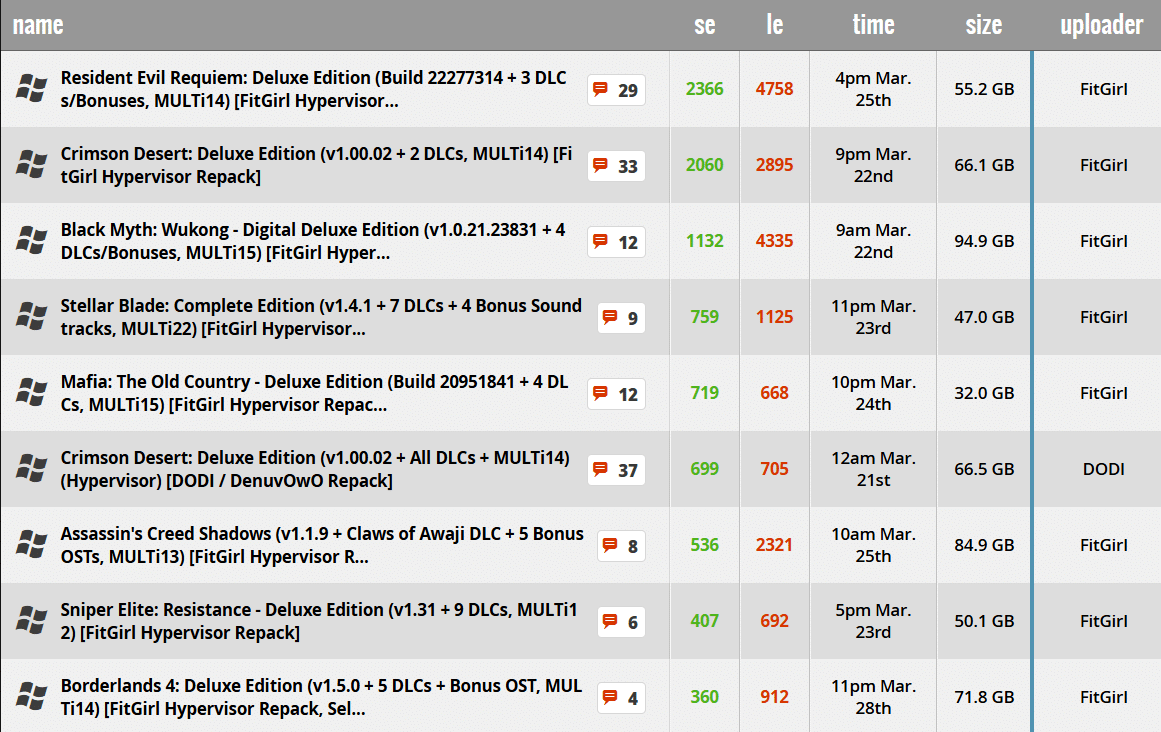 Traditionally, crackers were required to reverse engineer Denuvo’s DRM paths to patch the game, which is a labor-intensive process that could take months. Hypervisor bypasses take a fundamentally different approach. They don’t interfere with the game directly, but they operate beneath the operating system’s standard security visibility level, in what security researchers call Ring -1. At this fundamental level, with key security features disabled, the hypervisor bypasses can intercept Denuvo’s CPU instructions and feed back false data to make the game believe that the tampering protection is still in place. Because these bypasses are much easier to develop, these new ‘cracks’ come out faster than ever. Where pirates previously had to wait for weeks, they can now play pirated games within hours. That’s unprecedented. Security ConcernsThe hypervisor bypasses are a breakthrough, but they are not without concern. Right off the bat, critics warned that for them to work, pirates essentially have to turn off a key protection layer on their computer. The bypasses are also plagued by hardware-specific problems and limitations that make them far from a simple patch. AMD systems are currently more stable, while Intel users face significant performance and stability issues, leading to other dangerous “tweaks”. This cracking approach is still relatively young, and new developments surface nearly daily, with the game piracy forum Steam Underground (CS.RIN.RU) being a central hub. The forum does not only facilitate pirate releases; it also offers detailed educational resources on potential security issues, warning that there are serious risks involved. “[E]ven if you trust the authors of the hypervisor driver and even compile it yourself from source, a serious vulnerability in its code could instantly provide maximum and undetectable access to your system,” forum administrator RessourectoR writes. 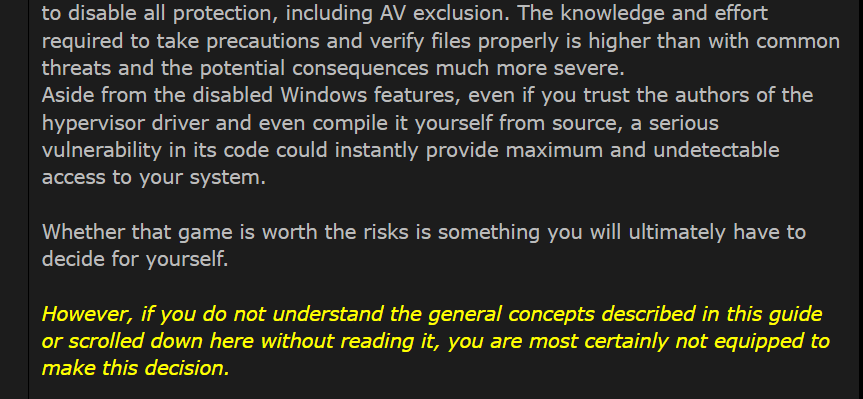 The question remains, of course, whether the average game pirate will read these warnings at all. Denuvo’s ResponseThe scale of the bypasses has not gone unnoticed. While pirates try to navigate the security issues, Denuvo is working on an update that will counter the new hypervisor ‘cracks’. Denuvo’s parent company, Irdeto, informs TorrentFreak that they are actively working on a countermeasure to address the Denuvo bypasses. “We’re already working on updated security versions for games impacted by hypervisor bypasses. For players, performance will not be compromised by these strengthened security measures,” says Daniel Butschek, Irdeto’s head of communications. Further details on these countermeasures will come out in due course. Some have speculated that to counter hypervisor cracks Denuvo would also has to operate in Ring -1, under the Windows kernel, but that is not the case. “Addressing hypervisor-based workarounds will not require Denuvo to move into Ring -1 or deeper kernel level, and that is not the direction we’re pursuing,” Butschek says.  Since people in the pirate ecosystem already warn about security issues, it is no surprise that Irdeto also highlights these concerns. “Hypervisor‑based bypasses rely on installing a custom, self-signed hypervisor that operates below the Windows kernel, giving it far broader control than a normal driver,” Butschek notes, warning that this makes systems more vulnerable. “To run, users must disable major Windows security protections such as Virtualization‑Based Security (VBS), Hypervisor‑Enforced Code Integrity (HVCI) and driver signature enforcement, which are designed to prevent kernel‑level malware, rootkits, and ransomware.” FitGirl Embraces Hypervisor BypassesInitially, popular game repacker FitGirl was also rather cautious due to the widespread security concerns. “You won’t see any HV-cracks repacks from me until you won’t need to actually disable security features,” FitGirl wrote in an early post, adding that no game is worth the potential irrecoverable damage it can do to one’s computer. However, as bypass development by KiriGiri and the broader MKDEV team continued, the security situation improved. When the requirement to disable Secure Boot or use the EfiGuard tool was eliminated, FitGirl shifted their position, while recognizing the drawbacks. FitGirl began publishing hypervisor repacks shortly after, tagging each one visibly with a HYPERVISOR label and committing to replace them with traditional cracks if and when those become available. Speaking with TorrentFreak, FitGirl further pointed to the ongoing technical improvements, while remaining cautious. “The team behind those cracks is now working on maturing both the VBS.cmd part and the cracks themselves,” they told us. “So I think that most of the issues coming from Intel or older CPU will be resolved shortly.” “Caution is still needed with hypervisor bypasses. Mostly for what you download and run. But that is true for any download; it is not hypervisor-specific,” FitGirl adds. Strict RulesFitGirl notes that people should never run anything on their computer until they’ve verified that it’s from a trusted source. This raises the question of whether one can trust semi-anonymous pirate sources, but for now no major incidents have been reported linked to hypervisor bypasses. What stands out is the high level of community rules and moderation. CS.RIN.RU has always been very strict, and with these hypervisor bypasses, forum administrator RessourectoR maintains oversight through detailed release requirements and best practices. 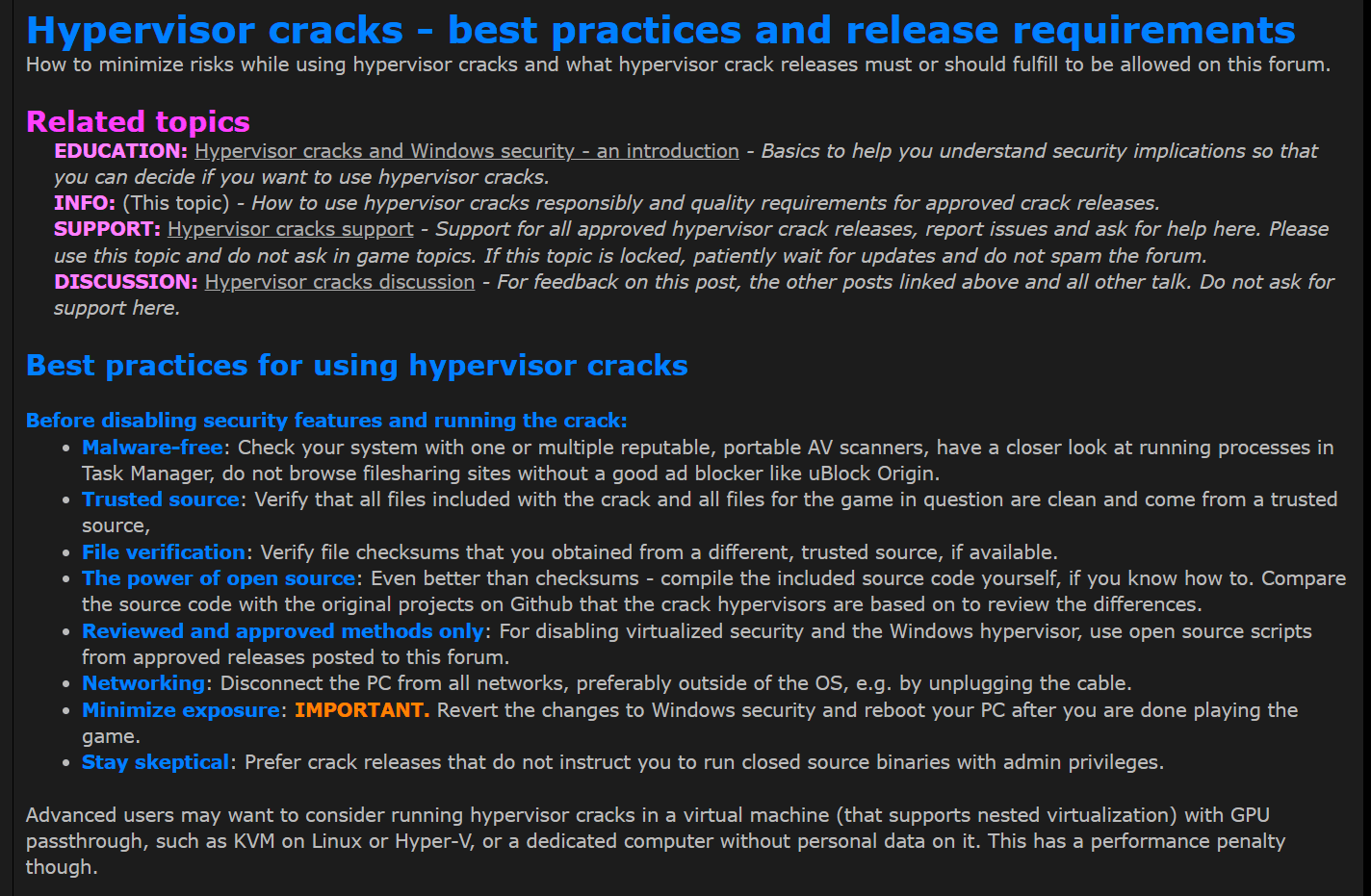 According to FitGirl, these strict rules are reassuring. However, trust can always be broken in the future, and that’s also a risk here. “Trust can be broken, yes, but we’re not there yet. And hope we won’t, considering how strict rules for publishing those cracks on CS.RIN.RU now are,” FitGirl tells us. The Cat-and Mouse Game ContinuesWhile Irdeto has several options to respond, the exact countermeasures remain a question for now. Denuvo could check if third-party hypervisors are running by checking CPUIDs or measuring CPU latency, for example. FitGirl suggested that Irdeto can also respond by shifting to daily license ticket checks, but that would be a nuisance to legitimate players while it may also be bypassed. Alternatively, the company might ask Microsoft for help by restricting Driver Signature Enforcement (DSE) mode, but that doesn’t seem viable either. One thing is for certain: Denuvo will try to tackle the problem as best as they can, continuing the seemingly endless cat-and-mouse game. While Irdeto knows that it can’t defeat piracy, it would like to go back to the situation where games remained crack-free for weeks. For now, however, the hypervisor bypasses have made Day-0 pirate releases a reality. For those who are willing to take the risk. From: TF, for the latest news on copyright battles, piracy and more. | ||||||||||||||||||
| Monday, March 30th, 2026 | |||||||||||||||||||
| LJ.Rossia.org makes no claim to the content supplied through this journal account. Articles are retrieved via a public feed supplied by the site for this purpose. | |||||||||||||||||||
| 7:30 am | Judge Allows BitTorrent Seeding Claims Against Meta, Despite Lawyers ‘Lame Excuses’
Most of these cases allege that AI developers used copyrighted works to train LLMs without first obtaining authorization. Meta is among a long list of companies now being sued for this allegedly infringing activity. This includes a class action lawsuit filed by authors including Richard Kadrey, Sarah Silverman, and Christopher Golden, which accused Meta of using libraries of pirated books as training material. Court Dismisses AI Training ClaimsLast summer, Meta scored a key victory in this case, as the court concluded that using pirated books to train its Llama LLM qualified as fair use, based on the arguments presented in this case. This was a bittersweet victory, however, as Meta remained on the hook for downloading and sharing the books via BitTorrent. By downloading books from shadow libraries such as Anna’s Archive, Meta relied on BitTorrent transfers. In addition to downloading content, these typically upload data to others as well. According to the authors, this means that Meta was engaged in widespread and direct copyright infringement. In recent months, the lawsuit continued based on this remaining direct copyright infringement claim. While this was unfolding, the authors’ legal team also ‘discovered’ a new claim Authors Pivot to Seeding ClaimLast December, the authors, through their attorneys, requested leave to file a fourth amended complaint. Specifically, they want to add a contributory copyright infringement claim, alleging that Meta facilitated third-party copyright infringement by seeding pirated books to others. While the BitTorrent angle is not new, the authors previously only included a ‘distribution’ claim based on direct copyright infringement. This claim has a higher evidence standard, as it typically requires evidence that the infringer shares a whole work with a third party. Since BitTorrent transfers break up files into smaller chunks before they are shared, it might be difficult to prove that a whole work is shared. However, the same transfers can be evidence that an infringer facilitated torrent transfers to third parties. 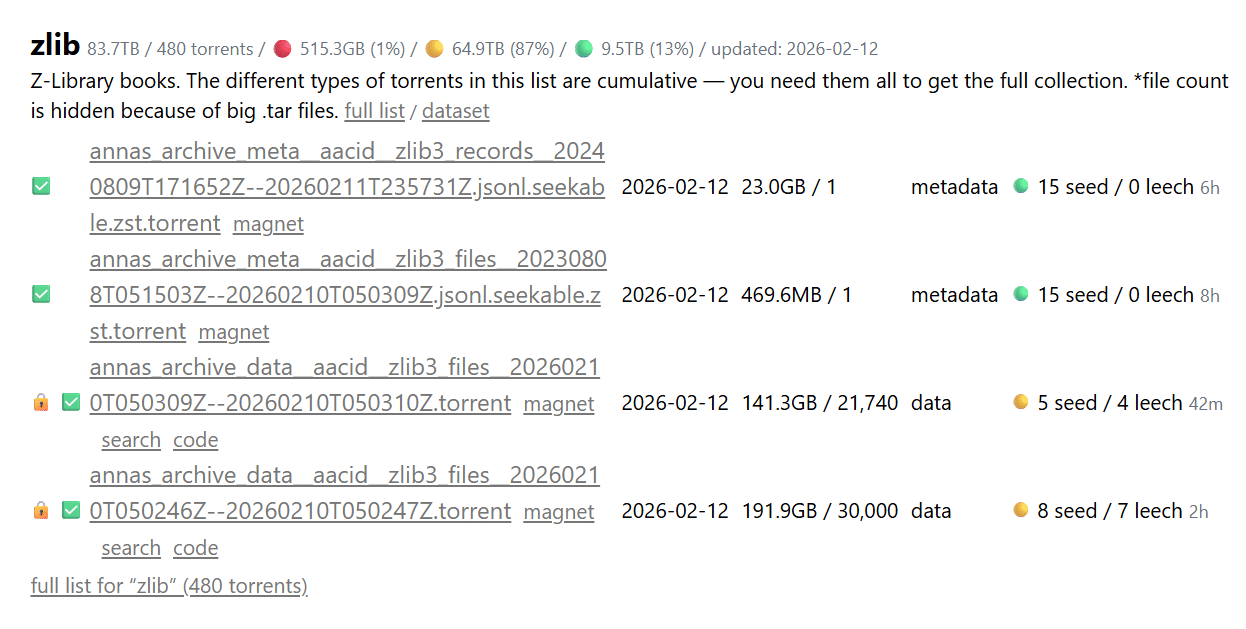 Court Grants BitTorrent Pivot, Despite DoubletalkThis week, U.S. District Court Judge Vince Chhabria granted the motion, but made little effort to hide his frustration with how plaintiffs’ counsel handled it. The judge acknowledged that the contributory infringement claim could and should have been added back in November 2024, when the authors amended their complaint to include the distribution claim. After all, both claims arise from the same factual allegations about Meta’s torrenting activity. “The lawyers for the named plaintiffs have no excuse for neglecting to add a contributory infringement claim based on these allegations back in November 2024,” Judge Chhabria wrote. The lawyers of the book authors claimed that the delay was the result of newly produced evidence that had “crystallized” their understanding of Meta’s uploading activity. However, that did not impress the judge. He called it a “lame excuse” and “a bunch of doubletalk,” noting that if the missing discovery truly prevented the contributory claim from being added in November 2024, the same logic would have prevented the distribution claim from being added at that time as well. “Rather than blaming Meta for producing discovery late, the plaintiffs’ lawyers should have been candid with the Court, explaining that they missed an issue in a case of first impression..,” the order reads. 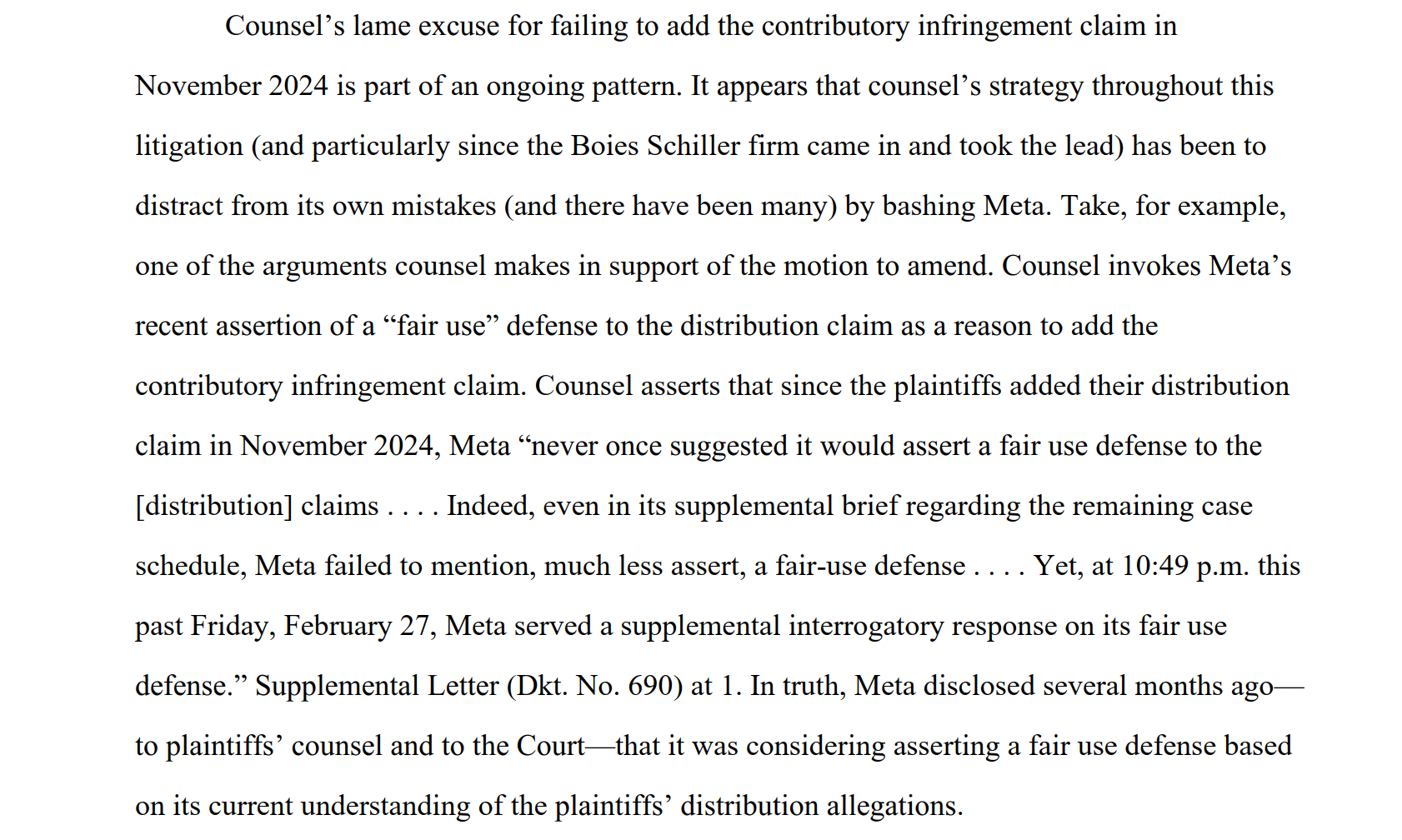 Judge Chhabria went further, noting that the authors’ law firm, Boies Schiller, showed “an ongoing pattern” of distracting from its own mistakes by attacking Meta. He pointed specifically to the dispute over when Meta disclosed its fair use defense to the distribution claim, which we covered here recently, characterizing it as a false distraction. “The lawyers for the plaintiffs seem so intent on bashing Meta that they are unable to exercise proper judgment about how to represent the interests of their clients and the proposed class members,” the order reads. Counsel “Lucked Into” a PassDespite the criticism, Chhabria granted the motion. The judge anticipated the obvious question from readers of his order. “By now, the reader might be thinking, ‘Wait a minute, you started off saying that the motion to amend the complaint was difficult. It seems like an easy deny to me,'” Chhabria wrote. 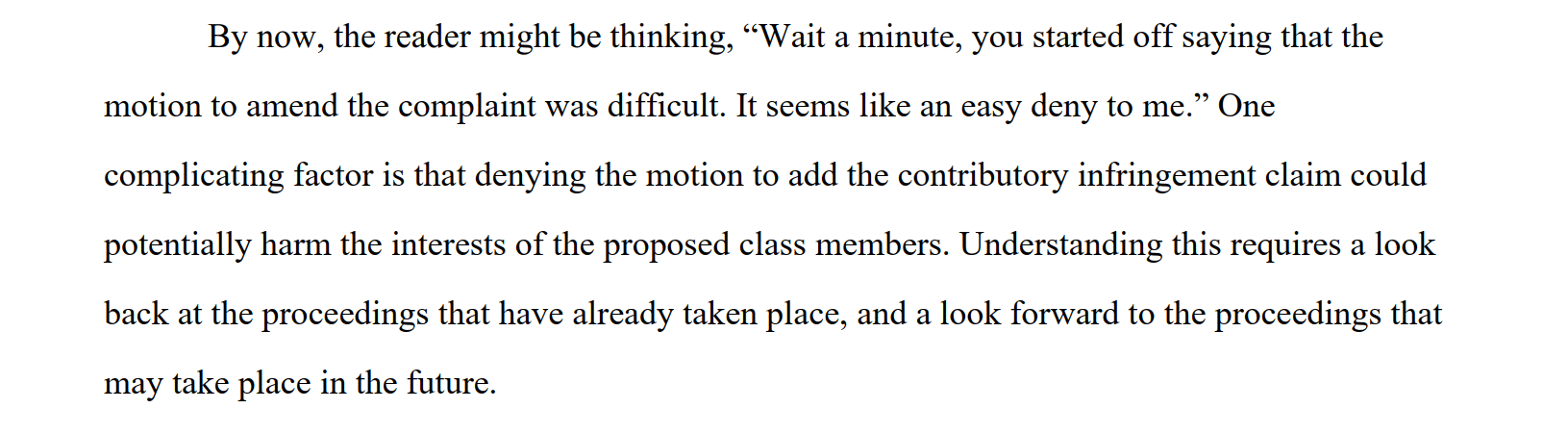 The primary reason to grant the motion is the risk to the other potential members of the class action. If the contributory infringement claim were excluded and the class later lost on the distribution claim at trial, those class members could potentially be barred from ever bringing the contributory claim separately. A second factor also made the decision easier. Meta has separately requested the court to align the schedule in this case with a separate but similar lawsuit filed by Entrepreneur Media. This case covers a similar contributory infringement claim and shares discovery the authors’ lawsuit. Granting the motion to amend, therefore, adds little practical burden to Meta. However, the judge stresses that this is the result of luck, rather than the skill of the authors’ counsel. “Plaintiffs’ counsel has lucked into a situation where Meta will not be meaningfully prejudiced by the failure to add a contributory infringement claim back in November 2024,” Chhabria wrote. The authors’ motion to open the class discovery process was denied. That will only be considered if the named plaintiffs survive the next round of summary judgment on both the distribution and contributory infringement claims. For now, the case moves forward with a fourth amended complaint, three new loan-out companies added as named plaintiffs, and a growing list of BitTorrent-related claims for Judge Chhabria to resolve. — A copy of the order, filed at the U.S. District Court for the Northern District of California, is available here (pdf). From: TF, for the latest news on copyright battles, piracy and more. | ||||||||||||||||||
| Sunday, March 29th, 2026 | |||||||||||||||||||
| LJ.Rossia.org makes no claim to the content supplied through this journal account. Articles are retrieved via a public feed supplied by the site for this purpose. | |||||||||||||||||||
| 5:46 pm | The Pirate Bay’s Oldest Torrent Turned 22….
After the verdict that sent its founders to prison, the site slowly started to decay. The option to comment or register as a new user eventually broke down, and aside from promoting a fishy token, public outreach ground to a halt. Despite this downward spiral, the site continues to live up to its official tagline: the galaxy’s most resilient torrent site. Where TorrentSpy, Mininova, isoHunt, Torrentz, KickassTorrents, ExtraTorrent, RARBG and TorrentGalaxy all fell, The Pirate Bay continues to serve many millions of monthly users. 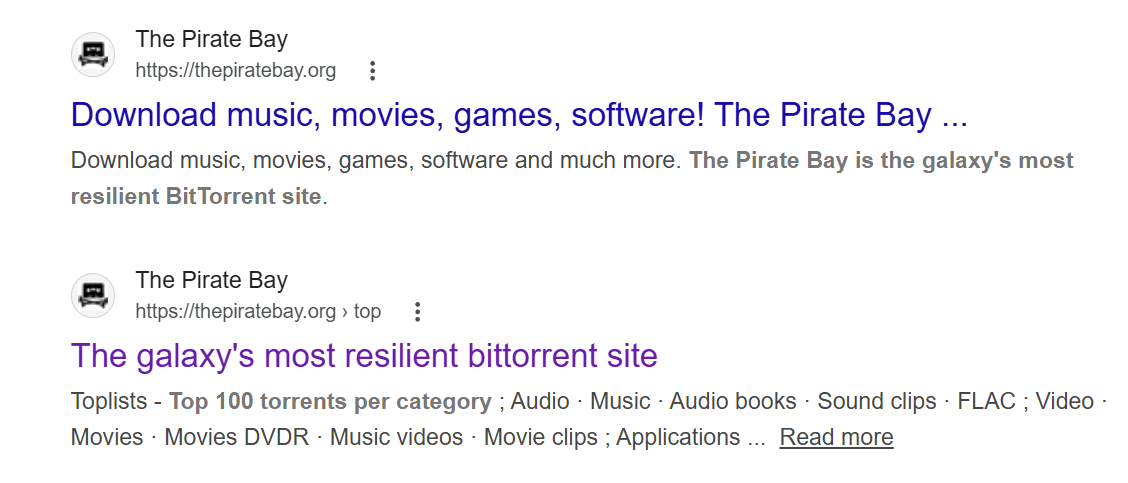 It’s safe to say that The Pirate Bay witnessed quite a bit of change. When the site launched, roughly 10% of the world’s population was connected to the Internet, and in the United States, the majority of all ‘world wide web’ users were still using a dial-up connection. At the time, all popular entertainment was consumed offline. People interested in watching a movie could use the Internet to buy a DVD at one of the early webshops, or sign up with Netflix, which shipped discs through the mail. However, on-demand access was simply not a thing. At least, not legally. With enough patience, file-sharing software allowed people to share large video files, and BitTorrent excelled at this, as transfer speeds typically picked up with more demand. This is why torrent sites popularized the on-demand downloading of movies and TV-series for millions of people. Pirate Bay’s Oldest TorrentToday, most files shared on The Pirate Bay in the early years are no longer available. BitTorrent requires at least one person to share a full file copy, which is difficult to keep up for decades. Surprisingly, however, several torrents have managed to stand the test of time and remain actively shared. Earlier this week, the site’s longest surviving torrent turned 22 years old. While a few candidates have shown up over the years, we believe that an episode of “High Chaparral” featuring Uri Geller has the honor of being the oldest Pirate Bay torrent that’s still active today. The file was originally uploaded on March 25, 2004, and several people continue to share it today. 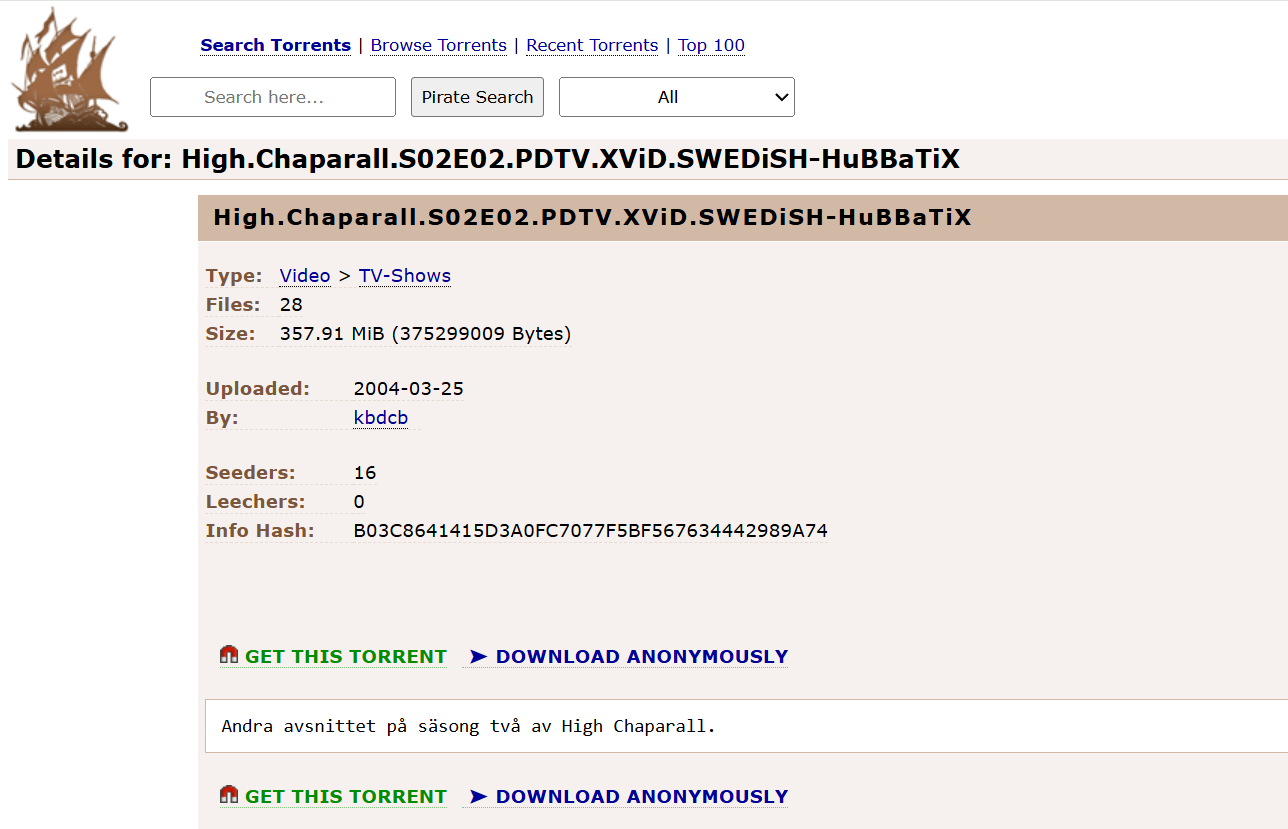 At this point, the torrent in question appears to have reached a cult status, with pirates sharing the release simply because it is the oldest torrent on The Pirate Bay. Despite the record, however, the Swedish TV series is shared without permission of the creators. Revolution OS & The FanimatrixThere are also other pirate releases on The Pirate Bay that continue to thrive. On March 31, 2004, someone uploaded a pirated copy of the documentary “Revolution OS” to the site, which is alive and kicking today. “Revolution OS” covers the history of Linux, GNU, and the free software movement, which was a good fit for the early Pirate Bay crowd. Thirteen years ago, we spoke to director J.T.S. Moore, who wasn’t pleased that people were pirating the documentary but was nevertheless glad to see it hadn’t lost its appeal. Fast-forward to the present day, and Revolution OS still has plenty of interest, with more than 33 people actively seeding the torrent. While these torrents are certainly dated, they’re not the oldest active torrents available on the Internet. That honor goes to “The Fanimatrix”, which was created in September 2003 and, after being previously resurrected, continues to be available today with dozens of people seeding. We’ll check back in 2028 for its 25th anniversary. From: TF, for the latest news on copyright battles, piracy and more. | ||||||||||||||||||
| Friday, March 27th, 2026 | |||||||||||||||||||
| LJ.Rossia.org makes no claim to the content supplied through this journal account. Articles are retrieved via a public feed supplied by the site for this purpose. | |||||||||||||||||||
| 8:56 am | Sky Wins Irish Court Order to Unmask 300+ Pirate IPTV Users via Revolut Bank
The initially defiant IPTV operator had destroyed evidence and was fined €30,000 for contempt of court. This penalty followed Dunbar’s refusal to allow investigators to search his home, despite a High Court-sanctioned Anton Piller order. While much of the internal service data was reportedly lost, the man’s Revolut account revealed that he received €118,992 from resellers over a period of three and a half years. During this time, subscribers also paid €72,414 and £9,256. While Sky was pleased with the actions against the man who they describe as a “top level” pirate, the company was not done yet. Revolut Must Unmask IPTV PiratesThis week, the story moved to the next stage. On Wednesday, Ireland’s High Court granted Sky a Norwich Pharmacal order requiring Revolut Bank UAB to hand over the names, addresses, and banking details of 304 IPTV subscribers and 10 resellers connected to Dunbar’s service, “IPTV is Easy.” The application was supported by Premier Sports, GAA+, LOITV, and Clubber TV, which shows that the affected content extends well beyond Sky’s own channels. To obtain the identities of these IPTV resellers and subscribers, Sky initially approached Revolut directly. However, the bank said it could only disclose information following a court order, and on Wednesday Judge Brian Cregan granted one. Sky’s barrister, Theo Donnelly, told the court that it expects to use the personal information to take legal action against the resellers and some of the end users of these pirate boxes. For Sky, it would not be possible to take legal action against all 304 subscribers, he said. However, legal action against IPTV users is new in Ireland, which makes this a key change in tactics. Deterrent EffectBy unmasking the IPTV subscribers, Sky hopes to create a deterrent effect on the country’s estimated 400,000 pirate IPTV users, or “dodgy boxes,” as they are known in Ireland. At the same time, some of the resellers are arguably in more trouble. In an affidavit, Sky investigator Damien Gilmore notes that there is information suggesting that at least five of the resellers continue to sell the IPTV services to this day. The company expects to take action against all these active resellers. The timing is also no accident; with the Premier League season nearing its climax and major golf and Formula 1 events on the horizon, Gilmore said that Sky is anxious to take “decisive action” while interest in premium sport is at its peak. Broadening IPTV Subscriber CrackdownFor Ireland’s pirate IPTV users, this is the first time that they have come in the crosshairs of rightsholders. While only a few will face legal action, Sky hopes that the looming threat will have a deterrent effect. On paper, Ireland’s Copyright and Related Rights Act 2000 allows fines of up to €127,000 and up to five years imprisonment for those who use illegal streaming services. However, it’s worth stressing that there is no jurisprudence for action against subscribers. The Irish action appears to be part of a trend to hold IPTV subscribers accountable. Earlier this week, a French Public Prosecutor’s Office fined 19 IPTV subscribers between €300 and €400 after their identities were exposed through a reseller bust. In Italy, the Guardia di Finanza identified thousands of subscribers following the dismantling of a pirate network, and rights holders subsequently sent civil damages demands on top of the criminal fines. In Ireland, it appears that Sky can’t simply demand money without any oversight, as the judge’s order restricts use of the personal details to start legal proceedings against alleged infringers. The August judgment had already pointed in this direction. Mr Justice Sanfey warned that anyone running similar operations should consider how vulnerable they are to discovery and exposure, “with potentially calamitous consequences.” This week’s ruling suggests those consequences now extend to subscribers too. From: TF, for the latest news on copyright battles, piracy and more. | ||||||||||||||||||
| Thursday, March 26th, 2026 | |||||||||||||||||||
| LJ.Rossia.org makes no claim to the content supplied through this journal account. Articles are retrieved via a public feed supplied by the site for this purpose. | |||||||||||||||||||
| 2:47 pm | Spotify and Labels Seek $322 Million Default Judgment Against Anna’s Archive
However, last December, the site announced that it had also backed up Spotify, which came as a shock to the music industry. Anna’s Archive initially released only Spotify metadata, and no actual music, but that put the music industry on high alert. Together with the likes of Universal, Warner, and Sony, Spotify filed a lawsuit days later, hoping to shut the site down. Through a preliminary injunction targeting domain registrars and registries, the shadow library lost several domain names. However, not all were taken down, and the site registered various new domain names as backups. The legal pressure also appeared to pay off in other ways. Not long after the lawsuit was filed, the shadow library removed the Spotify torrents. The same applies to the first batch of music files that was released in February. According to a message posted on Reddit by the site’s operator, Anna’s Archivist, these Spotify releases were published accidentally and were put temporarily on hold because they are “not worth the additional trouble the music industry’s lawyers are bringing.” ‘Extremely Conservative’ $322 Million Default JudgmentDespite taking the torrents offline, Spotify and the labels are not letting the case go. On the contrary, without a response from Anna’s Archive in court, they seek a massive default judgment this week. “Defendant’s blatant and willful disregard for Plaintiffs’ rights and the Court’s authority warrants imposition of statutory damages against Defendant for copyright infringement in the amount of $22,200,000, and for violation of the Digital Millennium Copyright Act in the amount of $300,000,000, as well as permanent injunctive relief,” they write.
The music labels each seek the maximum of $150,000 in statutory damages for around 50 works. Spotify adds a DMCA circumvention claim of $2,500 for 120,000 music files, bringing the total to more than $322 million. The plaintiff describes their damages request as “extremely conservative.” The DMCA claim is based only on the 120,000 files actually downloaded during their investigation, not the full 2.8 million released. Had they applied the $2,500 rate to all released files, the damages figure would exceed $7 billion. Similarly, the copyright claim covers only 148 tracks, which is only a tiny fraction of the files Anna’s Archive claimed to have scraped. RIAA’s Senior Vice President Downloaded 120,000 filesThe temporary release of the music files plays a key role. The music companies note that the release of the nearly three million music files is evidence for their copyright infringement claim. Additionally, it shows that Anna’s Archive successfully circumvented Spotify’s DRM. According to the legal paperwork, RIAA Senior Vice President of Technology Jeremy Landis personally downloaded the first two torrents, confirming 120,000 files were accessible and included Spotify metadata identifying artist, track, album, and label. 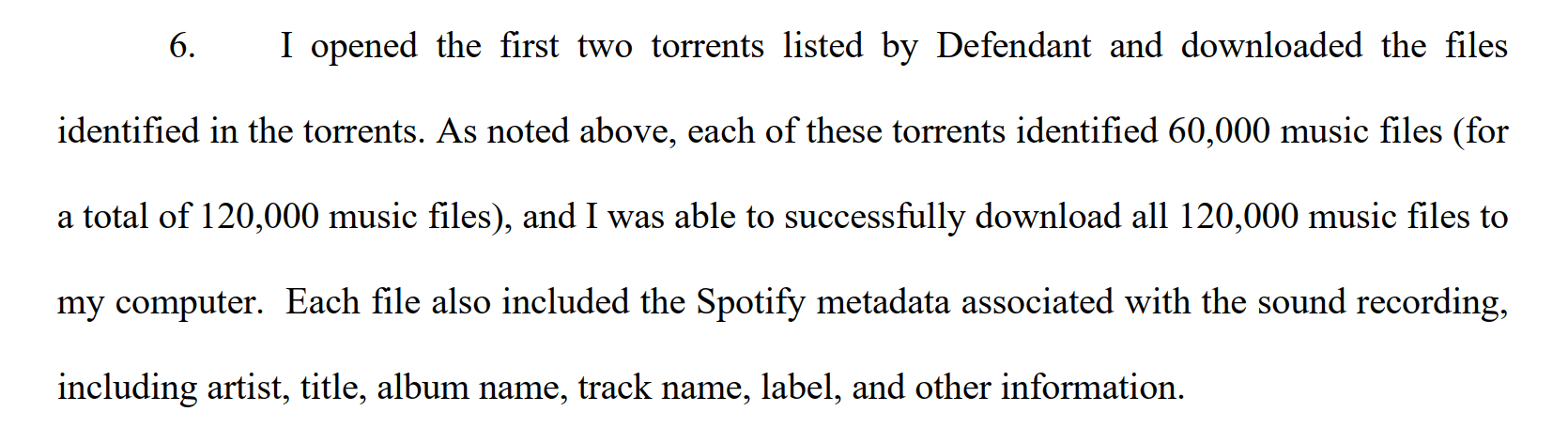 The music companies confirm that the torrent links were eventually removed from Anna’s Archive’s website around February 11. However, they stress that files distributed via BitTorrent remain available through the peer-to-peer network, regardless of whether the original posting site removes them. DRM Circumvention at ScaleSpotify Principal Engineer Richard Titmuss states in a declaration that each audio file on the platform is protected by encryption and digital rights management technology. The files Landis downloaded could be played on a standard media player outside the Spotify platform, meaning that Anna’s Archive effectively circumvented the DRM on each file. “In order to make each of these individual music files available through the BitTorrent network, Defendant necessarily had to circumvent and disable the technological DRM protections that Spotify had implemented with respect to each such music file,” Titmuss writes. This declaration is used as evidence for Spotify’s damages claim under the DMCA’s anti-circumvention provision, which allows for statutory damages of up to $2,500 per act of circumvention, bringing the total to $300 million. Broad InjunctionIn addition to the damages, plaintiffs seek a permanent injunction covering ten (current and previous) Anna’s Archive domains: annas-archive.org, .li, .se, .in, .pm, .gl, .ch, .pk, .gd, and .vg. The proposed order names every registry, registrar, and host that would be bound by the judgment, including Public Interest Registry, Cloudflare, Switch Foundation, The Swedish Internet Foundation, Njalla, Immaterialism Ltd., and several others. All would be required to permanently disable access to the named domains and cease hosting services for the site. To reach these third parties, the plaintiffs cite several legal bases, including the All Writs Act (28 U.S.C. § 1651), which grants federal courts the power to issue orders to non-parties that can help to enforce judgments. The labels argue this is justified because Anna’s Archive deliberately ignores U.S. law and bypasses the authority of the court. Anna’s Archive can seek relief from the domain seizures. However, that would require the site’s operator to pay the full $322 million judgment, which seems a rather unlikely scenario at this point. — A copy of the memorandum of law supporting the motion for a default judgment is available here (pdf). The statement of damages can be found here (pdf). The declarations of Jeremy Landis and Richard Titmuss are available here (pdf) and here (pdf). From: TF, for the latest news on copyright battles, piracy and more. | ||||||||||||||||||
| Wednesday, March 25th, 2026 | |||||||||||||||||||
| LJ.Rossia.org makes no claim to the content supplied through this journal account. Articles are retrieved via a public feed supplied by the site for this purpose. | |||||||||||||||||||
| 3:57 pm | Supreme Court Wipes Out Record Labels’ $1 Billion Piracy Judgment Against Cox
The verdict, in favor of major record labels including Sony and Universal, was a catalyst for many other ‘repeat infringer’ lawsuits. This resulted in yet more multi-million dollar claims and awards, with many still in the pipeline today. Meanwhile, Cox did everything it could to fight the verdict, all the way up to the Supreme Court, which formally heard the case last December. The panel had to decide whether an ISP can be held liable for not taking any action in response to piracy notices, which the Court answered today with a clear no. Supreme Court Reverses: Knowledge is Not IntentIn a 7-2 decision handed down this morning, the Court reversed the Fourth Circuit decision, ruling that Cox is not contributorily liable for the infringing actions of its pirating subscribers. The opinion was written by Justice Thomas and is joined by six other justices. Justices Sotomayor and Jackson concurred, but disagreed sharply with the majority’s reasoning. 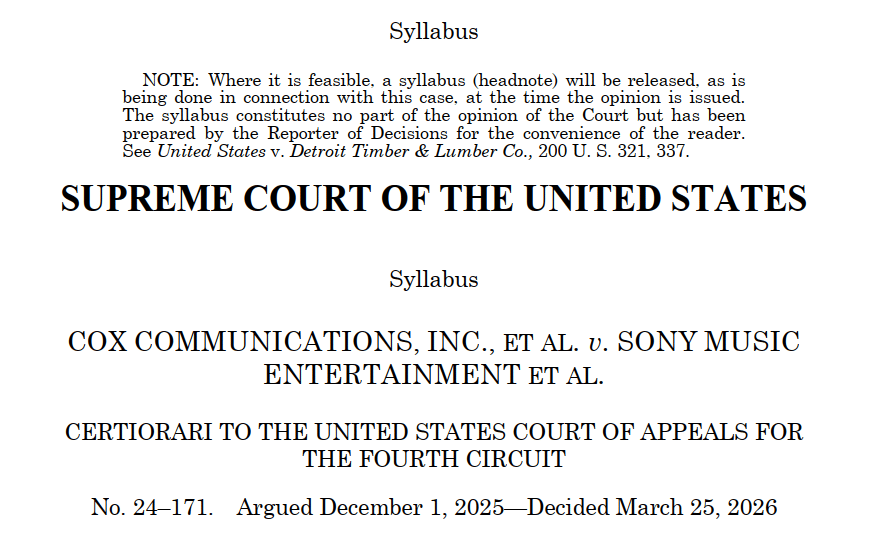 The opinion states that contributory liability requires proof that the provider intended its service to be used for infringement. That intent can only be shown in one of two ways. Either the provider actively induced infringement, or the service is one that has no substantial non-infringing uses. In the present case, Cox met neither test. It never encouraged its subscribers to pirate anything. And internet access, as the Court noted, is used for countless lawful purposes. “Under our precedents, a company is not liable as a copyright infringer for merely providing a service to the general public with knowledge that it will be used by some to infringe copyrights. Accordingly, we reverse,” Justice Thomas writes. 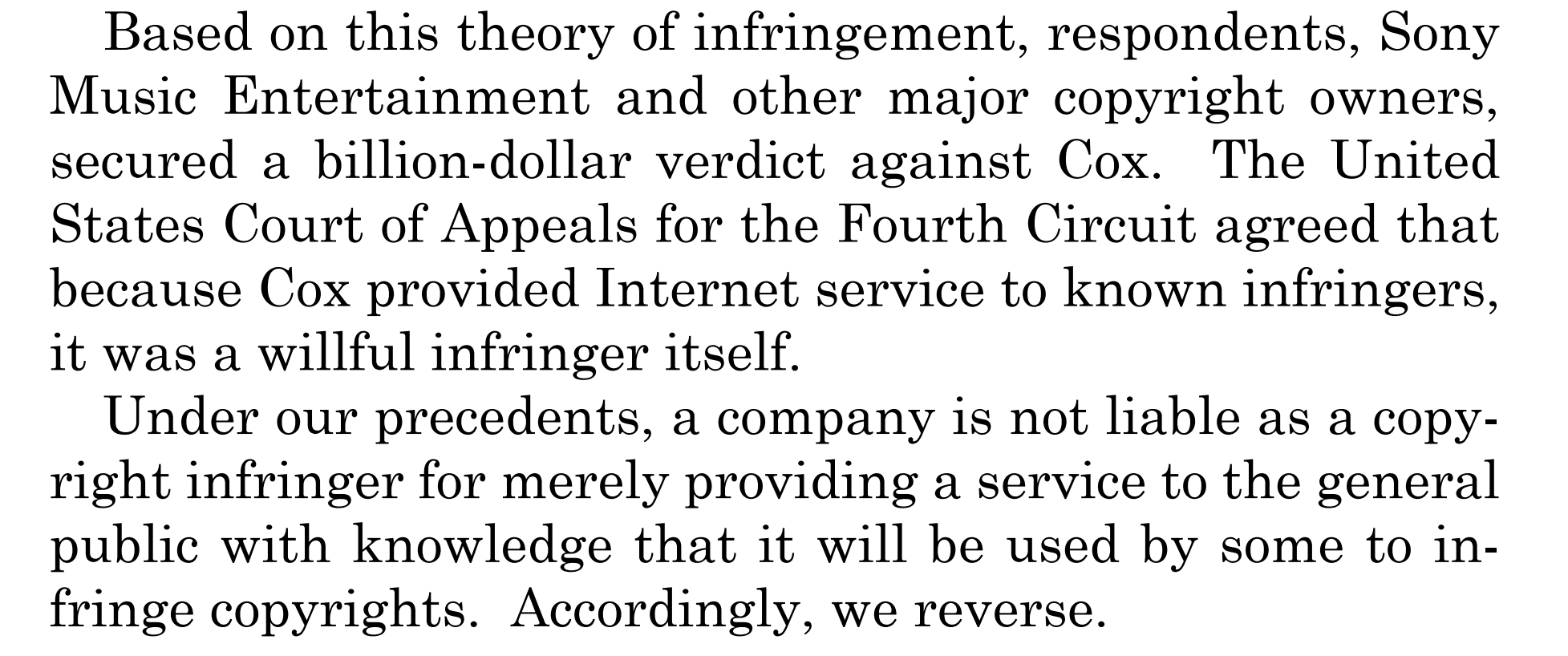 The Court also directly countered the Fourth Circuit’s reasoning, which held that supplying a product with “knowledge” of future infringement was enough to establish liability. The Supreme Court called this an improper expansion of copyright law that conflicted with decades of precedent. This means that Cox may have known about the infringing activity of its subscribers, but that they are not liable for not taking action in response. The “IP Address” ProblemIn a concurring opinion, Justice Sotomayor agreed that Cox shouldn’t be held liable, but for a more practical reason. Under the common-law aiding-and-abetting doctrine, which she argued the majority should have applied, liability requires proof that a defendant intended to help a specific wrongful act succeed. Sotomayor noted that when the anti-piracy tracking company MarkMonitor flagged an infringing IP address, it only identified a connection, not an individual. Whether the infringer was a specific account holder, a roommate, or a neighbor stealing Wi-Fi remained a mystery. Without knowing who was actually infringing, Sotomayor argued, it is impossible to prove Cox intended to help that specific person succeed in their “wrongful act”. Is the DMCA Safe Harbor Now “Obsolete”?The ruling leaves a massive question mark over the future of the Digital Millennium Copyright Act (DMCA). Sony argued that the DMCA’s “safe harbor” provisions, which require ISPs to terminate “repeat infringers”, would be meaningless if ISPs weren’t already liable for serving those infringers in the first place. Justice Sotomayor went even further, warning that the majority’s new rule “consigns the safe harbor provision to obsolescence”, adding that ISPs now have little incentive to take any action against online pirates. “The majority’s decision thus permits ISPs to sell an internet connection to every single infringer who wants one without fear of liability and without lifting a finger to prevent infringement,” she notes. What Happens NextWith today’s opinion, the verdict is reversed and remanded to the Fourth Circuit for further proceedings. Whether the music labels will pursue further litigation on remand, and what that would look like, remains to be seen. For rightsholders, the ruling removes the primary legal tool they have used to pressure ISPs to terminate infringers more aggressively. For ISPs, however, it resolves years of uncertainty about how far they have to go in response to copyright infringement notices. Whether that means that they will indeed take less action has yet to be seen. — A copy of the Supreme Court’s opinion is available here (pdf). This is a developing story; more quotes, comments, and notes may be added later. — The RIAA responded through CEO and Chairman Mitch Glazier “We are disappointed in the Court’s decision vacating a jury’s determination that Cox Communications contributed to mass scale copyright infringement, based on overwhelming evidence that the company knowingly facilitated theft. To be effective, copyright law must protect creators and markets from harmful infringement and policymakers should look closely at the impact of this ruling.” “The Court’s decision is narrow, applying only to ‘contributory infringement’ cases involving defendants like Cox that do not themselves copy, host, distribute, or publish infringing material or control or induce such activity.” Cox Communications issued the following statement: “The Supreme Court’s unanimous opinion is a decisive victory for the broadband industry and for the American people who depend on reliable internet service. This opinion affirms that Internet service providers are not copyright police and should not be held liable for the actions of their customers — and after years of battling in the trial and appellate courts, we have definitively shut down the music industry’s aspirations of mass evictions from the internet.” “Internet service providers provide the critical communications infrastructure for millions of Americans. Today’s decision allows us to focus on our goals of preserving open internet access, protecting consumers’ privacy, and ensuring that broadband remains a reliable resource for the families and businesses in the communities we serve.” From: TF, for the latest news on copyright battles, piracy and more. | ||||||||||||||||||
| LJ.Rossia.org makes no claim to the content supplied through this journal account. Articles are retrieved via a public feed supplied by the site for this purpose. | |||||||||||||||||||
| 8:43 am | France Fines First Batch of Pirate IPTV Subscribers Following Reseller Bust
It pioneered the three-strikes “graduated response” system back in 2009, where the Hadopi agency tracked, warned, and fined online pirates, mostly those using BitTorrent. As piracy shifted to streaming, however, enforcement became more complicated. Unlike BitTorrent, IPTV services don’t broadcast users’ IP addresses publicly, which has made individual subscribers difficult to identify and prosecute. However, IPTV operators and resellers keep records. When investigators reach those records, subscribers can find themselves exposed. 19 IPTV Subscribers FinedLast week, the French football league LFP announced that the Arras Public Prosecutor’s Office reached financial settlements with 19 subscribers of a pirate IPTV service. These users signed a criminal settlement that requires them to pay a fine ranging from €300 to €400. The criminal investigation was started following a complaint from LFP. The prosecutors eventually identified 21 defendants and have now settled with 19 of them. The remaining two defendants are resellers, who are summoned to appear before the Arras criminal court in April, Zataz reports. This is the first case in France where IPTV users are sanctioned. While the plea agreements are relatively modest, LFP stresses that the law provides for penalties of up to €7,500. The authorities did not disclose how the subscribers were identified, but IPTV resellers typically hold customer records including email addresses and payment details. If the authorities collected this as evidence, they could effectively expose the subscribers. Mafia-like EcosystemThe Arras case is not the first time European IPTV subscribers have faced consequences. In Italy, the Guardia di Finanza identified thousands of subscribers following the dismantling of a pirate network, and rights holders subsequently sent civil damages demands on top of the criminal fines. Last May, the authorities announced that 2,282 pirate IPTV subscribers had been fined across 80 Italian provinces. Following this action, rightsholders collected additional damages settlements of up to €1,000 from a number of the same people. France has followed a different path, but the Arras prosecutions suggest the gap may be narrowing. In its official communiqué, the LFP made clear the intent behind the action, while warning that more actions are underway. “The LFP and LFP Media welcome this strong message to users of piracy services, who mistakenly believe they can act with impunity when in fact they are knowingly contributing to a mafia-like ecosystem that seriously harms the entire sports sector,” the organization writes. “Many criminal actions targeting resellers of IPTV subscriptions are underway, and their customers may, as such, be questioned and prosecuted,” the league added (TF translated). Millions of LFP Pirates RemainWhile LFP hopes that the prosecutions and the associated fines against 19 IPTV subscribers will send a deterrent message, there is still a long way to go. At a sports piracy conference held at Roland-Garros on March 23, LFP Media’s Douglas Lowenstein presented survey data showing that around two million people in France watched Ligue 1 via pirate services this season, making it the most pirated competition in the country. Prosecuting millions of people isn’t very practical, which is why rightsholders are also continuing to push for expanded site-blocking powers. Arcom, France’s broadcasting regulator, has blocked more than 12,600 domain names since 2022, but rightsholders argue that real-time automated blocking is needed to keep pace with live match piracy. This is particularly important with the 2026 FIFA World Cup in mind. The French football league is pushing for Article 10 of a pending sports law, which would allow automated blocking without manual approval. Sports Minister Marina Ferrari has indicated the legislation could move before June, ahead of the 2026 World Cup. If LFP’s warnings are correct, we may also see more prosecutions of IPTV pirates in the near future. In any case, the two resellers in the Arras case will have made their appearance in court by then, which is scheduled for April 7. From: TF, for the latest news on copyright battles, piracy and more. | ||||||||||||||||||
| Tuesday, March 24th, 2026 | |||||||||||||||||||
| LJ.Rossia.org makes no claim to the content supplied through this journal account. Articles are retrieved via a public feed supplied by the site for this purpose. | |||||||||||||||||||
| 9:56 am | GitHub Nukes 900+ Anime Piracy Repos and Forks, But Rejects ‘Circumvention’ Claims
“It’s time to say goodbye. And thank you for a wonderful journey with great moments,” the operators announced. The decision was a major setback for anime pirates, including many third-party tools and services that relied on the site, formerly known as Aniwatch. This includes unofficial “API” tools that could be used by other pirate sites to serve anime content. Anti-Circumvention TakedownWith HiAnime gone, these third-party tools presumably stopped working too. And even if that was not the case, a recent takedown notice sent by Remove Your Media LLC, on behalf of Crunchyroll, VIZ Media, and other anime rightsholders, would have rendered them useless. The takedown notice, published yesterday, lists several high-profile repositories, including aniwatch and aniwatch API, which offered access to HiAnime streams. These partially worked by using keys from the MegacloudKeys repository, which was also targeted. 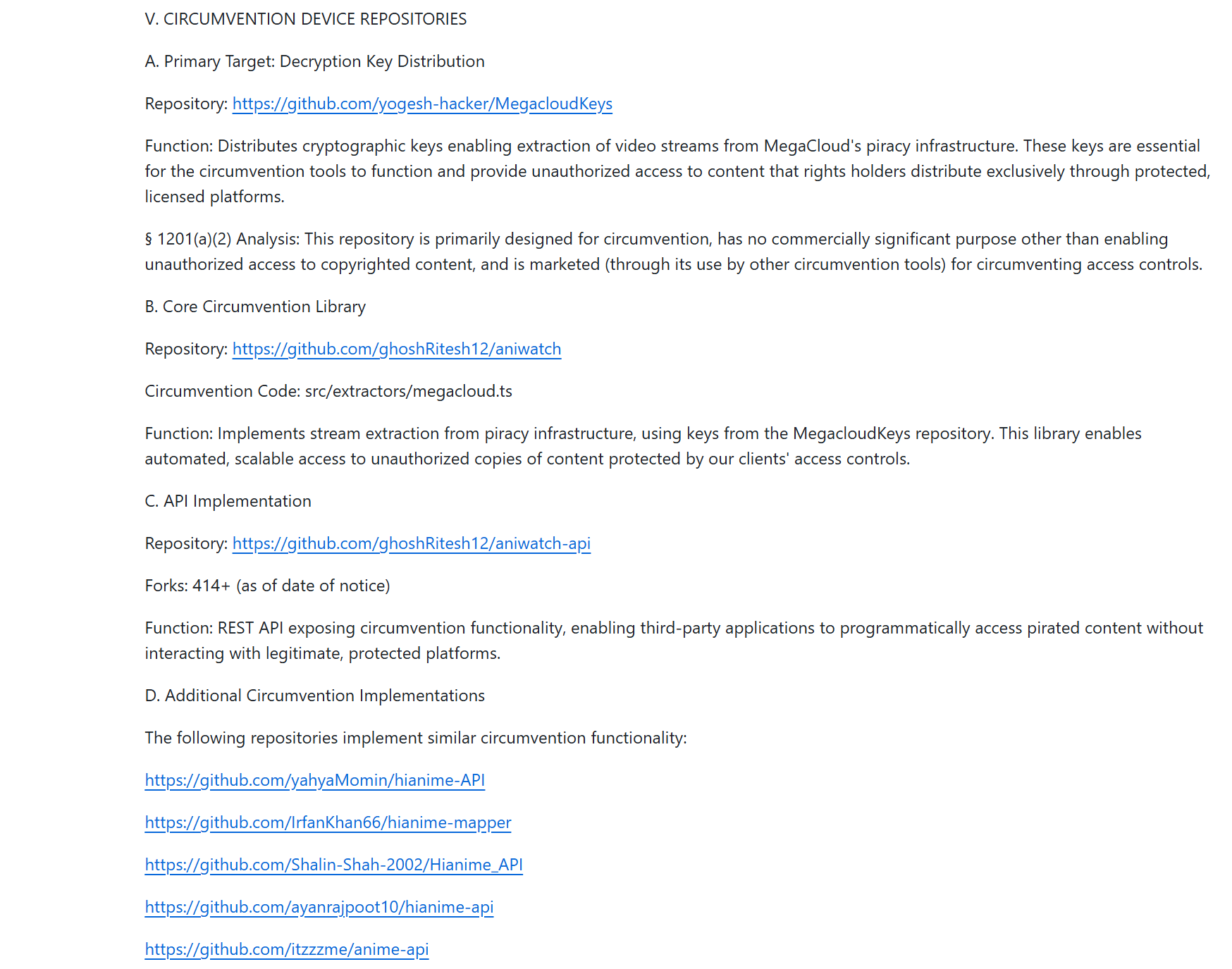 The takedown notice targets several repositories, which taken together have more than 900 forks. While it is not clear whether the notice was sent before or after HiAnime’s shutdown, the outcome is the same. After reviewing the allegations, the repos and forks were removed. 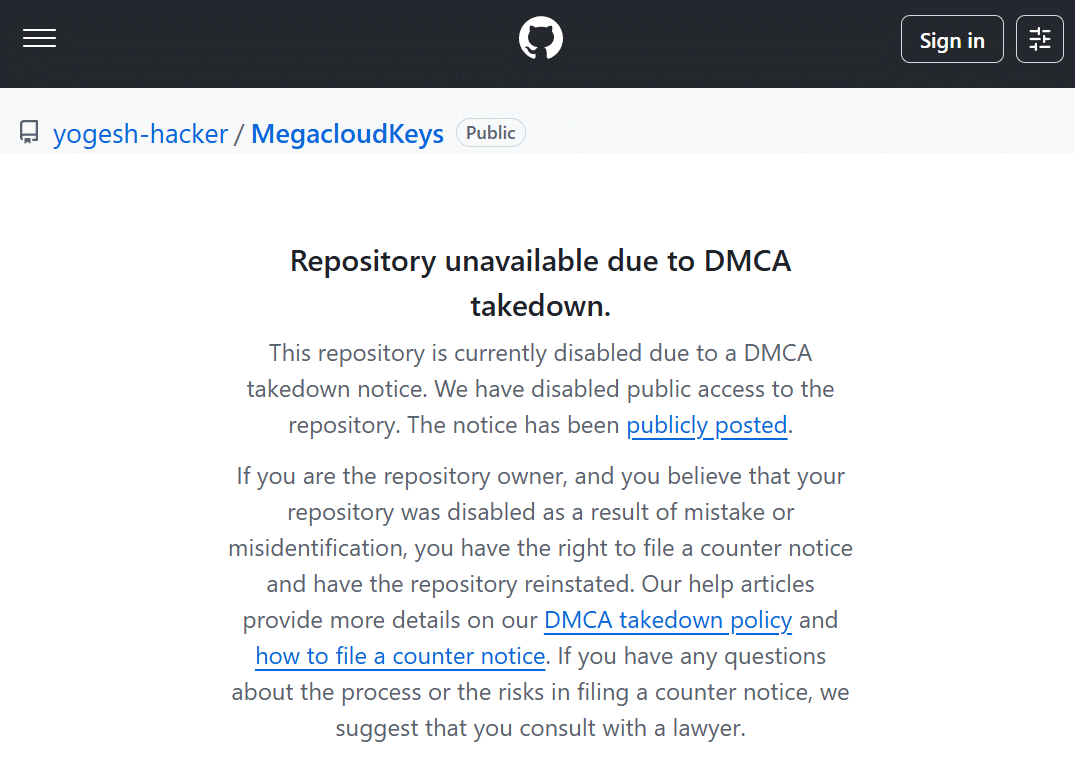 Anti-Circumvention Claim FailsIt is important to note that the notice is not a standard DMCA takedown request, but a DMCA anti-circumvention claim. Remove Your Media explicitly suggests that the tools bypass various copyright protections. According to the takedown notice, these repositories facilitate the “circumvention of technological protection measures implemented by authorized streaming services”. Because they provide access to pirated content, they circumvent “subscription paywalls, digital rights management, and access controls”. This anti-circumvention claim was rejected by GitHub, potentially because there are no direct rightsholder DRM circumventions involved. However, because the developer platform found other issues, all repositories were removed anyway. “While GitHub did not find sufficient information to determine a valid anti-circumvention claim, we determined that this takedown notice contains other valid copyright claim(s),” GitHub notes. Youtube-dl & Notorious MarketsThe takedown notice explicitly made a distinction between the anime repositories and youtube-dl, which was reinstated by GitHub after it was targeted by an RIAA circumvention notice in October 2020. The notice is redacted and doesn’t mention youtube-dl by name, but the context makes it rather clear. 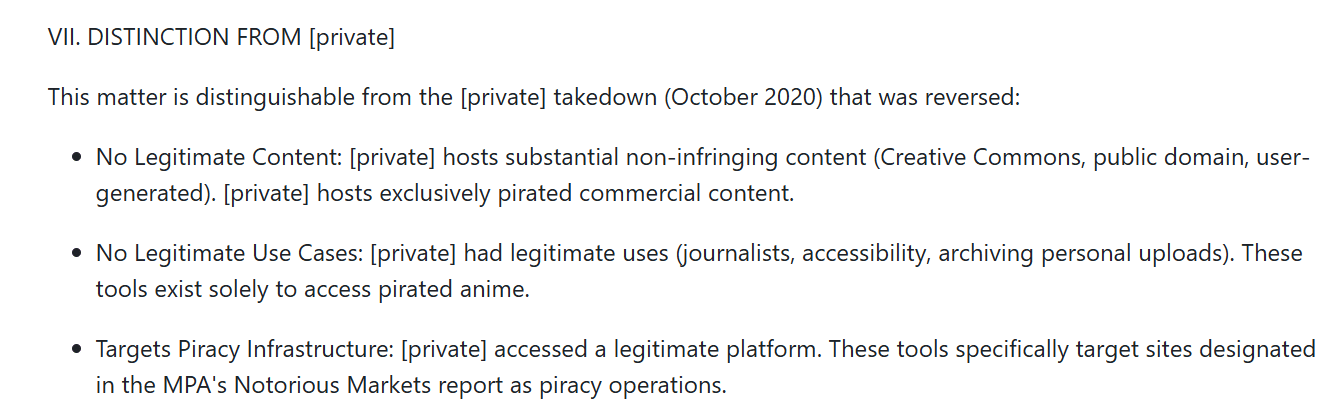 This description did not help with the anti-circumvention claim. However, GitHub did flag copyright issues. This may be in part due to the fact that HiAnime and MegaCloud were both listed as a notorious market by the MPA and the U.S. Trade Representative recently. The USTR described MegaCloud as a pirate content management system that provides access to a large library of infringing content. “The network reportedly acts as a backend hosting system delivering infringing video files —including more than 46,000 movies and 16,000 TV series— directly to more than 260 pirate streaming sites around the world,” USTR wrote. For now, the repositories are gone, and HiAnime remains offline, leaving the third-party tools that depended on both without a clear path forward. However, since we have already seen many rebrands of these services in the past, it would not be a surprise to see a new service pop up in the future. From: TF, for the latest news on copyright battles, piracy and more. | ||||||||||||||||||
| Monday, March 23rd, 2026 | |||||||||||||||||||
| LJ.Rossia.org makes no claim to the content supplied through this journal account. Articles are retrieved via a public feed supplied by the site for this purpose. | |||||||||||||||||||
| 8:25 am | Cloudflare Reports Surge in Geo-Blocked Pirate Site Domains
The American company says it powers nearly 20% of the web. This includes several Fortune 500 companies, but also many pirate sites and services. For years, rightsholders have urged Cloudflare to do something about these pirate sites. However, the company typically doesn’t take action against customers that use its ‘pass-through’ CDN services. Instead, it simply forwards takedown notices to their respective hosting services. According to some rightsholders forwarding is not enough. To compel Cloudflare to take action against pirate sites, they requested formal blocking orders in France, Spain, South Korea, and elsewhere. Cloudflare Adds 2,791 Geoblocked Domain NamesCloudflare’s latest transparency report, covering the second half of 2025, shows that 2,791 domain names that use its pass-through services were geoblocked. This means that these sites of Cloudflare customers are effectively rendered inaccessible in these countries. Nearly 2,800 is a significant increase compared to the same period a year earlier, when 308 domain names were geo-blocked. 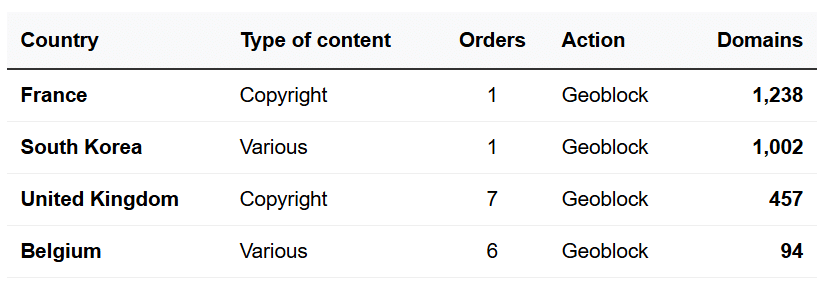 When Cloudflare geoblocks a domain, the company posts an interstitial page linking to the relevant order so that visitors can see why access has been restricted. 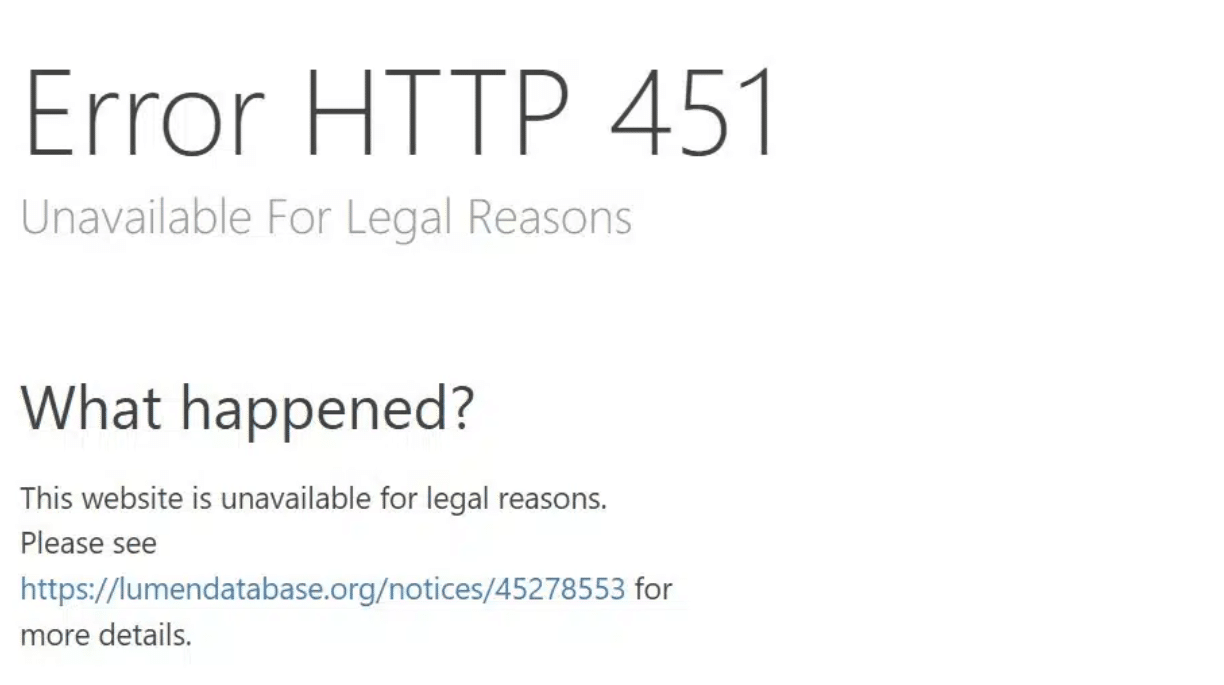 It’s worth noting that not all geo-blocks are equal. In the UK, for example, Cloudflare is taking action voluntarily based on an older High Court order against ISPs, to which it is not a party. This is similar to the voluntary blocking approach Google takes. In Belgium and France, Cloudflare does respond to orders where it is named. These predominantly cover pirate sites, but in Belgium Cloudflare is also compelled to geo-block several illegal gambling sites. In Korea, a new law requires CDN providers, including Cloudflare, to implement a government-mandated blocklist. This prohibits the CDNs from facilitating access to these sites through servers in South Korea, which resulted in hundreds of blocks in the second half of 2025. Cloudflare clarifies that these South Korean sites are not “blocked” in the traditional sense. Instead, they are restricted from being served through equipment located physically in South Korea. DNS BlockingInterestingly, these geo-blocking measures are sometimes also used by Cloudflare to comply with DNS (1.1.1.1) blocking orders. If the sites are geo-blocked, Cloudflare doesn’t have to block these through its DNS. “Cloudflare has sometimes taken action to geoblock access to websites through Cloudflare’s pass-through CDN and security services, in response to orders directing Cloudflare to block through its public DNS resolver,” the transparency report reads. As in previous transparency reports, Cloudflare separately confirms that it “has not blocked content through the 1.1.1.1 Public DNS Resolver.” Automated Hosting TakedownsIn addition to blocking domains for which Cloudflare acts as a CDN or pass-through, the company also takes more direct action if it is hosting sites. In the second half of 2025, rightsholders sent 121,681 copyright infringement reports, with Cloudflare taking action in 67,941 instances. Notably, these removals are mostly the result of automatic processes, which were put in place last year. “In H2 2025, Cloudflare used automated means to action 64,161 of the 67,941 copyright infringement reports actioned,” the company reports in a footnote, adding that it also terminated 59,843 accounts of R2 storage services. Italy’s €14 Million FineThe transparency report makes no mention of the recently appealed €14,247,698 fine that was imposed on Cloudflare in January by Italy’s communications regulator, AGCOM. Cloudflare received this fine as it refused to implement blocking measures through its 1.1.1.1 DNS resolver under Italy’s Piracy Shield measures. AGCOM concluded that Cloudflare’s cooperation is “essential” for the enforcement of Italian anti-piracy laws, as its services allow pirate sites to evade standard blocking measures. In response to the fine, Cloudflare’s CEO Matthew Prince considered pulling out of Italy entirely. While that hasn’t happened yet, Cloudflare firmly draws a line at their public DNS resolver, and it recently appealed AGCOM’s fine in court. — A copy of Cloudflare’s H2 2025 Transparency Report (Abuse Processes) is available here (pdf). From: TF, for the latest news on copyright battles, piracy and more. | ||||||||||||||||||
| Saturday, March 21st, 2026 | |||||||||||||||||||
| LJ.Rossia.org makes no claim to the content supplied through this journal account. Articles are retrieved via a public feed supplied by the site for this purpose. | |||||||||||||||||||
| 8:48 am | DISH Seeks $28.65 Million Default Judgment in Lemo/Kemo IPTV Lawsuit
DISH has accused the company of providing its services to pirate IPTV operations, including Lemo TV and Kemo IPTV, but it failed to establish jurisdiction. The dismissal was a clear setback for the American pay TV provider and its anti-piracy partner IBCAP. However, at a federal court in Florida, DISH Network still has a separate lawsuit pending that could impact the IPTV operations in a more direct manner. DISH vs. Lemo, Kemo, and IPTV ResellerLast October, DISH filed a copyright infringement complaint against the alleged operators of the Lemo TV and Kemo IPTV pirate services, as well as one of their U.S.-based resellers: ‘1 Dollar IPTV’. DISH alleged that the Malaysian company Kemo E Marketing Sdn. Bhd and its sole shareholder, Noorhayati Binti Abdul Rahim, are driving forces behind the Lemo/Kemo operation. Ammar Towir, also from Malaysia, allegedly owns and operates the Lemo/Kemo domains and financial accounts.  The identities of these defendants were presumably obtained through subpoenas that were obtained in a previously filed lawsuit in Texas that has since been dismissed. In addition to the foreign defendants, DISH also names a Florida-based reseller; 1 Dollar IPTV. This is allegedly operated by Artistry Group LLC, from St. Petersburg, Florida. This company was voluntarily dissolved on February 27, 2025, but DISH notes that the company or its successors continue to run 1 Dollar IPTV. DISH Seeks $28.65 Million DefaultBecause the defendants failed to respond to DISH’s complaint, while continuing their infringing activity, DISH successfully requested a default, which it now hopes to convert into a formal judgment. In a motion filed at the Florida federal court, DISH seeks $150,000 in damages against Lemo and Kemo for each of the 181 registered works listed in the complaint. For the American reseller operating under Artistry Group, it seeks the maximum available damages for 10 works. These damages amount to $27.15 million for the IPTV services and $1.5 million for the reseller. That is substantial, but according to DISH, it is needed to send a deterrent message. “Defendants’ clear willfulness and the strong need for deterrence, as shown by their ongoing infringement in the face of numerous infringement notices and Defendants’ intent to operate their business on the basis of stealing the intellectual property of others, justifies an award of $150,000 for each of the registered Works,” the motion reads. Servers Targeted Across Three CountriesBecause the defendants have been unresponsive thus far, recouping the damages is not straightforward. Therefore, DISH believes that it is vital that the court issues a broad permanent injunction. In this case, the proposed injunction has unusually specific infrastructure demands. DISH’s enforcement partner NagraStar traced the IPTV services to three hosting providers: IPv4 Superhub Limited in Hong Kong, 24 Shells Inc. in New Jersey, and INTERKVM HOST SRL, operating as ZetServers, in Romania. DISH asks the court to order all three to disable the relevant IP addresses. In addition, the proposed injunction also lists 19 domain names, requiring registries and registrars to transfer these to DISH. The list includes Kemoiptv.com, Lemotv.com, 1DollarIPTV.com, and 1DollarIPTV.net, along with a range of reseller and marketing storefronts. 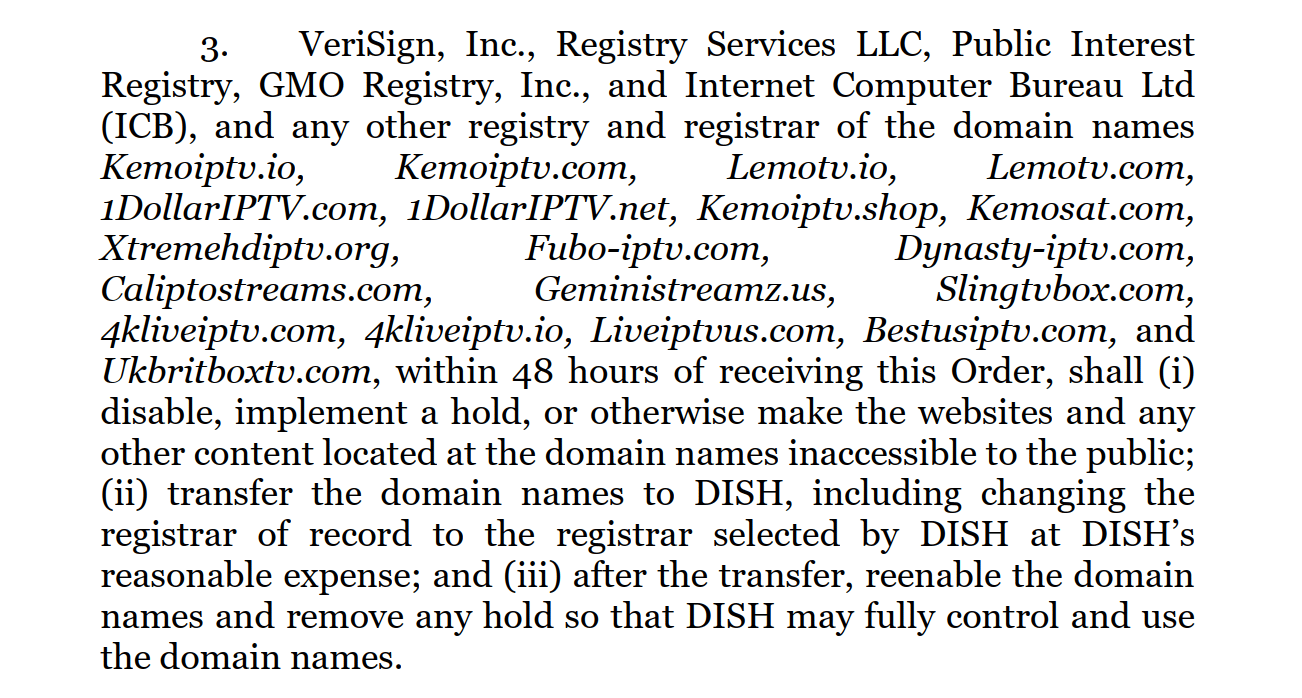 Notably, the proposed injunction is designed to be “evergreen”. It includes a provision that would require registries and registrars to automatically disable any future domain names used by the defendants, provided that DISH submits a declaration confirming the new domains are being used for infringing purposes. At the time of writing, court has not yet ruled on the motion. However, the chances of a favorable outcome in this case are higher for the pay TV company, as the defendants all failed to appear. — A copy of DISH’s motion for default judgment, filed at the U.S. District Court for the Middle District of Florida, is available here (pdf). From: TF, for the latest news on copyright battles, piracy and more. | ||||||||||||||||||
| Friday, March 20th, 2026 | |||||||||||||||||||
| LJ.Rossia.org makes no claim to the content supplied through this journal account. Articles are retrieved via a public feed supplied by the site for this purpose. | |||||||||||||||||||
| 7:18 am | Oscar Winner ‘One Battle After Another’ Sees Piracy Surge, While ‘Sinners’ Stays Flat
At the time, mass movie piracy was still a fringe activity, with no instant streaming options available. Nonetheless, more than 100,000 ‘pirates’ voted for their own movie favorites. While the OscarTorrents project was a clear display of defiance, the outcome of the voting was rather mainstream. The Departed was crowned ‘Best Picture’ in the official Oscars ceremony, as well as in the pirate equivalent, and many of the other winners were also identical. 2026 OscarsFast forward nearly two decades, and the annual awards ceremony continues to make an impact. Typically, the winner of the Oscar for ‘best picture’ will see a boost in downloads on torrent sites and elsewhere. Based on a sample of torrent activity tracked by IKnow, we can report that pirated downloads of “One Battle After Another” tripled the day after the awards ceremony compared to the week before. The chart below shows the daily estimated downloads for five of the Oscar nominees, with the winner clearly standing out. 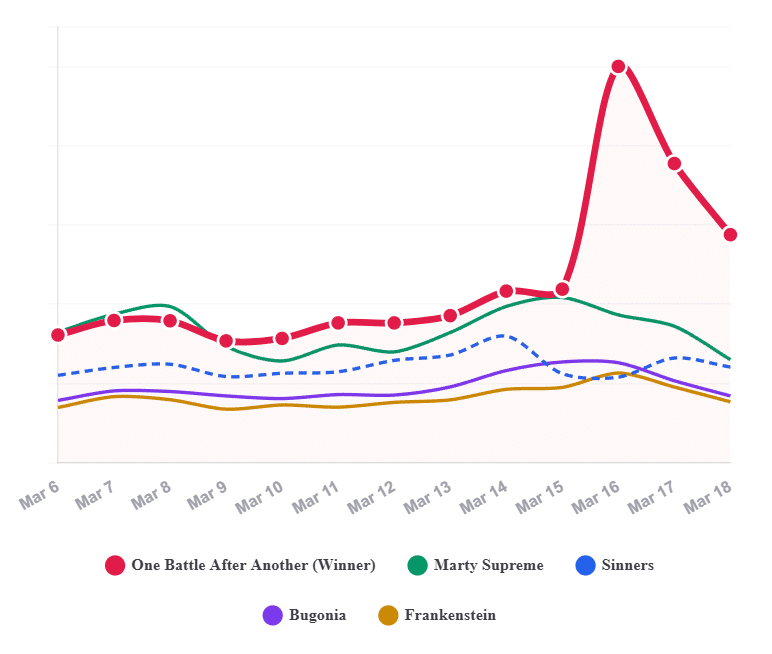 This Oscar winner’s surge doesn’t come as a surprise, as we have seen this play out before. While there is always a boost for the best picture winner, relatively speaking, this is typically greater for lesser-known films. The 300% increase for “One Battle After Another” is larger than that of “Oppenheimer” in 2024 but less pronounced than the quadrupling of last year’s winner, “Anora”. No Piracy Boost for SinnersWhat’s more surprising in this year’s data is the absence of an Oscar boost for Sinners, which was one of this year’s favorites with a record number of sixteen nominations. The film won four Oscars last weekend, but this didn’t trigger any new activity on pirate sites. Sinners already saw its downloads on pirate sites triple in January after the nominations were announced. The nominations surge in January appears to have already satisfied pirates’ demand. In the piracy data sample, we also see the lack of an Oscar effect for “Marty Supreme,” which did not see any increase in interest either. That is less surprising, of course, because the film failed to win any Oscars despite receiving nine nominations. That said, it is not only the best picture winner who enjoys a boost in pirate downloads. While less visible in the chart above, “Frankenstein” and “Bugonia” also saw temporary download spikes of close to 50%, which can be attributed to the Oscar night spotlight for these titles. Legal Demand Rises TooThe piracy boosts observed here are typically the result of an overall increase in demand. Legal streaming platforms tell a similar story, although not the same. Streaming search engine JustWatch informs us that, with a 231% increase, “One Battle After Another” was also the big winner in terms of legal demand. Interestingly, Sinners did get a boost in interest on legitimate streaming platforms. JustWatch reports that Sinners saw an increase of 136% following the Academy Awards. JustWatch’s data is based on activity from U.S. users but, even when looking at U.S. traffic alone, a similar piracy effect could not be observed on our end. 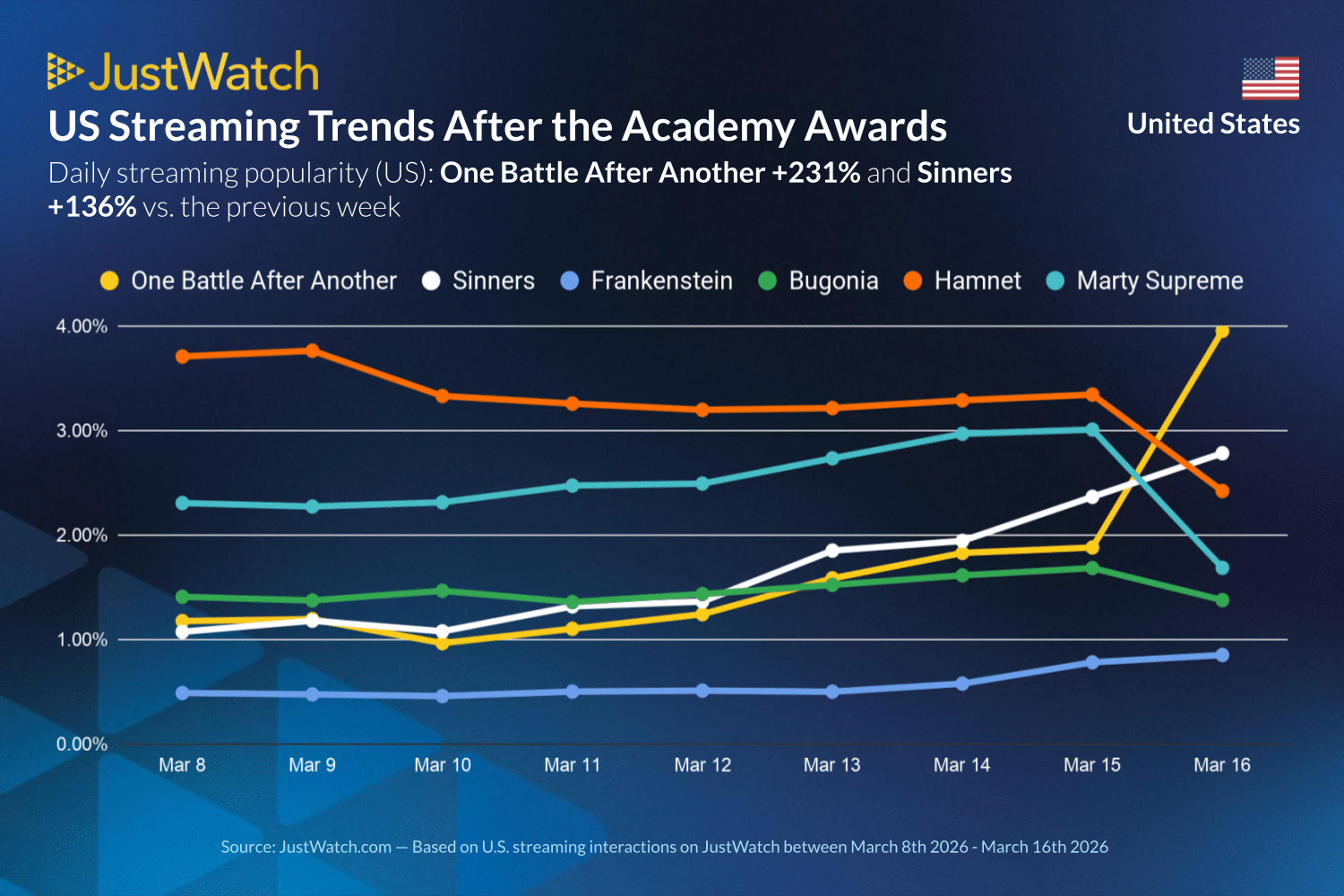 The graph above shows that legal demand for Marty Supreme through streaming platforms clearly dropped. That’s also different from our findings, as demand on pirate sites remained stable. As with all trends today, these media-triggered spikes in demand don’t tend to last very long. After the initial boost on Monday, the piracy interest for most titles immediately started to level off. That said, with an Oscar for best picture in the bag, the status of “One Battle After Another” will remain permanently elevated. — Note: The data used in this article comes from Iknow, which tracks torrent downloads through DHT and PEX. While it may not be able to track all downloads, it’s a substantial sample. This sample only looks at torrent downloads. Views on streaming platforms, direct downloads, and other piracy sources can’t be measured directly. That said, we assume that the trend will be similar there. From: TF, for the latest news on copyright battles, piracy and more. | ||||||||||||||||||
| Wednesday, March 18th, 2026 | |||||||||||||||||||
| LJ.Rossia.org makes no claim to the content supplied through this journal account. Articles are retrieved via a public feed supplied by the site for this purpose. | |||||||||||||||||||
| 7:18 am | Cloudflare Challenges Legality of Italy’s “Piracy Shield”, Appeals €14 Million Fine
To effectively tackle live sports piracy, its broad blocking powers aim to block piracy-related domain names and IP addresses within 30 minutes. While many pirate sources have indeed been blocked, the Piracy Shield is not without controversy. There have been multiple reports of overblocking, where the anti-piracy system blocked access to legitimate sites and services. €14,247,698 ‘Piracy Shield’ FineCloudflare was caught up in several of those incidents and became one of Piracy Shield’s most prominent critics. Following an amendment that extended the scheme’s reach to DNS providers and VPNs, the American Internet infrastructure company refused to filter pirate sites through its public 1.1.1.1 resolver, arguing that it was unreasonable and disproportionate. In response to the refusal, Italy’s communications regulator AGCOM launched a formal investigation. In January, the regulator concluded that Cloudflare has all the technological expertise and resources to implement the blocking measures. AGCOM argued that the company is known for its complex traffic management, and rejected the suggestion that complying with the blocking order would break its service. After weighing all arguments, AGCOM imposed a €14,247,698 (USD $16.4m) fine against Cloudflare for failing to comply with the required anti-piracy measures. The regulator added that this fine represents 1% of the company’s global revenue, adding that the law allows for a maximum of 2%. Cloudflare Formally AppealsThis week, Cloudflare explained in a blog post why it formally appealed the fine on March 8. According to the company, this case is about more than money, as it believes that the Piracy Shield blocking regime puts the open Internet at risk. The company stresses that the controversial pirate site blocking system essentially operates as a “black box”. “This case isn’t just about a single penalty; it’s about whether a handful of private entities can prioritize their own economic interests over those of Internet users by forcing global infrastructure providers to block large swaths of the Internet without oversight, transparency, or due process,” Cloudflare notes. 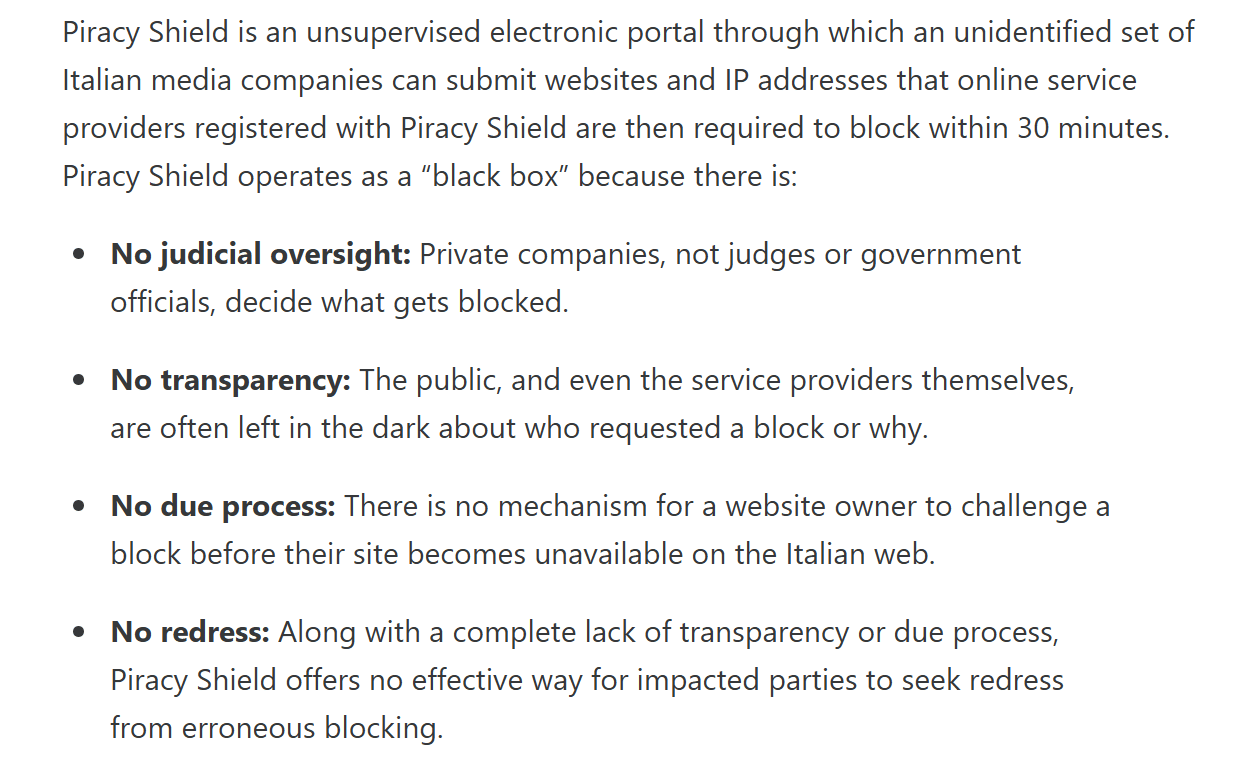 Cloudflare further stresses that the Piracy Shield’s flaws and shortcomings are no accident. In its blog post, the company points out that Piracy Shield was “donated” to the Italian government by SP Tech, an arm of the law firm that represents several of the scheme’s direct beneficiaries, including the Serie A, Italy’s top soccer league. Failures and FlawsCloudflare once again reiterates that the Piracy Shield scheme is a blunt instrument that created an unavoidable risk of overblocking. This includes many innovative sites and services, including Government websites, educational resources, and access to Google Drive, which were all blocked at some point. This massive overblocking and collateral damage was also confirmed in a study by researchers from the University of Twente last September. They concluded that Piracy Shield is linked to “significant collateral damage to legitimate infrastructure” and may pose a “potential threat to national security.” AGCOM has been aware of the critique, including the European Commission’s concerns, but it continues to stay the course. Instead of limiting the impact, it broadened the scheme to include DNS resolvers and VPNs. “Even when faced with clear evidence that Piracy Shield has caused significant and repeated overblocking, AGCOM did not change course. Rather, it chose to expand Piracy Shield to apply to global DNS providers and VPNs, services which are closely associated with privacy and free expression,” Cloudflare writes. Challenging Piracy Shield’s LegalityIn addition to overblocking concerns, Cloudflare also stresses that the Piracy Shield lacks transparency. These and other issues will likely be brought up during the appeal, which will also question the amount of the fine. AGCOM previously noted that the €14 million fine is less than the legally permitted 2% of Cloudflare’s global revenue. However, Cloudflare counters that Italian non-compliance fines are capped at 2% of a company’s revenue within the relevant jurisdiction, which would be approximately €140,000, not 100 times that. 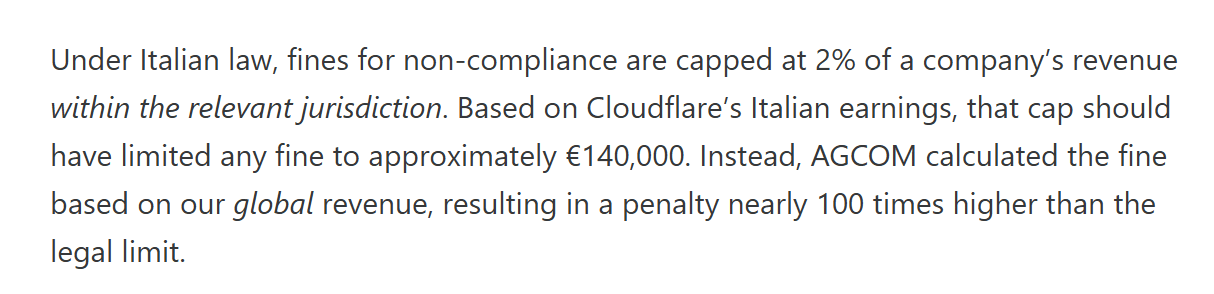 All in all, the company says that it will continue to challenge the controversial piracy blocking scheme to the best of its ability. “We are not backing down. Cloudflare is appealing the €14 million fine, pushing for full access to AGCOM’s Piracy Shield records, and will continue to challenge the underlying legality of the Piracy Shield blocking orders in the Italian administrative courts,” Cloudflare notes. From: TF, for the latest news on copyright battles, piracy and more. | ||||||||||||||||||
| Tuesday, March 17th, 2026 | |||||||||||||||||||
| LJ.Rossia.org makes no claim to the content supplied through this journal account. Articles are retrieved via a public feed supplied by the site for this purpose. | |||||||||||||||||||
| 9:02 am | Court Dismisses Musi’s Apple Lawsuit, Sanctions Law Firm for “Baseless” Claims
Apple’s action wasn’t completely unexpected. Music industry groups had been trying to take Musi down for a long time, branding it a ‘parasitic’ app that skirts the rules. Delisting from the App Store was an existential threat to Musi, which took the matter to court. Musi claimed that the App Store removal was the result of “backroom conversations” between Apple and key music industry players, including Sony, IFPI, and YouTube. The app developer accused Apple of breach of contract and breach of the implied covenant of good faith and fair dealing. The company hoped that the court would agree and compel Apple to reinstate the app, but that did not happen. Court Dismisses Musi’s ComplaintIn an order issued yesterday, Judge Eumi K. Lee of the U.S. District Court for the Northern District of California dismissed the case with prejudice, effectively ending the lawsuit. In its defense, Apple has argued that the terms of the Apple Developer Program License Agreement (DPLA) allowed the company to delist apps “at any time, with or without cause.” That would be sufficient to remove Musi.  Musi has countered that, according to the same agreement, Apple needed to conduct a review to establish “reasonable belief” before an app would be removed from its platform. However, the court disagreed, stressing that there are no limitations to Apple’s removal rights. 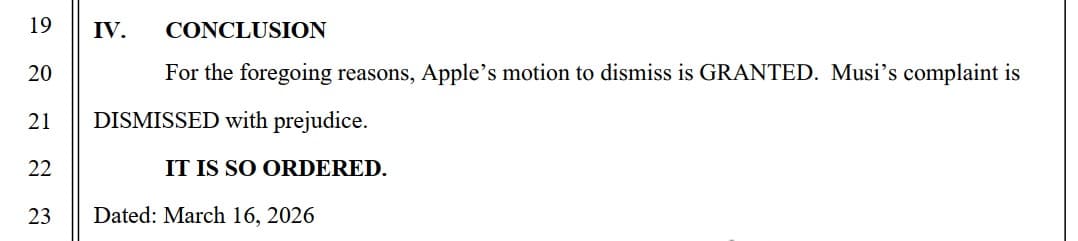 “There is simply no textual basis in the DPLA to construe a limitation on Apple’s right to cease offering an application, as long as Apple provided notice,” Judge Lee writes. Musi’s Claims FailMusi’s argument that Apple breached an “implied covenant of good faith” under California law also failed. While Apple was contractually allowed to remove the app, the court notes that Apple did not solely act in response to the YouTube claim. “[T]he complaint reflects that Apple was facing pressure from multiple music industry complaints. The letter from Sony expressly states that its trade organization (the IFPI) had already tried to resolve issues with Musi through the app dispute process, but Musi was not cooperating,” the order reads. The court already granted Musi the option to amend its complaint previously and allowed two months of discovery, including access to over 3,500 documents and depositions from Apple officials, but that was not enough. Therefore, the court dismissed the case with prejudice, meaning that it can’t be refiled. Sanctions Against Musi’s LawyersIn a separate order issued the same day, the court granted Apple’s motion for Rule 11 sanctions in part, ruling that one allegation in Musi’s amended complaint was factually baseless. Musi had alleged in the first paragraph of its amended complaint that Apple “knew that this ‘evidence’ was false, as it has since admitted.” Judge Lee found that this admission did not appear anywhere in the provided evidence. Therefore, Musi’s claim that Apple had “admitted” to knowingly relying on false evidence is sufficient to warrant sanctions. “Claiming that Apple ‘admitted’ that it knowingly relied on false evidence conveys that discovery yielded damning evidence,” the order states, “but it did not.” The sanctions order effectively removed the offending phrase from the amended complaint and ordered Musi’s law firm, Winston & Strawn LLP, to pay Apple’s reasonable attorneys’ fees related to the sanctions motion. More ScrutinyThe sanctions ruling was not the first time Musi’s honesty came under scrutiny in this case. In a motion filed in May 2025, Apple alleged that Musi had previously impersonated a Universal Music Group executive to get its app reinstated after an earlier removal. Apple claimed that Musi founder Aaron Wojnowski forwarded a fabricated email to Apple purportedly from UMG’s Jason Miller, using the address jasonmiller@umusic.solar-secure.com, which is not a UMG address. 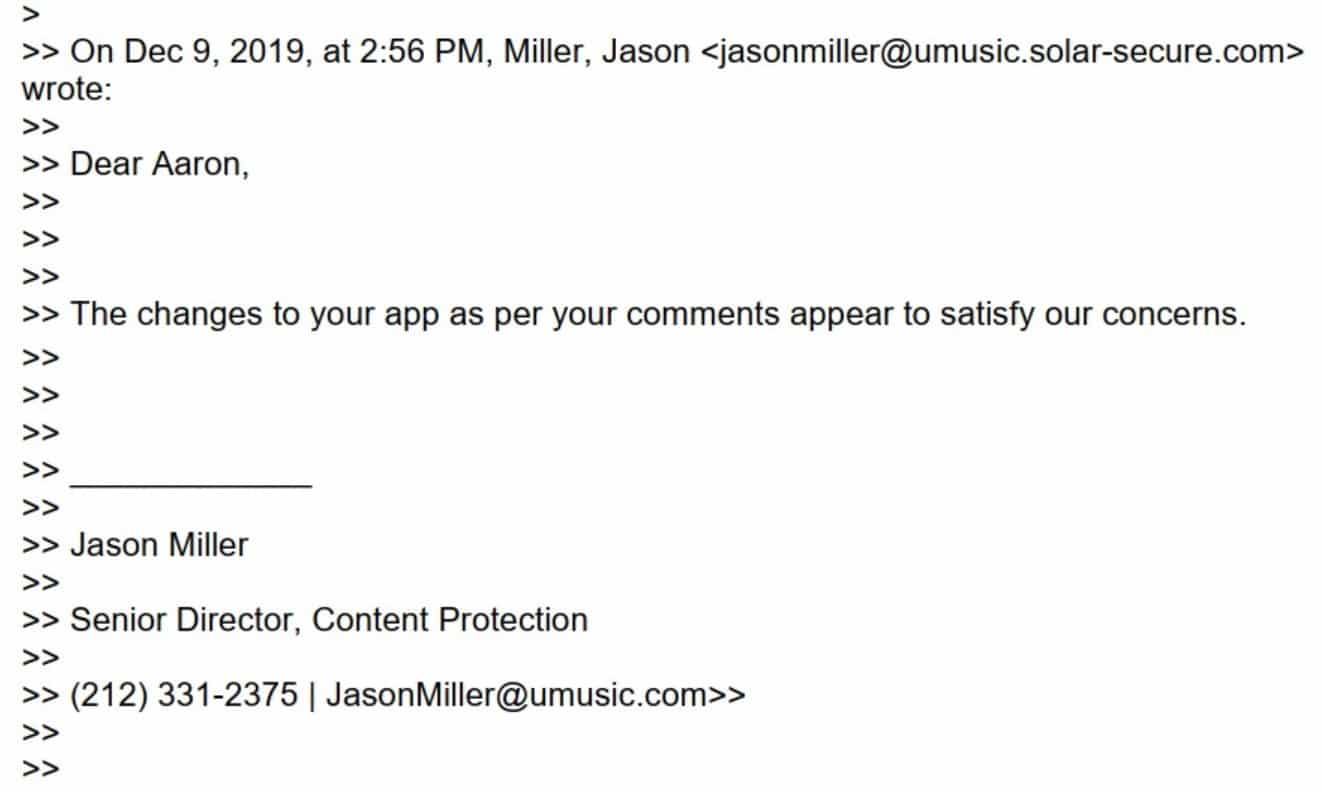 UMG later informed Apple the email was “fraudulent” and that Miller had no record of sending it. The same address was allegedly used to file a false copyright claim against a separate music streaming app, Yokee, in July 2020. With the dismissal order now in place, the case is effectively closed. This means that the once very popular music app will not return to the App Store via this route. Musi still has the option to appeal, but whether it plans to do so is unclear. The company did not immediately return our request for comment. — A copy of Judge Eumi K. Lee’s order granting Apple’s motion to dismiss is available here (pdf). The order granting in part Apple’s motion for Rule 11 sanctions is available here (pdf). From: TF, for the latest news on copyright battles, piracy and more. | ||||||||||||||||||
 Pirate streaming network Dramacool and several associated sites
  In late 2022, several of the world’s largest music companies, including Warner Bros. and Sony Music prevailed in
  Last week, X asked a federal court in Tennessee to
  The Supreme Court’s decision to
  YouTube downloaders and other nifty tools are seen as a major piracy threat by the music industry.
  Traditional site-blocking measures that require local ISPs to block subscriber access to pirate sites have been commonplace in France for years.
  For as long as protected computer games have existed, people have tried to break or bypass these digital locks with patches, loaders, and keygens.
  Over the past two years, rightsholders of all kinds have filed lawsuits against companies that develop AI models.
 The Pirate Bay was once the
  Last August, we reported on
 When a Virginia jury ordered internet provider Cox to pay
  Earlier this month, HiAnime surprised friends and foes by
  As one of the leading Internet infrastructure companies,
  In 2007, The Pirate Bay supported “
 In September 2024,
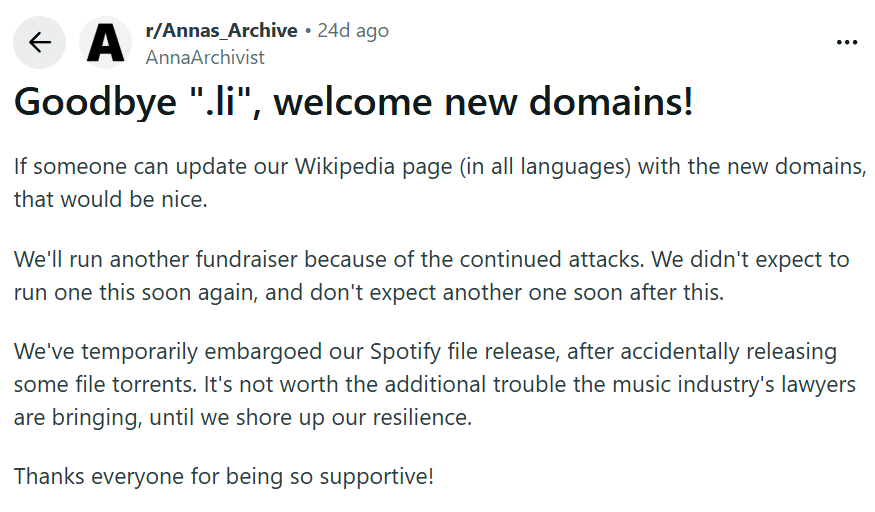
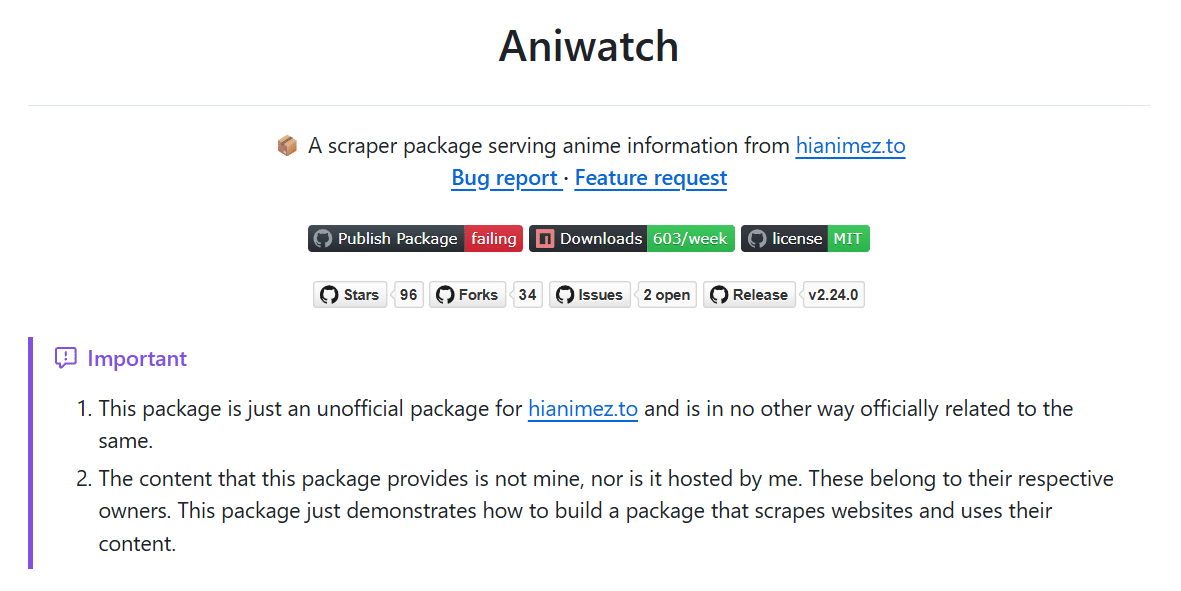
LJ.Rossia.org makes no claim to the content supplied through this journal account. Articles are retrieved via a public feed supplied by the site for this purpose.