
|
|


Пишет AnandTech (![[info]](http://lj.rossia.org/img/syndicated.gif) syn_anandtech) syn_anandtech)@ 2016-01-14 12:03:00 |
 |
|
 |
|
|
|
|
|
|
 |
|
 |


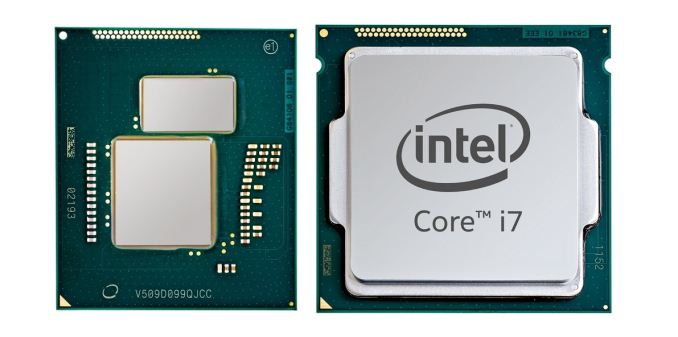
Intel’s integrated graphics processors (IGPs) are the most widespread PC-class graphics adapters on the planet. Enthusiasts of high-performance personal computers do not use Intel’s IGPs, but the world’s largest developer of microprocessors says that for mainstream and casual gamers its graphics solutions offer performance, which is comparable to that of inexpensive discrete graphics cards.
“For the mainstream and casual gamer, we have improved our Iris and Iris Pro graphics tremendously,” said Gregory Bryant, vice president and general manager of the desktop client platforms at Intel, at the J.P. Morgan Tech Forum at the 2016 International CES. “We have improved our graphics performance [by 30 times] from where it was five years ago. We believe that the performance of Intel’s integrated graphics today, what we offer in the products […], is equivalent to the performance of about 80% of discrete [GPU] installed base.”
Intel has been improving its integrated graphics cores rather rapidly after the company cancelled its discrete graphics processing unit code-named Larrabee in 2010. Thanks to timely transition to newer process technologies, Intel could increase transistor budget of its central processing units significantly every couple of years. As the company did not increase general-purpose core count of its mainstream CPUs for desktop and mobile computers in the recent years, the lion’s share of that additional transistor budget was spent on IGP-related improvements.

Intel considers its code-named Clarkdale and Arrandale processors as its first-generation CPUs with integrated Intel HD Graphics core (which is not entirely correct since these CPUs had two dies: the processor die as well as graphics and integrated memory controller die). Back then, Intel’s most advanced IGP featured 12 execution units (EU) with peak compute performance of around 43 GFLOPS. Since then, the architecture of Intel’s integrated graphics processors has evolved to accommodate new features and gain performance. Today, each EU features two ALUs that can execute up to four 32-bit floating point or integer operations per cycle (in fact, one of the two ALUs within Intel’s Gen8 EU also supports double precision 64-bit floating point operations). Intel’s latest microprocessors — Broadwell with GT3e and Skylake with GT4e graphics cores — have Iris Pro IGPs with 48 and 72 EUs as well as peak compute performance of 883 and 1152 GFLOPS, respectively.

While Intel did not define what it considers to be installed base of discrete graphics cards, it is obvious that the company compares its recent Iris and Iris Pro integrated graphics processors to discrete graphics adapters sold in the last five or even more years and which are currently in use. Such comparison generally makes sense since the Iris Pro 6200 (the most powerful IGP of Intel’s Broadwell processor with 48 execution units) offers performance, which is higher than that of AMD Radeon R7 240 graphics card (Oland GPU, 320 stream processors, 20 texture units, 8 raster operations pipelines, 128-bit memory controller), based on our findings published in June, 2015.
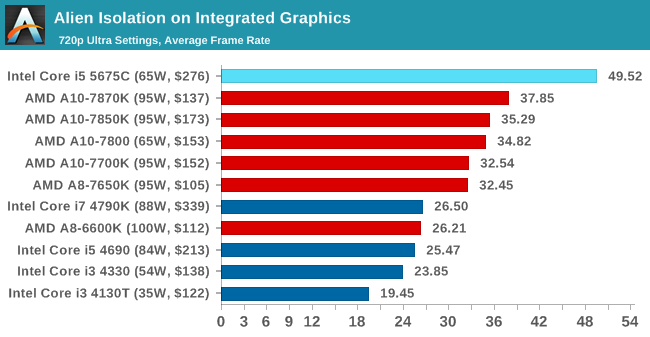
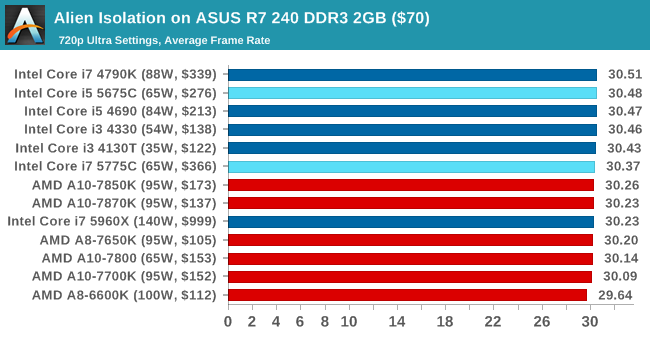
Intel’s latest integrated graphics processor found in Skylake chips — the Iris Pro 580 with 72 execution units and 1152 GFLOPS compute performance — should outperform even more advanced discrete graphics processors. In fact, AMD's latest integrated graphics core also outperforms the low-end graphics card (albeit, by a small margin).
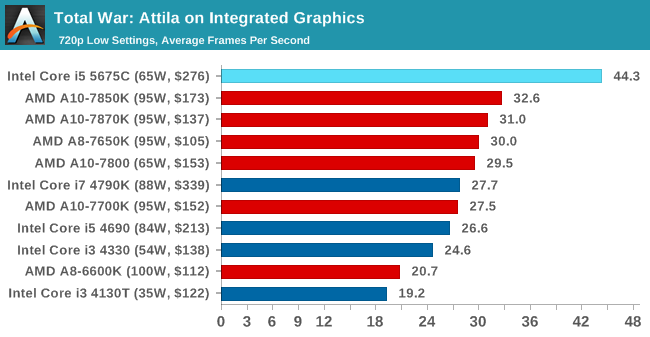
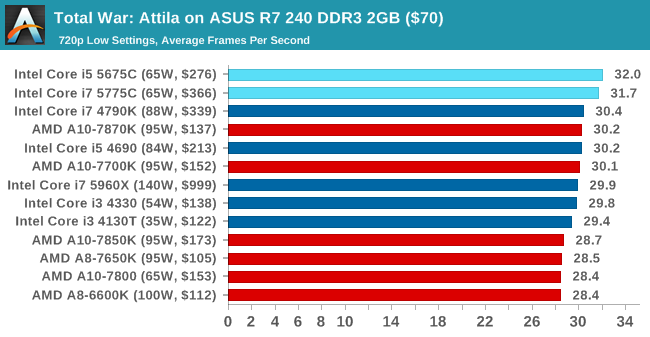
Since many people do not play demanding games, performance of Intel’s modern IGPs may be enough for them. Moreover, since casual and even some mainstream gamers buy low-end graphics adapters, performance offered by Intel’s Iris Pro 6200 and Iris Pro 580 could be the same or higher compared to video cards owned by such people. It is not clear whether 80% of discrete graphics boards currently in use belong to the entry-level segment, but it evident that contemporary IGPs are somewhat better than cheap video cards.
While demanding gamers will continue to use discrete graphics cards, rapid evolution of Intel’s IGPs may significantly improve their popularity going forward even among those, who need more or less high graphics performance.
Even though enthusiast gamers do not use Intel’s high-end IGPs, the company continues to thrive because of PC gaming. According to the chipmaker’s management, sales of its Core i7-series microprocessors set records in Q2 2015 despite weak demand for personal computers overall. Moreover, Intel claims that sales of high-end enthusiast-class hardware in general is at all-time high and growing. Intel sells not only powerful Core i7 CPUs with unlocked multiplier to demanding gamers, but also chipsets, solid-state drives, various controllers and other components for high-end PCs. As a result, the company takes advantage of increasing demand for powerful personal computers by PC gamers.

