
|
|


Пишет AnandTech (![[info]](http://lj.rossia.org/img/syndicated.gif) syn_anandtech) syn_anandtech)@ 2016-03-14 19:00:00 |
 |
|
 |
|
|
|
|
|
|
 |
|
 |


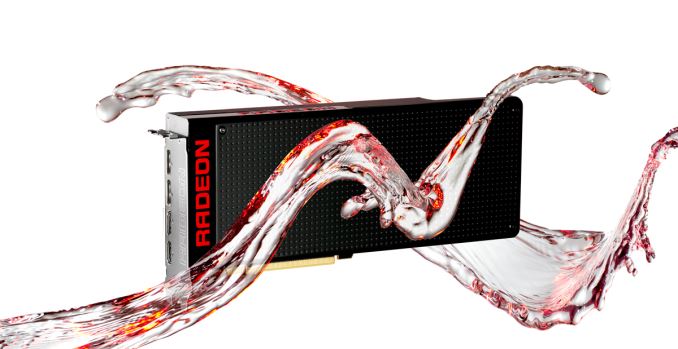
At AMD’s GDC 2016 “Capsaicin” event, the company has announced their long-awaited dual Fiji video card. Being released under the name Radeon Pro Duo, the new card is a departure from the usual for AMD, with the company specifically targeting it towards VR content creation rather than end-user gaming.
AMD originally teased their then in-development dual-Fiji card back at the Fiji launch event in June of 2015. At the time the card was expected to launch towards the end of 2015 as the company’s flagship gaming card. However at AMD’s Polaris event in December, the company announced that they were realigning the card to focus on the VR market, and would be holding it back to 2016 to launch alongside the major VR headsets.
Officially AMD’s commentary was limited reiterating their desire to have the card tied to the VR industry. However I believe that AMD also delayed the card due to the poor state of AFR scaling in recent AAA games, which would make a dual-GPU card a hard sale in the typical PC gaming market. VR, by contrast, is a much better fit since through technologies such as AMD’s affinity multi-GPU, the two perspectives that need to be rendered for VR can be mapped directly to each GPU, avoiding AFR’s dependency and pacing issues.
In any case, with the launch of the major VR headsets finally upon us, AMD is formally unveiling their dual Fiji card, the Radeon Pro Duo. That AMD is still not going after the consumer market means they have once again defied expectations, but first let’s take a look at the specs as we know them so far.
Note: AMD sent over their press release for the Radeon Pro Duo ahead of their event, with the embargo time set for the same time the event starts. Not all of the specs for the card are listed in the release, but based on the information given I believe the following to be reasonably accurate, and will be updating it with final specs as soon as they are available.
| AMD GPU Specification Comparison | ||||||
| AMD Radeon Pro Duo | AMD Radeon R9 Fury X | AMD Radeon R9 Fury | AMD Radeon R9 295X2 | |||
| Stream Processors | 2 x 4096? | 4096 | 3584 | 2 x 2816 | ||
| Texture Units | 2 x 256 | 256 | 224 | 2 x 176 | ||
| ROPs | 2 x 64 | 64 | 64 | 2 x 64 | ||
| Boost Clock | 1000MHz? | 1050MHz | 1000MHz | 1018MHz | ||
| Memory Clock | 1Gbps HBM? | 1Gbps HBM | 1Gbps HBM | 5Gbps GDDR5 | ||
| Memory Bus Width | 2 x 4096-bit | 4096-bit | 4096-bit | 2 x 512-bit | ||
| VRAM | 2 x 4GB | 4GB | 4GB | 2 x 4GB | ||
| FP64 | 1/16 | 1/16 | 1/16 | 1/8 | ||
| TrueAudio | Y | Y | Y | Y | ||
| Transistor Count | 2 x 8.9B | 8.9B | 8.9B | 2 x 6.2B | ||
| Typical Board Power | 525W? | 275W | 275W | 500W | ||
| Manufacturing Process | TSMC 28nm | TSMC 28nm | TSMC 28nm | TSMC 28nm | ||
| Architecture | GCN 1.2 | GCN 1.2 | GCN 1.2 | GCN 1.1 | ||
| GPU | Fiji | Fiji | Fiji | Hawaii | ||
| Launch Date | Q2 2016 | 06/24/2015 | 07/14/2015 | 04/21/2014 | ||
| Launch Price | $1499 | $649 | $549 | $1499 | ||
Officially, AMD promotes the Radeon Pro Duo as having 16 TFLOPS of performance; this narrows down the specifications considerably to two fully enabled Fiji GPUs, clocked at around 1GHz. Assuming the card doesn’t throttle for heat or power issues, this would put performance at an almost identical level to a Radeon R9 Fury X Crossfire, with a gap of no more than 5%.
Otherwise as this is Fiji, the rest of the specifications should not come as a surprise. Doubling up on Fijis gives us 64 ROPs and 256 texture units per GPU. And 4GB of HBM per GPU, clocked at 1Gbps for an effective memory bandwidth of 512GB/sec.
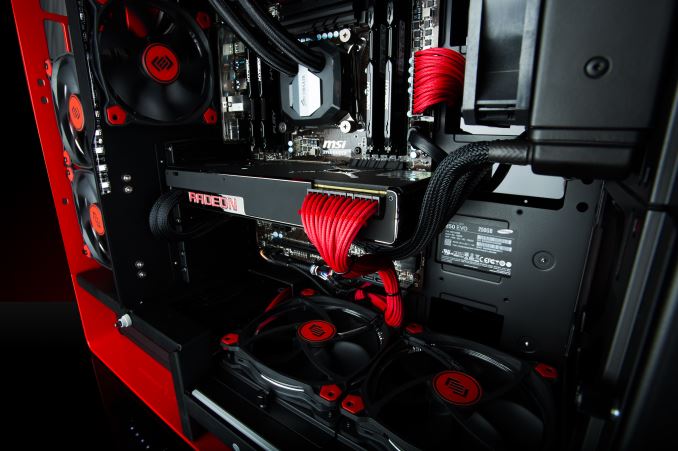
The big unknown right now is power consumption. The shots of the card in AMD’s press materials all show 3 8-pin PCIe sockets, which would put the maximum power draw as officially allowed by the PCIe specification at 525W. However I am waiting to see what AMD confirms, as this isn’t necessarily what the card will draw. In either case, given their performance goals, such high power consumption is to be expected, as Radeon R9 Fury X was rated for 275W, and Radeon Pro Duo appears to be very close to dual Fury X in performance. This is also comparable to AMD’s previous generation dual-GPU card, the Radeon R9 295X2, which was rated for 500W.
Perhaps the bigger news though is the target market for the card. While I had initially expected AMD to target the card at the VR consumer market, AMD has gone in a different direction. Rather the Radeon Pro Duo is being pitched as a content creation card, making this an unusual halfway point between a Radeon and a FirePro.
As I’m writing this up in advance I haven’t heard AMD’s formal reasoning for why they aren’t heavily promoting it for the consumer market – though clearly the card will work there – but after giving it some thought I suspect it has to do with the system requirements for VR gaming. Both Oculus and Valve are pushing the idea that a Radeon R9 290/GeForce GTX 970 should be the performance level VR games are designed around. If developers actually follow through on this, then having a faster card is not especially useful since VR displays are locked to v-sync and can’t exceed their cap. If a 290 delivers 90fps, what would a Pro Duo when developers are targeting a fixed level of quality?
In which case content creation is the next best thing to do with the card. Games under development have yet to be tuned for performance, so it’s sound reasoning that developers would want something as fast as possible to do their initial development on. The catch for AMD is that this does limit the market for the card; besides the high price tag, the market for developers is much smaller than the market for consumers.

Finally, let’s talk pricing and availability. AMD has announced that the card will retail for $1499. This is the same price that the Radeon R9 295X2 launched at in 2014, however it’s more than double the price of a pair of Fury Xes, so pricing is arguably not aggressive there. On the other hand it’s more compact than a pair of Fury Xes (or even a pair of Nanos), so there is the space argument to be made, and as AMD’s positioning makes clear this is first and foremost a development card to begin with. Meanwhile the Pro Duo will be shipping in “early Q2 2016”, which means we should see it become available in the next one to two months.
_thumb.jpg)
_thumb.jpg)
_thumb.jpg)
_thumb.jpg)
_thumb.jpg)
_thumb.jpg)

