[Most Recent Entries] [Calendar View]
Wednesday, July 12th, 2017
| Time | Event | ||||||||||||||||||||||||||||||||||||||||||||||||||||||||
| 9:15a | ASUS Launches the 360º Chromebook Flip C213: 11.6-inch Apollo Lake, Starting $349
Back in January of this year, ASUS announced they were coming to market with a new Chromebook targeted specifically at education-focused customers. With Google focusing on Education in their Chromebooks as of late, using these ‘convertibles’ instead of iPads, ASUS hopes to increase its market share with the newest offering.
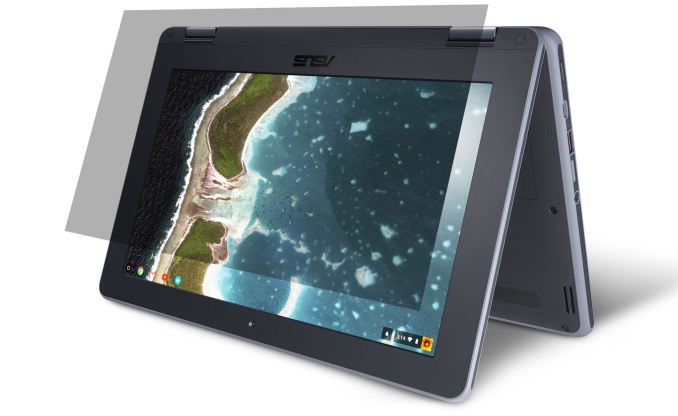
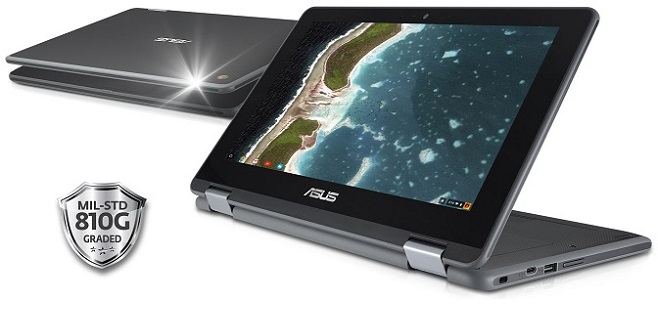
The Chromebook Flip C213 is listed as a rugged notebook and supposed to be designed to take bumps and bruises from daily use by students. To reinforce this, it touts a MIL-STD-810G spec construction, rated to protect it from drop damage (from nearly 4 feet) and moisture (spills up to 60ml). The outside of the laptop is protected by a rubber ‘bumper’ to protect it, as well as to reinforce the I/O ports. By virtue of the Flip nomenclature, it operates in various rotational modes. These include a standard laptop (pictured above), a tent, a stand, and tablet modes, making it an option for a wide variety of use scenarios. It also features dual cameras, a 5MP on the back and an HD camera on the front.
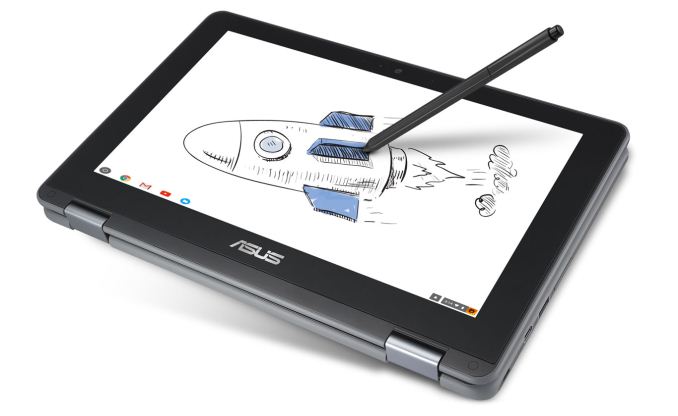
The 360-degree all metal hinges attach to the 11.6” touchscreen, working at a native resolution of 1366x768. There are two versions of the screen for two different use models: the first screen type uses an anti-glare finish, while the second is protected by Corning’s Gorilla Glass as well as supporting an (optional) stylus - using the Wacom EMR technology for painting, sketching, and handwriting. This version should be available in a couple of months, and carries with it a price premium over the anti-glare model.
The included 46Wh battery is said to last up to 12 hours of continuous use, which ASUS claims that it potentially eliminates the need for a charge in the middle of the day and more suitable for classroom or travel situations. The unit uses Chrome OS (59) to provide access to all of Google tools made for business and education, called the 'G Suite'. Users will get automated updates, built-in anti-virus protection, and the security that comes with using Google personal accounts. ASUS claims that the unit is designed for easy servicing: it has a modular construction, enabling quick replacement of key components like the keyboard, touchpad, battery, motherboard, power jack daughter board, and the display panel. Modularity replacements could reduce the burden on IT resources, potentially lowering total cost of ownership in servicing.
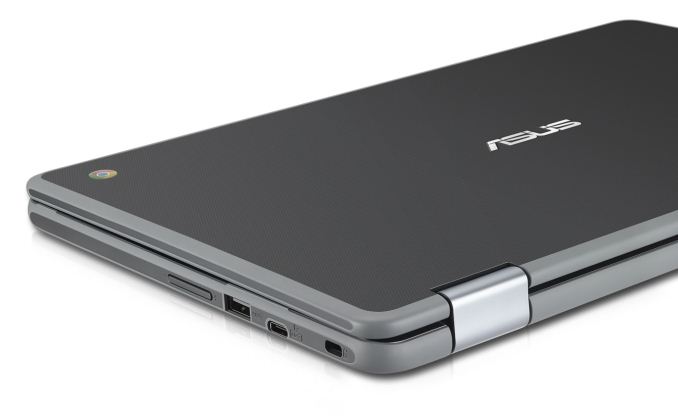
Hardware wise, the Flip C213 uses the Intel Apollo Lake N3350 - a dual core Atom-class CPU with a base clock of 1.1 GHz capable of bursting to 2.4 GHz. DRAM capacity sits at 4GB, with static storage at 32GB of eMMC rated up to 300 MB/s sequential reads and 140 MB/s sequential writes. Wireless is provided by an 802.11AC 2x2 Wi-Fi card with Bluetooth 4.0. There are 2x USB 3.1 Gen 1 Type-C ports, 2x USB 3.1 Type-A ports, a micro SD card reader and a 3.5mm audio combo jack rounding out connectivity.
Pricing on the two versions comes in at $349 for the anti-glare screen, while the Gorilla Glass version with an optional stylus will come in at $399. You can find the former version at authorized ASUS resellers now, while the latter will be available in September. Related Reading | ||||||||||||||||||||||||||||||||||||||||||||||||||||||||
| 11:00a | MSI Announces the X299 XPower Gaming AC Motherboard: Five M.2 Slots
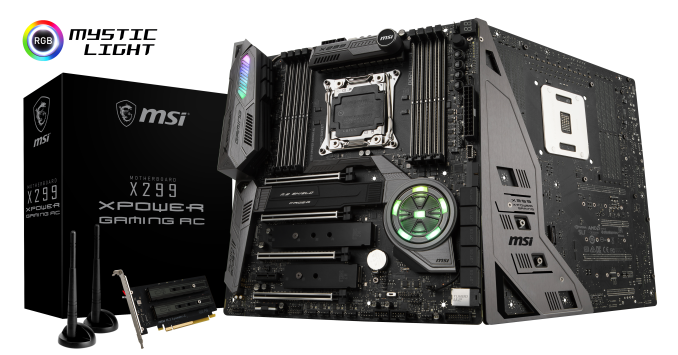
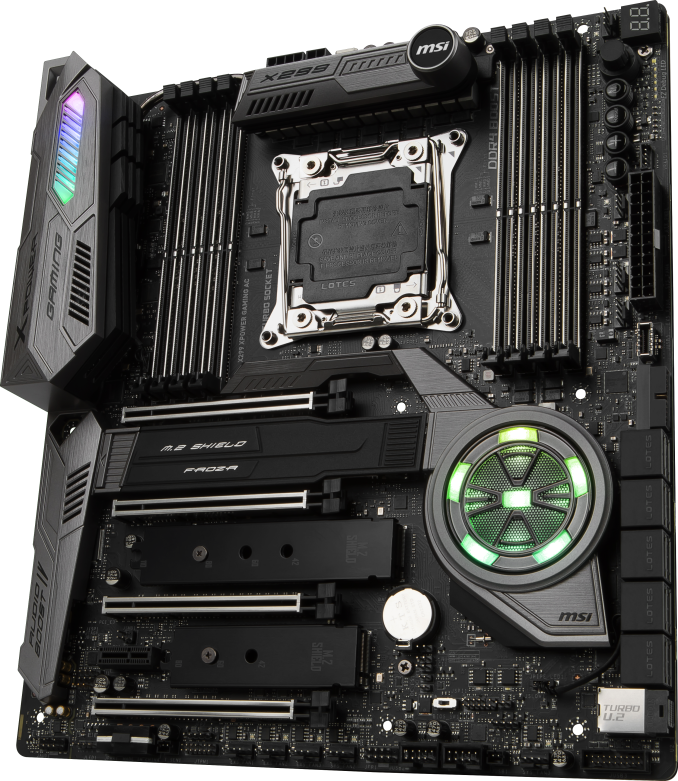
This week MSI has announced a new X299 motherboard: the MSI X299 XPOWER GAMING AC. This is designed as a flagship motherboard for MSI's X299 range, and aims to combine gaming features and performance with the overclocking pedigree of their XPower family from previous generations. One thing that may jump out is MSI is adjusting its aesthetic scheme and returning back to a more neutral black on the XPower, a deviation from the recent generations where the XPower would get a 'titanium' silver treatment (or even older generations of XPower that were yellow). The theme agnostic color choice is due to the prevalence of RGB LEDs, found on both the “reactor” design of the chipset heatsink as well as above the I/O area on the shroud. The basic premise is that having customizable RGB LEDs should allow the motherboard to fit into more customized and themed builds, whereas some of the previous color designs may have pigeon-holed the design of systems. To contrast the dark color scheme, MSI has used their branded 'Steel Armor' protective coverings for the x16 PCIe slots, as well as the DIMM slots and the U.2 connector.
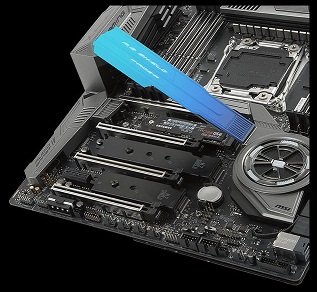
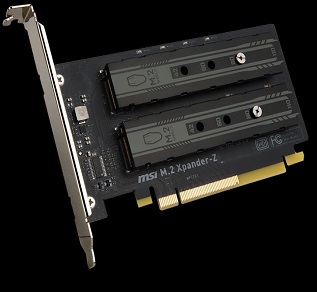
For the X299 XPower Gaming AC, MSI uses a 14 phase power design which is claimed to help heavy overclocking, combined with a joined VRM and IO heatsink. MSI likes to promote the use of 'Military Class' components for the power delivery and other features, and claims that their use of isolated memory circuits that use optimized routing (to ensure optimal signals to and from the CPU and RAM) will allow each motherboard to reach DDR4-5000 or higher depending on the CPU memory controller, although they do not state on what cooling (likely, sub-zero). One of the key features for this board will be the M.2 support. MSI is directly supporting three drives on board, but has also bundled a riser card for two more. For the onboard slots, MSI is using its new heatsink, the M.2 Shield Frozr. For the top M.2 slot, the heatsink is connected to the PCH heatsink in order to help move heat away. The bundled PCIe riser card is called MSI's XPander-Z, for M.2 slot expansion. This add-in-card gives a PCIe 3.0 x8 connection, and allows the user to mount two additional 110mm PCIe 3.0 x4 M.2 drives on it, giving the board a total of five M.2 slots. The expansion card setup supports Intel VROC technology, allowing a RAID-0 configuration directly from the CPU bypassing the typical throughput limits of PCIe 3.0 x4 slots.
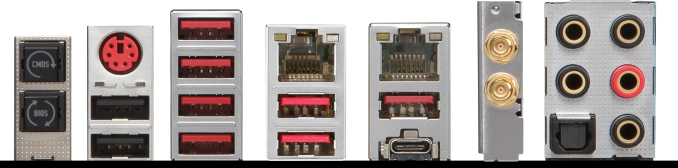
Moving more towards the connectivity, the XPower features two Intel Gigabit LAN ports (Intel I219V and Intel I211), an 802.11ac 2x2 WiFi card, and a Realtek ALC1220 audio codec. MSI likes to promote its use of advanced audio design options, such as EMI shielding, PCB separation, corrosion resistant audio connectors, and bundled software. MSI also bundles traffic shaping software for the networking.
MSI used the ASMedia ASM3142 controller to deliver two USB 3.1 Gen2 ports, including a front panel header. They claim to have worked closely with several case manufacturers for product testing to ensure they are compatible with any MSI X299 motherboard. We've not particularly approached the ASM3142 controller in detail on AnandTech yet, but it represents a more power efficient variant of the ASM2142, which in turn is a dual-bandwidth version of the ASM1142, the first dual-port USB 3.1 (10 Gbps) controller we found on motherboards. At the time of this writing, pricing and availability were not available. Related Reading | ||||||||||||||||||||||||||||||||||||||||||||||||||||||||
| 10:00p | Colorful Announces iGame GeForce GTX 1080 Ti Neptune W: All-in-One Liquid Cooling With 240mm Radiator
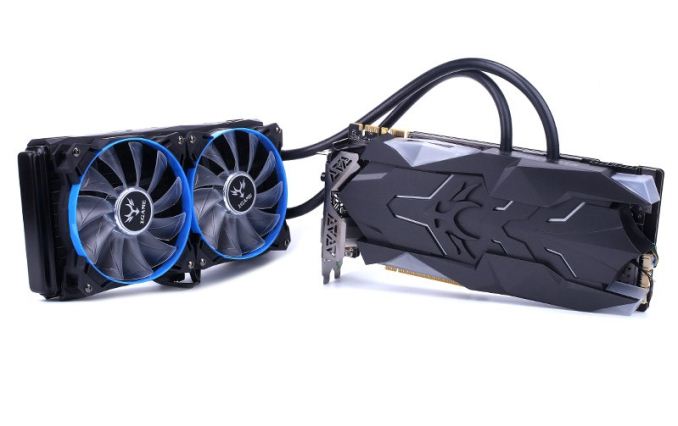
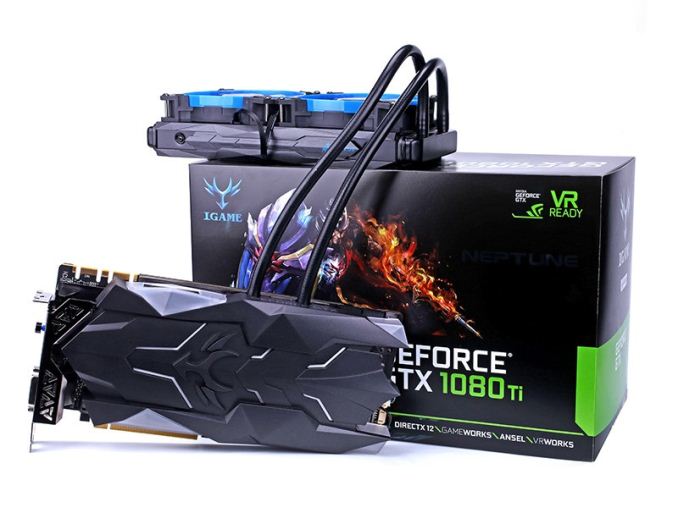
The past few months have been full of announcements and releases for all-in-one liquid cooled graphics cards, and now Colorful is joining the fray with their iGame GeForce GTX 1080 Ti Neptune W. First teased at Computex 2017, the Neptune W comes equipped with an all-in-one closed loop cooling solution, featuring a novel 240mm radiator. While Colorful is a China-based vendor, at Computex 2017 the company also disclosed plans to launch their iGame series cards worldwide, starting in Southeast Asia and Korea; Colorful already has branches in Germany, South Korea, and Vietnam. This follows previous information hinting at future market expansion with Colorful’s iGame GTX 1080 Ti Vulcan X OC. In the meantime, the Neptune W product page is only listed on their Chinese site.
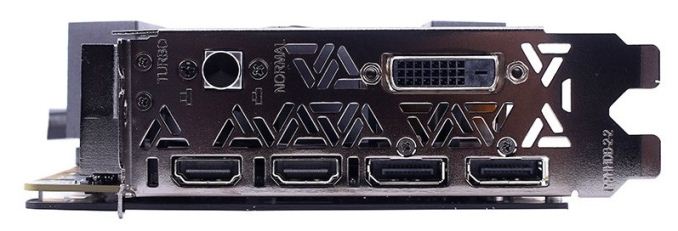
As the flagship entry in the iGame Neptune series, the 1080 Ti Neptune W is outfitted with all the LED trappings we’ve come to expect in modern ultra-high-end graphics cards. In handling the lights, Colorful offers the iGame-Zone II overclocking and LED controlling software. Toggling the “Turbo / Normal” labelled BIOS switch on the PCIe bracket activates Colorful’s “one-key” overclocking, a feature found on their other cards. This adjusts the base and boost core clocks upwards as listed in the prior table. Colorful's picture seems to show a 2 DP/2 HDMI configuration even though the specifications list 3 DisplayPorts and 1 HDMI port, so it's unclear whether the posted bracket picture is completely accurate.
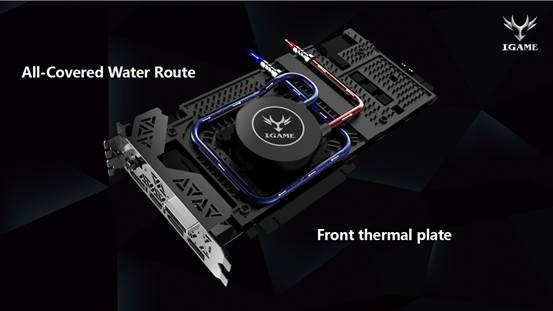
Details on the card’s cooling design were light. The water block appears to cover only the GPU while the cold plate/waterpipes complex covers the rest of the key components. In any case, a 240mm radiator setup is practically unknown in AIO graphics card designs and deserves mention. Although the extra cooling capacity is not fully harnessed with the listed TDP and the dual 8pin power configuration, the 240mm AIO CLC is an easy way for Colorful to differentiate the Neptune W from the competition, particularly if the increased cooling performance significantly enhances overclocking headroom.
As novel as a 240mm radiator may be, Colorful is not one to stray from envelope-pushing designs: the recent past has seen them showcase a gargantuan 4-slot hybrid cooled graphics card with their iGame GTX 1080 KUDAN, while the aforementioned Vulcan X OC is furnished with an LCD screen not unlike Palit’s GALAX/KFA2 1080 Ti HOF. Such products are not surprising in the context of the company’s size: in 2015, Digitimes reported that Colorful was on track to be the second largest graphics card vendor in the world. With the potential prospect of ultra-high-end iGame cards hitting the Western markets, the Colorful name may not be unknown in the West for much longer. Gallery: iGame 1080 Ti Neptune W
      Related Reading | ||||||||||||||||||||||||||||||||||||||||||||||||||||||||


| << Previous Day |
2017/07/12 [Calendar] |
Next Day >> |