[Most Recent Entries] [Calendar View]
Tuesday, November 20th, 2018
- NVIDIA’s DGX-2: Sixteen Tesla V100s, 30 TB of NVMe, only $400K
- NVIDIA Unveils & Gives Away New Limited Edition 32GB Titan V "CEO Edition"
- GIGABYTE Launches Two 4U NVIDIA Tesla GPU Servers: High Density for Deep Learning
- G.Skill Trident Royal Crystalline DRAM: Premium Gemstone Glamour
- G.Skill Unveils 64 GB DDR4-4266 and 128 GB DDR4-4000 Kits for HEDTs
- G.Skill Announces DDR4-4800 and DDR4-4500 Kits for Z390 Boards
- G.Skill’s DRAM Extremes: DDR4-4000 on AMD Ryzen, DDR4-5066 on Intel Core i7
| Time | Event | ||||||||||||||||||||||||||||||||||||||||||||||||
| 11:00a | Huawei Server Efforts: Hi1620 and Arm’s Big Server Core, Ares
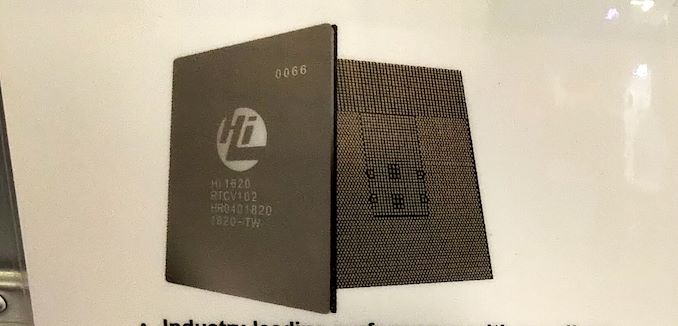
For at least four years now, Arm has been pushing its efforts to be a big part of the modern day server, the modern day data center, and in the cloud as a true enterprise player. Arm cores are found in plenty of places in the server world, with big deployments for its smartphone focused Cortex core family in big chips. However, over that same time period, we have been requesting a high-performance core, to compete in single threaded workloads with x86. That core is Ares, which we assume is due out in 2019, and while Arm hasn’t officially lifted the lid on the details yet, Huawei has already announced it has hardware with Ares cores at its center. | ||||||||||||||||||||||||||||||||||||||||||||||||
| 1:10p | Arm Delivers on Cortex A76 Promises: What it Means for 2019 Devices In the grand scheme of things, it hasn’t been all that long since we first covered Arm’s announcement of the new Cortex A76 CPU microarchitecture. The new CPU IP was publicly unveiled back on the first of June, and Arm had made big promises in regards to the performance and efficiency improvements of the new core. It’s been a little over 5 months since then, and as we originally predicted, we’ve seen vendors announce as well as ship silicon SoCs with the new CPU. Last week we published our review of the Huawei Mate 20 and Mate 20 Pro – both which contain HiSilicon’s new Kirin 980 chipset. Unfortunately for a lot of our readers which are based in the US, the review won’t be as interesting as the devices won’t be available to them. For this reason I’m writing up a standalone piece focusing more on the results of the new Cortex A76 inside the Kirin 980, and discuss more in detail how I think things will play out in the upcoming generation of competing SoCs. | ||||||||||||||||||||||||||||||||||||||||||||||||
| 2:00p | FreeTail EVOKE Pro microSDXC UHS-II Memory Card Capsule Review
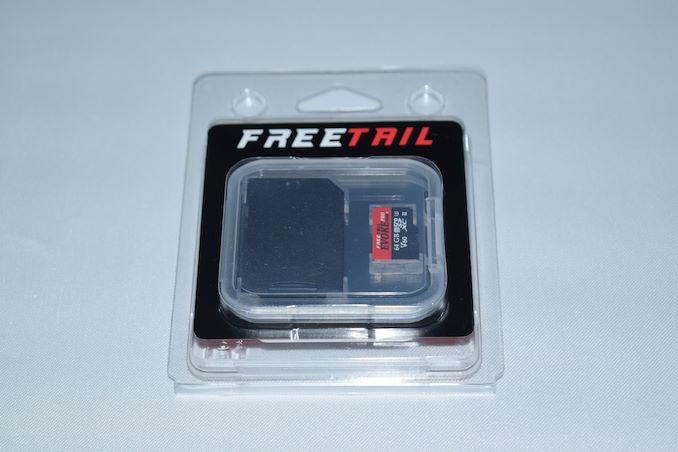
Almost all content capture devices employ memory cards (flash-based removable media) for storage. Hand-held consoles and many other computing systems (PCs as well as smartphones) also employ them for augmenting the available storage capacity. There are different varieties of memory cards catering to various performance levels. CompactFlash (CF) became popular in the late 90s, but, has now been overtaken by Secure Digital (SD) and its smaller form-factor version (microSD). We recently started in-depth evaluation of the performance of various memory cards. FreeTail sent over their UHS-II microSDXC card for inclusion in our performance database. Read on for our review of the card. | ||||||||||||||||||||||||||||||||||||||||||||||||
| 4:30p | NVIDIA Unveils DGX-2H Server with 450W Tesla V100 GPUs
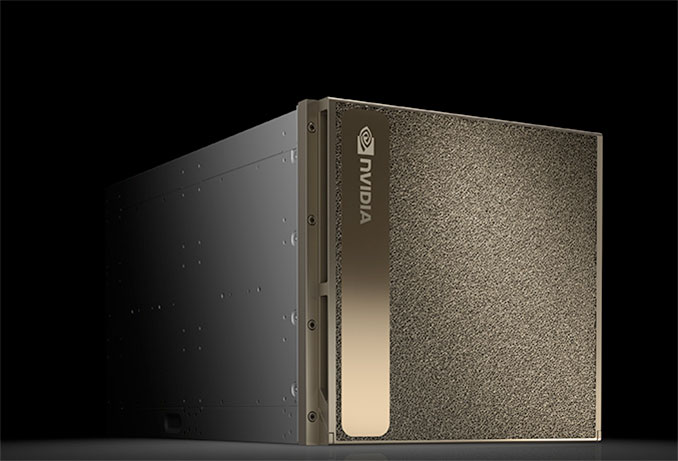
NVIDIA has introduced a new version of its DGX-2 server that is outfitted with higher-performing CPUs and GPUs. The DGX-2H server is powered by 16 Tesla V100 GPUs that run at higher clocks and feature a 450 W TDP each. The whole system consumes up to 12 kW of power and delivers 2.1 PetaFLOPS of compute horsepower. NVIDIA’s DGX-2H is an updated version of the DGX-2 machine the company introduced earlier this year. The new system is based on Intel’s two 24-core Intel Xeon Platinum 8174 processor accompanied by 1.5 TB of DDR4 memory, as well as 30 TB of NVMe storage. The key improvements of the new server versus the previous one are faster NVIDIA Tesla V100 GPUs featuring 512 GB of HBM2 memory in total. In addition, the new DGX-2H also has faster networking capabilities: it has dual 10/25/40/50/100 GbE instead of 10/25 GbE.
Thanks to faster graphics processors with a 450 W TDP each, the system now can deliver 2.1 PFLOPS of compute performance, up from 2 PFLOPS before. Meanwhile, in a bid to increase power, it looks like NVIDIA had to switch to a new cooling method. ServeTheHome believes that NVIDIA also uses a new cooling subsystem as the DGX-2H weighs 20 pounds more than its predecessor (360 pounds vs. 340 pounds), though the company has not confirmed this. Along with performance improvements NVIDIA had to decrease maximum operating temperature of the DGX-2H from 35C to 25C. NVIDIA has not disclosed pricing of the DGX-2H, though it is likely that it will cost more than $399,000, the price of the DGX-2. What remains to be seen is whether NVIDIA customers find the DGX-2H performance good enough for extra 2 kW of power consumption. Related Reading: Sources: NVIDIA, ServeTheHome | ||||||||||||||||||||||||||||||||||||||||||||||||
| 5:30p | Your Highness: G.Skill Trident Z Royal, Bling Factor 11
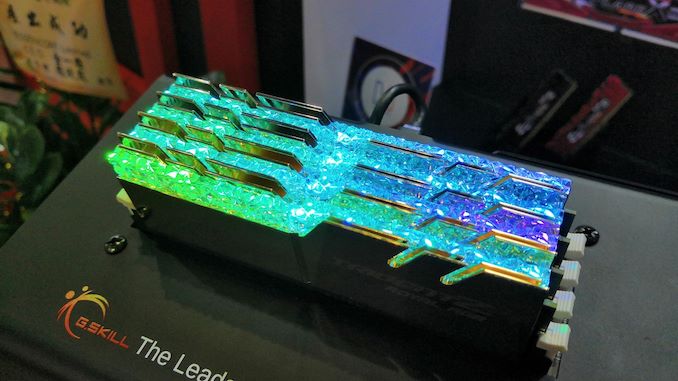
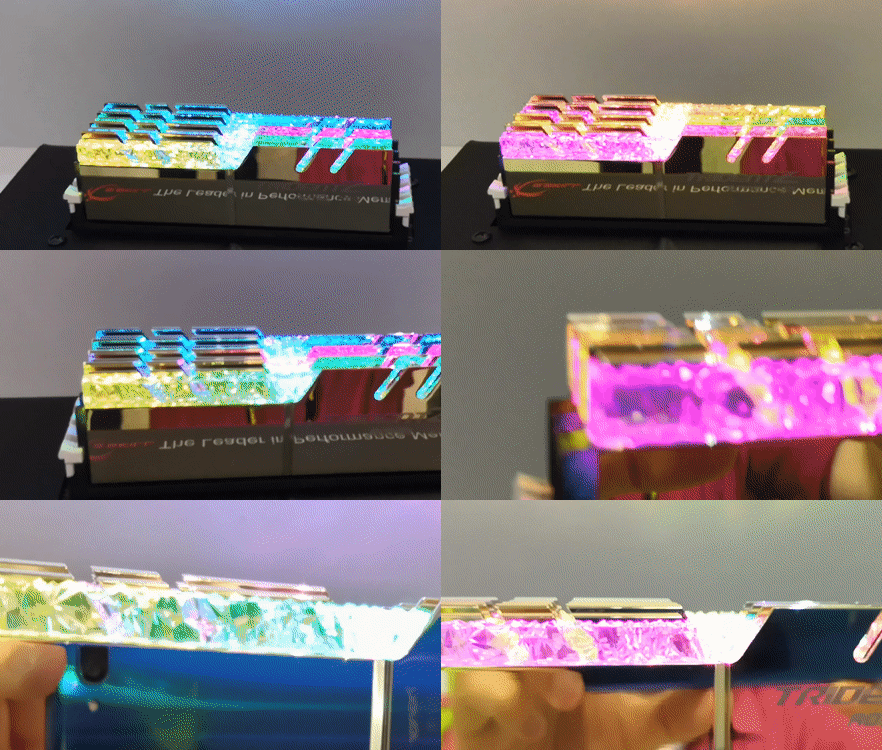
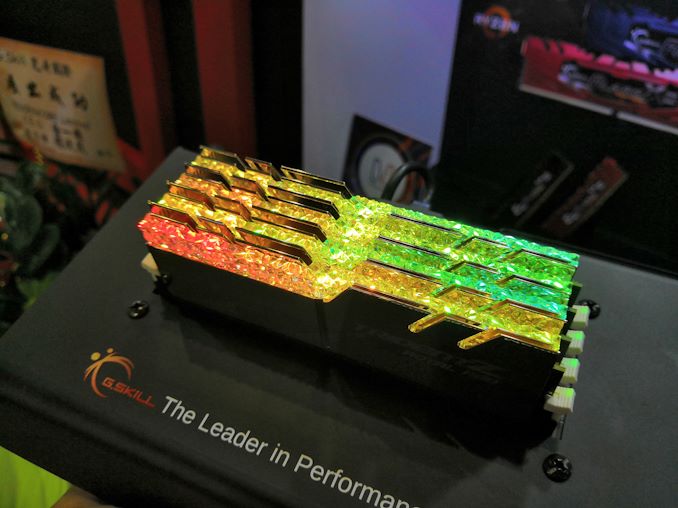
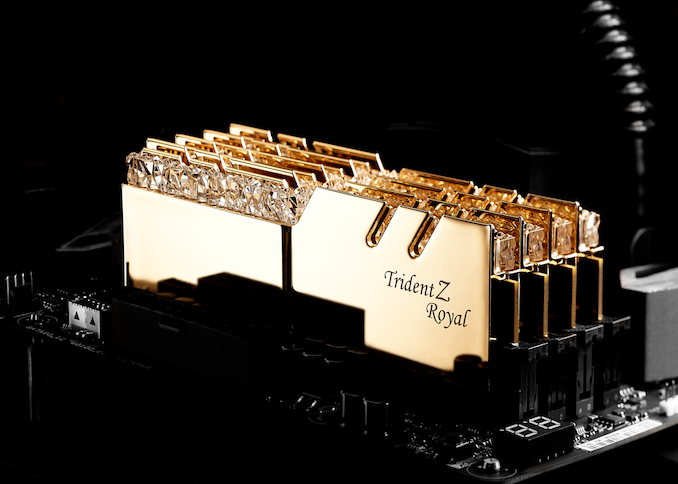
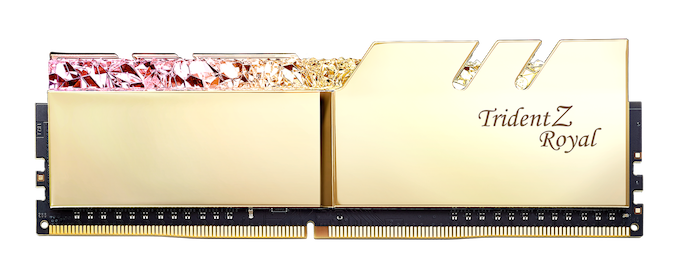
G.Skill this week has officially introduced its Trident Z Royal family of memory modules. This memory featuring crystalline light bars with RGB lighting and polished heat spreaders. The modules will be available at various speed bins with a maximum data transfer rate of up to DDR4-4600.
G.Skill’s Trident Z Royal memory modules will feature 8 GB and 16 GB capacities and will be available in dual-channel and quad-channel kits. The product family will include DDR4-3000, DDR4-3200, DDR4-3600, DDR4-4000, DDR4-4266, DDR4-4400, and DDR4-4600 speed bins at 1.35 V, 1.4 V, 1,45 V and 1.5 V. Being aimed at enthusiasts and overclockers, G.Skill’s Trident Z Royal will rely on the company’s PCBs designed in house.
The key feature of the Trident Z Royal memory modules is crystalline RGB lightbar with multiple lighting zones as well as polished silver or gold heat spreaders. Since the lightbar is unique, G.Skill will provide a special software to control it. The program will be available for download from G.Skill’s website once the modules hit the market.
G.Skill plans to start selling its Trident Z Royal memory modules in December, but as usual the company does not pre-announce pricing. One thing for sure is that the Trident Z Royal memory modules will carry a premium price tag because of the unique design.
Related ReadingSource: G.Skill | ||||||||||||||||||||||||||||||||||||||||||||||||
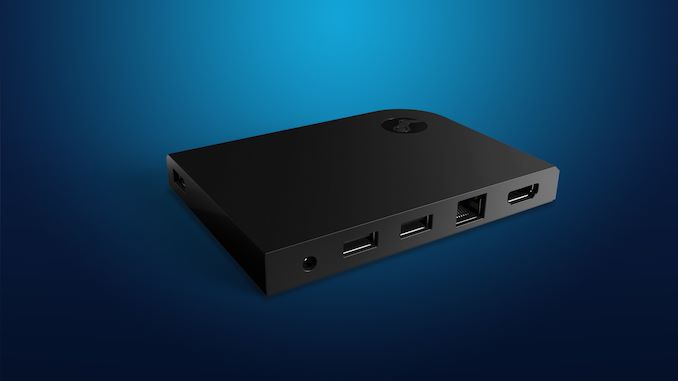
| 6:00p | Valve Discontinues Steam Link Streaming Box
First launched mid-decade, Valve’s Steam Link was one of several local game streaming products to hit the market, allowing users to play PC games away from their PC by streaming its contents to another room. And while the device definitely made an impression upon its launch, the writing has been on the wall for some time now that Valve hasn’t been completely satisfied with the hardware. Now the company is announcing that they have wrapped up production of the Steam Link, with the streaming box already out of stock in Europe and most of North America. Initially released back in November of 2015, the Steam Link was part of a multi-pronged Valve effort dubbed “Steam Universe” that focused on getting Steam and its games on to living room TV screens. This initiative included the SteamOS Linux distribution, Steam Machines running SteamOS, and then the Steam Link. The Steam Link in turn was a relatively simple and low-cost set-top box that served as a remote streaming endpoint; gamers could use it to see what Steam was seeing on their PC, and then remotely play their games. Valve kept the box simple – it was little more than an H.264 decoder with network connectivity and a Bluetooth adapter – allowing it to be small and cheap. Of the three prongs of the Steam Universe initiative, the Steam Link was in turn easily the most successful. While Steam Machines fizzled almost immediately – and SteamOS remains a neat side-project – the Steam Link was sold in volume by both Valve and retail partners. Though not the first PC streaming solution, it was by far the most prevalent. And, if you could get past the inheriant lag and occasional game compatibility issues, it worked pretty well. However it’s also been clear that while the Steam Link made an impact, Valve has wanted out. The company has offered frequent sales on the hardware in the past year, often selling it for only a few bucks plus shipping (including right now). So the company has been trying to draw down their Steam Link inventory for some time, and with their latest announcement it looks like they’ve finally completed the task. And while Valve’s very brief announcement doesn’t officially state why they’re getting out of the STB business, the more recent development of the Steam Link App paints a very clear picture. The STB was little more than an H.264 decoder to begin with, and the massive prevalence of smartphones means that pretty much everyone carries one of those in their pocket, never mind the rapid rise of smart TVs. Even with the Steam Link box, the strength of Valve’s play was in the software and integration, so like so many other discrete devices over the past decade, the streaming STB’s functionality has been subsumed by other smart devices. Finally, for their part, Valve is reiterating that they will still continue supporting all forms of Steam Link, app and STB. So while hardware production has wrapped up, Valve seems prepared to offer what little support is necessary for their most successful hardware product to date. | ||||||||||||||||||||||||||||||||||||||||||||||||
| << Previous Day |
2018/11/20 [Calendar] |
Next Day >> |