
|
|


Пишет AnandTech (![[info]](http://lj.rossia.org/img/syndicated.gif) syn_anandtech) syn_anandtech)@ 2018-05-08 08:30:00 |
 |
|
 |
|
|
|
|
|
|
 |
|
 |


Most home networks fall under one of three categories:
- ISP-supplied gateway (modem and wireless router combo) with optional wireless extenders
- Discrete modem and a standalone wireless gateway / router (coupled with optional network extenders, or, a Wi-Fi system)
- Discrete modem, discrete wired router, and switches / access points
All three choices have their pros and cons, with the first option being preferred by consumers who are not tech-savvy to begin with. In that case, the customer usually pays a monthly rental fee to the ISP. The maintenance of the gateway (including firmware updates) is handled by the ISP too.
Vendors such as Arris and Netgear have tried to play in this market segment with modem-router combo products in retail for direct purchase by the consumers. Such products have typically presented some usage challenges:
- Unsatisfactory activation process for the modem-router combo device (unlike the case of the ISP-supplied modem)
- ISP-handled firmware updates, preventing patching of router firmware for vulnerabilities / preventing users from taking advantage of new Wi-Fi router features developed by the vendor for their wireless routers product-line.
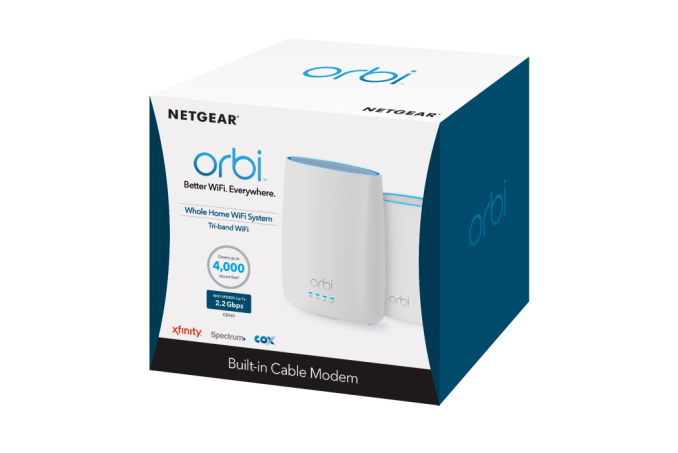
Today, Netgear is launching the Orbi cable modem - a dual PCB solution with the same form-factor as that of the existing Orbi RBK40 kit. The dual PCB solution refers to the cable modem and the wireless routers coming on distinct boards, with separate firmware for each. ISPs can handle the firmware update for the modem segment, while the consumers can update the wireless router firmware independently. The activation process has also been simplified by Netgear, with new features in the Orbi mobile app making it a seamless process.
Netgear has been very active in releasing new firmware features for their Orbi products (tying in with their pivot to a services-based revenue model for their offerings). Features such as 'Circle with Disney' (which has a premium subscription option) are turning out to be hits based on the feedback we have received from current Orbi customers. The ability to update the Orbi router firmware independent of the cable modem firmware is a key feature of the Cable Orbi.
Addressing the two main concerns with combo devices allows Netgear to promote the advantages of an Orbi with an integrated modem:
- The modem / router device can act as the master in a mesh Wi-Fi system.
- Combining the modem and router into one device implies fewer devices to purchase for the consumer.
- Existing Orbi satellites can be repurposed for usage with the Orbi Cable master unit
Netgear has two SKUs with the Cable Orbi hardware - the Cable Orbi Router (CBR40), priced at $300, is a single device that integrates the modem and wireless router into one unit. The Cable Orbi Kit (CBK40) bundles a satellite with the Cable Orbi Router for $400.
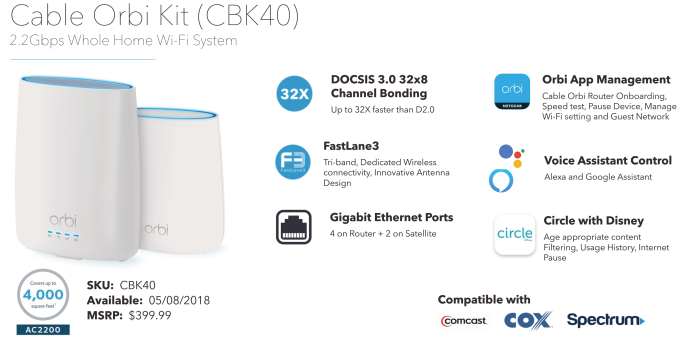
Coming to the technical specifications, the CBR40's wireless components are derived from the AC2200 Orbi RBK40 introduced last year - a Qualcomm Atheros IPQ4019 network processor with Wi-Fi SON features, and separate 2x2 radios for the client devices and the backhaul. The cable modem PCB is based on the Intel Puma chipset (we have reached out to Netgear to confirm that it is not the one affected by the network latency issue). It is a DOCSIS 3.0-compliant modem with a 32x8 channel bonding configuration supporting a maximum of 1.4 Gbps downstream and 262 Mbps upstream bandwidth.
Netgear is obviously building on the success of the Orbi lineup with the integration of a cable modem into the lineup. This definitely increases the addressable market for Orbi products within the home networking space. Consumers using ISP-supplied gateways to blanket large areas with Wi-Fi would do little wrong in opting for the CBR40 or CBK40. Power users and tech-savvy consumers might prefer a more flexible solution with a discrete modem, router, switches, and access points. The Cable Orbi is not meant for those folks. For the average consumer, the Orbi lineup now has SKUs that can cater to varying requirements and budgets.


