
|
|


Пишет AnandTech (![[info]](http://lj.rossia.org/img/syndicated.gif) syn_anandtech) syn_anandtech)@ 2020-02-20 12:00:00 |
 |
|
 |
|
|
|
|
|
|
 |
|
 |


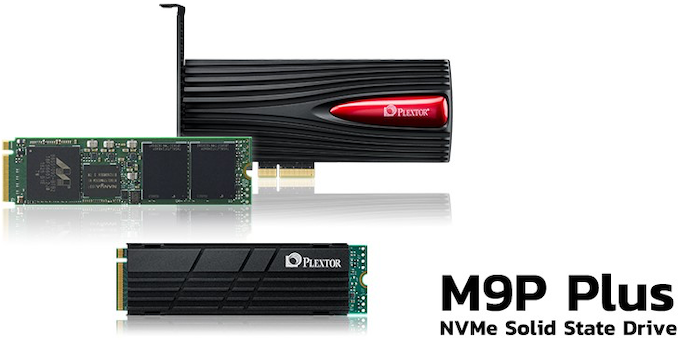
Plextor has introduced its new flagship consumer SSD lineup, the M9P Plus. The new drives continue to use Marvell’s proven "Eldora" controller, but come equipped with Kioxia’s 96-layer BiCS4 3D TLC NAND memory, and offer slightly higher sequential performance than its predecessors.
Set to be available in 256 GB, 512 GB, and 1 TB configurations, the new Plextor M9P Plus lineup is based on the Marvell 88SS1092 controller that is paired with Kioxia’s latest 96-layer BiCS4 3D TLC memory. By contrast, the previous-generation Plextor M9Pe family used the Marvell 88SS1093 controller (with higher clocks) along with Kioxia’s 64-layer BiCS3 3D TLC NAND.
When it comes to performance, the new M9 Plus 1 TB drives are rated for sequential read/write speeds up to 3,400/2,200 MB/s, which is 6.25% and 4.75% higher when compared to the M9Pe 1 TB. But there is a catch. Plextor says that the latest M9 Plus 1 TB SSDs deliver up to 340K/320K read/write random IOPS, which means 15% lower random reads yet 6.6% faster random writes when compared to the M9Pe 1 TB. Meanwhile, it is important to note that the 256 GB M9P Plus is rated to be considerably faster the 256 GB M9Pe (see the table below).
As they usually do, Plextor will offer its flagship SSDs in three versions: the M9PG Plus M.2-2280 module with a heat spreader, the M9PGN Plus M.2-2280 module without a heat spreader for laptops, and the M9PY Plus HHHL card with a heat spreader and an RGB LED. The drives are covered by a five-year warranty.
| Plextor M9Pe vs. M9P Plus Series Specifications Comparison | |||||||
| 256 GB | 512 GB | 1 TB | |||||
| M9Pe | M9P Plus | M9Pe | M9P Plus | M9Pe | M9P Plus | ||
| Form Factor | M9PeY/M9PY Plus: Half height half length PCIe add-in card (HHHL) M9PeG/M9PG Plus: M.2 2280 with heatspreader M9PeGN/M9PGN Plus: M.2 2280 without heatspreader |
||||||
| Controller | M9Pe: Marvell 88SS1093 M9P Plus: Marvell 88SS1092 |
||||||
| Interface | NVMe PCIe 3.0 x4 | ||||||
| DRAM | 512MB LPDDR3 | 1024MB LPDDR3 | |||||
| NAND | M9Pe: Toshiba 64L BiCS3 3D TLC M9P Plus: Kioxis 96L BiCS4 3D TLC |
||||||
| Sequential Read | 3000 MB/s | 3400 MB/s | 3200 MB/s | 3400 MB/s | 3200 MB/s | 3400 MB/s | |
| Sequential Write | 1000 MB/s | 1700 MB/s | 2000 MB/s | 2200 MB/s | 2100 MB/s | 2200 MB/s | |
| 4KB Random Read (QD32) | 180k IOPS | 300k IOPS | 340k IOPS | 340k IOPS | 400k IOPS | 340k IOPS | |
| 4KB Random Write (QD32) | 160k IOPS | 300k IOPS | 280k IOPS | 320k IOPS | 300k IOPS | 320k IOPS | |
| Endurance | 160 TBW | 320 TBW | 640 TBW | ||||
| Warranty | 5 years | ||||||
As Kioxia ramps up production of 96-layer 3D TLC NAND memory and winds down manufacturing of 64-layer 3D TLC NAND, it is not surprising that companies like Plextor have to adopt newer chips. What is odd is that Plextor isn't using a more recent controller. The 88SS1092 used in the M9P Plus is a derivative of the 88SS1093 that mostly adds support for more DRAM and NAND—changes that were primarily intended for the datacenter SSD market.
Meanwhile, Marvell has announced two newer generations of client NVMe SSD controllers. Their PCIe Gen4 controllers announced in 2019 mark a shift in strategy away from high-end drives and focus instead on low power using fewer PCIe lanes and NAND channels. But Marvell's 2018 controller announcements included the 88SS1100 as a direct successor to the 88SS1093, increasing the CPU core count and NAND interface speed to get closer to the limits of a PCIe 3.0 x4 interface. It's not clear why Plextor is sticking with such an old controller when their supplier has had newer, more competitive solutions available for quite a while.
Related Reading:
- Toshiba Memory to Acquire Lite-On’s SSD Business: Gains IP, R&D, Manufacturing Ops
- The Plextor M9Pe NVMe SSD Review: Teaching An Old Chip New Tricks
- Plextor Launches M9Pe NVMe SSDs
- Plextor Announces M9Pe SSD: 3.1 GB/s, Marvell Controller, 64-Layer 3D TLC, RGB LEDs
Source: Plextor

