
|
|


Пишет AnandTech (![[info]](http://lj.rossia.org/img/syndicated.gif) syn_anandtech) syn_anandtech)@ 2021-03-10 14:00:00 |
 |
|
 |
|
|
|
|
|
|
 |
|
 |


Seagate recently published its long-term technology roadmap revealing plans to produce ~50 TB hard drives by 2026 and 120+ TB HDDs after 2030. In the coming years, Seagate is set to leverage usage of heat-assisted magnetic recording (HAMR), adopt bit patterned media (BPM) in the long term, and to expand usage of multi-actuator technology (MAT) for high-capacity drives. This is all within the 3.5-inch form factor.
"We can use our recent experience, productizing our 20 TB HAMR drive to translate from laboratory demonstrations to products, which puts us on track to deliver 50 terabytes by 2026," said John Morris, Chief Technology Officer of Seagate. "We have drive technologies planned which will enable long term HAMR growth and a path to over 100 TB devices. And hard disk drives will continue to service the needs of mass capacity storage with the most optimal, total cost of ownership for the next decade and beyond."
HAMR to Enable 90 TB HDDs
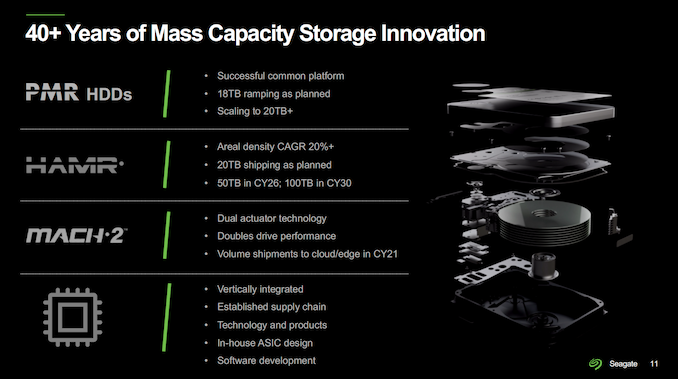
In the recent years HDD capacity has been increasing rather slowly as perpendicular magnetic recording (PMR), even boosted with two-dimensional magnetic recording (TDMR), is reaching its limits. Seagate's current top-of-the-range HDD features a 20 TB capacity and is based on HAMR, which not only promises to enable 3.5-inch hard drives with a ~90 TB capacity in the long term, but also to allow Seagate to increase capacities of its products faster.
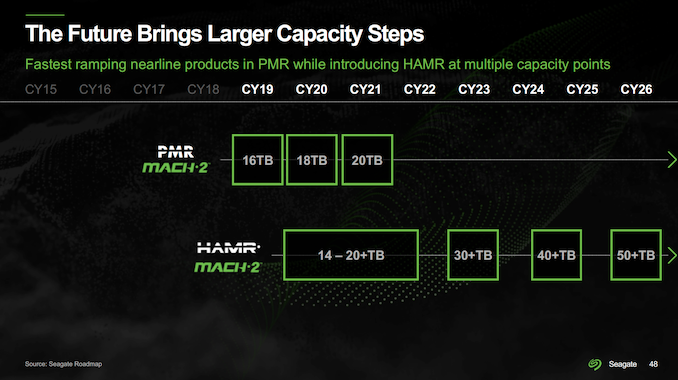
In particular, Seagate expects 30+ TB HDDs to arrive in calendar 2023, then 40+ TB drives in 2024 ~ 2025, and then 50+ TB HDDs sometimes in 2026. This was revealed at its recent Virtual Analyst Event. In 2030, the manufacturer intends to release a 100 TB HDD, with 120 TB units following on later next decade. To hit these higher capacities, Seagate is looking to adopt new types of media.
"As we approach the maximum useful capacity of PMR technology, each successive drive increases by 1TB or 2TB at a time," said Jeff Fochtman, Seagate's SVP of Business and Marketing at the company's Analyst Meeting. "With HAMR technology, it allows us to jump in steps of 4 terabytes, 6 terabytes, or even 10 terabytes at a time."
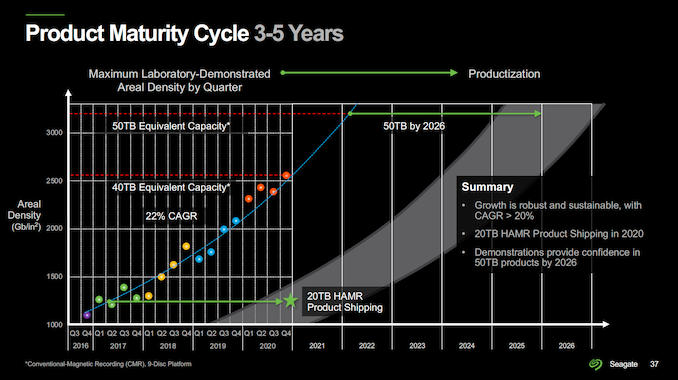
Today's 20 TB HAMR HDD uses nine 2.22-TB platters featuring an areal density of around 1.3 Tb/inch2. To build a nine-platter 40 TB hard drive, the company needs HAMR media featuring an areal density of approximately 2.6 Tb Tb/inch2. Back in 2018~2019 the company already achieved a 2.381 Tb/inch2 areal density in spinstand testing in its lab and recently it actually managed to hit 2.6 Tb/inch2 in the lab, so the company knows how to build media for 40 TB HDDs. However to build a complete product, it will still need to develop the suitable head, drive controller, and other electronics for its 40 TB drive, which will take several years.
Bit Patterned Media (BPM) to enable HDDs up to 120 TB
In general, Seagate projects HAMR technology to continue scaling for years to come without cardinal changes. The company expects HAMR and nanogranular media based on glass substrates and featuring iron platinum alloy (FePt) magnetic films to scale to 4 ~ 6 Tb/inch2 in areal density. This should enable hard drives of up to 90 TB in capacity.
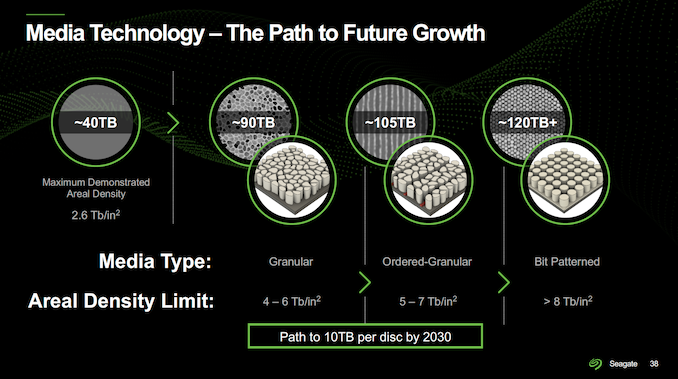
In a bid to hit something like 105 TB, Seagate expects to use ordered-granular media with 5 ~ 7 Tb/inch2 areal density. To go further, the world's largest HDD manufacturer plans to use 'fully' bit patterned media (BPM) with an 8 Tb/inch2 areal density or higher. All new types of media will still require some sort of assisted magnetic recording, so HAMR will stay with us in one form or another for years to come.
"We see an opportunity to scale this design space with granular media into the range of 4 Tb/inch2 to 6 Tb/inch2, at which point we plan to add patterning in one dimension through the use of ordered grain media," said Morris. "This, we expect to be a steppingstone in media to open up the range of 5 Tb/inch2 to 7 Tb/inch2. Then we will transition to fully patterned media to open up densities to 8 Tb/inch2 and even higher. With the areal density CAGR just introduced, we have a path to 10TB per disk by 2030. This then represents our outlook for technology limits over the next 10 to 15 years."
Performance Improvements Included
Increasing the capacity of hard drives is extremely important to keep them competitive with solid-state drives, but in a bid to stay relevant for operators of cloud datacenters, HDDs also need to improve sequential and random performance.
Sequential performance of hard drives surges along with areal density, so we see gradual HDD performance bumps every year. But as the capacity of a drive increase, the random IOPS-per-TB performance drops, which requires operators of large datacenters to mitigate this with caches to maintain their Quality-of-Service, which means additional costs.
Seagate and Western Digital have been looking to radically increase sequential and random performance of HDDs by installing more than one actuator, with multiple read/write heads into one drive. Seagate's Mach.2 technology — which embraces two actuators — can almost double IOPS-per-TB performance of a hard drive and substantially increase its sequential read/write speeds. Furthermore, with two independent actuators, Seagate can almost halve the time it needs to test one drive before shipping, which reduces its manufacturing costs. The advantage of two actuators will become even more significant as HDD makers transit to platforms with more platters.
"A notable benefit to dual actuator technology standardization is that it drastically cuts down test time, and therefore, hard drive production time is greatly reduced," said Fochtman. "This is a benefit we're looking forward to recognizing on the cost side of the business."
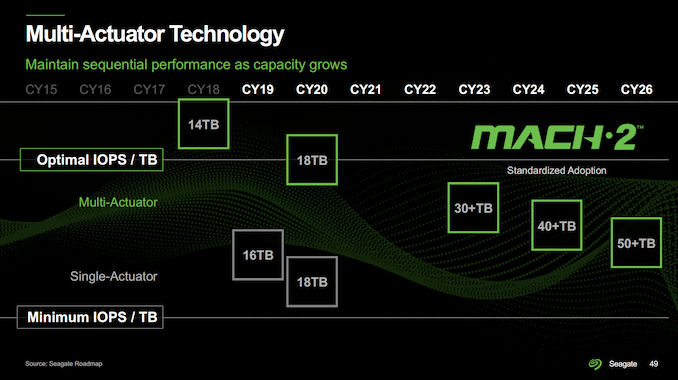
There are about a dozen of customers that already use Seagate's Mach.2 PMR-based HDDs in their datacenters, although these drives do not have a commercial branding. Eventually, the company plans to make Mach.2 HDDs available to other clients, yet the company does not disclose when this is set to happen. However, the manufacturer is poised to use its Mach.2 technology more broadly once its drives hit capacities of above 30 TB, as drives with one actuator will not have sufficient performance, and a one-actuator design would increase the total cost of ownership.
"Although Mach.2 is ramped and being used now, it is also really still in a technology-staging mode," said Fochtman. "When we reach capacity points above 30 terabytes, it will become a standard feature in many large data center environments."
HDD TCO to Remain Low
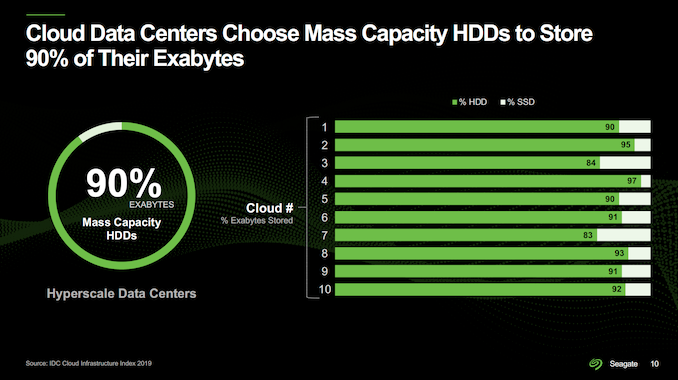
Speaking of TCO, Seagate is confident that hard drives will remain cost-effective storage devices for many years to come. Seagate believes that 3D NAND will not beat HDDs in terms of per-GB cost any time soon and TCO of hard drives will remain at competitive levels. Right now, 90% of data stored by cloud datacenters is stored on HDDs and Seagate expects this to continue.
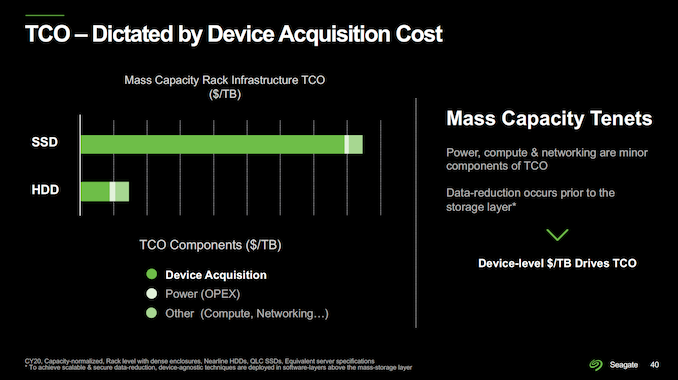
"We believe that the TCO for hard disk drives and SSDs will stay approximately in equilibrium," said Morris. "Both SSDs and hard disk drives will continue to improve their value proposition, and storage demand for both will continue to grow. They are both critical enabling technologies for the growing datasphere, and their synergistic relationship in the data center infrastructure will persist."
Related Reading
- Toshiba Unveils World's First FC-MAMR HDD: 18 TB, Helium Filled
- Western Digital Expands 18TB Purple Surveillance Storage
- Toshiba to Expand HDD Production: 20 TB & 10-Platter Drives Coming
- Demand for HDD Storage Booming: 240 EB Shipped in Q3 2019
- Seagate: 18 TB HDD Due in First Half 2020, 20 TB Drive to Ship in Late 2020
- Western Digital 20 TB HDD: Crazy Capacity for Cold Storage
- Toshiba's HDD Tech Roadmap: A Mix of SMR, MAMR, TDMR, and HAMR

