
|
|


Пишет AnandTech (![[info]](http://lj.rossia.org/img/syndicated.gif) syn_anandtech) syn_anandtech)@ 2012-10-29 15:30:00 |
 |
|
 |
|
|
|
|
|
|
 |
|
 |


Back in February, Intel released its first SandForce based SSD: the Intel SSD 520. Since then Intel's SSD lineup has evolved. A couple of months after the 520's release, Intel released a more mainstream focused SSD 330. Architecturally the SSD 520 and 330 were the same as both used SandForce's SF-2281 controller and IMFT's MLC NAND. The only real differences were limited to NAND quality and firmware; the 520 used higher binned NAND with more P/E cycles and its firmware was also more finely tuned to provide better performance.
While SandForce has yet to release its 3rd generation SSD controller, there's still room to upgrade one major component of these drives: the NAND itself. IMFT (Intel's and Micron's NAND joint-venture) has been fairly open about its next generation NAND products, including the transition to 20nm MLC NAND. Moving to smaller process geometries decreases die area, which increases the number of NAND die that can be produced on a single wafer (or increases the capacity that can reliably be produced on a single die). The move to 20nm is a necessary part of continuing to drive SSD costs down, although as with all process transitions we won't see those cost savings initially (die savings are offset by higher costs of a new process at the start).
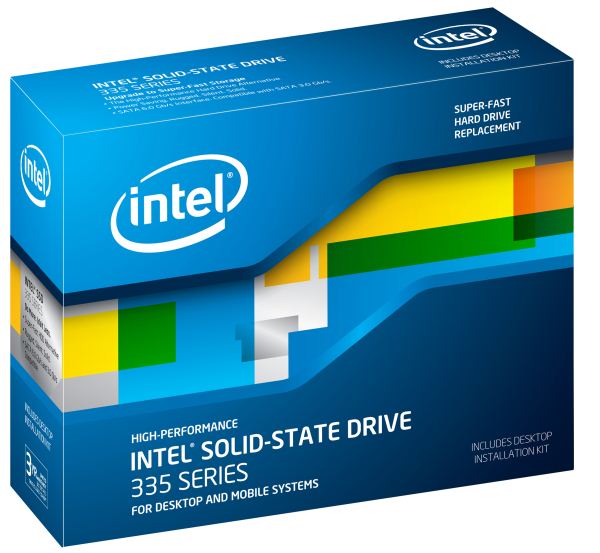
IMFT's 20nm announcement happened back in April 2011. At the time, we were told not to expect to see 64Gb 20nm MLC NAND devices in SSDs until the middle of 2012. Now, a year and a half later, production is finally at a stage where volume and yields are both high enough for an actual product release. The vehicle for introduction? Intel's SSD 335.

 |  |


