Add this feed to your friends list for news aggregation, or view this feed's syndication information.
LJ.Rossia.org makes no claim to the content supplied through this journal account. Articles are retrieved via a public feed supplied by the site for this purpose.
| Wednesday, December 24th, 2014 | |
| LJ.Rossia.org makes no claim to the content supplied through this journal account. Articles are retrieved via a public feed supplied by the site for this purpose. | |
| 5:25 pm | Christmas with Margaret Thatcher If you're finding your Christmas stressful or unpleasant, keep in mind that it could be worse; you could, for example, have been at one of Margaret Thatcher's Prime Ministerial Christmas parties, which were, if her friend and advisor Lord Bell's memoir is anything to go by, reputedly uniquely joyless affairs, more like an ordeal to be endured to prove one's loyalty than anything meant to be enjoyed: “There were absolutely no presents — presents were not part of Christmas as far as Margaret was concerned. No Christmas jumpers. No open-necked shirts. No charades. No games. And no children — apart from the year we had our three-month-old baby Daisy and she was too small to leave at home, so I had to get special permission to take her with us.” The day was centred around the Queen’s speech at 2.45, when complete silence was required. “You couldn’t speak, you couldn’t cough,” writes Bell. “You couldn’t move. You had to get yourself into a reasonably comfortable position because if you shifted once it had started she’d give you a killer death stare.After everyone had stood to attention through the Queen's speech, the Iron Lady's renowned sense of compassion would usually emerge: “She would never actually criticise the Queen, but she would usually make a sarcastic comment at the end — 'Oh dear, she’s going to feel sorry for the poor again.'” |
| Sunday, December 21st, 2014 | |
| LJ.Rossia.org makes no claim to the content supplied through this journal account. Articles are retrieved via a public feed supplied by the site for this purpose. | |
| 11:13 pm | Tulpamancy
Youth subcultures, as many middle-aged former teenagers have lamented, aren't what they used to be. In the old days, you see, you had to make your choices (or have them made for you by which class you had been born into and, in the light of this, what would get you camaraderie and what would get you beaten up), and stick with them. You were either a Mod or a Rocker, or a Punk or a Grebo or something, and you would live (and, in some cases, die) by that; you wore the uniform, listened to the music, and had little tolerance for other subcultures; if you fancied the other side's soundtrack or sartorial style, you would keep it to yourself, or else. But kids these days (kids these days...!) treat subculture as if it were a supermarket, or perhaps Noel Fielding's dressing-up chest; the entire back-catalogue of young cool is there for the taking and the mashing up, with elements going in and out of style by the season, to be worn as accessories. Beyond the dress-up element, the default becomes a globalised homogenate, a sort of international Brooklyn/Berlin/Harajuku of skinny jeans/ But once one goes beyond the idea of a subculture as being based around fashion or music, things sometimes start to get much more unusual. One case in point is the Tulpamancy subculture; which, could be summed up in three words as “extreme imaginary friends”. Tulpamancers essentially invent imaginary friends and believe in them really hard, to the point of voluntarily inducing dissociative personalities in themselves, hiving off one part of their minds to be another, autonomous, personality, with whom they can interact. The term tulpa is a Tibetan word meaning a sentient being created from pure thought; the practice crossed over from Tibetan mysticism into the Western occult/esoteric fringe in the early 20th century (the explorer Alexandra David-Neel was one pioneer), but the modern version owes more to internet “geek” subcultures; it started amongst Bronies (dudes who are really into My Little Pony, which may be either a repudiation of gender dichotomies or the ontological equivalent of a frat-bro panty raid on the idea of “girl”, or both or neither), before spreading to other branches of “geek” culture/fandom. Tulpas remained the preserve of occultists until 2009, when the subject appeared on the discussion boards of 4chan. A few anonymous members started to experiment with creating tulpas. Things snowballed in 2012 when adult fans of My Little Pony: Friendship is Magic – known as “bronies” to anyone who's been near a computer for the past three years – caught on. They created a new forum on Reddit and crafted tulpas based on their favourite characters from the show. In the cross-pollinating fields of the internet, it wasn’t long before tulpamancy also started to attract manga and fantasy fans. “My tulpa is called Jasmine,” says Ele. “She’s a human but from an alternative reality where she can do magic. I created her a dozen years ago for a fantasy series I write and then made her into a tulpa.”Being a fandom subculture, there are, of course, plenty of drawings (of varying levels of execution) depicting tulpas; one probably would not be too surprised to find that many look either like anime bishonen with fox ears/snouts and/or variants on Hot Topic Darkling. Because, of course, that's what one's magical alter-ego looks like in fandom. As for the creation of, and interaction with, these tulpas, an entire methodology has evolved for bringing them into being, and interacting with them. Tulpamancers don't so much consciously think up their spirit critters, but rather mentally create a wonderland, imagine themselves in it, and let them come up from their subconscious and meet them. From then on, they practice imagining them, allowing them to become clearer, and ultimately being able to hallucinate them in everyday reality, which is where the fun starts: While voice is the most common way tulpas communicate with their hosts, tulpamancers can learn to stroke their tulpa’s fur, feel their breath on their neck and even experience sexual contact. Tulpas soon get curious about their host’s body; some want to experience life as a “meatperson”. Indulgent hosts then use a practice called “switching”, which allows their tulpa to possess their body while they watch from the ringside of consciousness.This, of course, sounds a lot like disassociative personality disorder, something not generally seen as desirable. Some tulpamancers, though, have turned that claim on its head; rather than dissociation being a disorder, or a symptom of one, what if it could be a way of self-medicating or coping What if, in other words, the optimal number of personalities in one body is, in some circumstance, greater than 1? Koomer’s case is rare, and for Veissière “schizophrenia [could be understood as]… an incapacitating example of ‘involuntary Tulpas’", therefore, by forming positive relationships with their symptoms, sufferers can start to recover. It's an idea shared by the “Hearing Voices Movement”, who challenge the medical models of schizophrenia and suggest that pathologisation aggravates symptoms. “My schizophrenia manifested itself by having many thoughts and ideas all conflicting and shouting at me,” says Logan, who wanted his last name withheld. “Turning them into tulpas gave those thoughts a face and allowed them to be sorted out in a way that made sense.” |
| Tuesday, December 16th, 2014 | |
| LJ.Rossia.org makes no claim to the content supplied through this journal account. Articles are retrieved via a public feed supplied by the site for this purpose. | |
| 1:32 am | The Sydney siege Yesterday, Australia awoke to the news of what appeared to be a terrorist siege in the heart of Sydney. ISIS terrorists had, it seemed, seized the Lindt Café, a retail outlet of the Swiss confectioner and popular tourist destination, and were holding a few dozen terrified hostages, some of them forced to hold up a black flag with Arabic writing in the window. International terror had struck home, and the Lucky Country's innocence was shattered forever, the hard dawn of the Long Siege breaking with the pitiless intensity of the Arabian desert sun. Rumours abounded: of sweeping police raids across Lakemba, a desperate hunt for the unspoken nightmare scenario this could be merely a distraction for, the diabolical plans of an invisible enemy who is everywhere, his dagger at our throats like Hassan ibn Sabbah's fabled Assassins. Awful videos of beheadings, lit by familiar Australian sunlight, were sure to follow. But then the fog cleared and it turned out to be somewhat less than that. Far from an organised, tightly disciplined cell of fanatical death cultists, it turned out to be a lone individual with a gun and possibly an (actual or fake) bomb. The fearsome ISIS flag, that latterday skull and crossbones breathlessly reported by the Murdoch tabloids, turned out to be just a piece of black cloth with the fundamental tenet of Islam, the statement “there is no God but God and Mohammed is his prophet”, written on it, much as it is on the Saudi Arabian flag; superficially scarily terroristic-looking, though on deeper inspection, more like lazy set decoration than anything else. The siege dragged on through the day and well into the night; neither the gunman nor his accomplices managing to get their message into the media, partly because he didn't actually have any accomplices. Then, in the wee hours of the morning, the police stormed the building; at the end, three people were dead; two hostages and the gunman. Details soon emerged of the gunman; it turned out that he had been a somewhat odd character, to say the least. An Iranian refugee who had sought asylum in 1996 from the country's Islamist dictatorship, who had imprisoned his family. At various times, he had styled himself as an Islamic cleric, peace activist and spiritual healer. It is in the course of the last vocation that he seems to have incurred several dozen charges of sexual and indecent assault. Whilst doing this, he was apparently also writing harrassing letters to the relatives of Australian troops killed in Afghanistan. Furthermore, last year, he had been charged as an accessory to the murder of his ex-wife. As he awaited trial for this, he maintained his calling as an Islamic cleric, despite finding little support in the actual Islamic community, and seemingly came to the conclusion that the community was wrong, corrupted by the “new religion” of moderate Islam. His one-man ministry became increasingly radical; a week before his last stand, he posted to his website, pledging his allegiance to ISIS, the aforementioned mob of bloodthirsty attention-seekers in Syria. It is not clear whether anybody in this group acknowledged his pledge. There's a lot in that profile, and it's not flattering; it's like he's one part Martin Bryant (the mass murderer from Hobart) to one part Fred Phelps (also a self-proclaimed religious leader whose currency was hate); a deeply unpleasant troll and attention-seeking psychopath who escalated into possible murder. (It is not clear whether he killed either his ex-wife or any of the hostages, though it doesn't look good in either case.) Of course, a key difference between him and Bryant, Phelps, and indeed, any of the high school shooters of the past few decades, is that he was not “white”. Much has been said about white privilege recently, especially in the wake of the killings of black youths in the US whose only crime was that it could not be exhaustively proven that they weren't about to pull a gun. White privilege, it seems, can involve being able to behave normally, rather than erring on the side of proving one's unthreateningness, or avoiding situations where a jury might rule that Whitey could have reasonably considered one to have been a clear and present danger. And now, it seems, it can also involve being judged on one's individual circumstances, rather than as an exemplar of a homogeneous, pathological Other, should one flip out and kill some people. One can imagine how this would have been reported had someone from a white, Anglo-Celtic background been the perpetrator: a bingo-card of adverse circumstances (“broken home”, “failed marriage“, perhaps substance abuse and several possible types of mental illness); in and out of trouble with the law, the antihero turns to religion in an attempt to get his shit together, going from church to megachurch, but finding them all to be shallow phonies and leaving them behind, treading his own lonely, uncompromising, and increasingly narrow path. Then, one day, he snaps, and—surprise, surprise—nobody blames Hillsong. The hostage taker was clearly an unstable individual. He was also an unstable individual from an Islamic cultural background, and his pathology was coloured by Islam, by the currents of extremism on the fringe of Islam and the perception of the Islamic Jihadist as the bête noire of our age. However, it looks like that was all he was; there seems to be no evidence of him having been part of a larger terrorist conspiracy, or even having had much of a plan. Some are referring to him as “self-radicalised”, which is another word only used for the scary Other; one is less likely to see this word attached to, say, the failed pick-up artist in California who decided to shoot some women to avenge having been repeatedly rejected, despite the fact that, in both cases, we are witnessing a similar phenomenon: toxic resentment buttressed by ideology. It's just that, in one case, the ideology is not from here. Fortunately, with the exception of Murdoch's Daily Telegraph screaming terrorism, Australia has mostly kept its head on. Mindful of the posibility of a Cronulla-style backlash against conspicuously Muslim-looking bystanders, offered their solidarity on Twitter, with the #illridewithyou hashtag soon trending worldwide. Meanwhile, civic leaders have rejected the Murdochs' claim that everything had changed forever, framing the siege as an isolated incident. One does wonder how long this will hold; whether this will be used as justification to pass a new tranche of sweeping police powers or restrictions on civil liberties. (The government's planned mandatory data retention regime is coming up for debate soon, and could be rubber-stamped through parliament, even though it would have had no effect on this case, with the perpetrator having been very well known to police.) |
| Sunday, December 14th, 2014 | |
| LJ.Rossia.org makes no claim to the content supplied through this journal account. Articles are retrieved via a public feed supplied by the site for this purpose. | |
| 11:21 pm | 59.9% More despatches from the London property boom: The transformation of the London borough of Hackney from a byword for crime, squalor and perhaps an edgy bohemianism to high social status proceeds apace; the ultra-fashionable borough is now the most unaffordable place to rent in the UK, with the average Hackney resident's rent being 59.9% of their income. Meanwhile, the values of houses in Hackney have risen just under £100,000 in the past year, meaning that the average house in Hackney earns considerably more than the average resident. The same publication, Dalstonist (a journal for the residents of the eponymous hip'n'happening playground of moneyed, well-connected twentysomethings) also has an editorial arguing that it makes no sense to blame the hipsters for rising rents, the main gist being that the typical “hipster” is a young web designer/barista/media worker/miscellaneous “creative” renting a sharehouse and on the cusp of being evicted to Walthamstow or Tottenham or somewhere to make room for finance professionals whose musical and sartorial tastes are more Patrick Bateman than Nathan Barley. Oh, and that there is no such thing as a hipster. The people who get priced out are those who rent their homes on the private market – who have to shell out more than half their salaries just for somewhere to live. That might be people who’ve lived in Hackney for decades, like the residents of the New Era estate. Or it could be those who moved here more recently. The people who earn too much to qualify for social housing but not enough to buy a house. You know; graphic designers, jewellery makers, photographers, baristas. Hipsters, basically.Of course, that is assuming without question that the typical “hipster” is renting, rather than having bought a flat just off London Fields with the help of their parents, or been given one for their 18th birthday. This is a somewhat questionable assumption, partly because the contemporary hipster lifestyle (itself gentrified from the days of math-rock nerds and fashion refuseniks dressed in cheaply acquired, ironically repurposed thrift-shop clothes) is not a cheap one to maintain; if one really is paying 60% of their rent to a landlord, how much does that leave for the vintage trainers, imported Japanese denim, meticulously crafted hairstyles and other sartorial items that are de rigeur to be seen in? This malaise is not confined to the hipsterised East; everywhere across London, the city is being reorganised for (often absentee) investors over residents; a case in point is the demolition of the historic Earl's Court exhibition centre, and its replacement with expensive luxury apartments: The new apartments will – like those in the big new developments and Nine Elms – be aimed at the pockets of investors and speculators, people with deep pockets who have taken advantage of stagnant interest rates to buy up property and then charge eye-watering rents for them. It’s hard to blame them, as economic policy seems designed purely to over inflate London’s property market, but the damage is considerable. Because not only are they building identikit apartments in areas nobody that actually needs housing can afford, they are in the process annihilating anything that could be seen as fun – pub, music venues, sports grounds as well as historic structures like Earls Court. It’s a depressing, dismal outcome that offers the worst of all possible worlds. It’s also entirely typical of the current state of London: could you possibly imagine a scheme as imaginative and as exciting and beneficial for the public as the conversion of Tate Modern happening today? Not a chance. It would be flattened and replaced by luxury glass apartments. What do we get instead? A bloody Garden Bridge, stupid cable car and shopping centres.One could perhaps blame Boris Johnson for that; or possibly the Tories' (and to a lesser extent, neo-Blairite Labour's) faith in trickle-down economics, to the extent that it's seen as an unquestionable credo that, if one serves those at the top (wealthy investors, property speculators, developers), overall prosperity will rise, and the little people will be served, as amply as they deserve, by the shower of crumbs from the high tables. The corollary to this is, of course, that anybody who questions it is really advocating a return to the Leninist five-year plan and the kolkhoz, the legacy of blood-stained failure and collective misery that bears the name “socialism”. Also, new statistics reveal that people in their thirties are leaving London in droves, moving instead to regional cities where they can afford to do things other than pay a landlord for the privilege of having an address in a prestigious city; Birmingham seems to be the main recipient of disaffected ex-Londoners, followed by places like Manchester and Bristol. (Presumably Brighton counts as part of greater London.) There is still a net influx of twentysomethings; presumably, while one has youthful vigour, relatively few bulky physical possessions and no dependent family (or, indeed, not yet a long-term relationship), the benefits of living within staggering distance of the venues of a social life outweighs the costs of funnelling 60% of one's pay into a speculator's pocket for a shoebox-sized room. The attrition rate seems to be high, with few holding on into their 30s; presumably once they've got a partner, enough stuff to make sharehousing impractical, an aversion to working long hours and/or a tolerance to mephedrone, London no longer holds its charms, and they drop out, making room for more fresh meat, possibly of a more affluent nature. Meanwhile, the precincts associated with the young and with-it move further out (keep an eye on Newham/Waltham Forest/Barking being dubbed the “New Hackney” in media puff-pieces any day now), being pushed out by the centrifugal forces of hypergentrification. It may be that, in the fullness of time, they will be expelled beyond the M25, and London will, as prophesied by Alex Proud, become a city of rich old people, like Paris or Zurich. (But that can't happen, you say, because London is intrinsically, timelessly cool, before citing Britpop/Carnaby Street/Shoreditch or similar? Zurich, one must remember, was vibrant and edgy once; the Dadaist Cabaret Voltaire (the establishment after which the Sheffield electro-industrial band named themselves) was there in 1919.) |
| Tuesday, December 9th, 2014 | |
| LJ.Rossia.org makes no claim to the content supplied through this journal account. Articles are retrieved via a public feed supplied by the site for this purpose. | |
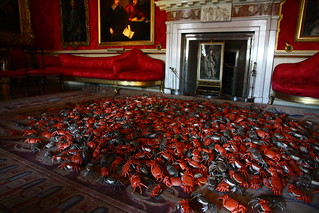
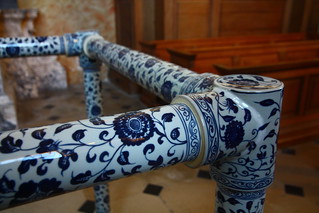
| 11:59 pm | Ai Weiwei at Blenheim Palace This past weekend, I finally managed to make my way down to Blenheim Palace to see the Ai Weiwei exhibition; it was well worth going. Ai Weiwei is best known these days as a thorn in the side of the Chinese government; having used his artistic practice to critique everything from China's territorial claims to corrupt officials' complicity in shoddy building practices (which claimed the lives of dozens of pupils when a school collapsed in an earthquake), and other provocations (such as the destruction of Ming vases in the name of questioning the nature of authenticity) have not won him any sympathy among China's more conservative politicians. For this reason, he remains under house arrest. Nonetheless, although he has not been allowed to travel abroad, he has managed to be intimately involved in the planning of his exhibitions outside China, working with the curators over the internet. Ai's artistic practice as we know it took form in New York, where he lived for a decade from 1983. His earlier works were in the readymade tradition pioneered by Marcel Duchamp; found or mass-manufactured objects repurposed into statements (such as two raincoats buttoned together on a coat rack, a statement on the AIDS epidemic of the 1980s). His move back to China in 1993, and engagement with the rapidly changing society in the age of Deng Xiaoping's market reforms, provided a cornucopia of new subjects for his work.
Ai's conceptual tactics have often been subtly mischievous;
In the Blenheim Palace show, the subtlety is taken to a new level. Whereas in an ordinary exhibition, one might expect the exhibits to be arrayed in a well-defined space, its boundaries defining what is and isn't in the exhibition, this exhibition does us no such favours; instead, Ai's works are placed in various locations in the palace, juxtaposed with the rich assortment of its existing contents. In the bedchamber where Winston Churchill was born, a pair of handcuffs carved out of wood lies, perhaps suggestively, on the quilt; on the ornately papered wall behind the bed, a simple wooden frame containing a human profile made from a bent coathanger takes its place next to landscapes painted in oils. Two Ming vases emblazoned with the word “Caonima”, in the style of the Coca-Cola logo, stand on an antique marble table.
Alas, this exhibition closes this coming Saturday, so those wishing to see it must hurry. However, it should be worth it. |
| Sunday, November 30th, 2014 | |
| LJ.Rossia.org makes no claim to the content supplied through this journal account. Articles are retrieved via a public feed supplied by the site for this purpose. | |
| 8:12 pm | Buying beer in Sweden and Finland Recently, I was in Sweden and Finland, catching up with some friends and seeing Loney Dear playing with the Norrbotens Kammarorkester in Lapland (which was amazingly good). At one point, I got invited to a party in the north of Sweden, with the advice that I may want to bring my own beer. Which is what found me in the aisles of the Systembolaget in Luleå.
The Systembolaget, for those unfamiliar with this word, is the state-run liquor shop chain in Sweden. The government there has a monopoly on the sale of strong beer and all kinds of spirits, and does so through a chain of shops throughout the country. Only those shops may sell any beer stronger than about Anyway, when I went to buy some beer, I was expecting the experience to have a sort of bland paternalism to it, deliberately avoiding any attempt to encourage people to actually drink. Having read about changes in Sweden between the 1970s and now in Andrew Brown's Fishing In Utopia, I understood that the Systembolaget used to look somewhere between a bookmaker's shop and the waiting room of a methadone clinic, being essentially a paternalistic harm-minimisation programme for those who, for whatever reason, insist on drinking, allowing—but never encouraging—them to do so, but had evolved into more of a standard consumer experience. Nonetheless, I was expecting it to look a bit more minimal and, well, institutional; perhaps like a Lidl or Costco for alcohol, with dim fluorescent lighting and pallets of bottles labelled with only their name and alcohol content in a monospaced laser-printed typeface. Instead, I found something that would put a North London Waitrose to shame; a brightly lit space with huge selection of beers, ales, craft beers and microbrews; each one had, on its shelf, a label enumerating food combinations it goes well with. (The only section where it lagged behind was the gin section, which was somewhat small and mostly limited to mainstream British gins; I suspect Sweden isn't really a gin-drinking country.) Later, when I recounted my Systembolaget experience, and the way it differed from my expectations, to a friend, they mentioned that the staff are also experts in beer and spirits, and able to make knowledgeable recommendations. The implication of this was that, if you live in Sweden and know your way around beer, the government will want to employ you to recommend ales and pilsners to consumers. Now I'm far from a hard Thatcherite or a believer in the Libertarian ideal of the minimal “nightwatchman state”, though, having grown up in an English-speaking world, in which the free-market principles articulated by Milton Friedman are as accepted as Copernican astronomy (even by those who regard themselves as being on The Left; while there, for example, are calls for the renationalisation of Britain's railways, for example, few would call for the Upper Crust franchises to be kicked out of stations and replaced with the return of the much-maligned British Rail sandwich), this strikes me as rather exotic and a little weird. Beer-recommending civil servants? A state liquor monopoly simultaneously discouraging and encouraging drinking? The State not as Orwellian Big Brother but as the older brother you go to to ask about how to enjoy vodka? We truly are no longer in the neoliberal Anglosphere. Almost all the Nordic countries have state liquor monopolies. The exception is Denmark, but the other Scandinavians regard the Danes, with one foot on the mainland, to be halfway towards being the wild, laissez-faire Germans (and yes, that is a stereotype in Scandinavia; while in the English-speaking world, the Germans may be stereotyped (at best) as precise, humorless BMW engineers and/or Kraftwerkian Mensch-Maschinen, in Scandinavia, they're an unruly people who drink in the street and don't tax their beer.) In Iceland, the equivalent monopoly chain is known as Vinbuð, though there was talk a while ago about rolling back or eliminating its monopoly. The Finns are slightly more liberal, in that one can buy beer from ordinary supermarkets, where (as in Australia) it's stored in a segregated section which (as I discovered shortly after disembarking from a Helsinki-bound train at 8:30) is physically closed off at 9pm. For stronger spirits, one has to go to the state liquor shop, which is called, with characteristic Finnish lack of euphemism, Alko. And it's not only the quasi-socialist Jante Law societies of the Nordic world that do this; in the US, the conservatively Mormon, and staunchly Republican, state of Utah also has a state liquor monopoly. I imagine that their shop shelves probably look less enticing than those at the Systembolaget. |
| Monday, November 3rd, 2014 | |
| LJ.Rossia.org makes no claim to the content supplied through this journal account. Articles are retrieved via a public feed supplied by the site for this purpose. | |
| 1:57 am | Han/hon/hen In most European languages, personal pronouns (like she, him and such) are gendered; it can be somewhat awkward to talk about a person in English without disclosing whether they are (or are regarded as) male or female. (In some other languages, such as French and German, not disclosing the gender of a person is even harder, with words for “friend”, “coworker” and various occupations being gendered as well.) This means that speakers of those languages have to classify a person as male or female before discussing them, or otherwise go a lot of squirming. Interestingly, this is by no means a universal property of human language; in fact, 57% of the world's languages do not have gendered pronouns. As the genders of people one deals with become less significant in most aspects of everyday life (discriminating between male and female coworkers could land one in legal trouble, and in the age of remote working, there's the possibility that you might not know whether your accountant or the freelance coder three timezones away you're working with is a man or a woman), this will eventually change, and gender-neutral personal pronouns will arise out of necessity. In English, what will probably happen is that “they” will lose its connotations of plurality, and become the natural way of referring to someone when their gender is irrelevant or unknown. Not everybody is happy to wait for hypothetical linguistic evolution to take its course; in Sweden, unsurprisingly, they have taken things into their own hands, and introduced a gender-neutral personal pronoun into society, through the child-care system; a generation of Swedish toddlers is growing up used to referring to people as hen (he/she), rather than han (he) or hon (she). The pronoun hen was introduced in two Stockholm nurseries in 2012, and now has spread out of the nursery system to several newspapers; also, it has crossed the border, with reports of it being adopted into Norwegian. (There's a good chance that it'll make it into Danish as well, as it, Swedish and Norwegian are very closely related, and partly mutually intelligible.) Not everybody is pleased with this, one can imagine the usual conservative talking heads, from Moscow to Wichita, fulminating darkly about “political correctness gone mad”, “Cultural Marxism” and/or “gender” (a term used pejoratively in reactionary circles to mean any deviation from traditional gender roles), in between making disparaging wisecracks involving meatballs and flat-packed furniture. And outside of that, there are some who think that teaching children to refer to people not as men or women but as persons is, for some reason, cruel: But, argues Dr David Eberhard, a leading Swedish psychiatrist, a new pronoun won’t change the fact that the vast majority of people identify either as men or women. “Whatever you choose to call people, the biological differences between men and women remain,” he notes. “We should treat each other with respect, but ignoring biological gender differences is crazy. Making us identical won’t create more equality.” Boys should be allowed to play with dolls – and girls with cars – if they like to, says Eberhard, who coined the expression “safety addiction” in reference to Sweden’s health and safety system. “But”, he adds, “calling them hen instead of him or her? That’s child cruelty.” I don't get why this is child cruelty; it's not that a user of a gender-neutral language would not learn to notice that some people are male and some female. The key difference is that this demotes gender from a defining attribute of a person—you are essentially a man or a woman—and turns it into a secondary attribute—you are a person, with a number of attributes (hair colour, height, maleness/femaleness). In a society which is (for the most part) no longer divided into hard-and-fast gender roles, should we still be using language which evolved when the two genders were organised hierarchically, with members of one all but owning members of the other as chattels? That's to say nothing of situations where one does not know the gender of a person (the aforementioned remote coworker), or indeed the rise of non-human personlike entities (with corporate personhood on the books in the US, it seems rude to refer to corporations as “it”, while they are obviously neither a “he” nor a “she”; add to that the prospect of artificial intelligences, which might not always be issued with gendered personae). Finally, one area where a non-gendered personal pronoun would reap immediate, if somewhat trivial, benefits is that of the naming of pets, especially ones hard to sex by superficial inspection (“Nice boa constrictor; what's his name?” “Her name's Ermintrude.”) |
| Tuesday, October 21st, 2014 | |
| LJ.Rossia.org makes no claim to the content supplied through this journal account. Articles are retrieved via a public feed supplied by the site for this purpose. | |
| 10:44 pm | It was time... Gough Whitlam, that lion of the Australian Left who shook up a sleepy, conservative backwater and made it, for at least a few decades, into a modern, forward-looking player on the world stage, died yesterday, aged 98. Whitlam's brief period in office began in 1972, when the Australian Labor Party which he led won a landslide victory, sweeping aside the arse-end of a decades-long period of conservative rule and cruising into office under the slogan “It's Time”, soundtracked by a groovy rock'n'roll jingle. Whitlam and his party didn't slow down; soon they had abolished conscription and the death penalty, brought in free university education, state-funded health care and arts funding, recognised Aboriginal land rights, passed the world's first no-fault divorce laws, replaced God Save The Queen as the national anthem with Advance Australia Fair (which, though admittedly somewhat turgid-sounding, was at least ours), among other accomplishments. He also had a gift for witty retorts. This spring was not to last, though, and after winning an early election with a narrower majority in 1974, Whitlam failed to get a budget passed and was dismissed by the Governor-General in 1975, in what some of the more paranoid types still say was a CIA coup. (Interestingly, the Pinochet-figure brought in to replace him, Malcolm Fraser, has, over the past few decades of retirement, drifted considerably to the left of Australian politics, and was last seen endorsing a Greens candidate in the 2013 election; or perhaps he has just stood still, with the political landscape drifting rightward around him.) Whitlam's accomplishments, however, stuck; by CIA-installed right-wing dictatorship standards, the Fraser government was somewhat of a damp squib, and kept things much as they were, until the ALP's Bob Hawke took over keeping them more or less as they were. It was not until into the first term of John Howard, with his obsession with his idol Robert Menzies, the conservative patriarch of the pre-Whitlam Australia, and the lost father-knows-best arcadia of white picket fences and children who are seen and not heard that he had presided over, that it started to look like what we had thought of as the new, modern Australia was merely a thaw. Howard's successor, Tony Abbott, meanwhile, seems to look even further back; his model of Australia seems to be closer to the authoritarian penal colonies and military outposts of virtuous Empire than to the “relaxed and comfortable” 1950s, dangerously close to outbreaks of rock'n'roll, feminism, male long hair or similar degeneracy. It's not yet clear which of Whitlam's achievements will be the last to be systematically rolled back by the current government; free education is on the way out, and payments for medical appointments were floated (without any economic planning to make a case for them, but that's not the point; it's the principle that counts, and, to a certain mindset, the very existence of free health care is fundamentally immoral). If Abbott succeeds in unlocking the Strong Wartime Prime Minister achievement, conscription might be on the agenda (though, then again, Australia may take a hint from the US, and eschew outright conscription in favour of, say, making university funding or unemployment benefits contingent on military service). The death penalty may be harder to sell to the public (Australia's regional neighbours threatening our bogans with it should they bring some weed with them tends to do that), but if anyone in Canberra would push for it, the current lot probably would. As for restoring God Save The Queen as the national anthem, for a government that brought back Imperial honours, that would be, if anything, too obvious. |
| Tuesday, October 7th, 2014 | |
| LJ.Rossia.org makes no claim to the content supplied through this journal account. Articles are retrieved via a public feed supplied by the site for this purpose. | |
| 5:50 pm | Where women don't ride bikes A new study has looked at why fewer women cycle in the United States than in the Netherlands, and found that it has less to do with an often stated Anglophone culture of cycling-as-macho-extreme-sport, and more to do with women in the US being too busy with domestic chores for the luxury of cycling: In short, despite years of progress, American women’s lives are still disproportionately filled with driving children around, getting groceries, and doing other household chores – housework that doesn’t lend itself easily to two-wheeled transportation. It turns out that women may be more likely to bike in the Netherlands because Dutch culture is giving them more time to do so.Of course, the fact that in the Netherlands it is possible to carry anything from a toddler to a bag of groceries on a bakfiets is one factor, as is the fact that Dutch children are more likely to go to school by themselves (often on their own bicycles) than be dropped off in Mom's SUV; a lot of it, though, comes down to more traditional gender-based divisions of labour in the US and that hyperefficient Anglocapitalist labour market leaving those who get stuck doing the chores (i.e., usually the women) with less time for the luxury of cycling: Dutch women can use bikes to get around because they are less pressed for time than American women, in three fundamental ways. First, thanks to family-friendly labour policies like flexitime and paternity leave, Dutch families divide childcare responsibilities much more evenly than American families. Second, work weeks in the Netherlands are shorter. One in three Dutch men and most Dutch women work part-time, and workers of either gender work fewer hours than Americans.Of course, this is a piece in the Grauniad; were it in, say, the Financial Times or the Economist, it may well say that large numbers of female cyclists is a symptom of an inefficient economy, one which fails to extract the maximum amount of productivity from its labour force; indeed, one can imagine a report from a neoliberal think tank claiming that women on bicycles are a drag on productivity. |
| Monday, September 29th, 2014 | |
| LJ.Rossia.org makes no claim to the content supplied through this journal account. Articles are retrieved via a public feed supplied by the site for this purpose. | |
| 5:50 pm | Cookies, caches and cows There's a piece in The Economist on the challenges of translating technological terms into minority languages, particularly ones whose speakers have lived traditional agricultural/fishing lifestyles until very recently, where the vocabulary tends to be more concrete and specific, and finding local words for new technical concepts requires some uses of poetic metaphor: Ibrahima Sarr, a Senegalese coder, led the translation of Firefox into Fulah, which is spoken by 20m people from Senegal to Nigeria. “Crash” became hookii (a cow falling over but not dying); “timeout” became a honaama (your fish has got away). “Aspect ratio” became jeendondiral, a rebuke from elders when a fishing net is wrongly woven. In Malawi’s Chichewa language, which has 10m speakers, “cached pages” became mfutso wa tsamba, or bits of leftover food. The windowless houses of the 440,000 speakers of Zapotec, a family of indigenous languages in Mexico, meant that computer “windows” became “eyes”.Of course, the other alternative would be just to use loanwords from English (or some other common vehicular language), possibly adapting them to the grammar of the language, which apparently ends up happening informally a lot of the time. |
LJ.Rossia.org makes no claim to the content supplied through this journal account. Articles are retrieved via a public feed supplied by the site for this purpose.