Add this feed to your friends list for news aggregation, or view this feed's syndication information.
LJ.Rossia.org makes no claim to the content supplied through this journal account. Articles are retrieved via a public feed supplied by the site for this purpose.
| Monday, December 2nd, 2013 | |
| LJ.Rossia.org makes no claim to the content supplied through this journal account. Articles are retrieved via a public feed supplied by the site for this purpose. | |
| 7:02 pm | High-speed rail makes unlikely progress High-speed rail projects may be facing controversy in the UK and US, but have gotten a boost in two unlikely countries. Iceland, a country with no railways, is looking at building a high-speed railway line from Keflavík airport to downtown Reykjavík; the line would either be conventional high-speed rail or a maglev line (as seen in China), would cost ISK100bn (about £500 million), and would get passengers from the international airport in Keflavík to the BSÍ bus terminal in 20 minutes or less.
Meanwhile in Australia, the conservative federal government has committed to safeguarding a corridor for a Melbourne-Canberra-Sydney-Brisbane high-speed railway network, and raising the priority of the project (first proposed by the Gillard Labor government, after pressure from the Greens). This was somewhat surprising, given the Australian Right's hostility to public transport, passenger rail , infrastructure spending (it's socialism, you know, and if there's demand, the free market will step in; besides, the money would be better spent on lowering petrol taxes or given to voters in marginal seats to buy plasma-screen TVs with) and anything with a whiff of the latte-sipping inner-city trendy-left's concern about carbon emissions (because, you know, once you acknowledge the problem, it's only a matter of time before ordinary Aussie battlers may find their 4WDs and cheap flights to Bali taken away from them, and before long their diet of rump steaks is replaced with organic lentil stew and they find themselves being lectured on checking their privilege by a woman named Rainbow with dreadlocks and a nose ring or something). Anyway, credit where credit's due; I tentatively laud the Abbott government's maturity at being able to get behind something like that, despite its un-Australian pedigree and the massive concession in the culture war it must have been, though, of course, the proof will be in what actually gets built and when. |
| Tuesday, November 5th, 2013 | |
| LJ.Rossia.org makes no claim to the content supplied through this journal account. Articles are retrieved via a public feed supplied by the site for this purpose. | |
| 12:03 pm | Kraftwerk in Reykjavík I am back in Reykjavík, Iceland; this time, I came here on occasion of Kraftwerk playing a gig at the Harpa concert hall. Having missed out on tickets to see them in New York (when they played tantalisingly close to the Chickfactor 20th anniversary gigs) and London and also having enjoyed visiting Iceland before, when the Reykjavík gig was announced, I jumped at the opportunity. Harpa is the new concert hall built recently in Reykjavík; it was part of a grand project started at the height of Iceland's finance bubble; when the economic crisis hit, construction was suspended, but then the government decided to finance the concert hall, which ended up opening in 2011. It is a spectacular-looking building, and a great place to see concerts in. On the way into the hall, we were handed a pair of 3D glasses each; these were not the red/blue ones, but some other type, with sheets of slightly tinted transparent plastic (possibly polarising filters?). Soon, a vocoded/synthesised voice announced “Damen und Herren, Ladies and Gentlemen...”, and the curtain fell slowly to the ground revealing the four members (Ralf and the three “new” guys, who've only been in the band for some 20 years), in grid-patterned body suits, standing in position behind black consoles whose edges were lit like vector graphics; behind them, a screen showed video projections. They started the first song: “The Robots”; the consoles' vector edges glowed red, and the screen was filled with Kraftwerk's computer-rendered doppelgängers, moving robotically, their extending arms projecting out of the screen. Then they went into “Metropolis”, with the consoles highlighted in white, and the screen filled with a geometric, monochromatic metropolis, a city of high buildings through which the camera glided, like a Bauhaus/Le Corbusier ideal of modernity. 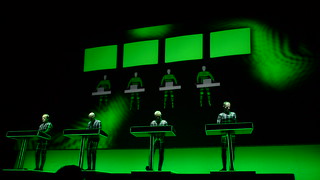 The rest of the set followed, with the visuals working spectacularly well; undulating three-dimensional sheets of green pixelised digits (Numbers), the vaguely Russian Constructivist-inspired 3D forms in The Man-Machine, Volkswagens and 1970s-vintage Mercedes motoring through green landscapes in a somewhat abbreviated Autobahn (the video of which seemed to be set in the era when it was written; other than the cars on the roads, these days, a road trip through Germany without seeing a single wind turbine would be unlikely), text and graphics floating above Tour de France footage, 3D-rendered musical notes gliding from the screen into the faces of the audience and more.
Several songs (like The Model/Das Modell, Neon Lights/Neonlicht and Die Mensch-Maschine) were performed with both English and German verses. Some of the songs were updated for today; Radioactivity mentioned Fukushima, and the Spacelab video zoomed in on Iceland, to applause from the audience, before ending with a flying saucer landing somewhere near Düsseldorf. Computer World had a particular resonance in the wake of recent events, but has not, to date, been rewritten to mention the NSA.
The rest of the set followed, with the visuals working spectacularly well; undulating three-dimensional sheets of green pixelised digits (Numbers), the vaguely Russian Constructivist-inspired 3D forms in The Man-Machine, Volkswagens and 1970s-vintage Mercedes motoring through green landscapes in a somewhat abbreviated Autobahn (the video of which seemed to be set in the era when it was written; other than the cars on the roads, these days, a road trip through Germany without seeing a single wind turbine would be unlikely), text and graphics floating above Tour de France footage, 3D-rendered musical notes gliding from the screen into the faces of the audience and more.
Several songs (like The Model/Das Modell, Neon Lights/Neonlicht and Die Mensch-Maschine) were performed with both English and German verses. Some of the songs were updated for today; Radioactivity mentioned Fukushima, and the Spacelab video zoomed in on Iceland, to applause from the audience, before ending with a flying saucer landing somewhere near Düsseldorf. Computer World had a particular resonance in the wake of recent events, but has not, to date, been rewritten to mention the NSA.
It was the first time I had seen Kraftwerk since their Melbourne show in 2003 (which didn't have 3D graphics, though otherwise was spectacular), and was well worth the trip. say what you will, Kraftwerk know how to create a spectacle, a multi-sensory celebration of a (slightly obsolescent) modernity. (There are some photos here, though of course the 3D effects just show up as noise in them.) |
| Saturday, November 2nd, 2013 | |
| LJ.Rossia.org makes no claim to the content supplied through this journal account. Articles are retrieved via a public feed supplied by the site for this purpose. | |
| 9:03 am | Science inspires, so don't let your art rule your head Tim Minchin has written a short piece about the (culturally conditioned) tendency to equate being “creative” and free-spirited with a woolly, mystical anti-rationalism, in an introduction to a collection of Australian science writing: I've only been to Portland once, but it's a great city - its population a paragon of liberalism and artiness, sporting more tattoos than you could point a regretful laser at, and boasting perhaps a higher collective dye-to-hair ratio than anywhere on earth. Great music, great art, wonderful coffee … it's my kind of town. Except, the residents recently voted - for the fourth time since the 1950s - against adding fluoride to the water supply. It's as if a mermaid on one's lower back is an impediment to sensible interpretation of data, or perhaps unkempt pink hair acts as a sort of dream catcher for conspiracy theories. As an artist who gets aroused by statistics - among other things - I find this deeply troubling. But I reckon (and yes, I only reckon: one of many advantages of being a not-Nobel-laureate is that I may hypothesise with relative impunity) that the apparent relationship between artiness and anti-science is a result of people acting out cultural expectations and subscribing to popular myths, rather than a genuine division of personality type or intellect. I wonder if artists identify themselves as spiritual (whatever that means) and reject materialism for the same reason they might wear a beret or take up smoking: it's an adherence to a perceived stereotype, rather than a fundamental feature of the creative brain. Science is not the opposite of art, nor the opposite of spirituality - whatever that is - and you don't have to deny scientific knowledge in order to make beautiful things. On the contrary, great science writing is the art of communicating that ''awe of understanding'', so that we readers can revel in the beauty of a deeper knowledge of our world. |
| Friday, November 1st, 2013 | |
| LJ.Rossia.org makes no claim to the content supplied through this journal account. Articles are retrieved via a public feed supplied by the site for this purpose. | |
| 11:43 pm | The Trojan clothes iron What happens when computers get cheap enough to be effectively disposable? Well, criminals start embedding penetration servers into dumb electrical goods like irons and kettles. The low-powered machines (which could consist of an exotic embedded OS running on something tiny, though these days, it could just as easily be a Linux distribution running on an ARM or MIPS system-on-a-chip, kitted out with standard Linux hax0r tools) then attempt to connect to any machines within range by WiFi or Bluetooth, find security holes and take them over. Which is the sort of thing you'd expect first-tier intelligence agencies to attempt to try on high-value targets, but it now seems to be in the hands of ordinary criminals. |
| Wednesday, October 30th, 2013 | |
| LJ.Rossia.org makes no claim to the content supplied through this journal account. Articles are retrieved via a public feed supplied by the site for this purpose. | |
| 1:14 pm | The Cynictrain Manifesto The Cynictrain Manifesto, an updating of the techno-boosterist Cluetrain Manifesto fourteen years on: 1. Markets are conversations in much the same way as the school bully picking on the disabled queer kid is friendship. (via davidgerard) ¶ 0 Share |
| Friday, October 25th, 2013 | |
| LJ.Rossia.org makes no claim to the content supplied through this journal account. Articles are retrieved via a public feed supplied by the site for this purpose. | |
| 2:41 pm | We Need You Now (More Than Ever) / Pegasus Dance We Need You Now (More Than Ever), a video by Danish artists Wooloo, in the style of We Are The World-style celebrity charity ensemble records, sardonically imploring the Catholic Church to dip into its vast wealth and bail Europe's economies out: This video is being screened until 17 November at the Göteborg International Biennial for Contemporary Art at Röda Sten in Gothenburg, along with Chilean artist Fernando Sanchez Castillo's Pegasus Dance, an amorous ballet for two riot-control water-cannon trucks set to a languid waltz: |
| Sunday, October 20th, 2013 | |
| LJ.Rossia.org makes no claim to the content supplied through this journal account. Articles are retrieved via a public feed supplied by the site for this purpose. | |
| 12:56 pm | The social function of monumental kitsch From an article by Nick Cohen about the current Frieze art fair in London, an observation on the function that huge, tacky-looking artworks fulfil in validating their wealthy purchasers' status; Cohen's argument is that monumental kitsch is a peacock-tail-like mechanism for (expensively and unforgeably) demonstrating that one has status putting one beyond the criticism of one's inferiors: The justifications from the critics whom galleries always seem able to find to dignify the shallow add to the melancholy spectacle. They talk of challenging our notions of what is art as Duchamp did with his urinal. They forget that Duchamp offered his "fountain" to a New York show in 1917 – almost a century ago, and his once radical ideas are now so established they will soon deserve a telegram from the Queen. "Everything changes except the avant garde," said Paul Valéry. Yet Frieze shows one change, although not a change for the better. Collectors do not buy Koons because he challenges their definitions of art. The ever-popular explanation that the nouveau riche have no taste strikes me as equally false – there's no reason why the nouveau riche should have better or worse taste than anyone else. What a buyer of a giant kitten or a gargantuan fried egg says to those who view his purchase is this: "I know you think that I am a stupid rich man who has wasted a fortune on trash. But because I am rich you won't say so and your silence is the best sign I have of my status. I can be wasteful and crass and ridiculous and you dare not confront me, whatever I do." |
| Saturday, October 19th, 2013 | |
| LJ.Rossia.org makes no claim to the content supplied through this journal account. Articles are retrieved via a public feed supplied by the site for this purpose. | |
| 8:33 pm | Book of Lamentations Book of Lamentations, a review of the American Psychological Association's Diagnostic and Statistical Manual of Mental Disorders, Fifth Edition as a work of dystopian literature: If the novel has an overbearing literary influence, it’s undoubtedly Jorge Luis Borges. The American Psychiatric Association takes his technique of lifting quotes from or writing faux-serious reviews for entirely imagined books and pushes it to the limit: Here, we have an entire book, something that purports to be a kind of encyclopedia of madness, a Library of Babel for the mind, containing everything that can possibly be wrong with a human being. Perhaps as an attempt to ward off the uncommitted reader, the novel begins with a lengthy account of the system of classifications used – one with an obvious debt to the Borgesian Celestial Emporium of Benevolent Knowledge, in which animals are exhaustively classified according to such sets as “those belonging to the Emperor,” “those that, at a distance, resemble flies,” and “those that are included in this classification.” As you read, you slowly grow aware that the book’s real object of fascination isn’t the various sicknesses described in its pages, but the sickness inherent in their arrangement... This mad project is clearly something that its authors are fixated on to a somewhat unreasonable extent. In a retrospectively predictable ironic twist, this precise tendency is outlined in the book itself. The entry for obsessive-compulsive disorder with poor insight describes this taxonomical obsession in deadpan tones: “repetitive behavior, the goal of which is […] to prevent some dreaded event or situation.” Our narrator seems to believe that by compiling an exhaustive list of everything that might go askew in the human mind, this wrong state might somehow be overcome or averted. References to compulsive behavior throughout the book repeatedly refer to the “fear of dirt in someone with an obsession about contamination.” The tragic clincher comes when we’re told, “the individual does not recognize that the obsessions or compulsions are excessive or unreasonable.” This mad project is so overwhelming that its originator can’t even tell that they’ve subsumed themselves within its matrix. We’re dealing with a truly unreliable narrator here, not one that misleads us about the course of events (the narrator is compulsive, they do have poor insight), but one whose entire conceptual framework is radically off-kilter. As such, the entire story is a portrait of the narrator’s own particular madness. With this realization, DSM-5 starts to enter the realm of the properly dystopian. |
| Friday, October 18th, 2013 | |
| LJ.Rossia.org makes no claim to the content supplied through this journal account. Articles are retrieved via a public feed supplied by the site for this purpose. | |
| 3:48 pm | PuzzleScript Toy of the day: PuzzleScript is an online (browser-based) game development environment capable of making a wide variety of turn-based puzzle games, ranging from Sokoban (of which the Hello World-esque example one starts with is a variant) to more sophisticated and/or eccentric games. Games are written in a functional/declarative notation, consisting of rules; for example, the Sokoban rule allowing the player to push a crate is written as: [ > Player | Crate ] -> [ > Player | > Crate ] Graphics are deliberately kept simple, with elements being 5x5 blocks of coloured pixels, giving the game a vaguely Atari 2600-esque aesthetic. There is a gallery of games made by users, each with an animated GIF representing the game's play. Some examples: Games were originally turn-based (in that nothing happened except when the player moved), but there is an experimental real-time feature. Somebody has already coded a (semi-functional and not particularly exciting) Pac-Man clone. |
| Wednesday, October 9th, 2013 | |
| LJ.Rossia.org makes no claim to the content supplied through this journal account. Articles are retrieved via a public feed supplied by the site for this purpose. | |
| 5:23 pm | The squeezed bankers of London Spare a thought for the latest victims of London's runaway property prices, mid-ranking bankers on less than £500,000 a year, who find themselves priced out of the property market, whose super-prime properties are being snapped up by global oligarchs, with the merely rich moving further downmarket: “People here are already carrying a lot more debt than they used to,” said a senior manager at one European investment bank in London – again speaking off the record. “A member of my team has a £750k mortgage on his house, which is a huge burden for him. A lot of other mid-ranking people here can’t afford to live in Zone 1 and are having to move out to Zones 3 or 4 – which is difficult when you’re a VP-level banker working very long hours.” As for other Londoners, the crunch point reportedly comes when bankers hit their early 30s and start having families. Until then, they’re happy to live in house shares or small flats conveniently situated in central London. Once they have families, they need larger London properties and aspire to pay private school fees. “People suddenly see their disposable income pared down considerably,” said the European banker. Traditionally, the head of HR says senior bankers would have moved their wives and children into the cheaper British countryside and bought themselves a weekday pied-a-terre so that they could live in London. Now, however, she suggests that bankers’ wives often have jobs of their own and want to continue living in the city – even if they’re not contributing much towards the cost of doing so.However, help is at hand. The Tory-LibDem government has just announced a “help-to-buy” scheme which seems tailored to the squeezed bankers' very needs. Let it never be said that the Tories don't have the welfare of the little people at heart... |
| Friday, October 4th, 2013 | |
| LJ.Rossia.org makes no claim to the content supplied through this journal account. Articles are retrieved via a public feed supplied by the site for this purpose. | |
| 8:50 am | Almost a Taliban-esque society Actor Gabriel Byrne talks about the 1950s Ireland he grew up in, and in which a new BBC crime series he stars in is set: Both Byrne and Banville, who are old friends, grew up in this Ireland of the 1950s. "It was almost a Taliban-esque society," says the actor, recalling an incident when his mother, who was walking down the street with him while pushing a pram, stepped off the pavement into the road to make way for a priest. "That's how much power they had. Now all the rocks have been lifted and all the maggots have crawled out. The Catholic Church is a tyrannical, evil institution, there's no doubt about it – anti-woman, anti-homosexual, anti-love, anti-condom, totally elitist."The series, Quirke, is to air on the BBC “later this autumn”, and looks like it could be interesting. |
| Wednesday, October 2nd, 2013 | |
| LJ.Rossia.org makes no claim to the content supplied through this journal account. Articles are retrieved via a public feed supplied by the site for this purpose. | |
| 12:45 pm | 71 years of jetlag Spain is looking at changing its time zone. While its longitude is close to Britain's, Spain shares with the rest of western and central Europe the condition of being one hour ahead of Greenwich Mean Time. This state of affairs originated during World War 2, when the dictator Franco unilaterally changed Spain's timezone to match that of Germany, in solidarity with the Nazi regime; what the iron fist of fascism put in place, inertia kept in place, leading to a national case of jetlag: "Because of a great historical error, in Spain we eat at 2pm, and we don't have dinner until 9pm, but according to the position of the sun, we eat at the same time as the rest of Europe: 1pm and 8pm," explained Professor Nuria Chinchilla, director of the International Centre for Work and Family at the IESE Business School. "We are living with 71 years of jet-lag, and it's unsustainable. Another thing that needs to change is late-night prime-time TV, said Buqueras. "In England, the largest TV audience is at 7 or 8pm, but in Spain, it's 10pm. Because at 8pm in Spain, barely 50% of the population is at home, and you have to wait until 10pm to find that number of people at home, thus guaranteeing the viewing figures needed for prime time. Sometimes football matches don't kick off until 11pm!" he said. All of this means people go to bed far later than they should and get less sleep than they need. Studies suggest Spaniards sleep an hour less than the rest of Europe, which means more accidents at work, less efficiency, and more children missing school. Additionally they work longer hours than their German and British counterparts, but are much less efficient.Any change to Spain's time zone is likely to also result in an end (or at least a great reduction) to the traditional siesta, the midday break for a long lunch and a nap. |
| Tuesday, October 1st, 2013 | |
| LJ.Rossia.org makes no claim to the content supplied through this journal account. Articles are retrieved via a public feed supplied by the site for this purpose. | |
| 9:32 pm | Hacking the hard drive Jeroen of Spritesmods (who previously built a miniature arcade machine out of a Raspberry Pi) has an interesting piece on the possibilities of hacking the controllers in hard drives; most hard drives these days contain embedded ARM-based systems, often with reasonably powerful processors. (One WD hard drive had two ARM Feroceon cores, similar to ones used in network-attached storage appliances.) It is possible to reprogram the firmware in hard drive controllers, which has a number of defensive, offensive and other applications, from silently patching system files to insert exploits to detecting attempts at drive imaging (such as by police, customs officials or spies) and returning corrupted or falsified data. (I wonder whether algorithmically generating a FAT32 filesystem, empty except for one file named GOATSE.JPG, would be feasible within the memory footprint.) Also, given that broken hard drives with perfectly functional controllers are literally free (they're legally electronic waste that costs money to dispose of correctly), they could possibly serve as a source of free microcontrollers for various projects, such as hobby robots or circuit-bent musical instruments (assuming that one figures out how to make them control things other than hard drives). |
| Friday, September 27th, 2013 | |
| LJ.Rossia.org makes no claim to the content supplied through this journal account. Articles are retrieved via a public feed supplied by the site for this purpose. | |
| 1:00 pm | Red-state America's man-crush Russian president Vladimir Putin, it seems, has a fan base in the US, whose membership leans conservative and admires his red-blooded, two-fisted old-world machismo with perhaps a hint of envy: There are many faux Putin fans in America—those who mock the hero worship ironically or half-ironically. But plenty of his fans are serious. Three months ago, Americans for Putin, a Facebook group, sprang up "for Americans who admire many of the policies and the leadership style of Russian President Vladimir Vladimirovich Putin" and think he "sounds better than the Republicrat establishment." The group has an eight-point policy platform calling for "a unified [American] national culture," a "firm stance against Israeli imperialism," and an opposition to the political correctness it says dominates Washington. Though that group is relatively small (167 likes as of Wednesday afternoon, ticking up every few hours), the Obama's-so-bad-Putin-almost-looks-good sentiment can be found on plenty of conservative message boards. Earlier this year, when Putin supposedly caught—and kissed—a 46-pound pike fish, posters on Free Republic, a major grassroots message board for the Right, were overwhelmingly pro-Putin: "I wonder what photoup [sic] of his vacation will the Usurper show us? Maybe clipping his fingernails I suppose or maybe hanging some curtains. Yep manly. I can't believe I'm siding with Putin," one wrote. "I have President envy," another said. "Better than our metrosexual president," said a third. One riffed that a Putin-Sarah Palin ticket would lead to a more moral United States. |
| Thursday, September 26th, 2013 | |
| LJ.Rossia.org makes no claim to the content supplied through this journal account. Articles are retrieved via a public feed supplied by the site for this purpose. | |
| 4:00 pm | No flight for you! Today's Champions of Liberty: EasyJet, the European budget airline, who moved to exercise their right to decide with whom a free corporation does business by refusing to let a passenger who criticised them on Twitter board. (The criticism had to do with EasyJet staff being less than helpful with advice concerning rail connections after an evening flight was delayed, but, hey, absolute personal responsibility and all that.) Unfortunately for EasyJet, the passenger turned out to be a law professor, and was aware of yet-to-be-repealed regulations tying the hands of wealth-creators, and thus they were forced to allow him to board the flight he had paid for. |
| Wednesday, September 25th, 2013 | |
| LJ.Rossia.org makes no claim to the content supplied through this journal account. Articles are retrieved via a public feed supplied by the site for this purpose. | |
| 12:42 pm | Down and out in Thailand / on Bitcoin Apparently Thailand these days is full of homeless European/American blokes; mostly middle-aged, and often alcoholic, they spend their time drinking and sleeping rough on beaches, which is considerably less idyllic than the big-rock-candy-mountain image the description evokes: Steve, who declined to give his surname over fears that his long-expired visa could land him in jail, said he has spent two years sleeping rough on Jomtien Beach, a 90-minute drive from Bangkok. “I’ve gone 14 days without food before. I lived off just tea and coffee,” he told The Independent. After his marriage of 33 years ended seven years ago, Steve began regular visits to Thailand before setting up permanently in Pattaya, a seaside resort with a sleazy reputation close to Jomtien. “I’m a bit of a sexaholic,” he says, also admitting a fondness for alcohol. Paul Garrigan, a long-time Thai resident, isn’t surprised by the growing problem of homeless and stranded Westerners. The 44-year-old spent five years “drinking himself to death” in Thailand before giving up alcohol in 2006 and writing a book called Dead Drunk about his ordeal and the expats who have fallen on hard times in the country. He told The Independent: “I’d been living in Saudi Arabia where I worked a nurse but I’ve been an alcoholic since my teens and, after a holiday to Thailand in 2001, I decided I may as well drink myself to death on a beautiful island in Thailand. Like many people I taught English at a school but spent much of my time on islands such as Ko Samui where I could start drinking early in the morning at not be judged.Meanwhile in the US, some homeless people are apparently surviving on Bitcoin; spending their days in public libraries earning the coins by doing vaguely sketchy online work (watching videos to bump up YouTube counters is mentioned; perhaps armies of the destitute to solve CAPTCHAs, artisanally hand-spam blog comments or otherwise laboriously defeat anti-bot countermeasures could make economic sense in today's climate too) and then cashing out through gift card services. Meanwhile, homelessness charities are embracing Bitcoin: Meanwhile, Sean’s Outpost has opened something it calls BitHOC, the Bitcoin Homeless Outreach Center, a 1200-square-foot facility that doubles as a storage space and homeless shelter. The lease – and some of the food it houses — is paid in bitcoins through a service called Coinbase. For gas and other supplies, Sean’s Outpost taps Gyft, the giftcard app Jesse Angle and his friends use to purchase pizza.(I suspect that the photo of the homeless man “mining Bitcoins” on the park bench on his laptop is mislabelled; wouldn't all the easily minable Bitcoins have been tapped out, with the computational power required to mine any further Bitcoins essentially amount to already having thousands of dollars of high-end graphics cards lying around and using them to heat your house, rather than something one could do with an old battery-operated laptop on a park bench?) |
| Saturday, September 21st, 2013 | |
| LJ.Rossia.org makes no claim to the content supplied through this journal account. Articles are retrieved via a public feed supplied by the site for this purpose. | |
| 8:26 pm | Germany 2013: the minor parties
Tomorrow, Germany goes to the polls, to elect its federal parliament, the Bundestag. The Bundestag is proportional, with members being elected using a complicated voting system, and the government is always a coalition of several parties. And there are many parties; as well as the ones in the press (the centre-right Christian Democrats, the centre-left Social Democrats, the neoliberal Free Democrats, the Greens (founded by none other than Joseph Beuys), the Left (a coalition of Eastern ex-Communists and Western leftists too radical for the SDP), the Pirate Party (who don't seem to be doing too well) and the just-different-enough-from-the-Nazis-to-b In the German electoral system (unlike, to choose an example at random, the Australian senate), a party needs at least 5% of the vote to get seats in the Bundestag; as such, it's unlikely that any of these minor parties, which typically get less than 1% in elections, will get up. |
| Friday, September 20th, 2013 | |
| LJ.Rossia.org makes no claim to the content supplied through this journal account. Articles are retrieved via a public feed supplied by the site for this purpose. | |
| 5:10 pm | Edward C++hands Edward C++hands, or an essay by Bartosz Milewski on why C++ is harmful to progress: I’ve been looking for a good analogy of what programming in C++ feels like and I remembered this 1990 Tim Burton movie, Edward Scissorhands. Having scissors for hands in not all that bad. Edward has many talents: he can, for instance, create stunning dog hairdos. I often have these kinds of thoughts after attending C++ conferences: this time it was Going Native 2013. The previous year, the excitement was all about the shiny new C++11 Standard. This year it was more of a reality check. Don’t get me wrong — there were many stunning dog hairdos on display (I mean C++ code that was elegant and simple) but the bulk of the conference was about how to avoid mutilation and how to deliver first aid in case of accidental amputation.The gist of the article is that, because of backward compatibility requirements with C (also known as “high-level assembly language”), C++ is a deathtrap, with numerous potential pitfalls and even more schemes to mitigate them, each with its own flaws and shortcomings: The C++ lore is that you should avoid naked pointers, avoid arrays, avoid delete. So the remedy for the lameness of malloc is operator new, which is also broken because it returns a dangerous pointer and pointers are bad. We all know (and have scars on our faces to prove it) that you should use the Standard Library containers and smart pointers whenever possible. Oh, and use value semantics for passing things around. No wait! Value semantics comes with a performance penalty because of excessive copying. So what about shared_ptr and vectors of shared_ptr? But that adds the overhead of reference counting! No, here’s a new idea: move semantics and rvalue references.Milewski's solution is to move to a functional language like Haskell, or if you can't, write your C++ code as if it were in Haskell: Of course, you might recognize all these pro-concurrency and parallelism features as functional programming — immutability and pure functions in particular. At the risk of sounding repetitive: Haskell is way ahead of the curve with respect to parallelism, including GPU programming. That was the reason I so easily converted to Haskell after years of evangelizing good programming practices in C++. Every programmer who’s serious about concurrency and parallelism should learn enough Haskell to understand how it deals with it. There is an excellent book by Simon Marlow, Parallel and Concurrent Programming in Haskell. After you read it, you will either start using functional techniques in your C++ programming, or realize what an impedance mismatch there is between parallel programming and an imperative language, and you will switch to Haskell. |
| Thursday, September 19th, 2013 | |
| LJ.Rossia.org makes no claim to the content supplied through this journal account. Articles are retrieved via a public feed supplied by the site for this purpose. | |
| 7:28 pm | The Danube / alternative Germany The Financial Times' blog section, of all places, has an interesting travelogue of the southeastern Danube, the ancient dividing line between central Europe and the Balkans/the West and the East/Catholicism and Orthodoxy/Christendom and the Ottoman Empire: A Roman bridge linking what is now Romania with Bulgaria collapsed in the fourth century and from then until another was built 1954, there was no crossing. This summer saw the opening of only the second link between the countries across the Danube, a 2km, €245m bridge between Vidin in Bulgaria and the Romanian city of Calafat. Engineers working on the project, now grandly christened the New Europe Bridge, resorted to a third language, English, to communicate with the precision required for the millimetrical convergence of rails and highway. Our trip had begun in Bucharest, unexpectedly appealing in a melancholy way with its crumbling neoclassical buildings. The Gallic inspiration for what was once celebrated as “Little Paris” is evident in broad boulevards radiating from Place Charles de Gaulle – which our guide described as “named after the great French revolutionary” – an attribution that might have surprised the conservative general. The square was originally named Piata (meaning “marketplace”) Jianu, after local folk hero Iancu Jianu. It was renamed Piata Adolf Hitler in 1940; followed, in 1948, by Piata Generalissim IV Stalin, in honour of the country’s “liberation” by the Red Army. Just off it is the outdoor Village Museum, where traditional houses from Transylvania (complete with anti-vampire features) and other regions have been reassembled beside a lake. Chickens scratch the dirt, the property of the peasants periodically imported to lend authenticity.Meanwhile, to commemorate the upcoming German elections, the Guardian's user-contributed photo section has a gallery titled Alternative Germany, most of which is not art-squats in Berlin. |
| Wednesday, September 18th, 2013 | |
| LJ.Rossia.org makes no claim to the content supplied through this journal account. Articles are retrieved via a public feed supplied by the site for this purpose. | |
| 1:48 pm | Unsavoury enterprises Builders of Star Trek-inspired rooms recently in the news: a convicted paedophile (or, to be precise, another one, though his Star Trek-inspired flat has been in the news previously), and the US National Security Agency. |




LJ.Rossia.org makes no claim to the content supplied through this journal account. Articles are retrieved via a public feed supplied by the site for this purpose.