Add this feed to your friends list for news aggregation, or view this feed's syndication information.
LJ.Rossia.org makes no claim to the content supplied through this journal account. Articles are retrieved via a public feed supplied by the site for this purpose.
| Sunday, September 15th, 2013 | |
| LJ.Rossia.org makes no claim to the content supplied through this journal account. Articles are retrieved via a public feed supplied by the site for this purpose. | |
| 10:28 pm | Coding the Australian senate preference visualisation For what it's worth, I have written an article about the technical details of the Australian senate preference visualisation I built a few weeks ago. (TL;DR: Python/BeautifulSoup for data scraping/crunching; JavaScript/D3 for the visualisation.) |
| Wednesday, September 11th, 2013 | |
| LJ.Rossia.org makes no claim to the content supplied through this journal account. Articles are retrieved via a public feed supplied by the site for this purpose. | |
| 10:34 am | The Liberation of Chile from Socialism Speaking of the past vanquishing the future, today is the 40th anniversary of the Chilean coup which, signed off by Richard Nixon, overthrew the (democratic socialist) Allende government and established the Pinochet dictatorship, a combination of classic Franco-style Iberian fascism and radical free-market ideology (courtesy of Chicago economist Milton Friedman, whom Nixon had parachuted in; Friedman went on to far greater things; advising Ronald Reagan and becoming the father of the neoliberal economic order we live in today). The Pinochet dictatorship ruled for seventeen years and crushed dissent, real and imagined, with stunning brutality, murdering Communists, trade unionists, human-rights activists, nuns and owners of suspicious literature (for example, books of art by Picasso—he was a Communist, you know—were enough) indiscriminately. Other than the big landowners whose near-feudal grip on their vast tracts of land and the lives of the peasants who came with it had been threatened by Allende, the big winners were multinational corporations (Friedman brought in a spree of privatisations, and the regime kept labour costs low and suppressed industrial complaints) and the Catholic Church (which was given a central role in the ultra-conservative society Pinochet built). The Pinochet regime had its defenders for a long time after it fell; the most infamous was the late Margaret Thatcher, a close friend of Pinochet's who went to her grave proclaiming him to be a champion of freedom. (Either Thatcher's views or her outspokenness in them weren't widely shared at the time.) Other than that, it's mostly trolls and cranks these days, with most respectable conservatives tactfully keeping shtum (the Daily Torygraph's front page, for instance, is conspicuous in its lack of mention of this anniversary). As memory of the dictatorship's atrocities recedes into the past and witnesses die, however, we will undoubtedly see it rehabilitated by the self-styled mavericks of the Right, in the way that Spain's conservatives are rehabilitating the Franco regime, and the cult of Mussolini is enjoying renewed popularity in Italy; perhaps in ten years' time, we'll see a spate of articles by the rising stars of free-market thinktanks about the 50th anniversary of the Liberation Of Chile From Socialism. |
| Sunday, September 8th, 2013 | |
| LJ.Rossia.org makes no claim to the content supplied through this journal account. Articles are retrieved via a public feed supplied by the site for this purpose. | |
| 12:29 am | Good news, bad news The good news: The predicted collapse of the Greens, with the Tories preferencing Labor ahead of them and Rupert Murdoch declaring them a cancer to be cut out of the Australian body politic, did not happen. Adam Bandt was comfortably reëlected in the seat of Melbourne and online liberty champion Scott Ludlam might just have scraped into the last Senate place in WA (though it won't be known for weeks), despite the Wikileaks Party kicking him in the teeth in their preference card, after a clusterfuck of right-wing minor parties coalesced into a seat for the Australian Sports Party. The bad news: The Coalition won by a landslide. Tony Abbott, a reactionary religious authoritarian who believes that climate change is “crap”, is Prime Minister, on a platform that can be summed up as “we'll have none of that here”. The good news: The Coalition didn't manage to get control of the Senate, so they'll have to negotiate to have their reactionary platform passed into law. The bad news: It looks likely that the Coalition plus the Religious Right (Family First and DLP) will, together, have a majority in the Senate. The main upshot of this is that the internet censorship system that was dismissed as a “gaffe” in the election is likely to materialise as a negotiating tactic (“Mr. Abbott, your industrial relations plan is anti-family. However, we could pass it if you give us a national mandatory internet filter blocking porn, homosexuality and blasphemous content.”) The other option, of Abbott striking a deal with the sizeable Green presence in the Senate, is, of course, utterly out of the question; one does not deal with un-Australian extremists. So, yes, basically, Australia is fucked, at least to the extent that one was expecting it to be a modern, progressive country; at least for the next 3 years, probably the next 7, odds-on to be the next decade, and quite possibly however long it takes for the Greens to transmute into a party of alternative government. From now on, 2013 is pronounced “nineteen-fifty-sixtythree” in Australian English. The past has vanquished the future, and here comes a victory of shit. Inner Melbourne, which reelected Bandt and almost sent a few other Greens to Canberra to join him, is a light in the darkness; a bit like Austin, Texas, or Barcelona in Franco's Spain. And as such, it can probably expect collective punishment; one part of that will be the razing of homes and parks to build freeways for outer-suburban Liberal voters to drive their 4WDs on. (Incidentally, all federal funding for public transport is to be scrapped, because “we don't do urban rail in Australia”. Which makes perfect sense, given that global warming is a load of black-armband Marxist crap, oil will be cheap forever, and if you start getting traffic jams, you can always build more roads and widen the existing ones.) |
| Thursday, September 5th, 2013 | |
| LJ.Rossia.org makes no claim to the content supplied through this journal account. Articles are retrieved via a public feed supplied by the site for this purpose. | |
| 4:43 pm | Abbott's dystopian vision revealed As Australia enters the final 48 hours before its election, a ban on electoral advertising has now come into force across the country. And, by coincidence, the Tories (who look almost certain to form the next government) have released their full policies and costings, and it's a doozy. Out goes renewable energy funding.. On the infrastructure front, there's a distinct back-to-the-1950s theme again, with the government scrapping public-transport programmes and replacing them with a road-building spree not seen since Grandpa got his first Holden. (It's a good thing that oil will always be cheap and global warming is nothing more than a lie spread by a conspiratorial elite of jealous inner-city leftists who can't afford 4WDs because they're losers, because otherwise we'd all be screwed.) Science and education funding are being slashed as well, with the Australian Research Council budget being cut by at least $103 million, and Abbott seems to have taken a leaf out of the Canadian government's book, introducing plans to control research funding on political grounds, because of, you know, we can't have politically-correct Marxist climatologists pushing un-Australian black-armband theories such as “global warming”. Oh, and if that wasn't good enough, a proposal for an opt-out internet censorship regime (i.e., “Stop the Bytes”) have somehow made it into the proposals, meaning that Australia's nobbled 20th-century broadband will now be even more useless. (The government-in-waiting soon started claiming that that announcement was a mistake, without elaborating on this.) This, truly, is the bouquet of shit that just keeps giving. |
| Tuesday, September 3rd, 2013 | |
| LJ.Rossia.org makes no claim to the content supplied through this journal account. Articles are retrieved via a public feed supplied by the site for this purpose. | |
| 1:13 pm | Thou shalt not offend Rupert Murdoch Rupert Murdoch's star may have fallen slightly in Britain, but in Australia, it seems, he's still the boss. As the Tories coast towards victory on the back of press coverage, provided by Murdoch's near-monopoly in crucial states, that straddles the line between hagiography and fellatio, the First Mate's influence is being felt not just in what's being said but in what's not being heard: Australia's three commercial TV networks have refused to air an ad criticising the Murdoch press's election coverage, put together by progressive activist group GetUP. Whether it took phone calls from News Corp. to get the ads banned from the mainstream media, or merely the hint that the boss would be displeased, and there'd be consequences, it's clear that one does not challenge Murdoch in his fiefdom. Meanwhile, Murdoch's tabloids seem to be sitting on reviews of a satirical play about the magnate's rise to power; a minor thing, to be sure, but emblematic of the entitled arrogance of one who claims ownership of public discourse. |
| Monday, September 2nd, 2013 | |
| LJ.Rossia.org makes no claim to the content supplied through this journal account. Articles are retrieved via a public feed supplied by the site for this purpose. | |
| 1:35 pm | The death of rationality in Australian politics Barry Jones (one of the more thoughtful and forward-looking figures from the past three or so decades of politics in Australia) writes about the decline of rationality in Australian political discourse, and its replacement by knee-jerk populism and a wilful, even proud, ignorance and short-sightedness: Party spin-doctors, on both sides of politics, work on the assumption that by this stage in the election cycle about 80% of voters have already decided how they will vote, and that short of some major event (cabinet ministers charged with felony, perhaps) nothing that is said or done in the campaign will change that. The 20% who are uncommitted, profiling suggests, are neither interested nor involved in the issues, do not much care about the outcome, are largely voting because they are obliged to do it, and will make up their minds on the day – perhaps as they stand in line waiting to receive their ballots. Geoff Kitney wrote an important article for the Australian Financial Review – Vote for Abbott, and vote against politics – describing Abbott as the anti-politics politician, who puts a heavy emphasis on appealing to those (many?) reluctant voters who say: “I can’t stand politics, and don’t even pretend to understand it”. This does not just discourage debate on complex issues, it kills it. There may be even a bonus for non-involvement, to be told: “don’t feel badly about knowing so little – celebrate it”. Despite Australia’s high formal levels of literacy, politicians are increasingly dedicated to delivering three word slogans (“stop the boats!”) – now degenerating even more to the use of one word, repeated three times (“Cut! Cut! Cut!” or “Lie! Lie! Lie!”).Of course, the fact that, in many states (most notably, the more right-leaning ones like Queensland), News Corp. has an effective monopoly on the media, which it runs in a nakedly partisan fashion resembling more Cold War-era Pravda than anything in a pluralist democracy, doesn't help. The Murdoch papers are no longer reporting the news, but shaping it. They no longer claim objectivity but have become players, powerful advocates on policy issues: hostile to the science of climate change, harsh on refugees, indifferent to the environment, protective of the mining industry, trashing the record of the 43rd parliament, and promoting a dichotomy of uncritical praise and contemptuous loathing. Does it affect outcomes? I am sure that it does, and obviously advertisers think so.A recent example of this would be a moment from the current-affairs TV show Four Corners, in which a Liberal candidate said that asylum seekers increase traffic congestion in the suburbs. Speaking of (ir)rationality in Australian politics, the Rationalist Society has published its scorecard of the political parties. Both major parties fail (the Liberals by a slightly greater margin than the ALP), with only the Greens, Secular Party and Australian Sex Party getting top marks. (The Pirate Party, however, have been omitted from the survey for some reason.) |
| Sunday, September 1st, 2013 | |
| LJ.Rossia.org makes no claim to the content supplied through this journal account. Articles are retrieved via a public feed supplied by the site for this purpose. | |
| 12:32 pm | The rise of the trollitician A piece in The Quietus about the rise of the “trollitician”, a type of gleefully objectionable right-wing populist whose shtick is that the “silent majority”—middle-aged straight white men, Christians, motorists, smokers, whatever—are now being oppressed by an all-powerful alien hegemony (variously defined as “the trendy Left”, “political correctness”, “health and safety” or “Cultural Marxism”) which is denying their God-given rights as straight, affluent white men, from smoking in the pub to spanking their children to slapping the secretary's bottom when she walks past or cracking racist jokes in public: “Today, we throw off our chains. Today is the day that, finally, we can say 'no', and to mean 'no'. 'No' to speed cameras, 'no' to overgenerous maternity pay, 'no' to wheelchair ramps and to cushy holidays for juvenile delinquents! 'No' to trendy teachers and the Marxist curriculum! 'No' to new mosques and gay marriage and, especially, to gay marriage in new mosques! 'No' to endless apologising for the slave trade, and for the Empire: after all, everyone's been invaded at some point! And it was ages ago! 'No' to striking nurses and firemen, and 'no' to the union leaders who still – still, can you believe it? - have us by the balls! What's wrong with a bit of sodding common sense? Look, some of our best friends are black! If they can take a laugh and a joke, I don't know why that Owen Jones and Laurie Penny bloody can't. And we'll say 'yes', too. 'Yes' to the property ladder. 'Yes' to golf clubs, to kit cars and the neighbourhood watch! 'Yes' to new, better wedding vows: 'Do you take this fine piece of totty to be your lawfully wedded crumpet?' 'Yes' to the Royal Family – I'm not that bothered myself, but, let's face it, they bring the tourists in and older people like them. Think about it. Think about how happy they make your gran, you wouldn't want to take that away from her, would you? We'll celebrate the Best of British – Churchill and Brunel and Nelson. Dogged, determined, wouldn't take 'no' for an answer, cut through the red tape. Where's all that now? Where's tradition? Where's 'Si fueris Romae, Romano vivito more'? What do we have instead? Communism! Great idea in theory, but it'd never work in practice; people are naturally competitive – Darwin proved this, but try telling that to the schools. All the kids ever hear these days is about how everything we've done is wrong. But it's stopping now. No more, we say, no more of this nonsense. Because today, Rugby Club Land dares to do more than whisper the word, and instead shouts it out loud, proud and British – 'INDEPENDENCE'.” The altering of the dimensions of the argument is where the likes of Bloom become significant. Their work is twofold. On one hand, they consume the energies of the left through irritation: while we know what they're saying is essentially dumb and contradictory, we still feel obliged to respond (as I'm doing here). For conservatives – from the rabid right to the parish council – they serve to stoke a sense that it's the dominant sections of society (the white, the male, the heterosexual, the middle class) who are getting it in the neck. If one read nothing but the Daily Mail it would be easy enough to become convinced that Britain really was a country in which it was possible to be oppressed and persecuted for being a straight bloke with a Lexus. The new mythology states that the left are dictating the political sphere and, in doing so, hammering the "ordinary people in the rugby and cricket club." |
| Saturday, August 31st, 2013 | |
| LJ.Rossia.org makes no claim to the content supplied through this journal account. Articles are retrieved via a public feed supplied by the site for this purpose. | |
| 12:50 pm | The Meanderings of Memory Mystery The Oxford English Dictionary is appealing to the public for help with tracing down a mysterious (and possibly pornographic) 19th-century book, from which a number of quotations used in the dictionary derive. The book, Meanderings of Memory, attributed to one “Nightlark”, is dated to 1851 and cited in 51 dictionary entries for words including “couchward” and “revirginize” (“Where that cosmetic … Shall e'er revirginize that brow's abuse”), though no copies nor any evidence of it having existed have been found: Hurst was contacted; she expected to track the book down within 10 minutes. "That turned into half an hour, and I was no further along the line to solving it – I looked on Google Books, in the Oxford Dictionary of National Biography, in short I looked everywhere I could think of and couldn't come up with anything," said Hurst. "We're not usually completely floored, but this time we're stumped." The only evidence for the book's existence the OED could find was an entry in a bookseller's catalogue, which includes the description: "Written and published by a well-known connoisseur with the epigraph 'Cur potius lacrimae tibi mi Philomela placebant?'" "We naturally thought the Latin quotation would be a huge clue [but] it's not a quote from anything," said Hurst. "It means, roughly, 'why did my tears please you more, my Philomel?', and Philomela is another name for a nightingale." The book's author, meanwhile, is "Nightlark", she pointed out. |
| Monday, August 26th, 2013 | |
| LJ.Rossia.org makes no claim to the content supplied through this journal account. Articles are retrieved via a public feed supplied by the site for this purpose. | |
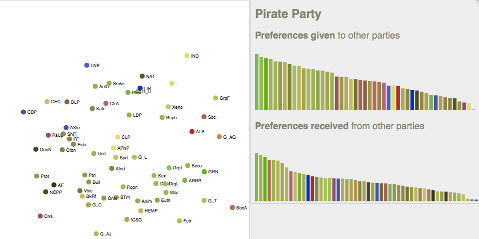
| 6:11 pm | Australian Senate Preference Navigator 2013 Continuing on from the previous post about Australian Senate how-to-vote cards and who really is preference-swapping buddies with whom, I have spent some time playing around with the D3 web-based data visualisation library, and have managed to build an interactive visualisation of the Senate voting sheets (and, more specifically, the various parties' affinities for each other). As such, I present to you: the Australian Senate Preference Navigator: It requires a reasonably modern browser (or at least one with SVG support). |
| Saturday, August 24th, 2013 | |
| LJ.Rossia.org makes no claim to the content supplied through this journal account. Articles are retrieved via a public feed supplied by the site for this purpose. | |
| 1:07 am | Australian election 2013: the how-to-vote cards As the Australian election approaches, the ABC has published the various parties' and groups' Senate how-to-vote cards, i.e., the order in which your preferences are distributed to other parties if you can't be bothered to vote below the line and, instead, tick the convenient box by the party's name at the top and hope for the best. Though whether one can be bothered to fill in the hundred or so boxes or not, knowing how each group distributes its preferences can be very telling about their philosophy and world-view and/or what deals they hammered out in lieu of having a philosophy. So, I decided to examine the numbers more closely. I wrote a small Python script to go through the parties' tickets, calculate the average preference each party gives to any other party, and then rank them in order from most- to least-preferred. Soon, patterns started showing up: clusters of left- and right-leaning groups soon made themselves evident, and parties with seemingly neutral names showed decided slants. To further simplify the classification of the parties, I decided to analyse them on where in their preferences they place a handful of marker parties: the three major parties (Labor, the Liberals and Nationals), the Greens and, as a proxy for the far right, the One Nation party (now largely ineffectual, though once seen as the bête noire of the racist fringe). Soon, a handful of fingerprints made themselves visible. Conventional thinking places these five parties on a linear scale from left to right: the urban progressive Greens on the left, followed by the ALP (managerial centrists with a trade-union socialist heritage, which can also appeal to those of a populist bent), the Liberal Party (pro-business centre-right shading into DLP-influenced social conservatism), the Nationals (a largely agrarian God-and-Country party) and, finally, One Nation. (This isn't the entirety of the Australian political spectrum; the line extends further, with Trotskyists on the far left and white supremacists and conspiracy theorists on the far right, though those parties are on the fringes.)
|
| Thursday, August 22nd, 2013 | |
| LJ.Rossia.org makes no claim to the content supplied through this journal account. Articles are retrieved via a public feed supplied by the site for this purpose. | |
| 11:19 pm | Prince Charles' architectural veto Architect Richard Rogers alleges that Prince Charles, our infallible future head of state and staunch traditionalist, has a veto over all major new developments in London and the UK, using his influence to scupper any ones which he does not approve of: Developers must square projects with the heir to the throne first to avoid the financial risk of a major undertaking being scuppered by a direct intervention from the great opponent of architectural novelty, who has succeeded in blocking several building plans. Architects given the Prince’s blessing for their incorporation of his favoured classical style would be attached to projects. Even when Charles did not succeed in getting a development dropped, his intervention could prompt expensive delays, sometimes for years.Prince Charles, of course, had Rogers' plans for the Chelsea Barracks site scuppered after petitioning one of his fellow royals, the Emir of Qatar, who was funding the project to intervene; the article enumerates a number of other instances in which the Prince saved the Realm from the spectre of architectural modernism: Called plans for skyscraper by German-born modernist Mies van der Rohe at One Poultry, London a “glass stump” which would “ruin” the skyline. Plans were replaced by a Sir James Stirling design which Charles said “looks rather like an old 1930s wireless.” Warned Cardiff Bay redevelopment against replicating London’s Docklands where warehouses were “wantonly destroyed”. Plans for an opera house in the Wales Millennium Centre area by modernist Zaha Hadid were scrapped.Clarence House, Prince Charles' office, has replied, saying that, while a charity funded by the Prince is “often approached for advice and works with local authorities”, Prince Charles has no formal planning approval powers. |
| Tuesday, August 20th, 2013 | |
| LJ.Rossia.org makes no claim to the content supplied through this journal account. Articles are retrieved via a public feed supplied by the site for this purpose. | |
| 11:57 pm | Miranda rights, British-style A few days ago, David Miranda, a Brazilian man who is the partner of investigative journalist Glenn Greenwald, was detained for nine hours under anti-terrorism legislation whilst passing through Heathrow on the way from Berlin to his home in Brazil. Metropolitan Police threatened him with imprisonment, demanded his passwords and seized all electronic devices on his person; GCHQ have been unable to crack encrypted files seized from him, which could be plans for a doomsday device. Or they might not. US conservative columnist Andrew Sullivan has compared this incident to events in Putin's Russia: In this respect, I can say this to David Cameron. Thank you for clearing the air on these matters of surveillance. You have now demonstrated beyond any reasonable doubt that these anti-terror provisions are capable of rank abuse. Unless some other facts emerge, there is really no difference in kind between you and Vladimir Putin. You have used police powers granted for anti-terrorism and deployed them to target and intimidate journalists deemed enemies of the state. You have proven that these laws can be hideously abused. Which means they must be repealed. You have broken the trust that enables any such legislation to survive in a democracy. By so doing, you have attacked British democracy itself. What on earth do you have to say for yourself? And were you, in any way, encouraged by the US administration to do such a thing?The Whitehouse "says" "it" "played" "no" "role" "in" the detention, though acknowledged that it was briefed on Miranda's presence on the plane and on the detention, as was PM David Cameron. Which suggests that, unless one makes the extraordinary mental gymnastics of extending the definition of “terrorism” to leaking information embarrassing national security agencies, this was a naked act of intimidation against a journalist by targeting his family, of the sort practiced in China and Iran. Meanwhile, it emerged that, a month earlier, officers of the security services raided the headquarters of the Guardian and forced staff to destroy hard drives and computers used to store the NSA revelations. Copies apparently exist abroad, for the time being, with Guardian staff working on the case being based in the New York office. I wonder how long until the Guardian relocates its editorial headquarters to a location that is not a pervasive security state, selling the shiny new building they have at Kings Place (though perhaps keeping a floor as a local bureau and/or for writing whimsical middle-class humour columns for the Saturday supplement) and using part of the undoubtedly hefty profit to buy a block in, say, downtown Reykjavík? Also, Groklaw founder Pamela Jones has shut the site down, on account of the environment of pervasive surveillance, and is going into internal exile off the internet: One function of privacy is to provide a safe space away from terror or other assaultive experiences. When you remove a person's ability to sequester herself, or intimate information about herself, you make her extremely vulnerable.... The totalitarian state watches everyone, but keeps its own plans secret. Privacy is seen as dangerous because it enhances resistance. Constantly spying and then confronting people with what are often petty transgressions is a way of maintaining social control and unnerving and disempowering opposition.... And even when one shakes real pursuers, it is often hard to rid oneself of the feeling of being watched -- which is why surveillance is an extremely powerful way to control people. The mind's tendency to still feel observed when alone... can be inhibiting. ... Feeling watched, but not knowing for sure, nor knowing if, when, or how the hostile surveyor may strike, people often become fearful, constricted, and distracted. My personal decision is to get off of the Internet to the degree it's possible. I'm just an ordinary person. But I really know, after all my research and some serious thinking things through, that I can't stay online personally without losing my humanness, now that I know that ensuring privacy online is impossible. I find myself unable to write. I've always been a private person. That's why I never wanted to be a celebrity and why I fought hard to maintain both my privacy and yours.And here's Charlie Stross' take, in which he connects the British security state to David Cameron's mandatory anti-porn internet filter plans: The spooks are not stupid. There are two ways they can respond to this in a manner consistent with their current objectives. They can try to shut down the press — a distinct possibility within the UK, but still incredibly dangerous — or they can shut down the open internet, in order to stop the information leakage over that channel and, more ambitiously, to stop the public reading undesirable news.I think they're going for the latter option, although I doubt they can make it stick. Let me walk you through the early stages of what I think is going to happen. If you can tap data from the major search engines, how hard is it to insert search results into their output? Easy, it turns out. As easy as falling off a log. Google and Facebook are both advertising businesses. Twitter's trying to become one. Amazon and Ebay both rent space at the top of their search results to vendors who pay more money or offer more profits. Advertising is the keyword. All the NSA needs, in addition to the current information gathering capability, is the ability to inject spurious search results that submerge whatever nugget the user might be hunting for in a sea of irrelevant sewage. Imagine hunting for "Snowden" on Google and, instead of finding The New York Times or The Guardian's in-depth coverage, finding page after page of links to spam blogs. |
| Saturday, August 17th, 2013 | |
| LJ.Rossia.org makes no claim to the content supplied through this journal account. Articles are retrieved via a public feed supplied by the site for this purpose. | |
| 11:47 pm | The Murdochian Vice Rupert Murdoch, the patriarch of the Right in the English-speaking world over the past few decades, has bought 5% of VICE, the hipster magazine/record label/documentary producer: Fox, which was spun off from News Corp earlier this year, confirmed the $70m (£45m) deal, which marks the latest stage in the evolution of Vice from an off-beat Canadian magazine into a global brand frequently dubbed the hipsters' bible.One does wonder what Murdoch's motivation is: is this a purely business decision, that of the last of the old broadcast-age newspapermen seeing his original world's time running out and trying to break into the new paradigm, either from scratch (the ill-fated Daily iPad magazine) or by buying his way in (MySpace, and now VICE)? Or is it Murdoch, the quintessential right-wing ideological warrior, responding to a different shift—namely, the political Right's electoral and opinion-forming base being set to shrink as the scared old people eventually die and their ranks aren't replenished by younger people who aren't sufficiently scared of gays, boats, gays on boats, atheism, socialism, uppity sheilas or brown people to pick up on watching FOX News or agreeing wholeheartedly with the Rush Limbaughs and Andrew Bolts of this world that everything's going to hell. (And if they agree that everything's going to hell, they'd be more likely to pin the cause on being neoliberalism and regulatory capture by sociopathic elites than foreigners, feminism or the decline in traditional values, which is not quite the message Murdoch and his ilk would approve of.) As such, what if the purchase of a stake in VICE is the first stage in creating a means of selling the values of the Murdochian Right to the sorts of nominally socially progressive trend-seeking young urbanites—let's call them “hipsters”—who typically regard the Tories/Republicans with disdain, or if that's a bridge too far, of instilling a cynical contempt for leftist idealism, that places it behind the (obviously uncool) old Right among those in the know. The positional good of Cool that is the currency of hipsters and the readership of VICE has a number of paradoxical properties, which emerge from it being not an absolute quest for truth or an ideal for living, but a positional good in the marketplace of status. One of these properties is that anything that's too obviously right on, and thus must, to a novice, be obviously cool is not really cool. (Imagine, if you will, a provincial teenager from a small village somewhere obsessively studying the classics of cool, and then, one day, moving to the big city and gravitating to the epicentre of hipness they have read about—say, to Dalston or Williamsburg, Newtown or Neukölln, or the equivalent in your city of choice. He spends some weeks hanging around bars, posing in his meticulously styled clothes and hairstyle, looking dishevelled and insouciant in precisely the right way, before being noticed and getting invited to a warehouse party. At that party, another hipster (about the same age, equally sharply styled, though having been in town for six months longer) asks him what music he's into, and as he reels off a curriculum vitæ of classically cool and credible bands—say, Joy Division, the Velvet Underground, the Smiths, Neutral Milk Hotel—you can almost hear her eyes rolling back, over the sound of the DJ segueing from Hall & Oates into a hard-wonky mashup of an old Michael Bolton track.) So for cool to function as a peacock-tail-style proof of connectedness, it must be disconnected, at least to some extent, from anything objectively inferable from first principles, and consist at least partially of arbitrary conventions, and furthermore, it must not be possible to fake knowledge by merely going by what is commonly known to be cool and reeling off a list of the classics. One side-effect of this is that cool is not intrinsically connected to earnestness or principles, whether it's the inherent authenticity of post-punk guitar rock or the principles of the New Left; it can ride with such principles while they're outside of the mainstream (and function as a shibboleth in themselves), but no further. Sooner or later, major recording labels will discover grunge rock and “alternative music” and flood the market with authentically rough-sounding bands; soon after that, the hipsters will cede that territory, abandoning the equation of roughness with authenticity and look elsewhere, an then we get electroclash, Yacht Rock and new waves of Italo-disco made by hardcore punks. The same can go with ideals, no matter how lofty. The cool kids were all vegans who boycotted Nike sweatshops once, but once vegetarianism and anti-sweatshop campaigns went mainstream, they're more likely to be artisanal carnivores with meticulously curated vintage Nike collections. Conspicuously boycotting meat and sweatshop-made trainers is like showing up at a loft party in Bushwick and enthusing about this awesome band named The Pixies whom you've just discovered. Assuming that someone like Rupert Murdoch wants to sell right-wing politics (or at least cynicism of, and disengagement from, the ideals of the progressive Left) to hip urbanites, the help of VICE Magazine could be indispensable. The wilfully contrarian tone VICE has often adopted is not too far from downward-punching conservative humorists like P.J. O'Rourke and Jeremy Clarkson, and with a bit of guidance could be put to use against overly earnest progressives. Granted, actually selling membership to the Conservative Party (or its equivalent) would be a stretch too far, though it's conceivable that, with a few strategically dissembling attack pieces, a Murdoch-guided VICE could, for example, hole the Australian Greens (whom Murdoch has said must be “destroyed at the ballot box”) below the waterline amongst crucial inner-city demographics. (A piece about how the dreams of “leftist utopians” like Stalin, Mao and Guevara have caused vast amounts of suffering, with an insinuation that that's what the Greens would have in store if they ever came to power, may be enough; similar calumnies have worked remarkably well among older demographics in the Australian.) In Britain, meanwhile, while saying nice things about David Cameron may be a dead loss, subtly building up Boris Johnson could be doable, as could attacking the critiques of Bullingdonian privilege often brought to bear against blue-blooded Tory politicians. Indeed, a sort of “hipster Bullingdonianism”, a celebration of privilege à la Vampire Weekend and rejection of the by now mainstream idea that soaring inequality is bad or dangerous, could be not too far from a Murdochian Vice. |
| Thursday, August 8th, 2013 | |
| LJ.Rossia.org makes no claim to the content supplied through this journal account. Articles are retrieved via a public feed supplied by the site for this purpose. | |
| 12:33 pm | Fietsstraat: auto te gaast There's a piece in BBC News' Magazine section about the bizarre upside-down world of the Netherlands, where the bicycle is king and cars are grudgingly tolerated; where bike lanes and bike parking are ubiquitous, cycling safety is a compulsory school subject, cyclists have priority at roundabouts and roads are labelled “fietsstraat: auto te gaast” (“bike street: cars are guests”). Consequently, near everybody cycles, and nobody wears a helmet or lycra like some kind of extreme-sports nut whilst doing so: Cycling is so common that I have been rebuked for asking people whether they are cyclists or not. "We aren't cyclists, we're just Dutch," comes the response.Meanwhile, on the other side of the world (both geographically and culturally), there is gradual movement in Australia towards the acceptance of cycling as a normal activity, with infrastructure being slowly provided for cyclists. However, not all are happy with this; after the Melbourne City Council opened a bike lane on the Princes Bridge, right-wing shock jocks and the Murdoch press have launched a campaign against bike lanes, arguing that they take away the motoring majority's roads to pander for a tiny fringe of (radical/politically correct/trendy) inner-city hipsters in lycra. Indeed, the limits of how bike-friendly Australia can become may be fairly low, as long as motoring is the default (and, in most places, the only practical) means of transport (one could, indeed, reverse the Dutch formula to “we aren't motorists, we're just Aussies”), and elections are decided by car-dependant marginal seats. They don't want large numbers of cyclists getting in their way and slowing them down when they drive to the supermarket, and certainly don't want some politically-correct latte-sipper lecturing them that they should leave the 4WD at home and cycle to the shopping centre, and they decide elections, so policy is designed partly around the goal of suppressing the rise of cycling as a non-fringe phenomenon. Take, for example, Australia's near-universal and strictly enforced mandatory bike helmet laws, which serve the purpose of raising the economic and psychological barrier to entry from cycling, marking it out as a moderately dangerous extreme sport that requires special safety equipment, and is only for the hardcore. |
| Sunday, August 4th, 2013 | |
| LJ.Rossia.org makes no claim to the content supplied through this journal account. Articles are retrieved via a public feed supplied by the site for this purpose. | |
| 2:40 pm | The Ecuadorian Library Bruce Sterling has written a witty and insightful essay about the NSA leaks and the Edward Snowden situation: This is the kind of comedic situation that Russians find hilarious. I mean, sure it’s plenty bad and all that, PRISM, XKeyScore, show trials, surveillance, threats to what’s left of journalism, sure, I get all that, I’m properly concerned. None of that stops it from being hilarious. Modern Russia is run entirely by spies. It’s class rule by the “siloviki,” it’s Putin’s “managed democracy.” That’s the end game for civil society when elections mean little or nothing, and intelligence services own the media, and also the oil. And that’s groovy, sure, it’s working out for them. Citizens and rights have nothing to do with elite, covert technologies! The targets of surveillance are oblivious dorks, they’re not even newbies! Even US Senators are decorative objects for the NSA. An American Senator knows as much about PRISM and XKeyScore as a troll-doll on the dashboard knows about internal combustion. If you’re a typical NSA geek, and you stare in all due horror at Julian, it’s impossible not to recognize him as one of your own breed. He’s got the math fixation, the stilted speech, the thousand-yard-stare, and even the private idiolect that somehow allows NSA guys to make up their own vocabulary whenever addressing Congress (who don’t matter) and haranguing black-hat hacker security conventions (who obviously do). The civil lib contingent here looks, if anything, even stupider than the US Senate Intelligence Oversight contingent — who have at least been paying lavishly to fund the NSA, and to invent a pet surveillance court for it, with secret laws. That silly Potemkin mechanism — it’s like a cardboard steering wheel in the cockpit of a Predator drone. And, yeah, by the way, Microsoft, Apple, Cisco, Google et al, they are all the blood brothers of Huawei in China — because they are intelligence assets posing as commercial operations. They are surveillance marketers. They give you free stuff in order to spy on you and pass that info along the value chain. Personal computers can have users, but social media has livestock.  So, the truth is out there, but nobody’s gonna clean up all that falsehood. There is no visible way to make a clean break with the gigantic, ongoing institutional deceits. There’s no mechanism by which any such honesty could be imposed. It’s like reforming polygamy in the Ottoman Empire. People, you couldn’t trust any of these three guys to go down to the corner grocery for a pack of cigarettes. Stallman would bring you tiny peat-pots of baby tobacco plants, then tell you to grow your own. Assange would buy the cigarettes, but smoke them all himself while coding up something unworkable. And Ed would set fire to himself, to prove to an innocent mankind that tobacco is a monstrous and cancerous evil that must be exposed at all costs. |
| Thursday, August 1st, 2013 | |
| LJ.Rossia.org makes no claim to the content supplied through this journal account. Articles are retrieved via a public feed supplied by the site for this purpose. | |
| 9:07 pm | The bastard children of Communism Der Spiegel has an interesting interview with Adam Michnik, former Polish Solidarność dissident and now editor of the broadsheet Gazeta Wyborcza, talking about democracy, authoritarianism and civil society in Europe, looking partly at the hardline authoritarian-nationalist turn Hungary has taken, and to a lesser extent the Catholic-nationalist right in Poland: SPIEGEL: Orbán is trying to direct his country into a "system of national cooperation without compromises." What does he mean by that? Michnik: Back in 1990, I wrote that nationalism is the last stage of communism: a system of thought that gives simple but wrong answers to complex questions. Nationalism is practically the natural ideology of authoritarian regimes. |
| Wednesday, July 31st, 2013 | |
| LJ.Rossia.org makes no claim to the content supplied through this journal account. Articles are retrieved via a public feed supplied by the site for this purpose. | |
| 12:37 am | Indietracks 2013 This weekend, I went to Indietracks, which, as previous years, was ace. Highlights were:
I have posted photos here; I'm also uploading some videos I took here. |
| Saturday, July 27th, 2013 | |
| LJ.Rossia.org makes no claim to the content supplied through this journal account. Articles are retrieved via a public feed supplied by the site for this purpose. | |
| 1:11 pm | Never too old to rock The Quietus has a piece on the decline (if not reversal) of the equation of rock'n'roll with youth, as evidenced in the recent milestone of a 70-year-old Mick Jagger fronting the stage at Glastonbury: Most of my predictions as a music journalist have come to grief in the near three decades I've been practising the art but one at least, which I first made 25 years ago, has successfully come to pass – that rock groups would still be touring in their 70s. Others demurred at this – we're talking about a time when a 45-year-old John Peel was considered unfeasibly senior still to be hauling his old bones to Fall gigs, like some old tennis pro ill-advisedly hitting the tournament circuit for yet another hurrah. This was a time when rock & roll still just about considered itself youth culture and the first crease had yet to be ironed into its jeans. In the 80s, the mid-20s was considered some significant cut-off point. When Q magazine was launched, it was aimed at what it considered an audaciously senior, Jeremy Clarkson-style demographic – the over-25s. Still earlier, it was still worse. In 1964, Melody Maker ran a concerned editorial about the ageing Beatles drummer entitled “Ringo – Too Old To Rock At 24?” It's not so much that the old guard of artists have necessarily redeemed themselves, or rediscovered their old powers, it's that the critical mood has changed. The iconoclastic scepticism of the punk generation gave way, in the conservative, nostalgic, Oasis-dominated 1990s to a reverence for wealth, prestige, superstardom, a longing for the old days of mega-mania, rather than interesting, diverse, locally sourced clusters of new music. This has gradually intensified, as a sense grows that the mainstream rock narrative has run its course, the smoke is clearing, and we can look back at the legends of yore with renewed biographical clarity, their often trite sayings and doings regarded with utter fascination, their present day activities reviewed with slavering, uncritical awe.Rock'n'roll's focus on youth was itself an anomaly amongst established genres; in other genres such as jazz and blues, artists have often created work, and often groundbreaking work, well into advanced age (the article mentions Duke Ellington and Sonny Rollins); rock, however, started as a commercialised adaptation of the blues, packaged into 7" singles and marketed at teenagers, and remained tied to youth until its intrinsic momentum as a genre overwhelmed the scaffolding of commerce and/or a generation of middle-aged people refused to give up rock'n'roll and start listening to something more age-appropriate like, say, Mantovani or Harry Belafonte. There are countless examples from the avant-garde world that old age doesn't dim the creative powers and reduce them to a twilight of tea and biscuits, Max Bygraves and the 'Semprini Serenade'. Musique concrète composers like Luc Ferrari, Henri Pousseur and of course Karlheinz Stockhausen were still operating on the ultra-radical fringes of music before they died of eventual, natural causes early in the 21st century. The same can be said of Derek Bailey, vigorous and active and expanding the guitar lexicon way beyond the confines of rock until his death, aged 75. Quite simply, music isn't sport. You can perform to the physical level required well into your senior years. Your faculties, health permitting, are quite capable of seeing you through the flails and thrashes and moves like Jagger. This is an extremely gratifying spectacle because, of course, the rock audience itself is growing older year by year, and is most pleased to see that while death will claim us all, old age (as lived out by previous generations sometimes from about their mid-30s onwards if old photos are anything to go by) need not. And so it will go on. I predict rock groups touring and working into their 80s, maybe 90s, with the 70+ brigade, currently a relatively select group, a commonplace band filled out by the likes of Prince, Elvis Costello, Dexys. No one stops. Why would they? Why should they?The article also mentions David Bowie, Bruce Springsteen and Paul McCartney, and finishes with taking Jagger to task for taking the easy way out and resting on the laurels of mega-celebrity rather than pushing boundaries: And so, happy birthday, Mick Jagger. You truly deserve your slice of cake. You are, after all, Fucking Mick Jagger. Never mind “Sir” Mick Jagger; you should replace the “Sir” with “Fucking” and insist, at all times on that far more appropriate mode of address. You should have a party. Only, don't invite the Kate Mosses, Chris Martins and the rest of the showbiz kids – you know they don't give a fuck about anybody else. Invite your own contemporaries, who deserve their slice of cake also. Invite Leonard Cohen. Invite Alan Vega, who just turned 75 but whose group Suicide have never enjoyed the good commercial fortune their innovations deserved. Invite Hans-Joachim Roedelius, whose birth in October 1934 is the very first event on the krautrock timeline, whose work with Kluster and later Cluster is foundational in the histories of noise and ambient respectively, and who is still cutting it, as shown in his very latest release Tiden. Invite Irmin Schmidt and Jaki Liebezeit, surviving founder members of Can, whose continued inventions (on the Cyclopean EP for example) are a discreet counterpoint to Kraftwerk's more widely feted Touring Synthpop Museum. Invite Joni Mitchell, who might have a thing or two to say about why women aren't necessarily granted the same indulgence to carry on being rock stars into their senior years as their male counterparts. Happy birthday and rock on – we know you will.Meanwhile elsewhere, how Guns'n'Roses' Chinese Democracy made possible the current wave of comeback albums, including albums like My Bloody Valentine's m b v and the new Kraftwerk, Stone Roses and Smiths albums we'll almost certainly hear over the next few years. |
| Thursday, July 18th, 2013 | |
| LJ.Rossia.org makes no claim to the content supplied through this journal account. Articles are retrieved via a public feed supplied by the site for this purpose. | |
| 6:04 pm | Veteran vs. modern UNIX administration Nine Traits of the Veteran UNIX Admin, a quasi-humorous list of grizzled-neckbeard stereotypes: 1: We don't use sudoAnd in reply, Nine traits of a modern UNIX admin (first draft), by Justin Dugger, illustrating how things have changed in the age of cheap virtualisation and git everywhere: 1. Sudo is mandatory. Not because we make mistakes but because it's easier to audit. And because you shouldn't need to poke around as root, since you have a functioning configuration management tool.(I agree with the vi thing, and still use it for things which are too small to fire up SublimeText for. Or which have to be done through a ssh connection or text console. There is often a terminal running vi open on my MacBook.) |
| Monday, July 15th, 2013 | |
| LJ.Rossia.org makes no claim to the content supplied through this journal account. Articles are retrieved via a public feed supplied by the site for this purpose. | |
| 4:02 pm | Michael Grace Jr. on the state of indie From an interview with Michael Grace Jr., of The Secret History and My Favorite in a Swedish web publication: I think the record is the equivalent of an honest, expressive film or novel…something people can spend a bit of time inside. I know it’s good. But those are not the kind of attributes that a lot of the Pitchfork side of indie culture values. They mostly want clever abstraction of a good idea or aesthetic from the past. Which is like the same thing say… a trendy clothier does. Presented by skinny young white people whenever possible. Which is also what a trendy clothier does actually. I mean all artists explore what’s been done before, that’s WHAT ART IS, but ideally on top of a foundation of intention, something with a bit of warm blood in it. Music like DIIV seems to just aggregate other good records and blur the meaningful bits that aren’t quite as easy to ape. Youth as the best car commercial ever. VICE on the other hand just promotes what I call ”transgression tourism”. Nothing entertains rich kids quite like the fucked up things poor people, or better yet, poor people of color do. But beyond that, people aren’t really looking to take chances with what they expose. Thus you get coverage for a whole label, with the same publicist whom essentially do the same thing. Honestly, soon we will only be thinking in 7 second intervals and real art will be something exchanged in the shadows like cigarettes or Levi jeans in the 60s Soviet Union. So our plans are to try to get people to give a listen, and our dream is to be part of a wave of groups that starts a discussion about the state of ”overground” music in the boutique subculture. Capitalism has finally alienated us from our music. Rock n’ roll was actually one of the success stories of capitalism in the 20th century. But no longer. We need to demand poetry. |

LJ.Rossia.org makes no claim to the content supplied through this journal account. Articles are retrieved via a public feed supplied by the site for this purpose.