Add this feed to your friends list for news aggregation, or view this feed's syndication information.
LJ.Rossia.org makes no claim to the content supplied through this journal account. Articles are retrieved via a public feed supplied by the site for this purpose.
| Monday, April 8th, 2013 | |
| LJ.Rossia.org makes no claim to the content supplied through this journal account. Articles are retrieved via a public feed supplied by the site for this purpose. | |
| 1:53 pm | Margaret Thatcher, 1925-2013
Contentious former British Prime Minister
Thatcher died following A state funeral was proposed by the New Labour government a few years ago when Thatcher's frailty came up; there was also a petition to privatise it last year, as to better honour Thatcher's views. Meanwhile, a mausoleum, a towering pyramid of black onyx, is being constructed in Canary Wharf, where the great lady can spend eternity in the centre of the thrumming hive of finance she so loved in life. A few years ago, there were also stickers circulating around London, presumably put up by some left-wing group or other, announcing a mass party in Trafalgar Square the Saturday after Thatcher died. I imagine, though, that, in this day of kettling and protest suppression, Trafalgar Square will be as conspicuously free of any political statements as Tienanmen Square is on any 4 June. |
| Saturday, April 6th, 2013 | |
| LJ.Rossia.org makes no claim to the content supplied through this journal account. Articles are retrieved via a public feed supplied by the site for this purpose. | |
| 11:03 pm | Feline-Computer Interaction The next thing after the study of human-computer interaction might be feline-computer interaction. Now there are iPad games and painting apps ostensibly designed specifically for cats, and hackathons to develop apps for cats, and now, on the first of April, HCI guru Jakob Nielsen has published a study into Essential Design Principles for Felines. The study found that Fitts' Law holds for cats as it does for humans, but that apps for cats require larger tap targets, should respond to swiping and use blinking and animation copiously, and should have a pause mode triggered by the user lying on the tablet. Unsurprisingly, the game Fruit Ninja performed fairly well with feline users. While it is possible to write apps for existing tablets optimised for feline users, I suspect that human-oriented tablet hardware may be somewhat suboptimal for them. Certainly sound systems designed for humans (whose hearing range extends to barely above 20kHz when young, and deteriorates with age) would sound muffled to an animal whose hearing range goes well into the ultrasonic (apparently up to 75kHz). Designing a screen for a cat's eyes would probably result in a very different device than one for humans (though, since humans have to develop and debug them, there would have to be some overlap). Needless to say, scratchproofing would also be a consideration. Also, it remains to be determined whether there is any way of allowing a cat to select different apps (or different activities) from a device, or indeed whether a non-tool-using animal such as a cat could conceive of a tablet as being anything other than a random phenomenon it reacts to. |
| Monday, April 1st, 2013 | |
| LJ.Rossia.org makes no claim to the content supplied through this journal account. Articles are retrieved via a public feed supplied by the site for this purpose. | |
| 9:38 pm | Googollum An apposite piece of commentary from the EFF's April Fool's Day newsletter: Google's Good and Evil Divisions Reportedly in Talks Over Precious |
| Saturday, March 30th, 2013 | |
| LJ.Rossia.org makes no claim to the content supplied through this journal account. Articles are retrieved via a public feed supplied by the site for this purpose. | |
| 4:58 pm | Training up Britain's schoolchildren A piece in the Guardian looking at what exactly is taught in the Christian Fundamentalist academies enthusiastically enabled by the Tories' education reforms: In an English test, students face the following multiple-choice question: A church history assessment contains these questions: (1) The four foes of the faith considered in this Pace are____________. In economics, Keynesian ideas are wrong while Adam Smith's are right. In geography, the prosperity of nations is clearly linked to the amount of Christian influence ("God blessed the United States, and it became the strongest and most prosperous nation on Earth"). In US history, it is taught that Jesus commanded us to make a profit; giving "handouts to citizens" was contrary to the intentions of America's hallowed founding fathers; nontaxpayers should not vote; and it is wrong for governments to provide welfare for citizens. "Liberals" receive particular criticism.Which sounds like the plan is to build up a Religious Right bloc who can be counted on to vote Tory, contribute to election campaigns, go out letterboxing for campaigns rain or shine, and wage holy war against the Left in all its forms; i.e., the crystal meth of right-wing politics. It's a rush when you start, but before you know it, your party is beholden to religious fundamentalists and unable to shake them off even when facing electoral annihilation from those who don't count themselves among their ranks; this happened to the Republicans in the US, and for all the voices calling for modernisation, they're in no hurry to go cold turkey and go even further into the wilderness. |
| Friday, March 29th, 2013 | |
| LJ.Rossia.org makes no claim to the content supplied through this journal account. Articles are retrieved via a public feed supplied by the site for this purpose. | |
| 3:04 pm | Boston's War on Punk Rock In Boston, the local police are cracking down on unlicensed hardcore punk shows in private homes, and to find them and shut them down, have been attempting to infiltrate online message boards looking for details, often doing a laughable job of it: “Too bad you were not here this weekend,” “Joe Sly” wrote. “Patty's day is a mad house I am still pissing green beer. The cops do break balls something wicked here. What's the address for Saturday Night, love DIY concerts.” He might as well have written “Just got an 8 ball of beer and I’m ready to party.” You don’t have to be a local-music Agent Smith, though, to tell that some of these emails smell pretty fishy. “Hey there, local P native here,” wrote one probable imposter to a local band, (who probably meant to type JP, slang for Jamaica Plain). “What is the Address for the local music show tonight?"Granted, whilst these profiles do look laughable, the police have successfully shut down a lot of shows before they happened, presumably from intelligence gathered elsewhere; whether that was done by more successfully impersonating punk rock fans or from obtaining warrants to intercept the email/Facebook messages of known organisers. Meanwhile, in a climate where one knows that narcs are about, it's hard to promote shows and yet make sure that only the right people hear about them: As a result of efforts like this, promoters and houses have become much more cautious when they receive requests out of the blue for information about shows. And this kind of caution may be, in its way, a kind of success for the BPD initiative. It's kind of hard to put on a show when you can't tell anyone ahead of time where it's going to be. In that sense, the cops seem to be succeeding through another tried-and-true Internet tradition. Trolling is almost always transparently obvious, but when it's unflagging and endlessly annoying, it can be extremely discouraging. Troll a group of people hard enough, and they may end up saying, like famed Boston Beat Gang punk Joe Sly, “What's the point?”As such, requests for information that sound like they're obviously from clueless cops may be exactly the right tactic; they're not meant to catch the prey, but rather force the prey to keep their heads down, because there are predators about. |
| Wednesday, March 27th, 2013 | |
| LJ.Rossia.org makes no claim to the content supplied through this journal account. Articles are retrieved via a public feed supplied by the site for this purpose. | |
| 5:57 pm | We don't like your sort in the USPS A Berlin-based trainer manufacturer named Atheist Shoes has discovered that packages sent to the US with the word ATHEIST on the box have a way of going missing inside the postal service; packages sealed with printed tape reading ATHEIST were ten times as likely to disappear as unlabelled packages, and when they didn't disappear, took on average three days longer to reach their destinations. Which could mean that a significant proportion of postal workers regard atheism as a hostile ideology to be stopped, even if they are technically committing a federal crime in doing so (even if they were caught and jailed, I imagine that FOX News and/or talk radio would talk them up as martyrs defending America from Satan); or perhaps, mindful of the prevalence of militant atheist terrorism around the world, they prudently detain the packages for extra screening. Of course, there's also the possibility that the tape confuses automated scanning machinery of some sort; perhaps one should repeat this experiment with a third cohort labelled JESUS SAVES; and perhaps a few other religious, political and neutral messages as well? (I also wonder what the geographic distribution of the effect was. Does mail from Germany to the US usually pass through any fixed points? And would packages to, say, the deep South be significantly more likely to disappear than those to the Pacific Northwest?) A similar experiment was conducted in the 1960s by the psychologist Stanley Milgram (best known for his infamous obedience experiment with the fake electric shock machine): volunteers would drop sealed, stamped envelopes with the name of an ostensible organisation and the address of a PO box on them, and by counting how many were helped to a mail box, would determine how much sympathy there was for the views encoded in the organisation name; i.e., the Society for the Protection of Cute Kittens would get more help than Friends of the Nazi Party. Only in that case, voicing one's disapproval was a passive act, and not a federal crime. |
| Sunday, March 24th, 2013 | |
| LJ.Rossia.org makes no claim to the content supplied through this journal account. Articles are retrieved via a public feed supplied by the site for this purpose. | |
| 5:27 pm | The Bacon-Wrapped Economy The Bacon-Wrapped Economy, an article looking at how the rise of a stratum of extremely well-paid engineers and wealthy dot-com founders, mostly in their 20s, has changed the San Francisco Bay Area, economically and culturally: You don't need to look hard to see the effects of tech money everywhere in the Bay Area. The housing market is the most obvious and immediate: As Rebecca Solnit succinctly put it in a February essay for the London Review of Books, "young people routinely make six-figure salaries, not necessarily beginning with a 1, and they have enormous clout in the housing market." According to a March 11 report by the National Low Income Housing Coalition, four of the ten most expensive housing markets in the country — San Francisco, San Mateo, Santa Clara, and Marin counties — were located in the greater Bay Area. Even Oakland, long considered a cheaper alternative to the city, saw an 11 percent spike in average rent between fiscal year 2011-12 and the previous year; all told, San Francisco and Oakland were the two American cities with the greatest increases in rent. Parts of San Francisco that were previously desolate, dangerous, or both are now home to gleaming office towers, new condos, and well-scrubbed people.The economic effects of gentrification, soaring costs of living and previous generations of residents being priced out are predictable enough (and San Francisco has been suffering from similar effects since the 1990s .com boom, when a famous graffito in one of the city's then seamy neighbourhoods read “artists are the shock troops of gentrification”). And then there are the effects of the city's wealthy elite being replaced by a new crop of the wealthy who, being in their 20s and from the internet world, share little of the aesthetic tastes and cultural assumptions of the traditional plutocracy, favouring street art to oil on canvas and laptop glitch mash-ups to the philharmonic; their clout has sent shockwaves through the philanthropic structures of patronage that supported high culture in the city: Historically, most arts funding has, of course, come from older people, for the simple reason that they tend to be wealthier. But San Francisco's moneyed generation is now significantly younger than ever before. And the swath of twenties- and thirties-aged guys — they are almost entirely guys — that represents the fattest part of San Francisco's financial bell curve is, by and large, simply not interested. "If you're talking the symphony or other classical old-man shit, I would say [interest] is very low," an employee at a smallish San Francisco startup recently told me. "The amount of people I know that give a shit about the symphony as opposed to the amount of people I know who would look at a cool stencil on the street ... is really small."And not only the content of philanthropy has changed, but so have the mechanisms. Just handing over money to a museum, without any strings, no longer cuts it to a generation of techies raised on test-driven development and the market-oriented philosophy of Ayn Rand, and believing in fast iteration, continuous feedback and quantifiable results. Consequently, donations to old-fashioned arts institutions have declined with the decline of the old money, but have largely been replaced by the rise of crowdfunding, with measurable results: (Kickstarter) The self-described "world's largest funding platform for creative projects" has, in its three-year existence, raised more than half a billion dollars for more than 90,000 projects and is getting more popular by the day; at this point, it metes out roughly twice as much money as the National Endowment for the Arts. And though hard statistics are difficult to come by, it's clear that this is a funding model that's taken particular hold in the tech world, even over traditional mechanisms of philanthropy. "Arts patronage is definitely very low," one tech employee said. "But it's like, Kickstarters? Oh, off the map." Which makes sense — Kickstarter is entirely in and of the web, and possibly for that reason, it tends to attract people who are interested in starting and funding projects that are oriented toward DIY and nerd culture. But it represents a tectonic shift in the way we — and more specifically, the local elite, the people with means — relate to art. "A lot of this is about the difference between consuming culture and supporting culture," a startup-world refugee told me a few weeks ago: If Old Money is investing in season tickets to the symphony and writing checks to the Legion of Honor, New Money is buying ultra-limited-edition indie-rock LPs and contributing to art projects on IndieGoGo in exchange for early prints. And if the old conception of art and philanthropy was about, essentially, building a civilization — about funding institutions without expecting anything in return, simply because they present an inherent, sometimes ineffable, sometimes free market-defying value to society, present and future, because they help us understand ourselves and our world in a way that can occasionally transcend popular opinion— the new one is, for better or for worse, about voting with your dollars.Which suggests the idea of the societal equivalent of the philosopher's zombie, a society radically restructured by a post-Reaganite, market-essentialist worldview, in which all the inefficient, inflexible bits of the old society, from philanthropic foundations in support of a greater Civilisation to senses of civic values and community, have been replaced by the effects of market forces: a world where, if society is assumed to be nothing but the aggregation of huge numbers of self-interested agents interacting in markets, things work as they did before, perhaps more efficiently in a lot of ways, and to the casual observer it looks like a society or a civilisation, only at its core, there's nothing there. Or perhaps there is one supreme value transcending market forces, the value of lulz, an affectation of nihilistic nonchalance for the new no-hierarchy hierarchies. The article goes on to describe the changes to other things in San Francisco, such as the attire by which the elite identify one another and measure status (the old preppie brands of the East Coast are out, and in their place are luxury denim and “dress pants sweatpants” costing upwards of $100 a pair–a way of looking casual and unaffected, in the classic Californian-dude style, to the outside observer, whilst signalling one's status to those in the know as meticulously as a Brooks Brothers suit would in old Manhattan), the dining scene (which has become more technical and artisanal; third-wave coffee is mentioned) and an economy of internet-disintermediated personal services which has cropped up to tend to the needs of the new masters of the online universe: And then there are companies like TaskRabbit and Exec, both of which serve as sort of informal, paid marketplaces for personal assistant-style tasks like laundry, grocery shopping, and household chores. (Workers who use TaskRabbit bid on projects in a race-to-the-bottom model, while Execs are paid a uniform $20 per hour, regardless of the work.) According to Molly Rabinowitz, a San Franciscan in her early twenties who briefly made a living doing this kind of work — though she declined to reveal which service she used — many tech companies give their employees a set amount of credit for these tasks a month or year, and that's in addition to the people using the services privately. "There's no way this would exist without tech," she said. "No way." At one point, Rabinowitz was hired for several hours by a pair of young Googlers to launder and iron their clothes while they worked from home. ("It was ridiculous. They didn't want to iron anything, but they wanted everything, including their T-shirts, to be ironed.") Another user had her buy 3,000 cans of Diet Coke and stack them in a pyramid in the lobby of a startup "because they thought it would be fun and quirky." Including labor, gas, and the cost of the actual soda, Rabinowitz estimated the entire project must have cost at least several hundred dollars. "It's like ... you don't care," she said. "It doesn't mean anything because it's not your money. Or there's just so much money that it doesn't matter what you spend it on." |
| Thursday, March 21st, 2013 | |
| LJ.Rossia.org makes no claim to the content supplied through this journal account. Articles are retrieved via a public feed supplied by the site for this purpose. | |
| 2:09 pm | Abbott says: send the unemployed into the mines As Australia's Labor government confirms its inability to win the next election, we begin to see what the Abbott government's legislative agenda might look like. Until now, Abbott's handlers have been mindful about not scaring the swinging voters and careful to keep him sedated and making reassuring noises about not imposing his religious beliefs on the public (as, for example, he did when he used ministerial powers to ban morning-after contraceptive pill RU486 from Australia, effectively deputising Australia's medical regulatory system into an arm of the Catholic Church's Congregation of the Doctrine of the Faith), now as victory becomes more of a certainty, the mask has started to slip, revealing radical policy ideas like eliminating unemployment benefits for people under 30, instead requiring them to go work in the mines. A bit like the British Tories' Workfare, only with a truly Australian sense of scale: The Opposition Leader made the controversial remarks during a two-hour meeting with about 15 senior resources industry leaders in Perth on Monday night. Mr Abbott told the roundtable briefing he believed stopping dole payments to able-bodied young people would take pressure off the welfare system and reduce the need to bring in large numbers of skilled migrants to staff mining projects.To be fair, the remarks are not currently Coalition policy, though the fact that the likely future Prime Minister can suggest them with a straight face, and not as some kind of Swiftean modest proposal or reductio ad absurdum, gives one a foretaste of what is to come. Herding young people into labour battalions at the command (and for the profit) of the Gina Rineharts of the country: Howard may have wanted to take Australia back to the 1950s, but Abbott seems to have his sights set on the penal-colony era. |
| Tuesday, March 19th, 2013 | |
| LJ.Rossia.org makes no claim to the content supplied through this journal account. Articles are retrieved via a public feed supplied by the site for this purpose. | |
| 5:27 pm | Sarah Records interview in Backseat Mafia Backseat Mafia, a music blog from Sheffield, has an interview with Clare Wadd about Sarah Records: I hate the term twee, loathe it. I think there was a lot of sexism in the abuse we got from the music press, we were girlie we were fey, we were twee, they were all bad things, but they’re feminine rather than masculine things. Most indie labels still are and were then run by men, I was co-running as an equal, we were called Sarah, & that was all a reason to put us down. Quiet concerning really. That said, I hate all the childishness side of twee that a few people embraced, I always wanted to be a grown up, felt required to be a grown up, I’m not a fan of escapism. ‘We don’t do encores’ your press statement said on ‘a day for destroying things’. does a little part of you, if only occasionally, think well……maybe if…. It’s disappointing that nothing much seems to have changed, particularly with regard to feminism and the preponderance of bands or labels still to think the main role of women is decoration – a cool sixties chick on the sleeve or poster, some nice female backing vocal – and to fail to question what they’re doing and why. We tried to run the label we would have wanted to be consumers of, so we didn’t do limited editions or extra tracks or things designed to get people to buy the same record several times over, there’s a degree of respect for the audience and the fan that was completely lacking through a lot of the eighties and nineties – they were the little people essentially, and that’s a very Tory attitude.Previously: (via Chickfactor) ¶ 0 Share |
| Sunday, March 17th, 2013 | |
| LJ.Rossia.org makes no claim to the content supplied through this journal account. Articles are retrieved via a public feed supplied by the site for this purpose. | |
| 4:12 pm | Slavoj Žižek, copywriter In 2003, US mass-market clothing retailer Abercrombie & Fitch approached Slovenian Marxist philosopher Slavoj Žižek to write some ad copy for them; he took them up on the offer, and the result (NSFW) consists of goldenly sunlit vintage-soft-porn-style photographs of naked good-looking young people, with Žižek's unique brand of macaronic Freudian-Lacanian theorising superimposed over a proportion of the pages, in bold sans-serif face. A representative example of the text: 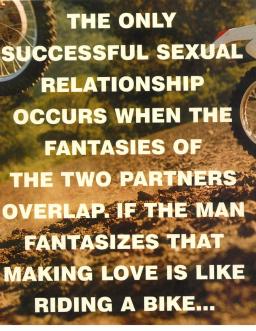 
Žižek reportedly said that the assignment took him 10 minutes of free associating, and that he found it less demeaning than the US academic sector: But Zizek bristled at the suggestion that there was anything unseemly about an internationally renowned intellectual writing copy for a clothing catalog. ''If I were asked to choose between doing things like this to earn money and becoming fully employed as an American academic, kissing [EXPLETIVE] to get a tenured post,'' he growled, ''I would with pleasure choose writing for such journals!''Which sounds like a Marxist take on the “punk rock” philosophy mentioned in an earlier post: if the bourgeois-capitalist system is (a) bullshit and (b) inescapable, and the supposedly “credible” parts of it are the worst by their pretence of being something other than bullshit, why not show the lie of the system by shunning its serious institutions and engaging solely with the most honestly base and tawdry aspects of it: populist cinema and mass-market clothing chains? |
| Thursday, March 14th, 2013 | |
| LJ.Rossia.org makes no claim to the content supplied through this journal account. Articles are retrieved via a public feed supplied by the site for this purpose. | |
| 1:27 am | Google Reader condemned Google have announced that Google Reader will be shut down in July. Reader, a web-based RSS aggregator, has amassed a loyal user base over its eight or so years of operation, being a good way to keep up with articles from blogs, news feeds and various web sites in one place, and to have one's reading history (and which posts one has bookmarked for future reference) accessible from multiple locations. This audience didn't really fit with the brave new world of Google+, with its gamified social sharing, quasi-totalitarian restrictions on pseudonymity and proven means of monetisation, so Google have done their best to get rid of this audience, firstly by ripping out the social sharing features last year, and now by slapping a CONDEMNED sign on the service. The announcement has been met with shocked disbelief by the considerable number of users for whom Reader is a means for keeping up with blogs, but that's OK, because they're not the sorts of hip, with-it model consumers Google are looking for. What the few old farts who still know what a RSS feed is, or who pay attention to updates longer than 140 characters, will do when Reader bites the dust, is an open question. Reader wasn't the first RSS aggregator, though it was one of the most popular ones, both for its web-based interface and the fact that it could synchronise with offline reading apps like Reeder, whose authors have promised that it will survive Reader's death. In my opinion, whatever replaces Google Reader will have to have a more sustainable business model than being provided for free by the benevolent space beings in Mountain View, driven by their ineffable alien altruisms to serve Man. Something with a freemium or subscription-based model, where the users of the service pay an annual subscription which funds its costs, and ensures that it remains viable and its interests are aligned with its users, not other parties, would meet these criteria. Such services already exist; examples include the photo-sharing site Flickr, the Pinboard bookmarking service (which replaced del.icio.us, a free service whose owners decided that Man wasn't cooked quite to their taste), the SoundCloud audio sharing service and App.net, a shiny new ghost town which, on the surface, appears like a pristine, empty Twitter without the sponsored tweets and creeping ad-squeeze. Actually, app.net may serve as the basis of such a system; while it seems on the surface like a slightly late-to-the-party microblogging site, it is actually a social API, which implements Twitter-like messages, and also gives each subscriber 10Gb of storage; developers are encouraged to build new applications on top of this API. An application that stores a list of RSS feeds, keeps track of new, read, unread and bookmarked messages from them, and communicates both via a web page and an API for Reeder-like clients, whilst hooking into app.net's messaging and publishing features, may well be the killer application needed to provide app.net with a raison d'etre in a world where Twitter already has been done. |
| Wednesday, March 13th, 2013 | |
| LJ.Rossia.org makes no claim to the content supplied through this journal account. Articles are retrieved via a public feed supplied by the site for this purpose. | |
| 11:50 am | Crunkin' gothnuts John “Menk” Doran on the last 10 years in music genres; it's not pretty: Even naysayers would have to admit that new rave was MDMAzing when compared to what we have now: EDM or Electronic Dance Music. Despite its utilitarian, almost sexy nomenclature, EDM is utter fucking neo-trance bilge for those who can’t tell the difference between a nightclub and the Stanford Prison Experiment. So we’re talking David Guetta, Afrojack and that cunt with the big metal rat helmet. Seriously, America, what the actual fuck? Your boys (mainly gay and/or black but still your boys) invented techno and house in the fucking 80s and you decide to wait 25 years until some spray-tanned berk from France who looks like Owen Wilson in Zoolander does this to it before you’ll dance to it? It’s a fucking disgrace.(Previously on “EDM”.) Weirdly, despite arguably being the most sonically progressive and inventive mainstream genre of the last ten years, R’n’B doesn’t really seem to have thrown up any particularly memorable or clearly defined sub-genres. Much to the dismay of fans of Usher and Ciara, the indie kids and hipsters have been getting in on the act to bring you PBR&B or R-Neg-B, a smacky, bro-friendly take on 80s/90s smooth music, with Gayngs, Destroyer and the Weeknd being the best and worst of the bunch, designed to give the bromantic a broner, which then may require the attention of bromide. Or a court-sanctioned brostraining order preventing you from going within 100 metres of her house. Elsewhere, the class system is as entrenched as ever with cakeeating aristocrats and the upper middle classes (hypnagogic pop), the students (chill wave) and the lumpen proletariat (glo-fi) all having different names for the same genre, which is not dissimilar to listening to Hall & Oates on a Walkman with a head injury while throwing orange-tinted Polaroids of your 1982 summer holiday to Morecambe into a swimming pool. The rest of the feral underclass had shit gaze, which, oddly, didn’t trouble the charts much.It's not all shit, though; Doran has some good things to say about hauntology, ironically possibly the most redeemably original phenomenon of the past decade. |
| Monday, March 11th, 2013 | |
| LJ.Rossia.org makes no claim to the content supplied through this journal account. Articles are retrieved via a public feed supplied by the site for this purpose. | |
| 5:54 pm | Virtually in France The latest example of the caprice of artificial borders: residents of a coastal village in Kent have found themselves facing high mobile phone bills as their phones latch onto signals from France, across the channel. Then, when their iPhones and Samsung Galaxys inevitably fetch data from the internet, they incur extortionate roaming charges, set at the dawn of time when mobile data abroad was the province of executives with deep expense accounts and left in place because bilking people for checking the email across a border is a nice little earner for the phone companies. The bay is blocked by the white cliffs from receiving UK signals and people in the village sometimes get connected to the French network depending on atmospheric conditions and the weather. Nigel Wydymus, landlord of the Coastguard pub and restaurant next to the beach, said: "We are a little telecommunications enclave of France here.The phone company, helpfully, advised residents of and visitors to such villages to switch off mobile data roaming: The spokesman from EE, which covers the T-Mobile and Orange networks, said: "We always recommend our customers switch off roaming while they are in this little pocket of an area to ensure that they are connecting to the correct network, because we cannot control the networks from the other side of the water."This minor absurdity is a result of the distortions of topology caused by a system whose building block is the post-Treaty of Westphalia nation-state, and which, by fiat, sets the distance between any two points within such a state to be a constant. From the mobile phone system's perspective, the distance from Dover to nearby Folkestone is exactly the same as that to London, Glasgow or Belfast, all of which are orders of magnitude nearer than Calais across the Channel. The costs of carrying the data across a system of base stations and trunk cables is part of the settlement of maintaining the legal fiction of the unitary nation-state; the sharp shock of roaming charges is the other side of the coin, a licence for the carriers to make a bit back from the tourists and business travellers, who are either in no position to complain or are used to the data they consume on the go being an expensive premium service. After all, it costs a lot to live in The Future. Kent isn't the only place where travellers may find themselves virtually (though potentially expensively) abroad; a while ago, I was walking in Cumbria, near Ravenglass, and found myself on the Isle of Man (a separate jurisdiction with its own phone companies and, lucratively, roaming rates). I wonder how this situation is handled on the continent, where the phones of people living near borders are likely to inadvertently cross them on numerous occasions. Do, say, Dutch phone companies charge roaming Belgians local rates? Do Italians find themselves inadvertently roaming in Switzerland or Croatia? Or do base stations on either side of a border do double-duty, serving both countries' carriers as if they were local? |
| Friday, March 8th, 2013 | |
| LJ.Rossia.org makes no claim to the content supplied through this journal account. Articles are retrieved via a public feed supplied by the site for this purpose. | |
| 7:00 pm | Punk Rock is Bullshit Punk Rock Is Bullshit, a robust broadside against the ideology and cultural phenomenon of punk and its legacy, both in terms of the lumpen aesthetic conservatism of punk rock as a musical genre and the narrow, self-defeating and ultimately nihilistic nature of punk's ideal of that great subcultural holy grail, Authenticity: I have friends in their mid-40s who don't even have a savings account because "saving money" never seemed punk rock. I can't count the number of small businesses I've seen fail because worrying about inventory or actually charging customers didn't seem very punk rock. I was once chastised for playing at a private Microsoft function by a guy who worked there, so disappointed was he that I would sell out by playing a corporate gig. I'm not talking about punk-rock music, because I don't believe there is such a thing. Punk music is just rock music, and the best punk is halfway decent rock. Punk rock was nothing new in 1976, and it's nothing new today. The Beatles' cover of "Roll Over Beethoven" is more punk than 90 percent of all punk rock; the Ramones were way more conservative—musically and socially—than Sha Na Na; the Sex Pistols were just dumb David Bowie; The Clash was a world-music band and the direct antecedent of the Red Hot Chili Peppers. If anything, the mantle of "punk rock" was an umbrella to describe a reactionary retro-ness, a feeling that music was best played with old-fashioned dumb energy, simple to the point of being simplistic—which not coincidentally corresponded to the period of the widest proliferation of recreational drug use in world history. It was music to validate being too wasted to think. What started out as teenage piss-taking at baby-boomer onanism quickly morphed into a humorless doctrine characterized by acute self-consciousness and boring conformism. We internalized its laundry list of pseudo-values—anti-establishmentarianism, |
| Thursday, March 7th, 2013 | |
| LJ.Rossia.org makes no claim to the content supplied through this journal account. Articles are retrieved via a public feed supplied by the site for this purpose. | |
| 3:40 pm | Just-in-time accomplices The street finds its own uses for things: Russian crime organisations have online marketplaces offering the services of willing underworld accomplices in various cities, administered through a cutting-edge web-based control panel: The service, advertised on exclusive, Russian-language forums that cater to cybercrooks, claims to have willing and ready foot soldiers for hire in California, Florida, Illinois and New York. According to the advertisement, customers of this service get their very own login to a remote panel, where they can interact with the cashout service and monitor the progress of their thievery operations. The service also can be hired to drain bank accounts using counterfeit debit cards obtained through ATM skimmers or hacked point-of-sale devices. The complicit mules will even help cash out refunds from phony state and federal income tax filings — a lucrative form of fraud that, according to the Internal Revenue Service, cost taxpayers $5.2 billion last year.The contractors are available for other services, such as pickup and forward shipping of sketchy merchandise and “other interesting transactions”. Once again, Russian biznesmeni are at the forefront of bringing free-market efficiency and the disintermediating, just-in-time power of the internet to the underworld (for long dominated by the almost Leninist command economies of hierarchical Mafia organisations and insular cells of bandits), or, if you will, liberating open-slather capitalism from pretences of legal propriety. Or, as has been said before, “Lenin failed to teach the Russians socialism, but he succeeded in teaching them capitalism”. |
| Wednesday, March 6th, 2013 | |
| LJ.Rossia.org makes no claim to the content supplied through this journal account. Articles are retrieved via a public feed supplied by the site for this purpose. | |
| 5:24 pm | Lech Wałesa vs. The Gays Nobel laureate Lech Wałesa, who had led the Solidarność movement that overthrew Poland's Soviet-backed puppet government in the 1980s and served as the first President of independent Poland, recently caused an uproar when he said that gay people had no right to serve in parliament: Wałesa said in a television interview on Friday that he believed gay people had no right to sit on the front benches in parliament and, if there at all, should sit in the back "or even behind a wall". "They have to know that they are a minority and adjust to smaller things, and not rise to the greatest heights," he told the private broadcaster TVN during a discussion of gay rights. "A minority should not impose itself on the majority."As a private citizen, Wałesa's words have no force in law, though given his status, they wield considerable influence, and resonate with a significant ultra-conservative proportion of Poland's population. (In Poland, the common colloquial word for “gay”, pedał, also means “paedophile”.) This proportion are well-represented; theirs is the opposition Law and Justice Party (currently allied with David Cameron's Tories in the EU Parliament, much to the discomfort of the we-are-not-the-Nasty-Party faction) and a conservative media which makes Fox News and The Australian look like the New York Times by comparison. (The fact that the Catholic Church was prominent in resistance to the Communist dictatorship imposed by the USSR, and that anything with a whiff of left-wing ideals, from secularism to equal rights for minorities, still stinks of Russian tanks to a proportion of the public doesn't help things.) Fortunately, they are not the unanimous voice of the Polish voting public: Poland's liberals have condemned the remarks, and the liberal Palikot's Movement party in parliament protested by temporarily promoting its two LGBT* parliamentarians to the front bench: On Wednesday, Robert Biedron, a gay rights activist, and Anna Grodzka, who had a male-to-female sex-change operation, took seats in the front row of the assembly. Both are members of the progressive Palikot's Movement party, and party leader Janusz Palikot arranged for the two to sit in, relinquishing his own seat to Biedron. The first row in the semi-circular lower chamber, or Sejm, is reserved for party leaders and prominent lawmakers. Biedron and Grodzka – who have been in parliament since 2011 – usually sit in the third row.Meanwhile, here is a petition asking for an apology from Wałesa for his statement. |
| Tuesday, March 5th, 2013 | |
| LJ.Rossia.org makes no claim to the content supplied through this journal account. Articles are retrieved via a public feed supplied by the site for this purpose. | |
| 10:51 pm | The Thatcher monument Meanwhile, in Britain, there is a debate about what to do with a statue of Margaret Thatcher. The statue of the divisive former PM was proposed for her hometown, Grantham, though there is opposition from both sides. Some Tories oppose it—apparently out of respect for Thatcher's wishes—while much of the political Left and the geographical North regard Thatcher as a monster who should no more be commemorated by a statue than, say, Jack the Ripper. Indeed, an earlier statue was decapitated by a protester with a cricket bat in 2002. I think there may be some merit in a statue of as influential a figure as Thatcher, who reshaped Britain arguably as dramatically as, say, Henry VIII or Oliver Cromwell. Though if it does go up, the statue should be surrounded by a thick wall of bulletproof glass. The totality—the statue, the glass, and the inevitable patina of spit that accumulates on it—could form a gesamtkunstwerk representing Thatcher's legacy and the range of public views of it. |
| Friday, March 1st, 2013 | |
| LJ.Rossia.org makes no claim to the content supplied through this journal account. Articles are retrieved via a public feed supplied by the site for this purpose. | |
| 5:20 pm | Mr Wowereit, don't tear down this wall Berliners are protesting against the tearing down of what's left of the Berlin Wall, as a section decorated with murals and known as the East Side Gallery is demolished to make room for—wait for it—luxury apartments. About 120 international artists were invited to plaster it with colourful murals, as the strip of wall carried none of the colourful graffiti that had covered the western side. In 2009 the murals were renovated at a cost of €2m (£1.7m).So as Berlin is gentrified, the artists and bohemians are priced out and replaced by wealthy yuppies drawn to the city's aura of cool, and the schicki-mickis as they're called start voting with their euros to have more luxurious accommodation built. And so, yuppie apartment complexes are built, and everything from art squats like Tacheles to sections of the Berlin Wall is demolished to make room for the city's new owners. And soon, Berlin will be a city of prestigious apartment towers, luxury shops and expensive champagne bars, a sort of Dubai with worse weather; the remainders of the city's rough history, artistic ferment and unkempt, boisterous underground culture will be represented by a few curated exhibits that don't interfere with the business of making and spending vast amounts of money. There's a petition against the demolition of the East Side Gallery here. |
| Thursday, February 28th, 2013 | |
| LJ.Rossia.org makes no claim to the content supplied through this journal account. Articles are retrieved via a public feed supplied by the site for this purpose. | |
| 12:35 am | Vinum multum nimis habere
As Pope @BillGates Hey debemus occursum dent. Nos ambae faciunt terribilis products populus coguntur uti. @charliesheen Hey relinquo in XXXVI horis. Occursum mihi in Vegas cum kilo of cocainum?(“kilo of cocainum”? “terribilis products”?) |
| Sunday, February 24th, 2013 | |
| LJ.Rossia.org makes no claim to the content supplied through this journal account. Articles are retrieved via a public feed supplied by the site for this purpose. | |
| 10:02 pm | Sarah Records interview A Parisian outfit named Rectangle Radio has an interview with Clare Wadd of Sarah Records, in the form of a podcast, in which she discusses the label's origins, history, end and legacy. It was totally plucked out of the air; I guess you look back and I guess it was just on that cusp of, kind of.. lad rock, that whole kind of grebo thing, that then became the 90s Loaded thing; that's probably unfair on some of the grebo bands, but it was almost which side of the fence are you on. And record labels were run by boys as well, so I guess we were making a point about that. I ws reading “Emma” by Jane Austen at the time, so it kind of came from if a book can be called Emma then a record label can be called Sarah. It was never meant to be Sarah Records, it was just meant to be Sarah, but that was too difficult. I think in a way, though, the thing I'm most proud of ... is the way we ended the label when we did and the reasons for doing it. One of the things that drives me absolutely crazy is when people think we went bust, or something like that. We always felt that there were about three or four ways to end a record label. One's to go bust, which happens reasonably often; two is to start putting out crap records and everyone stops buying them and you just kind of dwindle away. You could sell out to a bigger record label. We didn't want to do any of those. And then there's just getting to a nice round number ... throwing a big party, and taking out some ads in the press and saying, you know, we're basically destroying it. That I'm just so pleased we did, even though it was so hard to do.Whilst derided, somewhat though perhaps not entirely unfairly, as twee at the time, and not getting much recognition in histories of alternative/indie music (Sarah Records is mentioned in a footnote in Richard King's alternative-music history “How Soon Is Now”, in reference to being even more idealistic and out of touch with commercial realities than the labels the book's about), Sarah seems to be finally getting its due, with a book about the label (by Canadian writer Michael White) due this year and a documentary in production. Sarah Records as a label is gone, and definitely not coming back, but the name exists on Twitter; Clare uses it to post music-related items. (via SarahRecords) ¶ 0 Share |
 These associates are not mere “money mules,” unwitting and inexperienced Americans tricked and cajoled into laundering money after being hired for bogus work-at-home jobs. Rather, as the title of the ad for this service makes clear, the “foreign agents” available through this network are aware that they will be assisting in illegal activity (the ad refers to them as неразводные “nerazvodni” or “not deceived”). Put simply: These are mules that can be counted on not to freak out or disappear with the cash.
LJ.Rossia.org makes no claim to the content supplied through this journal account. Articles are retrieved via a public feed supplied by the site for this purpose.