Add this feed to your friends list for news aggregation, or view this feed's syndication information.
LJ.Rossia.org makes no claim to the content supplied through this journal account. Articles are retrieved via a public feed supplied by the site for this purpose.
| Monday, May 6th, 2013 | |
| LJ.Rossia.org makes no claim to the content supplied through this journal account. Articles are retrieved via a public feed supplied by the site for this purpose. | |
| 1:16 am | The moral degeneracy of the childless Recently, celebrity right-wing intellectual Niall Ferguson caused a stir when, during an investors' conference, he implied that economist John Maynard Keynes did not care about the future, on the grounds of being childless and gay. The comments seemed to have been an attempt to attribute Keynes' famous quote, “in the long run, we are all dead”, to an amoral nihilism that comes from neglecting one's duty to reproduce in favour of a decadent hedonism and aestheticism, and thus to tar Keynes' model of government borrowing and economic stimulus, popular amongst the left of the political spectrum but anathema to the neoliberal right, with the brush of this effete, degenerate nihilism: Another reporter, Tom Kostigen of Financial Advisor, gave a longer account. Kostigen wrote that Ferguson had also made mention of the fact that Keynes had married a ballerina, despite his gay affairs. "Ferguson asked the audience how many children Keynes had. He explained that Keynes had none because he was a homosexual and was married to a ballerina, with whom he likely talked of 'poetry' rather than procreated," Kostigen wrote. He added that the audience at the event went quiet when the remarks were uttered.Ferguson has apologised unreservedly for the remarks once they became public, calling them “stupid and tactless”; chances are that they've served their purpose as a dog whistle, and many of the sorts of people who see “Cultural Marxism” and decadent weakness all around them will agree wholeheartedly. While Ferguson was rightly excoriated for the anti-gay tone of the remarks, there has been less comment on the other part of his statement, the assertion, still commonly held in many places, that childless people are selfish, amoral nihilists, who refuse to grow up and shoulder their responsibility: There is, among many otherwise intelligent individuals, an assumption that those of us who make a positive choice to not reproduce are selfish, rootless and have no concern about future generations or the planet. But those who have their own children often forget about the world and just worry about their own ever shrinking one. I have seen the most passionately committed feminist activists go gaga once they give birth. All the promises such as "I'll still come on that march/go to that conference/burn down that sex shop" disappear when they sprog. All those in my circle with offspring seem to become unhealthily obsessed with their own little world. Principles go out of the window ("I still hate the private education system/healthcare but I am not putting my politics before my children"), and socialising becomes impossible.Big families and the political Right have gone hand-in-hand for a while. Meanwhile, the white-supremacist British National Party, feeling the angry-white-people vote taken away by the less overtly fascistic UKIP, is encouraging its supporters to lie back and think of "I know, by now you will be giggling over this suggestion. But think about it, nationalists need to buck the trend of 1.8 children per white household. We need to aim between 3 and 4 children each if not more," he writes. "And the bonus is that making babies is fun! So fellow nationalists, less TV and more fun! Let's do our bit for Britain and our race." Matthew Collins, a former BNP member and now an anti-racism activist, said the post was an attempt by the party to get some attention after its poor election results. "It's tongue in cheek but there is a serious point. Griffin is always going on about being outbred and in the past he has said members need to put away their boots and go and meet women. The problem is that your typical BNP member is a social pariah who is more into pornography than starting a family," he saidA more frightening possibility would be if these people are successfully persuaded to do their duty, especially with the BNP's record on gender relations (they're not in favour of womens' rights; one of their MPs is on record as saying that women should be “struck like a gong”). I wonder in how many suburban culs-de-sac in BNP heartland, aspiring Josef Fritzls are now drawing up plans for soundproofing their basements and making notes on the movements and likely racial purity of fit-looking local shopgirls. |
| Saturday, May 4th, 2013 | |
| LJ.Rossia.org makes no claim to the content supplied through this journal account. Articles are retrieved via a public feed supplied by the site for this purpose. | |
| 3:40 pm | Sustainable natural lighting A private group of genetic engineers in the US have a plan to create light-emitting plants for “sustainable natural lighting”. The plants will include the luciferase gene, as present in fireflies and genetically modified rabbits commissioned by artists; the ultimate aim is to provide a better than carbon-neutral replacement for street lights and household lamps. To create the glowing plants, the team will first generate modified genes with the Genome Compiler software, then insert them into Arabidopsis, a small flowering plant related to mustard and cabbage (they make sure to point out that the plant is not edible). The main gene, luciferase, is the same one that makes fireflies light up the night.As luciferase is not sufficiently bright to light a street, or even a living room, the project will require optimisation; the engineers already have enhanced the gene's light output to an extent. A Kickstarter campaign was started to fund the research, with those (in the US) contributing $40 or more to receive a packet of glowing plant seeds in return. To day, the campaign, which aimed for $65,000, has raised $216,536, with 33 days to go. It'll be interesting to see if this is successful; will we see streets lit by fluorescing trees, or find ourselves putting a plantshade over the bedside plant when going to sleep? And will plants that emit a useful amount of light need to be fed large quantities of a sufficiently high-energy plant food to keep glowing? |
| Sunday, April 28th, 2013 | |
| LJ.Rossia.org makes no claim to the content supplied through this journal account. Articles are retrieved via a public feed supplied by the site for this purpose. | |
| 2:29 pm | Endbahnhof Visual treat of the day: Endbahnhof; a collection of photographs of all of Berlin's splendidly varied U-Bahn stations, by Melbourne photographer Kate Seabrook, who moved to Berlin some years ago. The platform are all photographed empty, without passengers or extraneous distractions, capturing the variety of architectural styles: from baroque grandeur and Jugendstil fancy to explosions of psychedelic kitsch, crisp modernism, and various steps in between. (And, of course, the nondescriptly utilitarian stations, typically on the outer reaches of lines, sporting just the stock BVG signage haven't been omitted.)    
There's a piece about Endbahnhof in Atlantic Cities here, and an interview with Seabrook in Australian twee-culture bible Frankie here. |
| Saturday, April 27th, 2013 | |
| LJ.Rossia.org makes no claim to the content supplied through this journal account. Articles are retrieved via a public feed supplied by the site for this purpose. | |
| 12:56 pm | Yesterday's modernity reheated Apparently it's time for another Mod revival now, only this one hearkening back to the 1990s and the heady days of Britpop, with Oasis being a touchstone: If you were looking for a reason, Oasis, forever riding on the fishtails of Paul Weller in the 90s, didn't help; the "Modfather" had ceased moving forward after the Style Council's ill-fated but entirely logical detour into house music. The Gallaghers were pictured on scooters, publicising their Earls Court gig, and mods now seem to equate Britpop (mainstream, nostalgic) with modernism (elitist, forward-facing). Mod bands who dress the part but favour Britpop over black music and its myriad mutations – and admittedly your writer has only anecdotal evidence, though it's the sort of thing mods argue over, a lot – are like a Jpeg of a photocopy of Liam's bumcheeks.Of course, strictly speaking, Paul Weller has little more claim to the holy grail of Mod authenticity than Noel Gallagher; despite being styled as “the Modfather”, he was a product of the 1979 Mod revival, the first backward-looking permutation of Mod which grew in the fertile soil following Punk's bonfire of 1970s vanities. Which, if one defines Mod as an explicitly reactionary phenomenon—a sort of mid-20th-century retrofuturism for those disaffected with the banality of the present day, and the present day always looks more banal than the tasteful photographs which survive from the past—would make Weller more authentically Mod than the paperback-reading Soho jazz intellectuals of 1960. Then again, there is no way that something stylistically true to the tropes of the cutting edge circa the 1960s could not be reactionary. All the symbols of modernity tied to Mod—Italian tailoring and coffee, Black American music, the end of national service and rationing—are so ubiquitous that they have not been cutting-edge for a long time. Even more damning is the fate of Mod's technology of young freedom, the moped. Back then it was cheap, modern and cool; nowadays, a vintage Vespa or Lambretta would be a cantankerous inefficient relic, less an enabler of freedom and more a cross to bear for one's commitment to the Mod identity. And even worse, in the age of climate change, electric cars and cycling, wilfully riding around on something powered by a dirty 2-stroke engine would seem trollishly reactionary, like propaganda of the deed for global-warming denial and anti-green hippy-punching, a transportational equivalent of voting UKIP or complaining about foreign food. Or, indeed, about music that doesn't sound like back-to-basics rock, as those latter-day Mod icons the Gallaghers have been wont to do. And so, just by standing still, yesterday's shining future becomes the ugly, reactionary past. |
| Thursday, April 25th, 2013 | |
| LJ.Rossia.org makes no claim to the content supplied through this journal account. Articles are retrieved via a public feed supplied by the site for this purpose. | |
| 5:44 pm | Geek misogyny roundup 25/4/2013 Today in geek misogyny:
|
| LJ.Rossia.org makes no claim to the content supplied through this journal account. Articles are retrieved via a public feed supplied by the site for this purpose. | |
| 2:37 pm | Bumpier and more expensive Another predicted consequence of global warming: transatlantic flights could get more turbulent and more expensive by the middle of the century, as the jet stream becomes more unstable: The study, published in Nature Climate Change, suggests that by mid-century passengers will be bounced around more frequently and more strongly. The zone in the North Atlantic affected by turbulence could also increase. "The probability of moderate or greater turbulence increases by 10.8%," said Dr Williams. "'Moderate or greater turbulence' has a specific definition in aviation. It is turbulence that is strong enough to bounce the aircraft around with an acceleration of five metres per second squared, which is half of a g-force. For that, the seatbelt sign would certainly be on; it would be difficult to walk; drinks would get knocked over; you'd feel strain against your seatbelt." |
| LJ.Rossia.org makes no claim to the content supplied through this journal account. Articles are retrieved via a public feed supplied by the site for this purpose. | |
| 12:08 pm | Do you want a McJob with that degree? In the US, McDonalds is now requiring candidates for cashier jobs to have bachelor's degrees. So if you're wondering what sort of work a BA qualifies you to do, wonder no more. I wonder whether this is because having studied something at university level provides essential skills for operating a till (which would suggest a collapse in secondary school standards in the US; i.e., the strong likelihood that a high-school graduate without a degree is functionally innumerate), or because employees with the level of debt accrued through taking a degree are more compliant? |
| Monday, April 22nd, 2013 | |
| LJ.Rossia.org makes no claim to the content supplied through this journal account. Articles are retrieved via a public feed supplied by the site for this purpose. | |
| 1:17 pm | RIP Chrissy Amphlett Sad news: Christina Amphlett, frontwoman of post-punk rock band The Divinyls, inspiration to many, first crush to many more and arguably the archetypal Australian Rock Chick, has died in New York, aged 53. The Divinyls are best known outside of Australia for I Touch Myself, though in their career had many more hits, including Pleasure And Pain, Back To The Wall and Science Fiction, through the 1980s and until their generation was displaced by the JJJ Grunge Revolution (many of whose key players, like Adalita from Magic Dirt, were inspired by her). It's fair to say that Amphlett lived the lifestyle. Born in industrial Geelong, she left home in her teens and spent time busking in Europe, at one point being imprisoned for three months for singing in the streets; she was born at the right time to be there when punk broke, and her artistic career embodied its values—aggressively forward, unapologetically raunchy and cuttingly honest, expressing both toughness and vulnerability; her voice certainly did. Amphlett was diagnosed with multiple sclerosis in 2006 and breast cancer in 2010; had it only been one of the two, she'd probably had more of a chance, but apparently the MS made radiotherapy impossible. There is more coverage, including quotes from other musicians who knew her, here |
| Sunday, April 21st, 2013 | |
| LJ.Rossia.org makes no claim to the content supplied through this journal account. Articles are retrieved via a public feed supplied by the site for this purpose. | |
| 12:49 pm | The ending of the age of endarkenment? The Beatles may have helped bring down the USSR, but in the West, they helped usher in an age of endarkenment by making mysticism fashionable and opening the door to an assortment of crackpots and frauds, according to debunker of “alternative medicine” and miscellaneous quackery, Professor David Colquhoun: At the same time, he hopes that the "fashion for irrationality", which he dates back to the Beatles going to India "when flower power stopped being fun and started being mystical bollocks", may be fading. His abiding hero is Bertrand Russell, and he laces his conversation with favourite quotes, including Russell's maxim that "it is undesirable to believe a proposition when there is no ground whatever for supposing it true".Professor Colquhoun has a blog, DC's Improbable Science, in which he debunks things from tabloid cancer scares to alternative therapies; see, for example, his Guide to Magic Medicine, which is handed out to medical students when discussing alternative medicine. |
| Saturday, April 20th, 2013 | |
| LJ.Rossia.org makes no claim to the content supplied through this journal account. Articles are retrieved via a public feed supplied by the site for this purpose. | |
| 10:51 pm | How The Beatles Rocked The Kremlin A new book, How The Beatles Rocked The Kremlin, makes the claim that the Beatles contributed greatly to the collapse of the Soviet Union (or at least to the collapse of the legitimacy of the communist regime among its youth; whether glasnost, perestroika and the disintegration of the USSR would have happened as they did without the Beatles is a matter for historical inquiry): The book's main character, the Russian writer and critic Art Troitsky, makes the claim that: "In the big bad west they've had whole huge institutions that spent millions of dollars trying to undermine the Soviet system. And I'm sure the impact of all those stupid cold war institutions has been much, much smaller than the impact of the Beatles." A grand assertion, maybe – but widely shared. "Beatlemania washed away the foundations of Soviet society," explains Mikhail Safonov at the Institute of Russian History. And the Russian rocker Sasha Lipnitsky – snowflakes falling on his beret as he talks to Woodhead in a park bandstand – insists: "The Beatles brought us the idea of democracy. For many of us, it was the first hole in the iron curtain."The Soviet authorities didn't quite know how to respond, and alternated between trying to co-opt the new fad and attempting to stamp it out, but to no avail; once music fans contrasted the music with the authorities' denunciations of it, they became more sceptical of the official party line: Indeed, the repression and harassment of the music ebbed and flowed as the party controls lapsed or intensified. "It went in waves: sometimes you could be approved for an official recording, and sometimes you were banned, losing your job or education. It must have driven them insane," says Woodhead. He not only excavates the minds of the rebels but also the propaganda machine at work. He recounts how a school staged a mock trial of the Beatles – broadcast on radio – with a prosecutor and denunciations in the manner of Stalin's show trials of the 1930s. A critical bulletin shown on state TV, entitled Pop Quartet the Beatles, told the story of how "these gifted guys could be real cash earners" while, "struck down with psychosis, the fans don't hear anything any more. Hysterics, screams, people fainting!" So ran the TV commentary, accompanied by shots of dancing fans intercut with images of the Ku Klux Klan and dire poverty in the American south. "Keep on dancing, lads, don't look around," the programme taunted, "You don't really want to know what's happening. Keep going, louder and faster! You don't care about anyone else."The article also mentions the USSR and its satellite states' interaction with other forms of countercultural and popular music, some deemed less threatening than others. (Disco, it seems, is OK because it's easy to contain. By then, the sclerotic Brezhnev-era USSR must have given up on trying to inspire its youth with Leninist zeal in its vision and was merely hoping that their recreations would remain safely apolitical, and, dare one say, bourgeois.) Looking through the other end of the telescope, it is enlightening to find what the Soviet authorities approved of. They "positively encouraged" disco music – the Bee Gees' Saturday Night Fever, Abba and Boney M (though Rasputin was officially banned) – because, says Woodhead, "it was musically rigid and could be contained within the dance floor, it wasn't going to spill out on to the streets". Why the Beatles? There is no hint of the Rolling Stones or the Who in all this. In Czechoslovakia, the underground was being inspired by dark dissonance in the Velvet Underground and Frank Zappa. "I think the Czechs had that recent memory of democracy, before the war," reflects Woodhead. "And their culture has roots in Kafka and the surreal. But Soviet taste was more melodic, they like tunes above all, even a little sentiment, verging on the beautiful – and there, I'm describing a McCartney song, not hypersexual rock'n'roll, or Street Fighting Man. |
| Thursday, April 18th, 2013 | |
| LJ.Rossia.org makes no claim to the content supplied through this journal account. Articles are retrieved via a public feed supplied by the site for this purpose. | |
| 11:56 am | Bump before you bonk In Iceland almost everyone is, to some extent, related to everyone else. Iceland also shares with its neighbours in Scandinavia fairly liberated and casual attitudes to sex. The downside of this is the possibility of inadvertently going home from a Reykjavík bar with a cousin, not to mention the prospect of running into exes and former one-night stands at family gatherings in the future. But fear not, because now there's an app for that: An online registry, Íslendingabók ('The Book of Icelanders') holds information about the families of about 720,000 individuals who were born in Iceland at some point in time. Today, the population in Iceland is just about 320,000. The database can be found on islendingabok.is and everyone registered in the database has free access to it. Three engineers made an app for the 'Íslendingabók' database. People can now easily, and on the go, look up how they are related to other Icelanders. And a precious feature, using the bump technology, allows people that meet to just bump their phones together, to instantly see if they are too related to take things any further. The engineers' slogan for this feature was: "Bump the app before you bump in bed".The app is Android-only, and only works if you're an Icelandic citizen or registered resident with access to the database. |
| Wednesday, April 17th, 2013 | |
| LJ.Rossia.org makes no claim to the content supplied through this journal account. Articles are retrieved via a public feed supplied by the site for this purpose. | |
| 10:51 am | Pay no attention to the man behind the curtain The International Monetary Fund has, once again, warned Britain's government to ease back on its austerity policy, or risk driving Britain into a triple-dip recession. The government has replied with a statement defending its approach. Meanwhile, researchers have found serious flaws in an economics paper used to justify austerity policies and the prioritisation of cutting debt at all costs. The paper, Growth In A Time Of Debt, which argues that high public debt stifles economic growth, and which has been a favourite of neoliberals and small-state libertarians, was found to have flaws including selective inclusion of data, unusual weighting of years studied, and a coding flaw in an Excel spreadsheet; when corrected, the data produced does not yield the same conclusions: This error is needed to get the results they published, and it would go a long way to explaining why it has been impossible for others to replicate these results. If this error turns out to be an actual mistake Reinhart-Rogoff made, well, all I can hope is that future historians note that one of the core empirical points providing the intellectual foundation for the global move to austerity in the early 2010s was based on someone accidentally not updating a row formula in Excel.So, if it does turn out that austerity policies are based on a spreadsheet error, does that mean that we can expect a contrite George Osborne to quickly change course? Of course not; the revelation that austerity is based on junk economics will have no more effect than what we've already known, such that Britain's current public debt is historically quite modest, because austerity never was purely about economic pragmatism, but rather about principle; the principle being “this money does not belong to you”, with the explanation being “because we say so”. Which is why, for example, the government has £10m to give Margaret Thatcher a state funeral in all but name (“we can afford it”), whilst cutting £11.6 from the arts budget, closing public libraries and slashing benefits. The principle is why the government has introduced a “bedroom tax”, cutting the benefits of those deemed to have a spare bedroom, despite the lack of suitably cramped accommodation they could move to (especially in economically depressed areas in the north). There is no economic benefit from this, but it has the moral benefit in the eyes of the Tories and the Daily Mail-reading public of punishing the unworthy poor. And punishing freeloaders is a good in itself, worth doing even if it costs us to do so. Even if there was no recession, if government coffers were flush with cash, spending money on the public good would be immoral. In Australia, where the economy escaped the recession and is carried aloft on a mining boom, there still is no money for public infrastructure, to the point where recent secondary education reforms had to be funded by massive cuts to the university sector. There is plenty of money, but it belongs not to the little people, but the mining oligarchs, whose sense of property rights does not extend to them rejecting billions of dollars of diesel fuel subsidies paid for by the taxpayer. Needless to say, there is no money for things like modern internet infrastructure or public transport, to say nothing of things like the high-speed railway line between Melbourne and Sydney (the two endpoints of the second busiest passenger air route in the world) for which studies have recently been published. Where there is money left over, it is handed back as tax rebates to middle-class households in outer suburban electorates, where it can do the most good electorally for the government. The libertarian myth that the economically prudent state is the minimal “nightwatchman state”–enforcing contract law, punishing freeloaders and otherwise keeping its hands off—doesn't bear out in reality, where prior investment and planning are often more prudent than leaving things to the wisdom of the free market. We have seen this in the United States' health care system, where costs are several times higher than in the supposedly inefficient socialised health care systems of socialist Europe (which is not counting externalities, from lower life expectancies and more chronic illnesses to people staying in less than ideal jobs out of fear of losing their health insurance), and in previous attempts to reduce public spending by cutting welfare (at least when the sainted Margaret Thatcher did so in the 1980s). Anyone who has had to commute in a city organised according to laissez-faire let-them-drive-cars principles, at least once it gets beyond a certain level of density, will know that it doesn't work; which is why even neoliberal London and New York spend billions on public transport facilities, which are used with almost Scandinavian egalitarianism by everybody from beggars to bankers. And, in a decade's time, it's not unlikely that the gutting of Britain's social infrastructure will end up costing more, as more people fall through the cracks; some will be picked up by a swelling prison system, as happens across the Atlantic, while others will subsist in dismal conditions, out of sight and out of mind of the people who matter. |
| Tuesday, April 16th, 2013 | |
| LJ.Rossia.org makes no claim to the content supplied through this journal account. Articles are retrieved via a public feed supplied by the site for this purpose. | |
| 2:04 pm | A General Technique for Automating NES Games A General Technique for Automating NES Games; a programmer in the US has created a system for automatically learning how to play some NES games, by monitoring control inputs, finding increasing sequences of bytes in the NES's 2Kb of RAM (which look like scores or level indicators, i.e., things to be increased) and taking it from there. It works better on some games than others (he has it playing Super Mario Brothers moderately well, and exploiting quirks no human player would stumble across, though it's hopeless at Tetris). There is a paper here. |
| Saturday, April 13th, 2013 | |
| LJ.Rossia.org makes no claim to the content supplied through this journal account. Articles are retrieved via a public feed supplied by the site for this purpose. | |
| 2:17 pm | Ding ____ The ____ is ____ As Ding Dong The Witch Is Dead stays stubbornly in the charts, the BBC, eager to not appear censorious and yet under sustained assault from its perennial foes in the Murdoch press and Daily Mail, has decided to half-heartedly censor it. A five-second excerpt of the song will be played, along with an explanation of sorts. Chances are the explanation will not be a list of grievances against Thatcher (the immiseration of the British working class, support for the Pinochet dictatorship and the South African apartheid regime, Section 28, a few getting rich on the suffering of many, Spandau Ballet, &c.), but instead saying something like that it got there as a silly internet prank piggy-backing on something a lunatic-fringe group said two decades earlier. Bonus points if they can mention Thatcher having been the first woman PM and insinuate an unreformed 1970s-vintage misogyny on the part of the original organisers. Personally, I think that the BBC missed a trick by deciding to actually play a five second excerpt, rather than finding one of the actors hired to voice statements by Sinn Féin in the 1980s and bringing them in to recite the words. That would have made a more powerful statement about the absurdity of the situation. Meanwhile, a small group of Tories have decided to fight market forces with market forces and launched a counter-campaign to get a different song into the charts; or, in the words of highly visible former Tory MP, successful popular novelist and somewhat less successful social media entrepreneur Louise Mensch: Good morning! Are we all doing it #GranthamStyle today? Download #ImInLoveWithMargaretThatcher on ITunes and Amazon - see RTs for linksThe song in question is, “I'm In Love With Margaret Thatcher” by punk band The Notsensibles; as you have probably guessed, it's not exactly a defiant statement of Conservative Party nostrums. '#GranthamStyle', of course, is a take-off of Gangnam Style, originally a song taking the piss out of rich twats living in a gated community in Seoul. At time of writing, “Ding Dong The Witch Is Dead” is at #1 on the iTunes charts, and “I'm In Love With Margaret Thatcher” is at #8. For what it's worth, incidentally, the Wizard of Oz soundtrack is owned by 20th Century Fox, so this is one anti-Thatcherite protest Rupert Murdoch profits from. |
| Friday, April 12th, 2013 | |
| LJ.Rossia.org makes no claim to the content supplied through this journal account. Articles are retrieved via a public feed supplied by the site for this purpose. | |
| 1:31 pm | Not a state funeral, honest In death, it seems, Margaret Thatcher is being as much of a unifier as she was in life. Whilst still alive, she requested to not have a state funeral (“I am not Winston” being her reported words), the Cameron government seem determined to give her one in all but name, celebrating the triumph of their tribe and rhetorically reducing the vast dislike of her and her policies and actions outside of their charmed circle to a few disgruntled sore losers. In other words, the late Thatcher becomes, in death, the People's Prime Minister, with those who object redefined to be outside of “the People”. The funeral itself will, officially, fall one step short of being a state funeral; it will be almost identical to the ones Winston Churchill and Princess Diana received, with central London shut down for a military parade (for bonus points, themed around the Falklands War; that's right, they have themed funerals for former prime ministers); Thatcher's remains will be borne on a gun carriage to St. Paul's, and the dress code is “Full Day Ceremonial without swords”. (Does one get issued a sword upon ascending to that echelon of British society?) Further blurring the distinction, the Foreign Office ordered its staff to wear mourning clothes on the day; once it was pointed out that this was a breach of protocol (what with it not being a state occasion, and the deceased not having been the head of state), the order was hastily retracted; the foreign office said that it was the result of an “administrative error”, and certainly had nothing to do with any ministers. As expected, those of inadmissible views are likely to protest, and activists are bracing for a wave of preemptive arrests before the event, as happened with the Royal Wedding. The police are reportedly scanning online conversations for references to protest and compiling lists of troublemakers. These plans and the imperial tone of the funeral have not gone unnoticed in Buckingham Palace, who are concerned that it is encroaching on the tradition that the monarchy handles the ceremonial side of statecraft and the elected politicians just do the practical stuff. Or, as the trade unionists of yore would have called it, a demarcation dispute. Meanwhile, some have called for a statue of Thatcher to be erected permanently in Trafalgar Square (also the site of the poll tax riots). And there have been calls for Heathrow Airport to be renamed after her. There is a petition to the Prime Minister here; at time of writing, it has 18 signatures. Were it successful, the government actually renaming the airport would be complicated by it having been privatised by Thatcher herself. Boris Johnson has helpfully suggested naming the new airport he wants to build in the Thames Estuary after her instead. Meanwhile, the guest list for the funeral has been announced; it's partly a Tory tribal gathering (the likes of Lord Lloyd-Webber, pulp novelist/former jailbird Lord Archer and the yet-to-be-ennobled Jeremy Clarkson), with fellow travellers from all over the world (the Reagan family is sending someone in lieu of Nancy, who's too unwell to make the trip). It's not clear whether the Pinochet family will be sending anyone. Argentina's prime minister has been snubbed, in line with the Falkland War theme. Australia, meanwhile, will be represented by conservative former PM and current Warden of the Cinque Ports, John Howard, to whom the invitation was apparently passed by current PM, Julia Gillard. (The Tories missed a trick by not going over her head and inviting next PM Tony Abbott, giving him a chance to look like an accomplished statesman even before his coronation in September.) One notable name that may be absent is Rupert Murdoch, the power behind the throne, who unfortunately has a meeting on that day Meanwhile, some notable reactions you may have missed: video of a speech given by actress turned Labour MP Glenda Jackson at the Thatcher memorial parliamentary session, condemning her legacy; and a rebuttal by Jackson's son, Dan Hodges, listed as a Blairite (i.e., neo-Thatcherite) Labour MP. And Australia's foreign minister Bob Carr recounts Thatcher having made a racist remark about Asian immigration just out of earshot of his Malaysian-born wife. And here is An Obituary From Below, a comprehensive assessment of the history, origins, contraditctions and legacy of Thatcherism. |
| Thursday, April 11th, 2013 | |
| LJ.Rossia.org makes no claim to the content supplied through this journal account. Articles are retrieved via a public feed supplied by the site for this purpose. | |
| 1:37 pm | Burglars can use cameras too The street finds its own uses for things: Burglars are now starting to use cheap, concealable surveillance cameras for staking out properties. "This one has already been camouflaged," said detective Ben Singleton, holding what looks like a piece of bark that would go unnoticed in most yards. It's actually a video camera not much bigger than a matchbox, and it's activated by a motion detector. Such cameras turned up in March planted outside several upscale homes in Dalworthington Gardens. The detective said it turned out to be surveillance for a long-running, sophisticated burglary scheme. But at first, police feared it might even be a kidnapping plot to take a wealthy person captive. |
| Wednesday, April 10th, 2013 | |
| LJ.Rossia.org makes no claim to the content supplied through this journal account. Articles are retrieved via a public feed supplied by the site for this purpose. | |
| 9:27 pm | The 20/80 solution Meanwhile in Australia, the right-wing opposition (and, at this point, almost inevitably the next government come September) has launched its alternative to the Labor government's National Broadband Network policy. It's an improvement on their previous policy (“rip it out, fill in the trenches and let the free market provide”), but nonetheless still falls well short. While Labor's network would bring high-speed fibre-optic connections straight to the home, giving 100 megabits per second (increasing to gigabit speeds), the Coalition's cut-rate plan would extend fibre only to boxes on the kerb, relying on a largely deteriorating copper infrastructure for the “last mile”, topping out at a theoretical 25 megabits per second (though that would be in ideal conditions; as with ADSL, distance from the node and cable condition would affect this). It would achieve this at about 2/3 of the cost of the all-fibre NBN. Or, the Pareto Principle: You're Doing It Wrong.
The Coalition's policy has been roundly criticised by experts and mocked online as “fraudband”. However, all that means zip to the average outer-suburban swinging voters who get 100% of their information from the Murdoch press, right-wing shock jocks and/or 30-minute TV news programmes which are mostly sport, celebrity gossip and wacky human-interest stories, and who actually decide elections. So it looks like Australia, a country which coined the term “tyranny of distance” and was an early adopter of everything from telegraphy to mobile phones, will be stuck behind, paying off a 20th-century system and living much as the generation before them did, just because the bogans hate Julia Gillard. |
| LJ.Rossia.org makes no claim to the content supplied through this journal account. Articles are retrieved via a public feed supplied by the site for this purpose. | |
| 1:43 am | Elite panic Sociological term of the day: elite panic: basically, the tendency of those who have clambered to the top of an unequal society to take a brutally Hobbesian view of the rest of humanity, and to live in fear that those under their feet might not stay there: Elites tend to believe in a venal, selfish, and essentially monstrous version of human nature, which I sometimes think is their own human nature. I mean, people don't become incredibly wealthy and powerful by being angelic, necessarily. They believe that only their power keeps the rest of us in line and that when it somehow shrinks away, our seething violence will rise to the surface -- that was very clear in Katrina. Timothy Garton Ash and Maureen Dowd and all these other people immediately jumped on the bandwagon and started writing commentaries based on the assumption that the rumors of mass violence during Katrina were true. A lot of people have never understood that the rumors were dispelled and that those things didn't actually happen; it's tragic. But there's also an elite fear -- going back to the 19th century -- that there will be urban insurrection. It's a valid fear. I see these moments of crisis as moments of popular power and positive social change. The major example in my book is Mexico City, where the '85 earthquake prompted public disaffection with the one-party system and, therefore, the rebirth of civil society.The relevance of this term is left as an exercise to the reader. |
| Tuesday, April 9th, 2013 | |
| LJ.Rossia.org makes no claim to the content supplied through this journal account. Articles are retrieved via a public feed supplied by the site for this purpose. | |
| 11:47 pm | A nation mourns/celebrates/shrugs A day after the death of an elderly, long-retired Margaret Thatcher, the reactions in Britain have been varied. The national news media have generally been lavish in their hagiography, at most conceding that Thatcher “polarised opinion” or was “controversial”; the implication being that all sides, from the yuppies whom made out like bandits during the Big Bang to the miners who were kicked in the teeth, had, over time, put their differences aside. (The BBC has been particularly fawning, careful to avoid giving a voice to anyone who may say anything remotely critical, or in any way shatter the illusion that the PM who smashed the miners' unions, immiserated the North and began the dismantling of the post-WW2 social contract may well have been a much loved and thoroughly apolitical member of the Royal Family. Between that and their silence on the privatisation of the NHS, one suspects that they are betting that, maybe if they cooperate enthusiastically, the Tories won't dismember them and sell the bits off to Rupert Murdoch before the next election.) Even the Guardian, whilst publishing a mildly condemnatory editorial, hedged its bets, as not to offend those of its readers who vote Conservative (and presumably there are some). Regional newspapers have been somewhat less equivocal, especially those in places like Sheffield, Newcastle and Wales. Meanwhile, television schedules have been cleared to make room for turgid memorial programming. Last night, after her death was announced, spontaneous celebrations did erupt in parts of Britain; as of yesterday afternoon, the centre of Liverpool reportedly looked “like bonfire night on Endor”, and other celebrations took place in Glasgow, Bristol, Brixton and Republican areas of Northern Ireland. Elsewhere, the manager of an Oddbins was suspended after announcing a special on champagne “in case anyone wanted to celebrate for any reason”. Other than that, there have been few signs of public jubilation in London; no red bunting bedecking streets, no spontaneous street parties around portable stereos blaring out Billy Bragg songs, no jubilant signs in windows, not even an uncanny sense of euphoria in the air. And, when one thinks about it, it's hardly surprising, as there's precious little to celebrate. An old, frail woman, whose actions caused considerable suffering for many (and, for a few, great fortune) a quarter-century ago, died at an advanced age, amidst luxury; and, short of being borne to Valhalla on the wings of valkyries, there could scarcely be a more victorious way to exit life. If she was aware of anything in her last days, it would have been of the triumph of her views and the utter vanquishment of all opposition. The welfare state has been dismantled to an extent she dared not imagine, trade unions are all but extinct, and neo-Thatcherism is the backbone of all admissible political parties. Other than there still being homosexuals and trains in Britain, there could have been little to disappoint her. Thatcher may be dead, but Thatcherism is stronger than ever. If anyone has reason to be popping the corks on those bottles of champagne, it would be the Conservative Party faithful and perhaps the Blairite wing of Labour, paying tribute to the end of a triumphant life. While she may have been victorious, that is not to say that her victory was accepted. Perhaps telling are official shows of respect which were not called for, in case lack of observance says too much. For instance, football matches will not be observing a minute's silence. There will also be no state funeral, which would have required both a parliamentary vote (and the spectacle of Labour backbenchers defying the whip and Sinn Fein members being ejected from the chamber would have been somewhat insalubrious) and a national minute's silence. The funeral itself will be one step short of a state funeral, and the first Prime Minister's funeral attended by the Queen since Churchill's state funeral; it will be held next Wednesday, with central London under lockdown and a heavy police presence; one imagines that Thatcher wouldn't have wanted it any other way. Finally, at the time of writing, Judy Garland is enjoying an uncanny career resurgence in the British pop charts; Ding Dong The Witch Is Dead is at number 2 on the iTunes chart and number 1 on the Amazon MP3 chart. Yay for slacktivism! |
| LJ.Rossia.org makes no claim to the content supplied through this journal account. Articles are retrieved via a public feed supplied by the site for this purpose. | |
| 1:05 pm | An archipelago of private governments Continuing the Margaret Thatcher Memorial Season on this blog: why the Left gets neoliberalism wrong, by political scientist Corey Robin. It turns out that the thing about rugged individualism is (once one gets beyond the pulp novels of Ayn Rand and Robert Heinlein, not exactly founts of academic rigour) a red herring, and the true atom of the neoliberal world view is traditional, vaguely feudal, hierarchical structures of authority: patriarchial families, and enterprises with owners and chains of fealty: For all their individualist bluster, libertarians—particularly those market-oriented libertarians who are rightly viewed as the leading theoreticians of neoliberalism—often make the same claim. When these libertarians look out at society, they don’t always see isolated or autonomous individuals; they’re just as likely to see private hierarchies like the family or the workplace, where a father governs his family and an owner his employees. And that, I suspect (though further research is certainly necessary), is what they think of and like about society: that it’s an archipelago of private governments. What often gets lost in these debates is what I think is the real, or at least a main, thrust of neoliberalism, according to some of its most interesting and important theoreticians (and its actual practice): not to liberate the individual or to deregulate the marketplace, but to shift power from government (or at least those sectors of government like the legislature that make some claim to or pretense of democratic legitimacy; at a later point I plan to talk about Hayek’s brief on behalf of an unelected, unaccountable judiciary, which bears all the trappings of medieval judges applying the common law, similar to the “belated feudalism” of the 19th century American state, so brilliantly analyzed by Karen Orren here) to the private authority of fathers and owners.By this analysis, while neoliberalism may wield the rhetoric of atomised individualism, it is more like a counter-enlightenment of sorts. If civilisation was the process of climbing up from the Hobbesian state of nature, where life is nasty, brutish and short, and establishing structures (such as states, legal systems, and shared infrastructure) that damp some of the wild swings of fortune, neoliberalism would be an attempt to roll back the last few steps of this, the ones that usurped the rightful power of hierarchical structures (be they noble families, private enterprises or churches), spread bits of it to the unworthy serfs, and called that “democracy”. On a related note, a piece from Lars Trägårdh (a Swedish historian and advisor to Sweden's centre-right—i.e., slightly left of New Labour—government) arguing that an interventionist state is not the opposite of individual freedom but an essential precondition for it: The linchpin of the Swedish model is an alliance between the state and the individual that contrasts sharply with Anglo-Saxon suspicion of the state and preference for family- and civil society-based solutions to welfare. In Sweden, a high-trust society, the state is viewed more as friend than foe. Indeed, it is welcomed as a liberator from traditional, unequal forms of community, including the family, charities and churches. At the heart of this social compact lies what I like to call a Swedish theory of love: authentic human relationships are possible only between autonomous and equal individuals. This is, of course, shocking news to many non-Swedes, who believe that interdependency is the very stuff of love. Be that as it may; in Sweden this ethos informs society as a whole. Despite its traditional image as a collectivist social democracy, comparative data from the World Values Survey suggests that Sweden is the most individualistic society in the world. Individual taxation of spouses has promoted female labour participation; universal daycare makes it possible for all parents – read women – to work; student loans are offered to everyone without means-testing; a strong emphasis on children's rights have given children a more independent status; the elderly do not depend on the goodwill of children.So, by this token, Scandinavian “socialism” would seem to be the most advanced implementation of individual autonomy and human potential yet achieved in the history of civilisation whereas Anglocapitalism, with its ethos of “creative destruction”, is a vaguely Downtonian throwback to feudalism. |
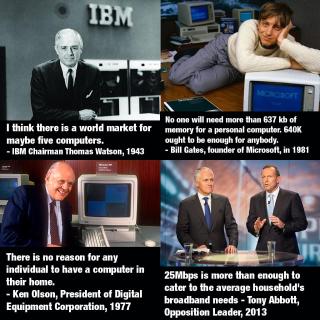 And while 25Mbps is an improvement on what we have now, and good enough for the sorts of things people do today (watching videos, shopping online, playing games), to say it will be good enough betrays a lack of imagination, or a deliberate narrowing of horizons that is all too familiar in Australian politics. Australia has always been the lucky country, borne at first on the sheep's back and now on Chinese demand for iron ore, which has led to a sclerotic apathy in terms of any sort of forward planning, in particular infrastructure and development. Combined with the stultifying conservatism of the Australian Right from Howard onwards, with its quasi-edenic visions of the conformistic white-picket-fenced utopia of the golden age of Menzies, the implicit message is clear: we are not Korea or Finland. We don't have a Nokia or a Samsung. We're a simple country. Our place in the world is to dig stuff up, put it on big ships and send it to China, and then to go home and relax in front of our big-screen TVs with a tinny of VB. That is all. It's a comfortable life, but we shouldn't get ideas beyond our station. All we need from the internet is to be able to shop online, pay the odd bill and download last week's episode of Jersey Shore a bit faster, and two rusty tin cans and a length of barbed wire fence is good enough for that. Well, that coupled with the sort of facile, nihilistically short-sighted anti-government rhetoric (infrastructure investment is “waste”; you can't prove it's not, so there) that the Abbott government-in-waiting has been borrowing from the US Tea Party.

LJ.Rossia.org makes no claim to the content supplied through this journal account. Articles are retrieved via a public feed supplied by the site for this purpose.