[Recent Entries][Archive][Friends][User Info]
Below are 7 entries, after skipping 20 most recent ones in the "Сообщество, посвящённое ра" journal:| December 18th, 2013 | |
|---|---|
| 08:38 pm [industrialterro] [Link] |
Leptocleidus Лептоклейд (Leptocleidus, от др.-греч. λεπτός «тонкий» и κλείς «ключица») — мелкий примитивный плиозавр раннемеловой эпохи. Возможно, происходит от раннеюрских ромалеозавров. Описан Ч. Эндрьюзом в 1922 году на основании фрагментарных остатков из раннего мела Англии. Название отражает строение плечевого пояса. Ключица и межключица крупные, лопатка небольшая. Череп небольшой, треугольный, длиной около 30 см, с развитым сагиттальным гребнем, идущим вдоль всей верхней поверхности черепа. Зубы немногочисленные (21 пара на верхней челюсти, 35 — на нижней). Рёбра одноголовчатые. 13-24 шейных позвонков, около 20 туловищных. По-видимому, питался разнообразной добычей — как рыбой, так и более крупными водными позвоночными, падалью. Мог обитать в лагунах и пресных водах. В длину не превышал 3 метров. Недавнее исследование скелета молодой особи около 1 метра длиной показало значительную подвижность шеи (в отличие от других плезиозавров). Типовой вид — Leptocleidus superstes (Andrews 1922), из раннего мела (готерив-барремий) Сассекса в Англии. Известны остатки из раннего мела острова Уайт. Это очень мелкое животное, не более 2 метров длиной. В 1911 году Эндрьюз описал частичный скелет с неполным черепом из валанжина Южной Африки как «Plesiosaurus» capensis, позднее выделенный в род Peyerus. Сейчас этот вид также относят к роду Leptocleidus. Наконец, в 1997 году три почти полных скелета лептоклейдов, отнесённых к особому виду Leptocleidus clemai были описаны из одновозрастных отложений Западной Австралии. Этот вид — самый крупный, до 3 метров длиной. Нельзя исключить, что все три вида относятся к географическим вариациям типового вида. Так называемый «Эрик» — полный скелет мелкого плиозавра из раннего мела (апт -альб) Кубер Педи в Южной Австралии одно время считался ещё одним представителем данного рода. Прозвище было дано в честь Эрика Айдла из «Монти Пайтон». В настоящее время этот плиозавр выделен в особый род и вид Umoonasaurus demoscyllus. Умуназавр отличался мелкими размерами — не более 2,5 метров в длину и необычным развитием зазубренных гребней на черепе. По-видимому, лептоклейды представляли реликтовую ветвь примитивных плиозавров, дожившую до середины мела преимущественно в Южном полушарии. Эта группа вымерла после появления поликотилид — возможно, экологически близких короткошеих эласмозавров. Последние исследования показывают близость лептоклейдов к поликотилидам, а обеих этих групп — к ромалеозаврам и плиозаврам. Leptocleidus is an extinct genus of pliosaurid plesiosaur, belonging to the family Leptocleididae. It is the only known pliosaur to be found in sediments on the Isle of Wight. With large clavicles and interclavicle and small scapulae, Leptocleidus resembled the Early Jurassic Rhomaleosaurus and members of the Cretaceous family, Polycotylidae. The animal had 21 teeth on either side of its maxilla and approximately 35 teeth on each side of the mandible. The Leptocleidus' triangle-shaped skull had a crest running from a ridge on the end of the nose to the nasal region. Differing from other pliosaurids, Leptocleidus had single-headed cervical ribs and a deep depression in the centra of the neck vertebrae. Leptocleidus was on an average of 3 meters (10 feet) long. Leptocleidus superstes however, was found to be almost 50% smaller (1.5m, 5 ft) making it the smallest known pliosaur species. Leptocleidus, unlike many pleisiosaurs, lived in shallow lagoons and likely visited brackish and fresh water systems (such as the mouths of large rivers). This led A. R. I. Cruikshank to infer that this movement to fresh water was an attempt to flee larger plesiosaurs and pliosaurs. Most species are known from The British Isles but L. capensis was discovered in Cape Province, South Africa. Leptocleididae is a family of small-sized plesiosaurs that lived during the Early Cretaceous period (early Berriasian to early Albian stage). Leptocleidus and Umoonasaurus had round bodies and triangle shaped heads. Hilary F. Ketchum and Roger B. J. Benson (2010), transferred Brancasaurus, Kaiwhekea, Nichollssaura and Thililua to this family. However, Ketchum and Benson (2011) reassigned Kaiwhekea and Thililua to their original positions, as an elasmosaurid and a polycotylid, respectively. ( Read More ) Tags: Вымершие рептилии, Мел, диапсиды, завроптеригии, лепидозавроморфы, лептоклейдиды, плезиозавроиды, плезиозавры |
| April 26th, 2012 | |
| 07:55 pm [industrialterro] [Link] |
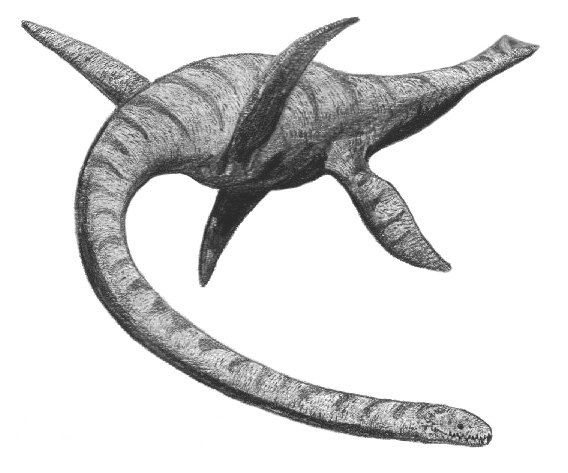
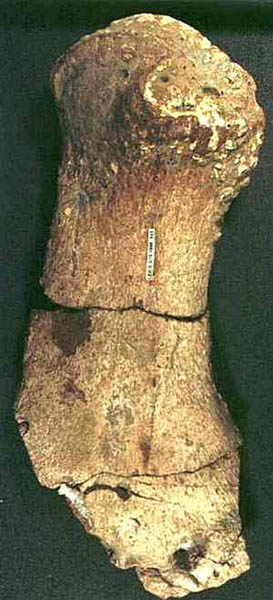
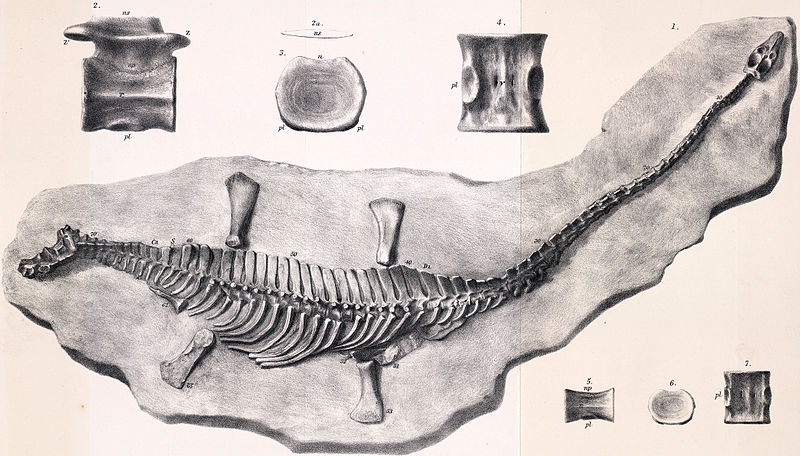
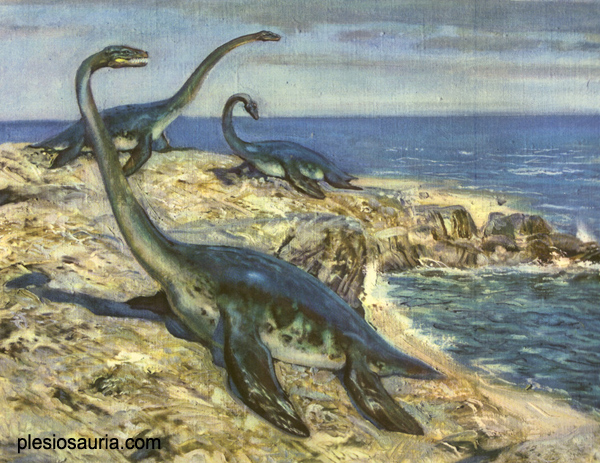
Plesiosaurus Plesiosaurus (Greek: πλησιος/plesios, near to + σαυρος/sauros, lizard) was a genus of large marine sauropterygian reptile that lived during the early part of the Jurassic Period, and is known by nearly complete skeletons from the Lias of England. It was distinguished by its small head, long and slender neck, broad turtle-like body, a short tail, and two pairs of large, elongated paddles. It lends its name to the order Plesiosauria, of which it is an early, but fairly typical member. It contains only one species, Plesiosaurus dolichodeirus. P. brachypterygius, P. guilielmiiperatoris and P. tournemirensis were assigned to new genera, Hydrorion, Seeleyosaurus and Occitanosaurus. Compared to other plesiosaur genera, Plesiosaurus has a small head. The skull is much narrower than long, reaching its greatest width just behind the eyes (the postorbital bar). The anterior portion is "bluntly triangular". In lateral view, the skull reaches its highest point at the rear of the skull table. "The external nostrils overlie the internal nares". They are not positioned at the tip of the snout, but farther back, nearer the eyes than the tip of the skull. Unlike the nostrils of Rhomaleosaurus, they do not appear to be adapted for underwater olfaction. The orbits (eye sockets) are roughly circular and are positioned about halfway along the length of the skull. They face up and to the sides. Just posterior to the orbits are the supratemporal fenestrae, which are about the same size as the orbits and also roughly circular. Between the four openings is the pineal foramen, and between the temporal fenestrae is a narrow sagittal ridge. As in other plesiosaurs, the pterygoids of the palate are fused to the basioccipital of the braincase, although the union is not as robust as in the pliosaurs Rhomaleosaurus and Pliosaurus. "The palatal bones are thin, but there is no suborbital fenestra." The two rami of the lower jaw make a "V" shape with an angle of about 45°. The specialized region where they meet, the symphysis, is robust. The two rami are fused at the symphysis, making a pointed, shallow scoop-like shape. The teeth of Plesiosaurus are "simple, needle-like cones" that are "slightly curved and circular in transverse section". They are sharply pointed with fine striations running from tip to base, and point forward (procumbent). This procumbency becomes more pronounced near the leading end of the skull, where they may be only 10-15° above horizontal. There are 20 to 25 teeth per upper jaw tooth row, and 24 per low jaw tooth row. Up to four teeth of a lower jaw's tooth row are found in the symphyseal region. Plesiosaurus was a moderately-sized plesiosaur that grew to a length of about 3.5 metres (11 ft). There are approximately 40 cervical vertebrae (neck vertebrae), with different specimens preserving 38 to 42 cervical vertebrae. Of the rest of the vertebral column, there are a handful (four or five in the holotype specimen) of "pectoral" vertebrae from the neck-torso transition, approximately 21 dorsal or back vertebrae, three or more sacral vertebrae, and at least 28 caudal vertebrae. Generally, the centra of the cervical vertebrae are relatively elongated, being slightly longer than tall. The width, however, is usually greater than or equal to the length. The articular surfaces of the cervical centra are "slightly concave and kidney-shaped, with rounded, slightly rugose edges." Small holes called foramina subcentralia are found on the ventral surface of the centra. Some of the dorsals have rugose articular edges, like the cervicals; this feature is typically absent from the caudals. Ribs are found from the neck to the tail. Cervical ribs are hatchet-shaped and have two articular heads. Dorsal ribs are thick and have only one head. Sacral ribs are "short, robust, and blunt or knob-like on both ends." Caudal ribs have different morphologies depending on their location along the tail, with anterior examples being pointed and more distal examples being "broad and blunt." Plesiosaurus also has gastralia, also known as "belly ribs." Nine or more sets of gastralia are present between the shoulder and pelvis. Each set is composed of seven elements: a bone on the midline flanked by three lateral elements. The shoulder girdle is only partly known but appears to be typical for plesiosaurs. It includes fused clavicles at the anterior end, scapulae (shoulder blades), and large coracoids. The scapulae and coracoids both contribute to the glenoids (arm sockets). A pair of oval holes called pectoral fenestrae are found midway along the scapular/coracoid contacts. The forelimbs are elongate and relatively narrow compared to those of most plesiosaurs. The humerus (upper arm bone) has distinctive curvature, which appears to be a retained primitive feature among sauropterygians. Mature Plesiosaurus also have a distinctive groove along the ventral surface of the humerus. The forearm includes a flat, broad, crescent-shaped ulna and a "robust and pillar-like" radius. The wrist includes six bones. The hand paddle has five digits; the phalangeal formula is uncertain, but the count for one large individual, from "thumb" to fifth "finger", is 4-8-9-8-6. The pelvis includes equant pubic bones, ischia, and blade-shaped ilia connecting the pelvis to the vertebral column. The acetabulum is formed by surfaces on the pubic bones and ischia. Similar to the pectoral girdle, there is a pair of holes between the ischia and pubic bones. The hindlimbs are long and narrow, and in adults, they are much smaller than the forelimbs. The thigh bones are straight. The lower hindlimb includes two roughly equal-sized bones, the robust tibia and the semilunate-shaped fibula. There are six bones in the ankle. The foot paddle includes five digits. Like the hand, the phalangeal formula is uncertain, but is at least 3-7-9-8-7 from innermost to outer "toe". Unequivocal specimens of Plesiosaurus dolichodeirus are limited to the Lyme Regis area of Dorset. It appears to be the most common species of plesiosaur in the Lias Group of England. Plesiosaurus is best represented from the "upper part of the Blue Lias, the 'Shales with Beef,' and the lower Black Ven Marls"; using the Lias Group ammonite fossil zones, these rocks date to the early Sinemurian stage. Some other Pleisosaurus fossils are from later Sinemurian rocks. The oldest specimen may be a skull thought to come from late Rhaetian or early Hettangian rocks. Plesiosaurus fed on belemnites, fish and other prey. Its U-shaped jaw and sharp teeth would have been like a fish trap. It propelled itself by the paddles, the tail being too short to be of much use. Its neck could have been used as a rudder when navigating during a chase. It is unknown if Plesiosaurus laid eggs on land like sea turtles or gave live birth in the water like sea snakes. The young might have lived in estuaries before going in the open ocean.
Репродукции (1, 2, 3, 4, 5, 6, 7, 8, 9):
( Далее ) Размеры тела в сравнении с человеком:
Ископаемые останки (1, 2, 3, 4, 5):
Tags: Вымершие рептилии, Юра, диапсиды, завроптеригии, лепидозавроморфы, плезиозавриды, плезиозавроиды, плезиозавры |
| April 25th, 2012 | |
| 07:22 pm [industrialterro] [Link] |
Muraenosaurus Муренозавр (Muraenosaurus) - род позднеюрских плезиозавров обитавших на территории современной Европы. Останки найдены в Англии, Франции, России. Животные достигали в длину приблизительно 6 метров и вели хищный образ жизни, питаясь, по большей части, рыбой. Хотя муренозавр известен, главным образом, по окаменелостям, найденным в Англии, очень сходные остатки были найдены в России, а также в Северной и Южной Америке. Весьма вероятно, что океанские животные такого типа существовали по всему миру. Хотя это был довольно крупный плезиозавр (длиной до 6 метров), один вид муренозавра - М. beloclis, отличался небольшими размерами: всего 2,5 м. Характеристики: шея муренозавра равна по длине телу и хвосту, вместе взятым, в ней 44 позвонка, крошечная голова занимает всего одну шестнадцатую часть длины всего животного. Голова довольно широкая, с коротким рылом. Зуб - от 19 до 22 пар на каждой челюсти, постепенно укрупняются к передней части пасти. Muraenosaurus grew to around 6 metres (20 ft) long, with around half of that length being taken up by the animal's neck, which possessed 44 vertebrae. Behind the neck, Muraenosaurus had a short, relatively inflexible body and powerful flippers. The head was remarkably small compared to the overall size of the animal, being only around 37 centimetres (15 in) long.
Размеры тела в сравнении с человеком (немного преувеличено):
Tags: Вымершие рептилии, Юра, диапсиды, завроптеригии, криптоклидиды, лепидозавроморфы, плезиозавроиды, плезиозавры |
| 07:15 pm [industrialterro] [Link] |
Microcleidus Microcleidus is an extinct genus of sauropterygian reptile belonging to the plesiosaur suborder. It was about the size of a medium sized dolphin, reaching a length of 3 metres (9.8 ft). Species include: Microcleidus homalospondylus (Owen 1865) and Microcleidus macropterus (Seeley 1865). The species has 40 neck vertebrae and a short tail of 28 vertebrae.
Tags: Вымершие рептилии, Юра, диапсиды, завроптеригии, лепидозавроморфы, плезиозавроиды, плезиозавры |
| 06:54 pm [industrialterro] [Link] |
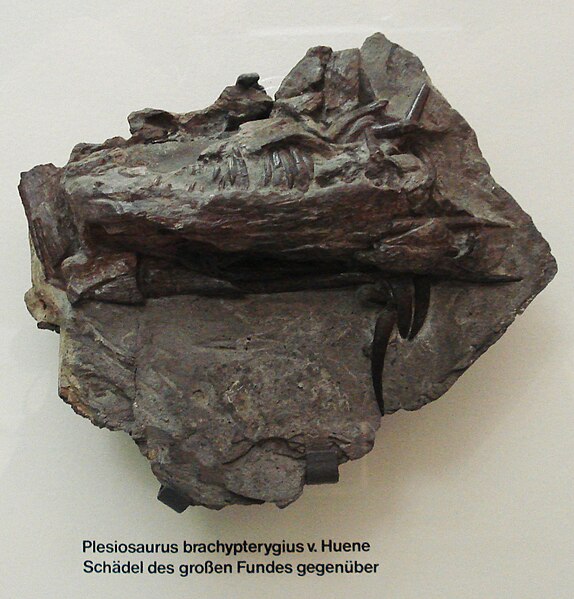
Hydrorion Hydrorion (meaning 'water hunter') is an extinct genus of plesiosaur. It was found in Jurassic formations in Germany. The only species is Hydrorion brachypterygius.
Tags: Вымершие рептилии, Юра, диапсиды, завроптеригии, лепидозавроморфы, плезиозавриды, плезиозавроиды, плезиозавры |
| April 21st, 2012 | |
| 05:46 pm [industrialterro] [Link] |
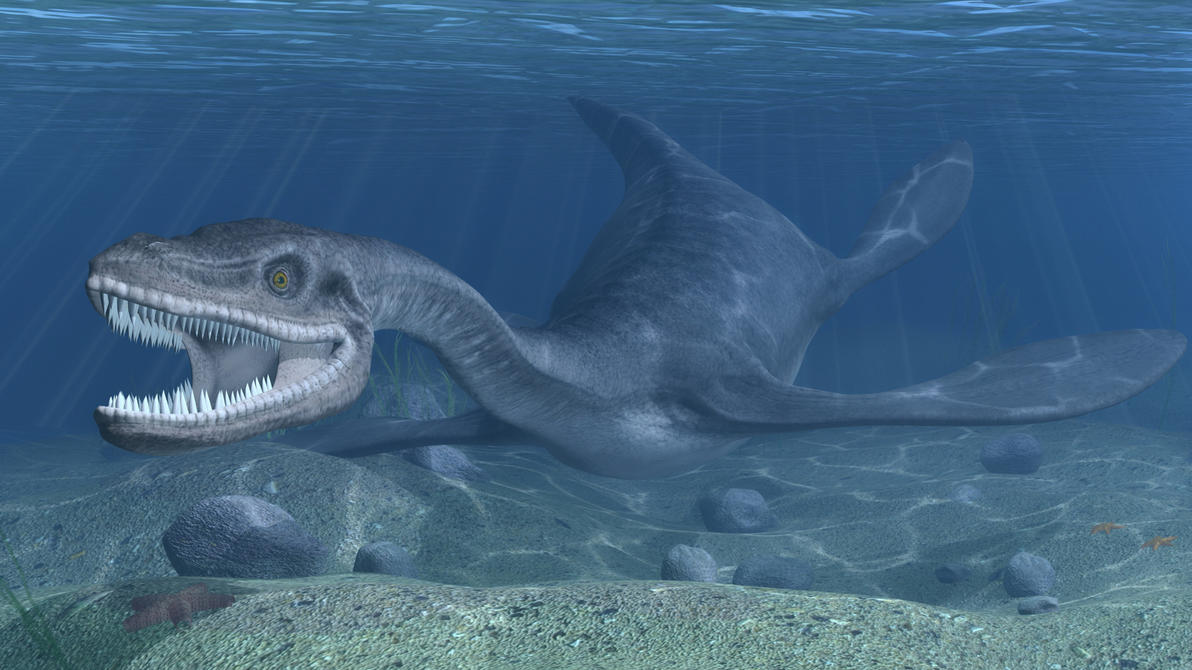
Cryptoclidus Криптоклиды (Cryptoclidus — "скрытая ключица") — род вымерших морских рептилий из отряда плезиозавров, датируемый поздним Юрским периодом (164—155 млн лет назад). Обитали на территории нынешней Англии, Франции и, возможно, Южной Америки. Целые скелеты Cryptoclidus euromerus находились в глинистых карьерах Оксфорда и Питерборо в Англии. Эта рептилия относилась к группе длинношеих плезиозавров и состояла в дальнем родстве с эласмозавром. Медлительный и сравнительно небольшой криптоклид, вероятно, нередко становился жертвой лиоплевродона и других крупных морских хищников. Криптоклид — это плезиозавр средних размеров, длиной до 4 метров, из которых шея с головой составляют 2 метра. Криптоклиды характеризуются длинной шеей, плоской головой и большим количеством острых зубов. Питались различной рыбой и беспозвоночными (например, аммонитами). Во время охоты он заплывал в крупный косяк рыб и, мотая из стороны в сторону своей двухметровой шеей, хватал жертв зубами. Cryptoclidus ( Cryptoclidus is estimated to have weighed about 8 tons. Its head was rather flattened, with eyes facing upward. The skull was broad and light, with jaws lined with about a hundred long, fine teeth, ideal for catching fish and squid. The internal nares were set forward, and the nostrils were relatively small. At up to 8 metres (26 ft) long, Cryptoclidus was a medium-sized plesiosaur. It had a neck that was up to 2 metres (6.6 ft) long that does not seem to have been very flexible. This probably kept its bulky body away from its small head so as not to alarm potential prey. It had four broad paddle-shaped limbs, with which it either "flew" through the water in wave-like undulating movements, or swam like a porpoise by moving upwards on two flippers and gliding back down again on the other two. Due to their seal-like body plan, small plesiosaurs such as Cryptoclidus have been depicted as amphibious animals instead of fully marine reptiles. Despite looking clumsy and cumbersome, in water it would have been relatively graceful, using all four limbs as paddles, to swim and hunt its prey. It may have laid eggs in sand, but this is conjectural. The fragile build of the head and teeth preclude any grappling with prey, and suggest a diet of small, soft-bodied animals such as squid and shoaling fish. Cryptoclidus may have used its long, intermeshing teeth to strain small prey from the water, or perhaps sift through sediment for buried animals. The size and shape of the nares and nasal openings have led Brown and Cruickshank (1994) to argue that they were used to sample seawater for smells and chemical traces.
Репродукции (1, 2, 3, 4, 5, 6):
Размеры тела в сравнении с человеком:
Ископаемые останки (1, 2, 3, 4, 5, 6):
( Далее ) Tags: Вымершие рептилии, Юра, диапсиды, завроптеригии, криптоклидиды, лепидозавроморфы, плезиозавроиды, плезиозавры |
| 05:02 pm [industrialterro] [Link] |
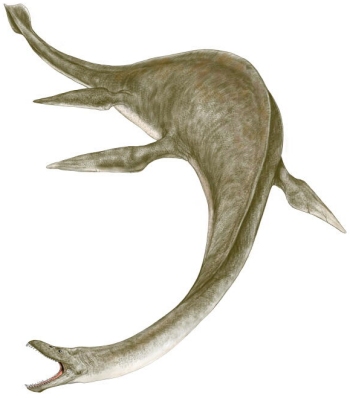
Attenborosaurus Attenborosaurus is an extinct genus of plesiosaur from the Early Jurassic of Dorset, England. The type species is A. conybeari. The genus is named after David Attenborough, the species after William Conybeare. Плезиозавры (Plesiosauria, греч. πλησιος — близкий, схожий, σαυρος — ящер) — отряд ископаемых пресмыкающихся, живших с триасового по меловой периоды (около 199,6 — 65,5 млн лет назад). Расцвет пришёлся на юру — ранний мел. Плезиозавры были прекрасно приспособлены к жизни в водоемах, хотя им приходилось выныривать на поверхность, чтобы вдохнуть воздуха. Имели четыре конечности, преобразованные в ласты, и бочкообразное тело. У одних были длинные шеи и маленькие головы, у других — короткие шеи и огромные головы. Обитали в солоноводных водоёмах — морях и океанах. Останки обнаружены на всех континентах, в том числе и в Антарктиде. В начале девятнадцатого века понятия плезиозавры еще не было. В то время также не было таких систематических таксонов как рыбы, млекопитающие и рептилии, не было никакой систематической разделенности внутри Ichthyosauria. В 1821 году Уильям Конибер и Генри Томас де ла Беш нашли некоторые отличия у исследуемых ими видов животных от ихтиозавра. Они назвали новую форму плезиозавром. В 1824 году в Англии, в окрестностях городка Лайм-Реджис, в скальной породе на берегу моря любитель-палеонтолог Мэри Эннинг откопала полный скелет раннеюрского плезиозавра вида Plesiosaurus dolishodeirus. Это была первая задокументированная находка плезиозавра. Мэри продала этот скелет. Скелет попал в руки палеонтолога Уильяма Коньирома, который в тот же год описал ящера. Затем Мэри обнаружила ещё два скелета. В 1868 году палеонтолог Эдвард Дринкер Коп описал из Верхнемеловых отложений Канзаса (США) плезиозавра Elasmosaurus platyurus. При реконструкции он совершил ошибку, поместив голову эласмозавра на кончик хвоста, а не на конец шеи. В дальнейшем соперник Копа, Гофнил Чарльз Марш, указал на эту ошибку. С тех пор останки плезиозавров обнаружены на всех материках, особенно останки многочисленны в юрских отложениях Европы; в СНГ останки плезиозавров встречаются в Среднем Поволжье, Заволжье, северо-западной части Казахстана и Якутии. Плезиозавры в основном питались моллюсками и рыбой. Крупные виды питались другими морскими рептилиями и летающими ящерами. Один из обнаруженных палеонтологами плезиозавров сохранил в области желудка остатки своей последней трапезы — труп летающего ящера, кости рыбы и раковину аммонита. Споры о способах размножения плезиозавров длятся вот уже 200 лет. Многие эксперты полагали, что из-за большого веса выбираться на берег и откладывать яйца животному было затруднительно, то есть они должны были быть живородящими. Первое прямое доказательство этой гипотезы было получено после тщательного изучения окаменелого скелета плезиозавра (он около 20 лет находился в подвале Музея естественной истории в Лос-Анджелесе).
Tags: Вымершие рептилии, Юра, диапсиды, завроптеригии, лепидозавроморфы, плезиозавриды, плезиозавроиды, плезиозавры |





















.jpg)


