[Recent Entries][Archive][Friends][User Info]
September 22nd, 2011
| September 22nd, 2011 | |
|---|---|
| 08:02 pm [industrialterro] [Link] |
Campbellodus Campbellodus decipiens is an extinct ptyctodontid placoderm fish that lived around 380 million years ago (Late Devonian). Its fossil remains have been found preserved in perfect three-dimensional form from the Gogo Formation of Western Australia. Originally it was described from large tooth plates and isolated skull roof bones by Miles & Young (1977). Long (1995) restored the complete fish based on new material found at Gogo in the mid 1980s, and described by Long (1997). Campbellodus has very short spinal plates, and is unusual in having a high dorsal spine formed by three median dorsal plates. The tooth plates are very robust and the upper plate has a high anterior spine.
Tags: Вымершие рыбы, Девон, Плакодермы |
| Time | Event |
| 08:10 pm [industrialterro] [Link] |
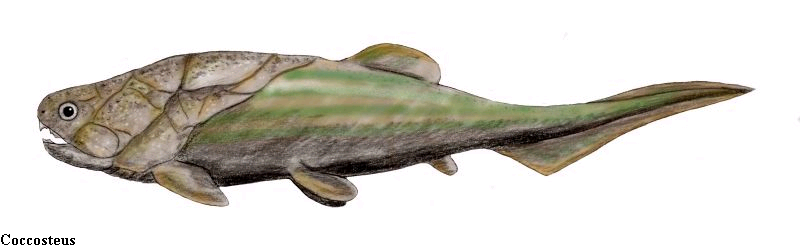
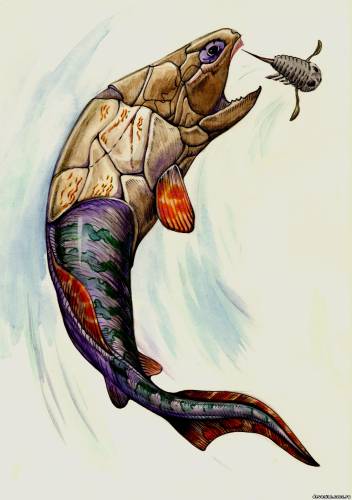
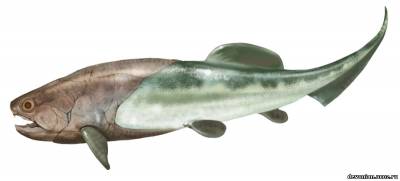
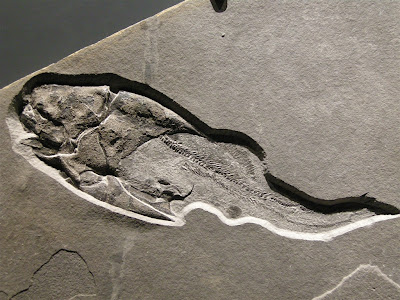
Coccosteus Coccosteus ("Seed Bone") is an extinct genus of arthrodire placoderm. Its fossils have been found throughout Europe and North America. The majority of these have been found in freshwater sediments, though, such a large range suggests that they may have been able to enter saltwater. The largest specimens were about 40 centimetres (16 in), although the average length was 20 to 24 centimetres (7.9 to 9.4 in). Like all other arthrodires, Coccosteus had a joint between the armor of the body and skull. In addition, it also had an internal joint between its neck vertebrae and the back of the skull, allowing for the mouth to be opened even wider. Along with the longer jaws, this allowed Coccosteus to feed on fairly large prey. The up-and-down movement of the skull also allowed for more water to be pumped through the gills. Possibly, the creature supplemented its diet with organic material filtered from mud using the gills. As with all other arthrodires, Coccosteus had bony dental plates embedded in its jaws, forming a beak. The beak was kept sharp by having the edges of the dental plates grind away at each other. Overall the creature looked similar to its gigantic cousin Dunkleosteus, save that its eyes were closer to the end of its snout than in its larger relative.
Ископаемые останки (1, 2, 3, 4, 5):
Tags: Вымершие рыбы, Девон, Плакодермы |
| Time | Event |
| 08:31 pm [industrialterro] [Link] |
Ctenurella Ctenurella ("Little Comb Tail") is an extinct genus of ptyctodont placoderm from the Late Devonian of Germany (Orvig 1960). As with other ptyctodonts, the armor of Ctenurella was reduced to a few thin plates on the head and shoulder region. It was also relatively small for a placoderm, at just 13 centimetres (5 in) in length. It had two dorsal fins, with that at the rear of the body being relatively long and low, and large pectoral and pelvic fins. Most ptyctodonts are presumed to have fed on the ocean floor, but the well-developed fins of this genus indicate that it probably also swam in open waters. Ctenurella had a long, whip-like tail, large eyes and robust upper and lower jaw tooth plates. It also had hook-shaped sex organs, known as claspers in males. Since all of these features are also found in the unrelated living chimaeras, they are thought to be an example of convergent evolution. Ctenurella gardineri was renamed as the new genus Austroptyctodus by Long (1997) in his review of the Gogo ptyctodontid species, relegating the genus Ctenurella as only coming from the German sites. A new description of Ctenurella gladbachensis by Long (1997) showed that the original restoration had wrongly restored the skull-roof as the central bones do in fact meet each other behind the nuchal plate. Ptyctodontid placoderms recently have been shown to give birth to live young, with two examples, Materpiscis and Austroptyctodus, both from the Gogo Formation of Western Australia, showing the presence of unborn embryos within the mother fishes (Long et al. 2008).
Tags: Вымершие рыбы, Девон, Плакодермы |
| Time | Event |
| 08:49 pm [industrialterro] [Link] |
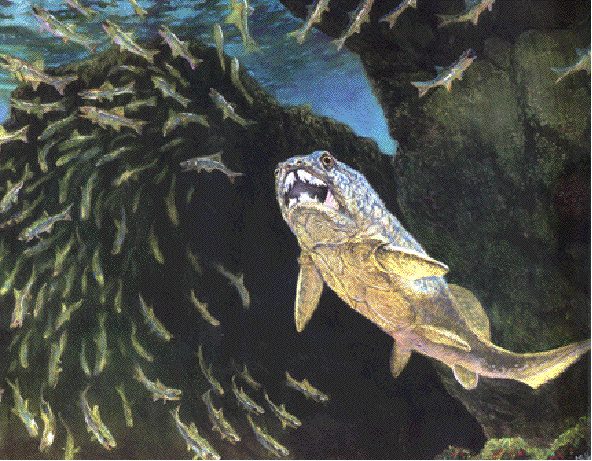
Eastmanosteus Eastmanosteus ("Eastman's bone shield") is a fossil genus of dinichthyid placoderms. It was closely related to the giant Dunkleosteus, but differed from that genus in possessing a distinctive tuberculated bone ornament, a differently shaped nuchal plate and a more zig-zagging course of the sutures of the skull roof. Species of Eastmanosteus had powerful jaws with sharp cutting edges and were likely active predators. Fossils have been found in many parts of the world in marine sediments dating from the Middle to Late Devonian. They were medium-to-large fish, with specimens E. pustulosus and E. licharevi approaching a total length of 3 metres. Complete exoskeletons with soft-tissue traces of E. calliaspis from Australia make this one of the best known dinichthyids. Eastmanosteus calliapsis Dennis-Bryan 1987 From the Frasnian Gogo Formation of northwestern Western Australia. This is the best known member of the genus with many articulated skulls and trunk armours in museum collections. Evidence of muscle fibres, circulatory structures and nerve tissue have been preserved representing some of the oldest known gnathostome soft tissue. The largest known skull is 272mm in length suggesting a total size of roughly 1.5m. It was one of the largest fish in the Gogo assemblage.
Tags: Вымершие рыбы, Девон, Плакодермы |
| Time | Event |
| 09:05 pm [industrialterro] [Link] |
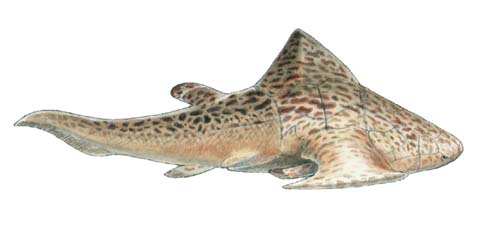
Gemuendina stuertzi Gemuendina stuertzi was an early placoderm species of the order Rhenanida, of the seas of Early Devonian Germany. Gemuendina resembled a scaly ray with a pair of staring eyes, a pug-nose, and an upturned mouth. This leads virtually all artists who reconstruct it to give the creature a quizzical, almost shocked expression. It is a good example of convergent evolution- with its flat body and huge, wing-like pectoral fins it is highly similar to rays. Unlike rays, both Gemuendina`s eyes and nostrils were placed atop the head. Unlike most other placoderms, such as the Antiarchs, or the Arthrodires, Gemuendina and its three other known relatives (six, if the species of Ohioaspis are considered to be rhenanids) had armor made up of a mosaic of unfused bony plates. Because their armor was so fragile, few examples of rhenanids have survived in the fossil record. Because several regions of the Hunsruck lagerstätte were anoxic, thus free of scavenging organisms, intact, nearly pristine (albeit flattened) specimens of G. stuertzi have been found as a result. Also unlike other placoderms, it did not have the characteristic tooth plates of placoderms. Instead, it had star-shaped tubercle scales that allowed it to seize, then swallow fish and other animals that swam too close with its mouth.
Tags: Вымершие рыбы, Девон, Плакодермы |
| Time | Event |
| 09:18 pm [industrialterro] [Link] |
Groenlandaspis Groenlandaspis ("Greenland Shield") is an extinct genus of armored placoderm. Groenlandaspis was a member of the Order Arthrodira, the most successful group of placoderms which also included the 10 metres (33 ft) superpredator Dunkleosteus. As with all other arthrodires, Groenlandaspis had a joint in the back of its head with its thoracic armor, allowing for its head to be thrown back, increasing its gape. However, as its head is somewhat compressed in comparison with many other arthrodires, and as the dorsal side came to a low, pyramid-like peak, it is believed that Groenlandaspis could not throw its head back very far. It was a relatively small fish, only 7.5 centimetres (3.0 in) in length, and lived on the ocean floor, where it is thought to have fed on either very small prey, or detritus; the small dental plates in its mouth strongly suggest that it was incapable of tackling large prey. This highly successful placoderm genus has been found throughout the world, though the first fossils were found in Greenland.
Репродукции (1, 2, 3, 4, 5, 6, 7):
Tags: Вымершие рыбы, Девон, Плакодермы |












| Previous Day | 2011/09/22 [Archive] |
Next Day |