[Recent Entries][Archive][Friends][User Info]
February 27th, 2013
| February 27th, 2013 | |
|---|---|
| 05:24 pm [industrialterro] [Link] |
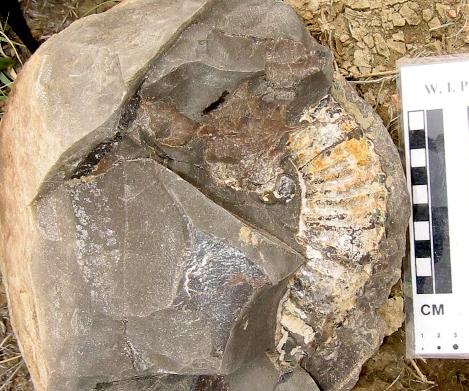
Collignoniceras Collignociceras is an evolute, strongly ribbed and tuberculate ammonite from the Upper Cretaceous of the western United States and Europe belonging to the Ammonitida family Collignoniceratidae. The type is Collignoniceras woollgari, named by Mantell in 1822 for specimens from Sussex, England. Wright in the 1957 Treatise on Invertebrate Paleontology, Page L426 gave the following description for Collignoniceras. Compressed in early stages, with rounded or high and clavate siphonal tubercles tending to form serrate keel; with straight or slightly sinuous ribs and weak umbilical and strong ventrolateral tubercles; later whorls tend to be squarer in section with exaggerated ventrolateral tubercles which may absort even the umbilile tubercle. Two subspecies are known from the Turonian of western North America, C. woollgari wooolgari and C. woollgari regulari. C. w. woollgari has been found with Mammites depressus at the top of the lower shale tongue and lowermost overlying Tres Hermanos sandstone member of the Mancos Shale in New Mexico, in a shale bed at the top of the Greenhorn Formation in Colorado, and alone in sandstone and shale in the upper Frontier Formation in Wyoming. The slightly younger C. w. regulari is known from the lower Carlile Shale, which overlies the Greenhorn. It has been found in U. S. western interior from as far west as northern Arizona and eastern Utah and from New Mexico to Montana.
Ископаемые останки (1, 2, 3, 4):
Tags: Аммониты, Вымершие беспозвоночные, Мел |
| Time | Event |
| 05:48 pm [industrialterro] [Link] |
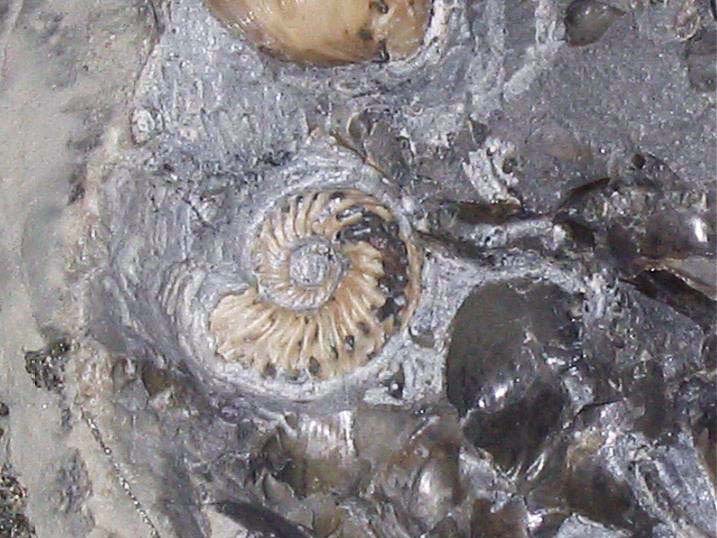
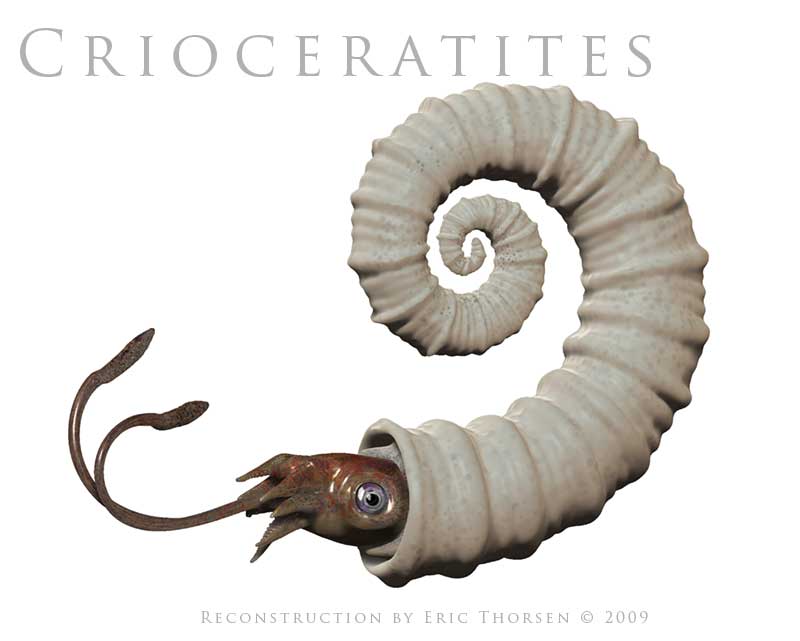
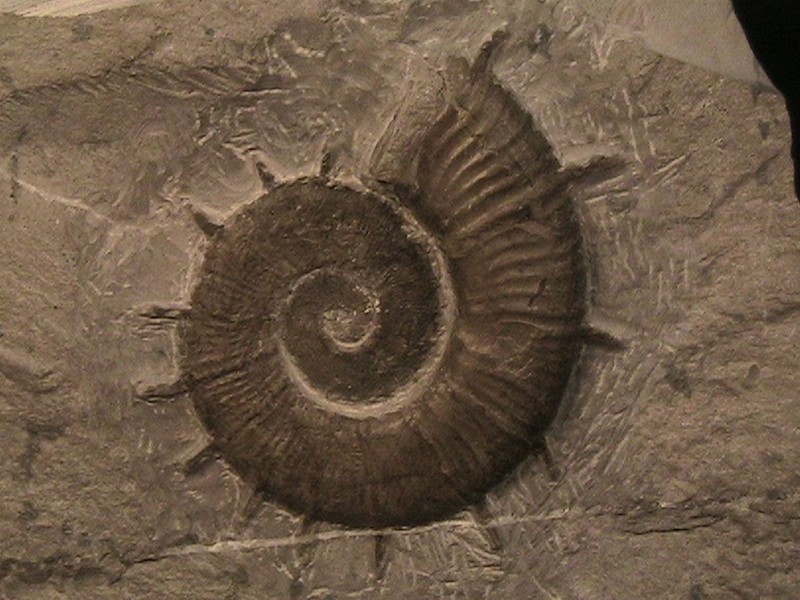
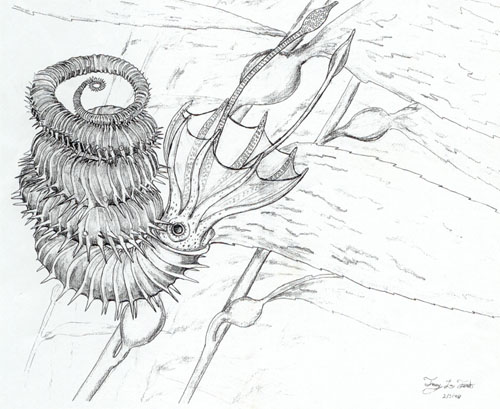
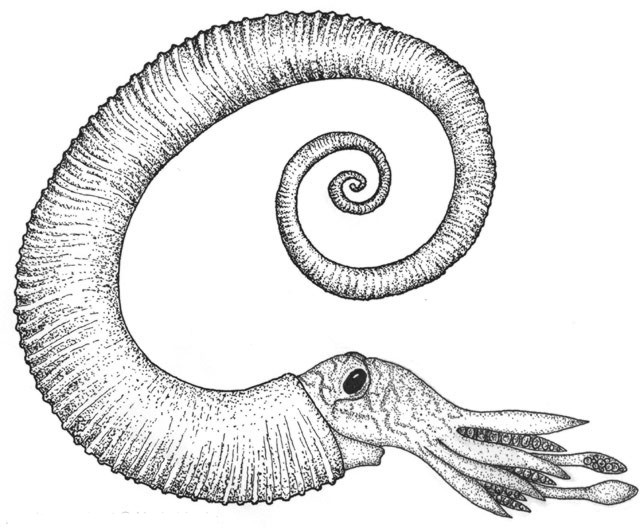
Crioceratites Crioceratites is an ammonite genus from the Early Cretaceous belonging to the Ancylocerataceae. Crioceritites is coiled in an open, normally equiangular spiral with an oval or subquadrate whorl section. The surface is banded by fine, dense, rounded ribbing sectioned by periodically spaced thick and often spinose ribs. Crioceratites was formerly included in the Ancyloceratidae, in the subfamily Crioceratinae which was subsequently elevated in rank to the family Crioceratidae. Crioceras and Toxoceras d'Orbigny and possibly Emericiceras Sarka 1954 are junior synonyms Crioceratities fossils have been found in Lower Cretaceous Hauterevian-Barremanian, sediments in Europe, Africa, Asia, North America and South America.
Ископаемые останки (1, 2, 3, 4, 5, 6):
Tags: Аммониты, Вымершие беспозвоночные, Мел |
| Time | Event |
| 06:02 pm [industrialterro] [Link] |
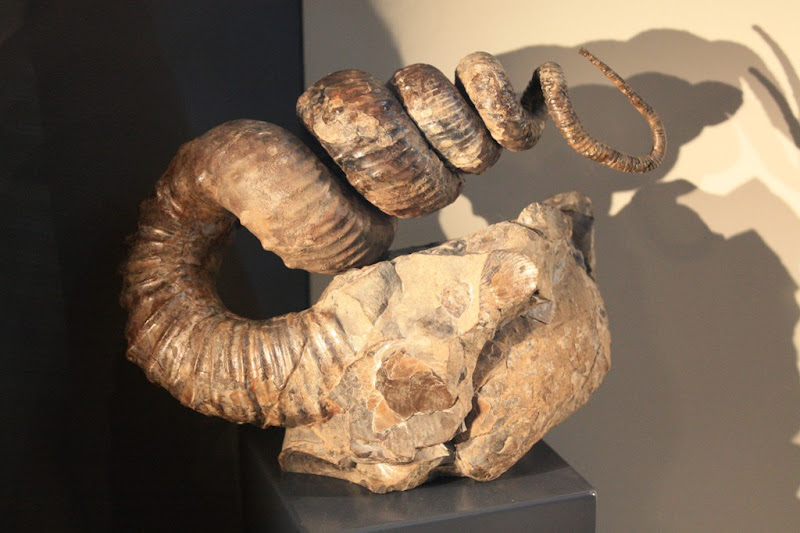
Didymoceras Didymoceras is an extinct genus of ammonite cephalopod. It is one of the most bizarrely shaped genera, with a shell that spirals upwards into a loose, hooked tip. It is thought to have drifted in the water vertically, moving up and down. The generic name is Latin for "paired horns". Its taxonomic place is often in flux, being placed in either Turrilitidae, Nostoceratidae, or its own family, Didymoceratidae. Didymoceras nebrascense was an extinct species of heteromorph ammonite from the upper Campanian age (around 83 to 70 million years ago). It was sexually dimorphic, with two adult sizes averaging at 270 mm (11 in) and 180 mm (7.1 in) high for females and males respectively. It exhibited three distinct growth stages. The first growth stage was composed of one or two straight sharply bending sections and a gently curved third. The second growth stage is composed of around three and a half loosely coiling whorls. The last (adult) growth stage is composed of a U-shaped bend facing upwards. Didymoceras nebrascense is relatively easily identifiable. It has three growth stages. The initial growth stage produces two more or less straight sections connected with each other by a sharply bent elbow. The sections are parallel to each other or diverging at an angle of 10° to 30°. The second, larger straight section is elliptical in cross-section, higher than it is wide. It connects to a third more broadly curving elbow. Like the second straight section, its cross section is also elliptical. Occasionally, some individuals only has one straight section and one curved section for the first growth stage. The middle growth stage begins at the end of the last curved limb of the first growth stage. It is composed of three and a half loosely coiled whorls. The whorls are usually widely separated, but some individuals display whorls that are just barely touching each other. The ribbing becomes denser than in the first growth stage and its cross-section is more or less circular. The third growth stage is that of the adult. It is composed of a single distinctive upward-facing U-shaped whorl. Ornamentation of Didymoceras nebrascense consists of a double row of nodes running along the ventral side. They are usually evenly matched with each other, but can sometimes alternate briefly. The straight sections of the first growth stage shows evidence of small sharp spines on the tubercles. The coiling can be to the left or right. Didymoceras nebrascense is sexually dimorphic, with adults showing two average heights - the smaller male adults (microconchs) had an average height of 180 mm (7.1 in); while the larger female adults (macroconchs) had the average height of 270 mm (11 in). Didymoceras nebrascense occurs in the western edge of the what was once an ancient sea that stretched from northern New Mexico to northeastern Montana in the upper Campanian age (around 83 to 70 million years ago) of the late Cretaceous. A putative specimen from the Mishash Formation of Israel has also been recorded in 1969. Didymoceras - еще один род семейства Nostoceratidae, достойный отдельного упоминания. В чем-то он похож на Nostoceras, но отличается большим размером, поскольку витки спирали не соприкасаются между собой. При этом они несут два ряда бугорков, пересекающих всю раковину или только жилую камеру. Самые молодые части раковины могут быть очень прямыми. Форма закручивания зависит от вида. У одних видов раковина закручивается направо, у других — налево. Виды этого рода часто встречаются в отложениях мела Европы и Америки. Одним из самых распространенных видов, представленных в Северной Америке, является Didymoceras nebracense, несущий два ряда выраженных бугорков и очень четкие ребра. Первые описания рода основывались на неполных образцах, что привело к ошибкам в классификации. В результате, часть ученых приписали его к другим родам, наподобие Cirrioceras, другие включили его в подрод Nostoceras.
Ископаемые останки (1, 2, 3, 4):
Tags: Аммониты, Вымершие беспозвоночные, Мел |
| Time | Event |
| 06:33 pm [industrialterro] [Link] |
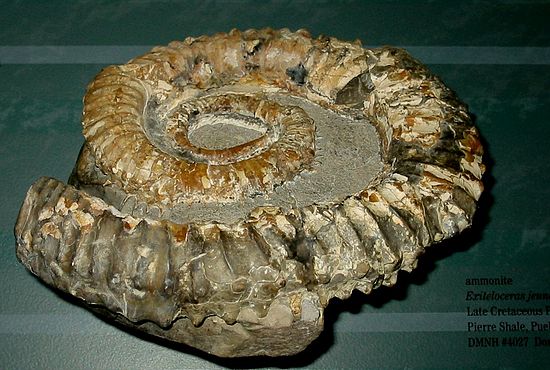
Exiteloceras Exiteloceras is an ammonite genus from the Late Cretaceous. Its fossils have been found in Egypt, Iraq, and North America. Exiteloceras was proposed by Alpheus Hyatt in 1894 for heteromorph ammonites with shells that are loosely coiled in a plane, early whorls varying from straight limbs connected by semicircular elbows to elliptical or nearly circular loops. Later whorls being elliptical to circular. Whorl section is ovate with the dorsum on the inside curve broader than the venter on the outside. Ribs may be straight or flexuous and mostly slant. Most end with a tubule on the ventrolateral shoulder. The suture is ammonitic. The deeply incised sutural elements are asymmetric, including the double pronged ventral lobe.
Tags: Аммониты, Вымершие беспозвоночные, Мел |
| Time | Event |
| 06:41 pm [industrialterro] [Link] |
Hamites Hamites ("hook-like") is a genus of heteromorph ammonite that evolved late in the Aptian stage of the Early Cretaceous and lasted into the Cenomanian stage of the Late Cretaceous. The genus is almost certainly paraphyletic but remains in wide use as a "catch all" for heteromorph ammonites of the superfamily Turrilitaceae that do not neatly fit into the more derived groupings. In an attempt to identify clades within the genus, it has been divided up into a series of new genera or subgenera by different palaeontologists, including Eohamites, Hamitella, Helicohamites, Lytohamites, Planohamites, Psilohamites, and Sziveshamites. The type species is Hamites attenuatus from the early Albian, named by James Sowerby in his Mineral Conchology of Great Britain of 1814, although the genus itself was created by James Parkinson in his 1811 book Organic Remains of the Former World. James Parkinson is best known as a man who made the first scientific description of a disease he called the Shaking Palsy, now referred to as Parkinson's disease in his honour. Hamites species are characterised by a shell that began with an open, sometimes helical, regular spiral that either opened into a single large hook, or else formed three parallel shafts that gave the mature shell the approximate appearance of a paper clip. No Hamites had spines or other such ornamentation on the shell, but several species appear to have developed apertural modifications when mature; that is, once the ammonite had grown to its final size, the aperture became constricted and was bounded by one or two thickened ribs, known as collars. These have been observed on other ammonites as well, and are assumed to be signs of sexual dimorphism. The open shell of these ammonites would have made them poor swimmers because of drag, but beyond that fact, very little is certain about their mode of life. It is widely assumed that they were planktonic, perhaps catching small prey in the manner of jellyfish, but repaired shell damage apparently caused by crabs may indicate that they spent at least some time close to the sea floor. The genus Hamites is of particular interest to palaeontologists because the species included in the genus span a wide range of morphologies including ones apparently similar to several more derived groups of heteromorph ammonites. The genus rapidly diversified during the Albian into a number of morphologically distinct lineages that seem to have given rise to at least three other families of heteromorphs, the Baculitidae, Turrilitidae, and Scaphitidae. The lineage that gave rise to the helical Turrilitidae, for example, had a shell that initially grew as a helix before straightening out; the Turrilitidae thus appear to have been derived from neotenic Hamites that retained the helically-coiled juvenile morphology of Hamites into adulthood.
Tags: Аммониты, Вымершие беспозвоночные, Мел |
| Time | Event |
| 07:00 pm [industrialterro] [Link] |
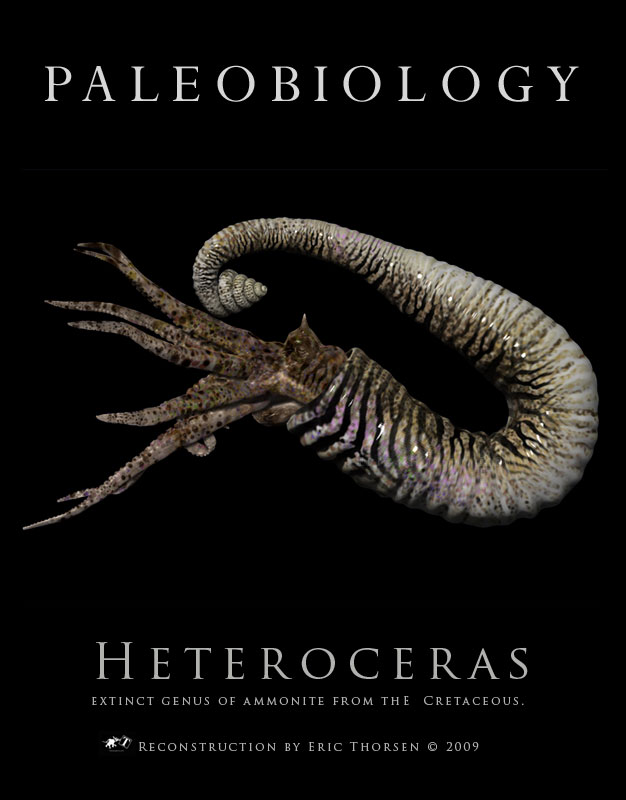
Heteroceras Heteroceras is a Lower Cretaceous heteromorph ammonite belonging to the ancyloceratacian family, Heteroceratidae, characterized by a helically coiled juvenile shell at the apex followed by slightly curved adult shaft, with a J-shaped section at the end of it. The shell is ribbed; ribs are concave and oblique on the helix, straight and transverse on the later stages. Heteroceras has been found in France, central Europe, the Caucasus, and Peru. Related genera are Hemibaculites and Cochidites. The family, Heteroceratidae, is a derivative of the Ancyloceratidae.
Ископаемые останки (1, 2, 3, 4):
Tags: Аммониты, Вымершие беспозвоночные, Мел |
| Time | Event |
| 07:21 pm [industrialterro] [Link] |
Mortoniceras Mortoniceras is an ammonoid genus belonging to the superfamily Acanthocerataceae, named by Meek in 1876, based on Ammonites vespertinu, named by Morton in 1834. Mortoniceras is the type genus of the Mortoniceratinae, one of 4 subfamilies in the Brancoceratidae which is part of the Acanthocerataceae (renamed Acanthoceratoidea to conform with the ICZN ruling on superfamily endings) Mortoniceras is found in middle and upper Albian sediments, at the end of the Lower Cretaceous in Africa, Europe, North America, and South America.
Ископаемые останки (1, 2, 3, 4):
Tags: Аммониты, Вымершие беспозвоночные, Мел |
| Time | Event |
| 07:33 pm [industrialterro] [Link] |
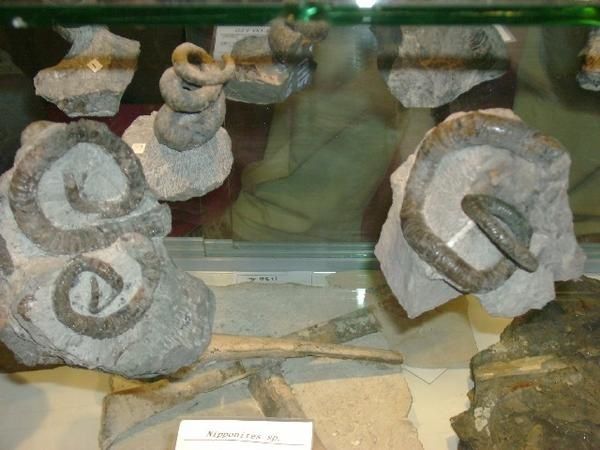
Nipponites Nipponites ("stone of Nippon") is an extinct genus of heteromorph ammonites. The species of Nipponites (primarily N. mirabilis) are famous for the way their shells form "ox-bow" bends, resulting in some of the most bizarre shapes ever seen among ammonites. The ecology of Nipponites, as with many other nostoceratids, is subject to much speculation.
Ископаемые останки (1, 2, 3, 4):
Tags: Аммониты, Вымершие беспозвоночные, Мел |
,%20kvas%20na%20papire,%202009%20(gouache%20on%20p.jpg)






















| Previous Day | 2013/02/27 [Archive] |
Next Day |