[Recent Entries][Archive][Friends][User Info]
June 9th, 2013
| June 9th, 2013 | |
|---|---|
| 05:10 pm [industrialterro] [Link] |
Albanerpeton Albanerpeton is an extinct genus of salamander-like lissamphibian found in North America and Europe. Members of the genus had a robust head and neck which likely allowed them to actively burrow, and they lived in a wide range of environments. This genus of amphibian was the last of its order, surviving until the late Pliocene in southern Europe, and likely went extinct when the region developed its present Mediterranean-type climate. Albanerpetontodae is an extinct family of superficially salamander-like lissamphibians. Albanerpetontids include four genera - Albanerpeton, Anoualerpeton, Celtedens, and Wesserpeton - and between 10 and 20 known species, spanning about 160 million years from the Bathonian stage of the Middle Jurassic to the end of the Pliocene. Albanerpetontids were long thought to be salamanders because of their small size and generalized body plans. However, these features are now thought to be ancestral for lissamphibians and not indicative of close relationships between the two groups. Albanerpetontids are now recognized as a distinct clade of lissamphibians separate from the three living orders of amphibians - Anura (frogs), Caudata (salamanders), and Gymnophiona (caecilians). They are thought to be more closely related to frogs and salamanders than to caecilians.
Tags: Вымершие амфибии, Мел |
| Time | Event |
| 05:56 pm [industrialterro] [Link] |
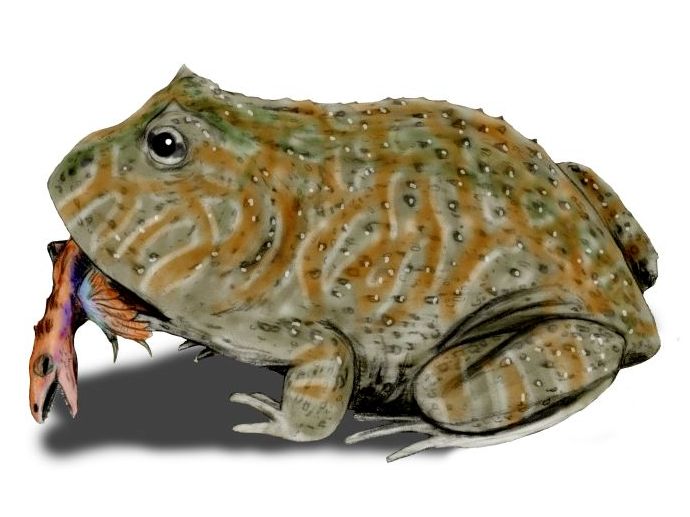
Beelzebufo Beelzebufo ampinga — гигантская ископаемая лягушка из семейства Ceratophryidae. Обитала на Мадагаскаре 70,6—65,5 млн лет назад (поздний мел). Описана в 2008 году. Название Beelzebufo происходит от греч. «Beelzebub» («Вельзевул»), что означает «дьявол», и латин. «bufo» — «жаба». Видовое название ampinga означает «щит» и соответствует защитному твердому покрову некоторых частей тела лягушки. Beelzebufo ampinga возможно была самой большой лягушкой из всех когда-либо существовавших, она достигала 40 см в длину (со сложенными ногами) и весила предположительно 4,5 кг — больше любой современной лягушки, в том числе самой большой из них лягушки-голиаф, которая достигает 32 см, и всех других лягушек, останки которых когда-либо были найдены. У нее было мощное телосложение, короткие ноги и очень широкий рот с мощными челюстями. Ближайшие современные родственники — лягушки-рогатки, обитающие в Южной Америке. Возможно, так же как и у них у Beelzebufo на голове были рога. Предполагают, что Beelzebufo ampinga населяла полузасушливые биотопы, была такой же агрессивной, как и современные лягушки-рогатки, так же нападала на добычу из засады и охотилась на мелких животных, скорее всего, небольших позвоночных, таких как мелкие млекопитающие, ящерицы и лягушки, а возможно, учитывая ее размеры, питалась и новорожденными динозаврами. The species may have grown to over 40 centimetres (16 in) and 4 kilograms (9 lb) — larger than any living frogs, including the largest known species, the goliath frog, which can be up to 32 centimetres (13 in). The bones of the skull roof shows a rugous external surface, indicating that at least parts of the head may have borne scutes. Although the fossils of Beelzebufo appear in what is now Madagascar, which, still attached to India, had split from the coast of Somalia in the earliest stage of the late Jurassic, it superficially resembles its closest living relatives, the Ceratophryinae or horned toads of South America, of which the largest today grow to 15 cm (6 in) long. As West Gondwana (South America) rifted away from East Gondwana, opening from the north and spreading southward, open marine conditions in the widening South Atlantic obtained by about 110 mya, isolating the amphibians on either side; the last common ancestor of Beelzebufo and the South American ceratophryinae is most likely to have existed before that date and probably before seafloor-spreading demonstrates the earlier isolation of Madagascar-India, a very long time undocumented by fossils. Alternatively the history of archaeogeography could be rewritten: Richard Lane, program director in NSF's Division of Earth Sciences, said "The occurrence of this frog in Madagascar and its relatives' existence in South America provides strong evidence that the supercontinent Gondwana 'disassembled' during the latest part of the Cretaceous." ( Read More )
Размеры тела в сравнении с человеком:
Размеры тела в сравнении с современной лягушкой-бык:
Tags: Бесхвостые, Вымершие амфибии, Мел |
| Time | Event |
| 06:28 pm [industrialterro] [Link] |
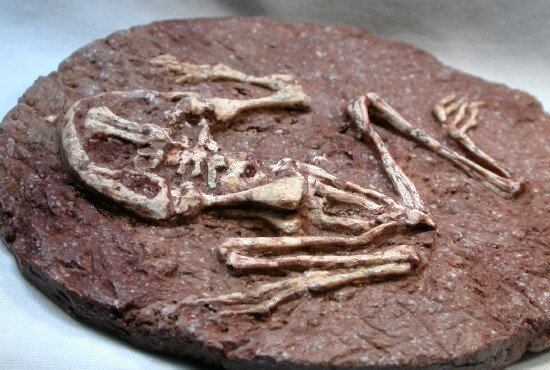
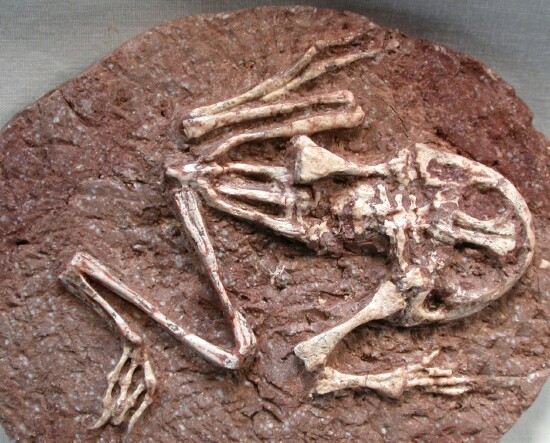
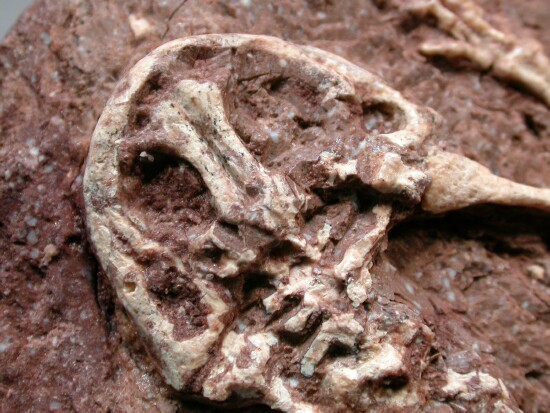
Callobatrachus Callobatrachus is an extinct genus of discoglossoid anuran amphibian from the Early Cretaceous-age Yixian Formation of Liaoning, China. It was described in 1999 by K. Gao of the American Museum of Natural History and Y. Wang of the Chinese Academy of Sciences. Discovered in the Sihetun locality of the western part of Liaoning province, in the lower part of the Yixian Formation, the fossil dates to approximately 124.6 Ma. Callobatrachus is considered to be the most basal member of Discoglossidae based on phylogenetic analysis. As frogs are rarely found as articulated skeletons in the fossil record, the discovery of this new taxon has provided important insight into anuran evolution. The holotype, IVPP V11525, is known from a nearly complete skeleton exposed in a dorsal view on a shale slab. Its total body length (from snout to vent) is estimated at approximately 94 mm. It differs morphologically in many respects from all other discoglossoids, including the number of presacral vertebrae (9 instead of the usual 8) and other primitive characters. Although it had a mosaic of primitive and derived characters, it can be unequivocally placed as the most basal taxon of the clade. This shows that the taxon diverged early from the stem and evolved separately as a distinct lineage by the Early Cretaceous in East Asia. The skull is described as being short and wide and is well preserved. The maxillary region is less well-preserved but it can be determined that each premaxilla bears 18-20 slender and conical teeth, and the maxilla bears approximately 40-50 fine pedicellate teeth. The vertebral column consists of nine presacral vertebrae, a single sacral vertebra, and a free urostyle. Three pairs of ribs were found associated with presacrals II-IV. The hind limbs are remarkably well-preserved and are slenderly built, with an approximate total length of 116 mm. Its hind feet have the phalangeal formula 2-2-3-4-3, with its fourth digit being the longest at 27 mm. Before its description, Callobatrachus was announced in Chinese media as "sanyanlichan".
Ископаемые останки (1, 2, 3, 4):
Tags: Бесхвостые, Мел. Вымершие амфибии |
| Time | Event |
| 06:55 pm [industrialterro] [Link] |
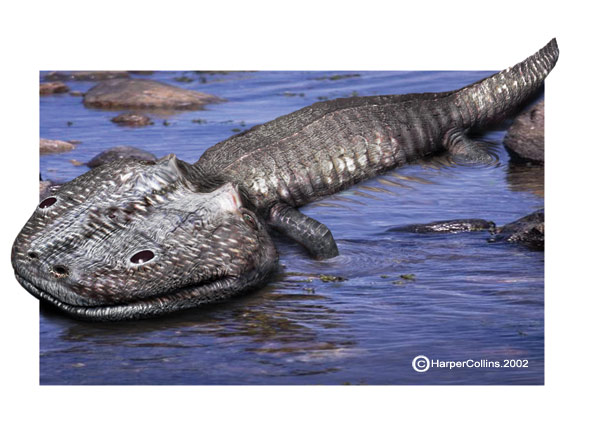
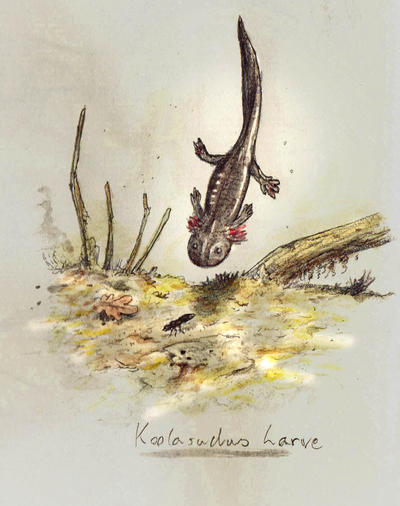
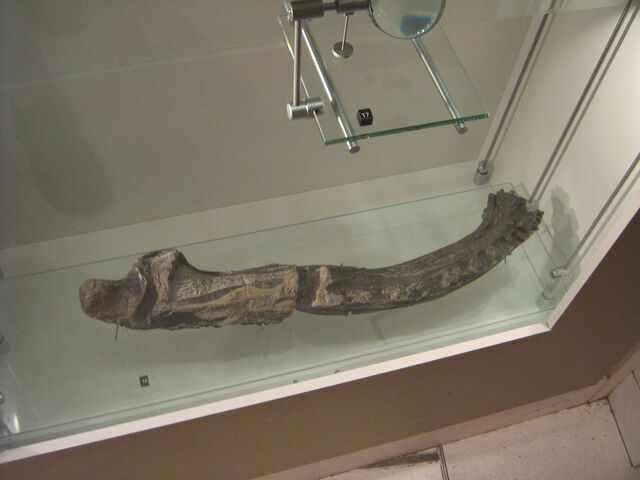
Koolasuchus Кулазух (Koolasuchus cleelandi — Крокодил Лесли Кула) — крупная амфибия, жившая в раннем меловом периоде, 140—112 млн лет назад, из семейства хигутизаврид (Chigutisauridae). В 1989 году были найдены две 80-сантиметровые челюсти кулазуха около города Сан-Ремо в Австралии. Кулазух назван в честь известного палеонтолога Лесли Кула. Данный вид, как и все амфибии, комфортно чувствовал себя и в воде, и на суше, но большую часть времени проводил в водоёмах. Кулазух внешне был похож на современных крокодилов: он имел похожую форму туловища и короткие лапы, но размеры его достигали гораздо большей величины, примерно до 5 - 6 метров в длину и весом почти в тонну. Останки кулазуха были найдены в Австралии, которая в раннем меловом периоде располагалась за Южным полярным кругом. Среднегодовая температура там составляла всего +10°С. Полгода в тех местах длился полярный день и столько же - полярная ночь. Зима была снежной и холодной, поверхность водоёмов на полгода сковывалась льдом. Очевидно, кулазухи впадали в спячку, в которой проводили подо льдом весь холодный период, как это делают современные лягушки. Кулазух был хищником, о чём говорят его многочисленные острые конические зубы (каждый до 10 см высотой), количество которых могло доходить до сотни, и прочный массивный череп. Его добычей могли быть ракообразные, моллюски, рыба и даже мелкие динозавры. Предполагают, что кулазухи могли по вибрации воды определить присутствие жертвы. Как и крокодилы, кулазух подстерегал свою добычу, и, когда она проплывала мимо, хватал её. Koolasuchus is an extinct genus of brachyopoid temnospondyl in the family Chigutisauridae. Fossils have been found from Victoria, Australia and date back 120 Ma to the Aptian stage of the Early Cretaceous. Koolasuchus is the latest known temnospondyl. Koolasuchus is known from several fragments of the skull and other bones such as vertebrae, ribs, and pectoral elements. The type species K. cleelandi was named in 1997. Koolasuchus was an aquatic temnospondyl estimated to have been around 4 to 5 metres (13 to 16 ft) in length. Its mass has been estimated to be up to 500 kilograms (1,100 lb). Although represented by incomplete material, the skull was likely 65 centimetres (26 in) long. Like other chigutisaurids, it had a wide, rounded head and tabular horns projecting from the backside of the skull. Koolasuchus inhabited rift valleys in southern Australia during the Early Cretaceous. During this time the area was below the Antarctic Circle, and temperatures were relatively cool for the Mesozoic. Based on the coarse-grained rocks in which remains were found, Koolasuchus likely lived in fast-moving streams. As a large aquatic predator, it had a similar lifestyle to crocodilians. Although crocodilians were common during the Early Cretaceous, they were absent from southern Australia 120 million years ago, possibly because of the cold climate. By 110 Ma, represented by rocks in the Dinosaur Cove fossil locality, temperatures had warmed and crocodilians had returned to the area. These crocodilians likely displaced Koolasuchus, leading to its disappearance in younger rocks.
Размеры тела в сравнении с человеком и остромордым крокодилом:
Tags: Вымершие амфибии, Лабиринтодонты, Мел, Темноспондилы |
| Time | Event |
| 07:37 pm [industrialterro] [Link] |
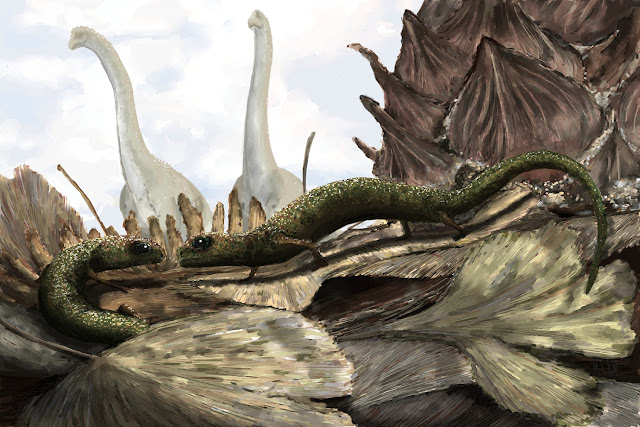
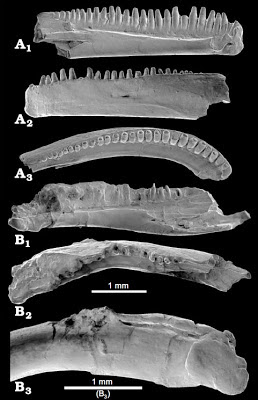
Wesserpeton Wesserpeton is an extinct genus of albanerpetontid amphibian known from the Isle of Wight, southern England. Wesserpeton is known from the holotype NHMUK PV R36521, nearly complete fused frontals and from the referred materials NHMUK PV R36522–36568 and R36595–36611. All specimens were collected from seven localities of the Wessex Formation on the southeastern coast of the Isle of Wight of southern England. The type locality (Bed 38) is exposed at Yaverland while the rest (Bed L2) are exposed high in the cliff at Sudmoor Point but have yielded only NHMUK PV R36539, R36522 and R36553–36558. All specimens are dating to the Barremian stage of the Early Cretaceous. Wesserpeton was first named by Steven C. Sweetman and James D. Gardner in 2013 and the type species is Wesserpeton evansae. The generic name is derived from Wess, from Wessex, an ancient British kingdom which included the Isle of Wight, and ἑρπετόν, erpeton, Greek for "creeping animal" which used in the construction of the name of Albanerpeton. The specific name honors Professor Susan E. Evans from the University College London for contributing the research of microvertebrate palaeontology and the understanding of Albanerpetontidae. Крошечную, но очень темпераментную амфибию обнаружили ученые в раннемеловых отложениях Британии. Древнее земноводное, похоже, отличалось задиристым характером, из-за которого даже получило при жизни перелом челюстных костей. Новое животное, получившее название Wesserpeton evansae, описал палеонтолог Стивен Свитман из Портсмутского университета. Внешне эта принадлежащая к группе Albanerpetontidae амфибия напоминала современных тритонов, но, в отличие от них, ее кожу покрывала чешуя, а глаза защищали настоящие веки. Эти признаки указывают на преимущественно сухопутный образ жизни. Кроме того, некоторые детали строения скелета говорят о том, что вессерпетоны отлично умели рыть землю и возможно, какую-то часть своего времени проводили в норах. Зубы этих амфибий выдают в них прирожденных хищников, а одна из найденных Свитманом челюстных костей вессерпетона оказалась сломана, но потом успешно срослась. Исследователи считают это повреждение свидетельством агрессивности и смелости мелких амфибий. По всей вероятности, как и современные саламандры, меловые Wesserpeton устраивали ожесточенные схватки из-за самок и территорий. "Когда я только начинал искать мелких животных, живших во времена динозавров, челюсти Wesserpeton были первым, что я нашел. Я до сих пор помню, как был взволнован, и подумал, что этот албанерпетонтид был чертовски ротастым для такого крошечного существа", – рассказал Свитман. По его словам, остатки Wesserpeton держат рекорд по частоте встречаемости среди всех 50 различных видов мелких тетрапод, обнаруженных палеонтологом в ходе исследований. "Ясно, что он был хорошо приспособлен к экологическим условиям поймы древней реки, в которой жил", – отметил ученый. Пока не найдено ни одного более-менее полного скелета вессерпетона, зато в отдельных костях у ученых недостатка нет, так что строение животного изучено вполне основательно. Оно удивительным образом дополняет мозаику черт, известных у других албанерпетонтид, живших на Земле с середины юрского периода до конца плиоцена. За эти 165 миллионов лет форма костей черепа амфибий постепенно менялась с колоколообразной к треугольной, и меловой Wesserpeton прекрасно вписался в эволюционный ряд, аккуратно заполнив предназначенный для него пробел. Остатки новой мезозойской амфибии портсмутские палеонтологи нашли на острове Уайт, известном как "Остров динозавров". В этом местонахождении раньше уже были встречены гигантские зауроподы, игуанодонты и хищный теропод Neovenator. Недавно PaleoNews писали о птерозавре Vectidraco daisymorrisae, которого нашла на острове Уайт пятилетняя девочка Дейзи Моррис. Родовым именем Wesserpeton обязан геологической формации Уэссекс (Wessex), в породах которой его нашли, сообщает Independent.
Tags: Вымершие амфибии, Мел |









| Previous Day | 2013/06/09 [Archive] |
Next Day |