[Recent Entries][Archive][Friends][User Info]
Below are the 6 most recent journal entries recorded in the "Сообщество, посвящённое ра" journal:| February 14th, 2012 | |
|---|---|
| 08:16 pm [industrialterro] [Link] |
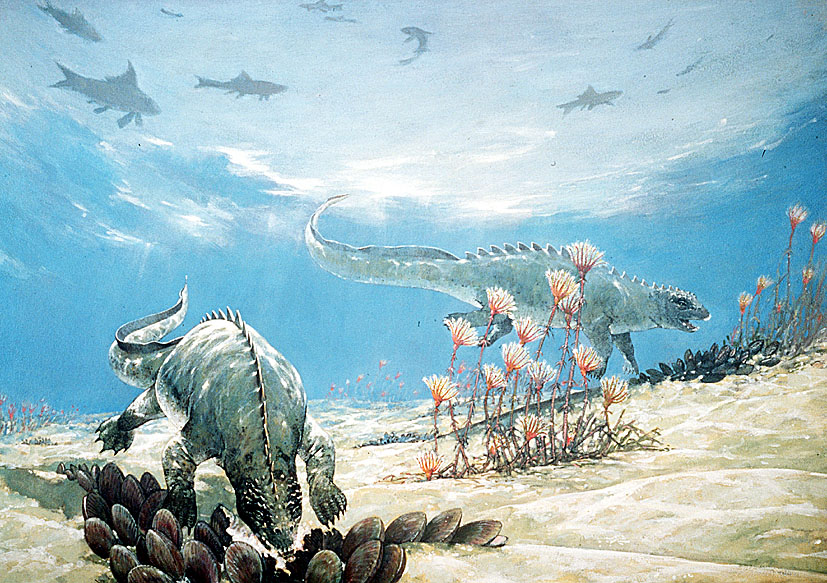
Placodus Placodus (meaning 'flat tooth') was a genus of marine reptiles, belonging to the order Placodontia, which swam in the shallow seas of the middle Triassic period (c. 240 million years ago). Fossils of Placodus have been found in Central Europe (Germany, France, Poland) and China. Placodus had a stocky body with a long tail, and reached a total length of up to 2 metres (6.6 ft). It had a short neck, and a heavy skull. They were specialized for a durophagous diet of shellfish, such as bivalves. Chisel-like incisors protruded from the anterior margin of the snout, and were probably used to pluck hard-shelled benthic prey from the substrate. The back teeth were broad and flattened, and would have helped to crush the prey. Before the animals' anatomy was known, they were regarded as fishes' teeth. Similar smaller teeth were present on the palatine bones. Placodus and its relatives were not as well-adapted to aquatic life as some later reptile groups, like the closely related plesiosaurs. Their flattened tails and short legs, which probably ended in webbed feet, would have been their main means of propulsion in the water. The parietal eye on top of the head assisted the animal with orientation, rather than its vision, and its presence is regarded as a primitive characteristic. The vertebral processes of Placodus dove-tailed into each other and were firmly connected, so that the trunk was rigid. The abdomen was covered with a special armor formed of the bent, right-angled abdominal ribs. Equipped with dense bones, heavy belly ribs, and a row of bony knobs above the backbone, Placodus was a heavily built and negatively buoyant creature that would have had no trouble staying on the seafloor to feed. This body armour would have offered protection from predators as well, but would have also hampered mobility on land, making Placodus slow and clumsy out of water. It was therefore most likey a terrestrial animal that ventured into the sea in search of food. Molluscs, brachiopods, crustaceans, and other inhabitants of the seabed would have formed its staple diet. Плакодус - один из ящеров семейства плакодонтов триасового периода, заслуживающий особенного внимания. Это был мощный, неуклюжий плакодонт с бочковидным телом, не отличающийся гибкими движениями и питающийся жителями прибрежной полосы водоёмов. В поисках пищи плакодус нерасторопно шёл в воду и нырял недалеко от берега, соскребая со дна моллюсков, ракообразных и других водных малоподвижных животных. В основном, он проводил время, лёжа на каменном берегу около воды и спал, не обращая внимания на ползающих по нему насекомых, потому что он их просто не ощущал, вследствие наличия бронированной кожи, которая также защищала его от крупных хищников. По воззрениям неких исследователей, плакодусы обладали очень увлекательной особенностью – третьим глазом в теменной области, при помощи которого они могли еще лучше видеть окружающий мир, по сравнению с остальными плакодонтами, и легче обнаруживать опасность. Плакодусы вымерли в конце триаса, но их отличительная черта в виде атавизма встречается и у современных пресмыкающихся - новозеландских гаттерий. Но и у них со временем произошла значительная деградация третьего глаза, в наше время он только немного различает изменение светотени.
Они походили на крупных горбатых ящериц и были одними из первых морских пресмыкающихся. У них имелись перепончатые лапы и уплощенный хвост, а кроме того -несколько других приспособлений, облегчавших им жизнь в море. У плакодусов была короткая голова и три вида зубов: зубы, напоминавшие резцы и торчащие спереди на обеих челюстях, округлые зубы по бокам и шесть уплощенных зубов на небе, из чего можно заключить, что плакодусы питались мелководными моллюсками, собирая их на подводных камнях и потом переламывая челюстями. Плакодусы принадлежали к пресмыкающимся плакодонтам, имевшим особо прочный скелет и в некоторых случаях защищенным костным панцирем. Однако плакодонты вымерли в самом конце триасового периода.
         Tags: Вымершие рептилии, Триас, диапсиды, завроптеригии, лепидозавроморфы, плакодонты |
| 07:54 pm [industrialterro] [Link] |
Placochelys Placochelys ('flat-plate turtle") is an extinct genus of reptile from the Triassic period of Germany. Placochelys looked remarkably similar to a sea turtle, and grew to about 90 centimetres (3.0 ft) in length. It had a flat shell covered with knobbly plates, and a compact skull. Its skull had beaked, mostly toothless jaws with powerful muscles, and specialized broad teeth on the pallet, which were most likely used for crushing shellfish. Its limbs were paddle-shaped for swimming, although, unlike modern sea turtles, they still had clear toes, and it also had a short tail.
Tags: Вымершие рептилии, Триас, диапсиды, завроптеригии, лепидозавроморфы, плакодонты |
| February 13th, 2012 | |
| 07:45 pm [industrialterro] [Link] |
Henodus Henodus chelyops ("Turtle-Faced Single Tooth") was a placodont of the Late Triassic period during the early Carnian age. Fossils of Henodus chelyops were found in Tübingen, Germany. It was around 1 metre (3.3 ft) in length. Henodus was the placodont that had the greatest (albeit superficial) resemblance to a turtle. Like turtles, it had a shell formed from a plastron on the underside and a carapace on top. The carapace extended well beyond the limbs, and was made up of individual plates of bony scutes covered by plates of horn. However, the shell was composed of many more pieces of bone than that of turtles, forming a mosaic pattern. The armor was fused to its spine, and its limbs were situated in normal positions, unlike the turtle, where they are located inside the ribcage. The weak limbs of Henodus suggest it spent little, if any time on land. Henodus chelyops also had a single tooth on each side of its mouth, though the remaining teeth were replaced by a beak. These teeth were flat to crush bottom dwelling shellfish. The head was squared-off at the front, just ahead of the eyes. Henodus is the only placodont thus far found in non-marine deposits, suggesting it may have lived in brackish or freshwater lagoons. Henodus - один из самых замечательных плакодонтов. Это курьезное пресмыкающееся длиной свыше 1 метра жило в триасе, его остатки найдены близ западногерманского города Тюбинген. Генод имел прямоугольную голову и неуклюжее приземистое туловище, целиком покрытое могучим панцирем, подобным черепашьему, у него сохранилось лишь четыре Геноды обитали в солоноватоводных, спокойных лагунах позднего триаса Центральной Европы. Их короткое (до 1 м) тело было заключено в широкий панцирь до области таза, конечности небольшие, тонкие, а относительно длинный хвост был покрыт костными пластинами. Череп почти прямоугольный. В задней части неба генода по обеим сторонам имелось по одному уплощенному зубу. От этих зубов до переднего режущего края морды вели бороздки, предположительно вмещавшие хитиновые пластинки. Возможно это был цедильный аппарат и генод питался мелкими придонными организмами.
Ископаемые останки (1, 2, 3, 4, 5):
Tags: Вымершие рептилии, Триас, диапсиды, завроптеригии, лепидозавроморфы, плакодонты |
| 07:40 pm [industrialterro] [Link] |
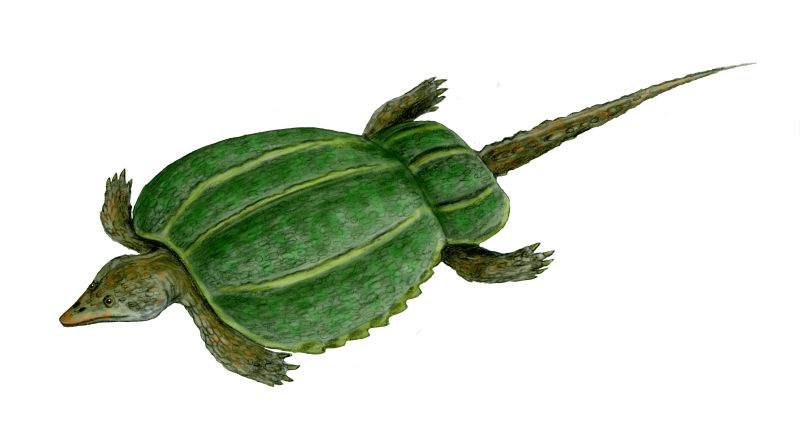
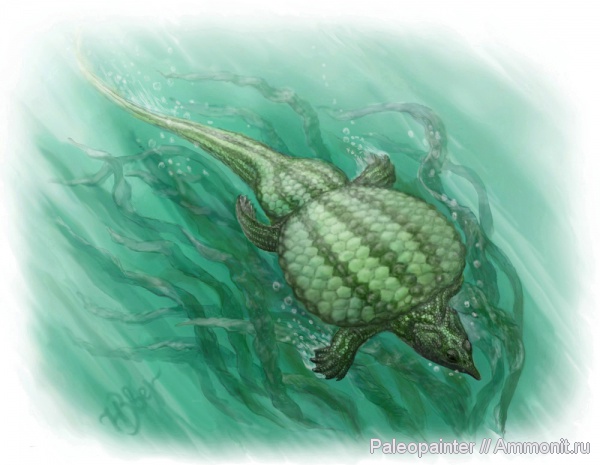
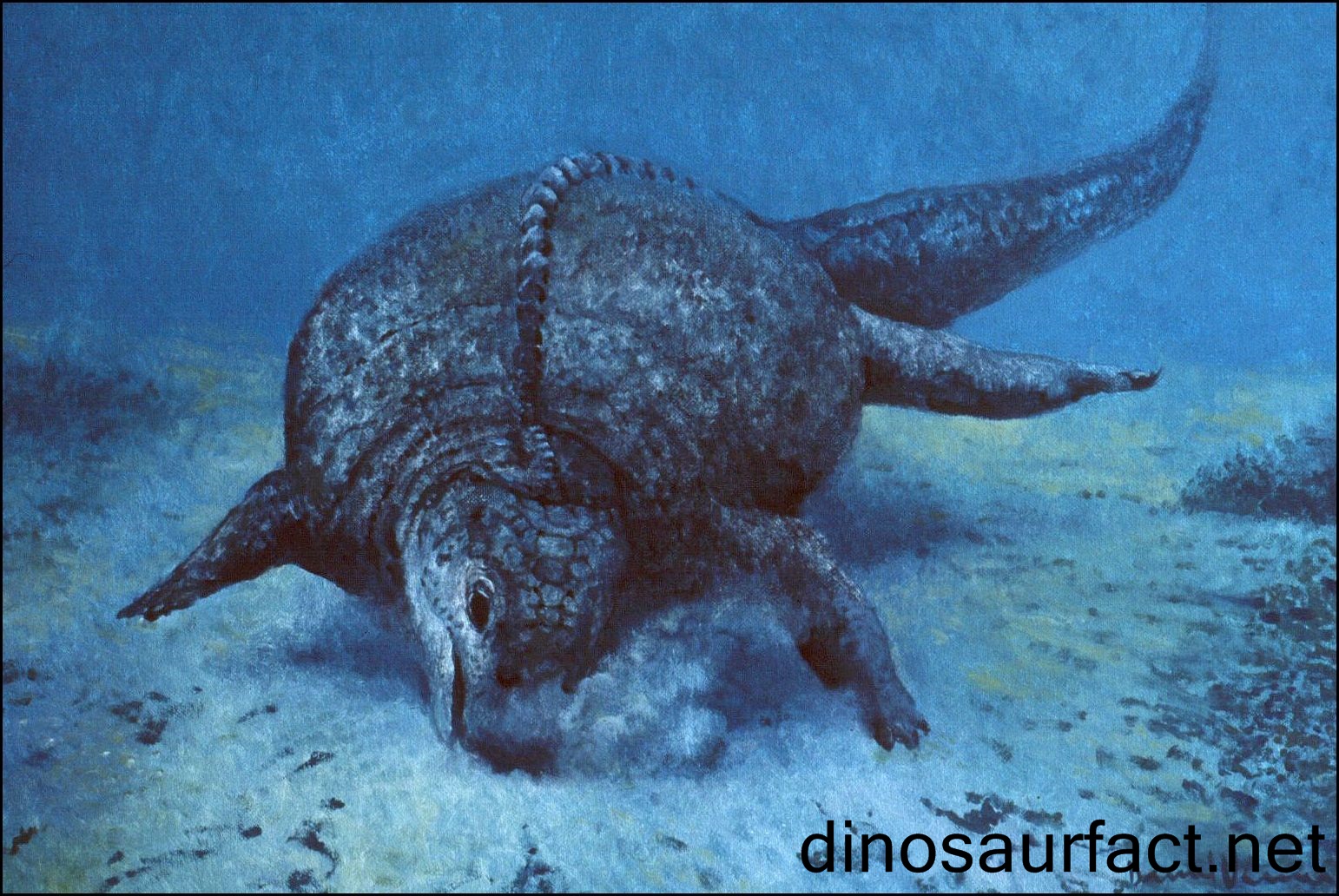
Psephoderma Psephoderma (meaning 'pebbly skin') is a genus of placodont that was very similar to its relatives Placochelys and Cyamodus. Psephoderma had a flattened skull and a narrow, straight rostrum. Inside this skull, embedded in the jaws, were rounded teeth specialized for crushing the shellfish it ate. Unlike most placodonts, Psephoderma had a carapace that was divided into two pieces, one on the shoulders and back, another on the rear end. Psephoderma grew to 180 cm long and lived in the Late Triassic (Norian), about 210 million years ago. It was one of the last placodonts to live.
Tags: Вымершие рептилии, Триас, диапсиды, завроптеригии, лепидозавроморфы, плакодонты |
| 07:17 pm [industrialterro] [Link] |
Cyamodus Cyamodus was a placodont, known from fossil remains discovered in Germany, in the early-to-mid-19th century and was named by Christian Erich Hermann von Meyer, in 1863. The fossils have been dated to the Triassic Period, from the Anisian to Ladinian stages. Cyamodus was 1.3 meters (4 feet) long. Cyamodus was a heavily armored swimmer that fed mainly on shellfish that it was specialized to uproot and crush with its powerful jaws. The body of Cyamodus, specifically the armor, has been described as possessing a turtle-like flatness. The shell was a two-part carapace on the upper surface of the body. The larger half covered Cyamodus from the neck to the hips and spread out flat, almost encompassing the limbs. The second, smaller plate covered the hips and the base of the tail. The shells themselves are covered in hexagonal or circular plates of armor. The skull is heart-shaped and broad. Thus far, five species of Cyamodus have been identified - C. rostratus, C. munsteri, C. tarnowitzensis, C. hildegardis, and C. kuhnschneyderi. Cyamodus is the type genus of the family Cyamodontidae.
Tags: Вымершие рептилии, Триас, диапсиды, завроптеригии, лепидозавроморфы, плакодонты |
| 07:07 pm [industrialterro] [Link] |
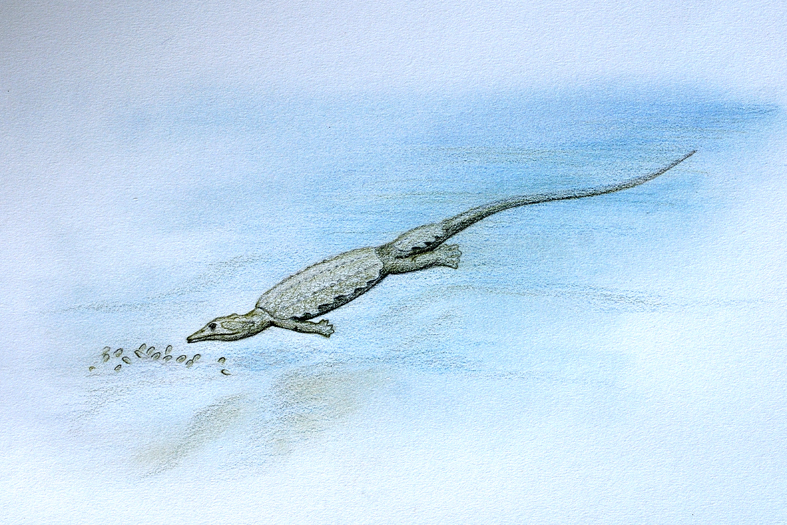
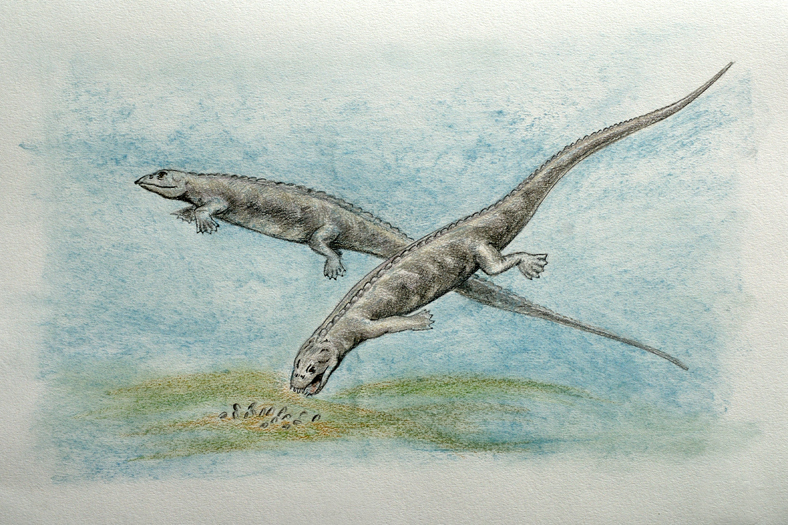
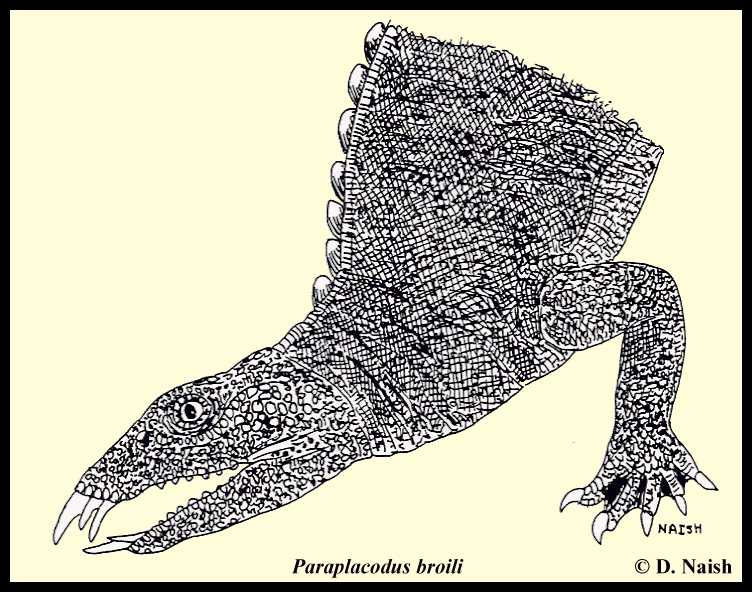
Paraplacodus Paraplacodus was a Placodont from the middle Triassic period, during the Anisian to Ladinian stages. The fossils were uncovered in Northern Italy and the species was named in 1931 by Bernhard Peyer. Paraplacodus means "Almost Placodus", and thus far only one species, P. broilli, has been identified, although as the name suggests, it was similar to Placodus, and also bore a strong resemblance to Saurosphargis. Like all known Placodonts, Paraplacodus was an aquatic reptile that fed almost exclusively on shellfish. Most known Placodont species can be divided into two groups - the unarmored placodontoids, which would resemble a large, scaly, tooth-filled newt, or the armored cyamodontids, which would resemble a heavily-armored turtle; Paraplacodus would have been in the newt-like family, but grew to a length of 1.5 meters (4.5 feet). The jaws of Paraplacodus were adapted to eat shellfish, with three pairs of protruding teeth in the top row and two rows of protruding teeth in the front of the jaw, with rounded crushing teeth in the upper and lower jaws. Thick ribs formed a box-like ribcage with an almost-square cross-section, which enabled Paraplacodus to remain close to the seabed while hunting for food. Плакодонты (Placodontia) — отряд ископаемых морских пресмыкающихся надотряда Sauropterygia, живших в триасовом периоде на территории Европы, Азии и Африки. Название означает «плоские зубы». Плакодонты не являлись полностью водными животными, в некоторых отношениях они были более приспособлены к жизни на суше, однако, по всей видимости, существенную часть времени проводили в теплых водах прибрежной полосы. Их рацион составляли разнообразные моллюски и ракообразные, которых они отрывали от морского дна (в этом им помогали ковшевидные челюсти, снабженные мощными мышцами, и шесть конических острых передних зубов). А 14 тупых, плоских коренных зубов позволяли перемалывать раковины, превращая их в кашицу. Длинный хвост помогал проталкивать под водой тело. Плакодонты, вероятно, были легкой добычей для хищников, поскольку медленно передвигались. Поэтому у многих из них на спине развился защитный панцирь. У некоторых панцири были довольно широкими и походили на черепашьи, но плакодонта нельзя счатать родственником черепахи. Одинаковые панцири выработались из-за обитания в одинаковой среде. Этот процесс называют конвергентной эволюцией. Плакодонты вымерли, вероятно, примерно 200 миллионов лет назад вместе с другими животными, исчезнувшими во время наступившего тогда массового вымирания. По одной теории это вымирание произошло из-за широкого распространения динозавров, по другой из-за перехода от обильных осадков к гораздо более засушливому климату.
Tags: Вымершие рептилии, Триас, диапсиды, завроптеригии, лепидозавроморфы, плакодонты |