[Recent Entries][Archive][Friends][User Info]
October 8th, 2011
| October 8th, 2011 | |
|---|---|
| 07:29 pm [industrialterro] [Link] |
Ianthasaurus Ianthasaurus was a small edaphosaurid from the Late Pennsylvanian. Ianthasaurus lacks many of the spectacular specializations seen in Edaphosaurus. For example, the marginal dentition of Ianthasaurus is similar to that of insectivorous reptiles, with slender conical teeth which are slightly recurved at the tips, and there is a slight development of a caniniform region. The palatal and mandibular dentition is unspecialized, and there are no batteries of teeth for crushing of plant materials. Also unlike Edaphosaurus, Ianthasaurus was lightly built and was probably quite agile. The skull was similar to that to Haptodus, a sphenacodontid, though they were distantly related. Самый примитивный из эдафозавров — янтазавр (Ianthasaurus), некрупное животное из позднекаменноугольных отложений Северной Америки и Европы. У него сохраняются длинные зубы, указывающие на возможное питание насекомыми. Длина около 1 метра, «парус» низкий. Типовой вид - Ianthasaurus hardesti из позднего карбона Гарнетта в Канзасе. Вид описан Рейсом и Берманом в 1985 году. Изучение остатков мелких эдафозавров из позднего карбона-ранней перми Западной Европы (Чехия и Германия) показало их возможную принадлежность к данному роду. Это I. mirabilis, описанный Фритчем в 1895 году и I. credneri, описанный Йекелем в 1910 году. Впрочем, посткраниальные остатки янтазавра практически неотличимы от таковых мелких эдафозавров.
Tags: Вымершие синапсиды, Карбон, пеликозавры |
| Time | Event |
| 07:38 pm [industrialterro] [Link] |
Ophiacodon Офиакодон (Ophiacodon) – примитивный хищный пеликозавр из позднего карбона – ранней перми Северной Америки и, возможно, Англии. Относится к группе офиакодонтов (семейство Ophiacodontidae). Самый крупный и самый известный представитель группы. Череп очень крупный, длинный и высокий, множество острых зубов. «Клыки» мало выделяются среди прочих зубов. Тело у крупных видов массивное, ноги короткие, слабо окостеневшие, иногда с тупыми когтями. Около 6 видов, крупнейшие из которых (O. retroversus) достигали в длину 2,5 – 3,6 метра. Интересная особенность – наличие у некоторых крупных особей двух височных отверстий, описан также экземпляр с двумя отверстиями только на одной стороне (с другой было одно отверстие). Считается рыбоядным, но у крупных особей слишком высокий череп. Вероятно, был полуводным хищником, питавшимся самой разнообразной добычей (например, земноводными или дохлой рыбой). Описан О.Ч. Маршем в 1878 году из ранней перми Техаса. Множество синонимов рода упоминается в старой литературе (Diopaeus, Theropleura, Therosaurus, Poliosaurus и др.). Ophiacodon mirus Marsh, 1878 — типовой вид, описан из нижней перми (сакмарский ярус) формации Або/Катлер, Нью-Мексико. Известен по неполному скелету. Некрупный вид, общая длина тела около 1,6 м. Из нижней перми (предположительно, отенский ярус) Англии описан пеликозавр, отнесенный к Ophiacodon sp. Он известен по плохо сохранившемуся фрагменту левой зубной кости. Изначально Мурчисон и Стрикленд (1840) приняли этот образец за верхнечелюстную кость рыбы. Челюсть тонкая и очень низкая, постепенно расширяющаяся спереди назад. Сохранен симфизный отдел и полный зубной ряд, но большая часть вентральной части отсутствует. Длина фрагмента составляет 122 мм. В зубном ряду размещалось приблизительно 34 зуба. Первый зуб в ряду, вероятно, был большим, как второй и третий. Третий зуб полностью сохранился, его длина состаляет 11 мм. Четвертая альвеола, вероятно, также вмещала большой зуб. Зубы с 5 по 26 примерно одинаковы по размеру, длиной 5 мм. Зубы с 27 по 34 намного меньше, уменьшаются в размере спереди назад; длина наименьшего зуба — 2 мм. Зубы не сжаты с боков и не имеют режущих краев; зубы с 5 по 34 конические и колышковидные, с тупыми вершинами. Полностью сохранившийся увеличенный третий зуб немного загнут и заострен. Структура челюсти и строение зубов европейского Ophiacodon sp. типичны для офиакодонтов и отличаются от таковых у сфенакодонтов. Группа увеличенных зубов на переднем конце нижней челюсти характерна для пеликозавров. Зубы мельче и более многочисленны, чем у сфенакодонтов, а в зубном ряду есть много промежутков. Это также особенность, присущая офиакодонтам, и, вероятно, связанная с медленной сменой зубов. По структуре челюсть напоминает нижнюю челюсть пеликозавров из рода Ophiacodon. До обнаружения этой находки представители рода, даже наиболее примитивные формы из каменноугольного периода, были известны только в Северной Америке. Длина черепа европейского офиакодона могла равняться приблизительно 185 мм, что значительно меньше, чем у любой из известных американских форм. Однако, возможно, остатки принадлежат молодому животному. Количество зубов также меньше, чем у американских видов, хотя и превышает число, характерное для сфенакодонтов. Кроме меньшего размера и числа зубов, в остальном челюсть наиболее сходна с челюстью Ophiacodon uniformis, формы из отенского яруса формации Уичита. Малое число отличительных признаков не позволяет отнести европейскую форму к отдельному или одному из описанных видов рода Ophiacodon.
Ископаемые останки (1, 2, 3, 4, 5):
Tags: Вымершие синапсиды, Карбон, пеликозавры |
| Time | Event |
| 08:04 pm [industrialterro] [Link] |
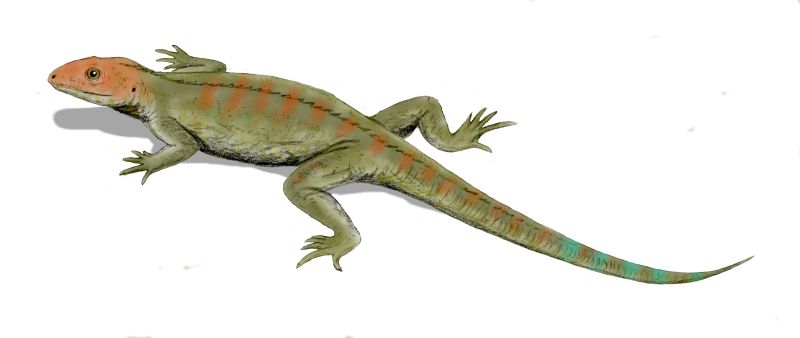
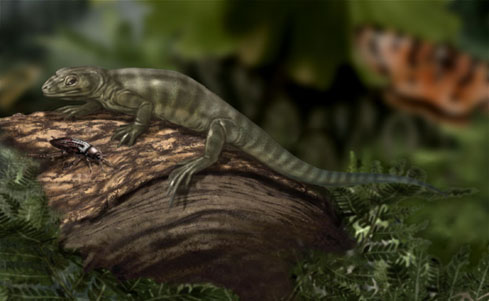
Hylonomus Hylonomus (pronounced /haɪˈlɒnəməs/, hylo- "forest" + nomos "dweller") was a very early reptile. It lived 312 million years ago during the Late Carboniferous period. It is the earliest unquestionable reptile (Westlothiana is older, but may in fact be an amphibian, and Casineria is rather fragmentary). Hylonomus was 20 centimetres (8 in) long (including the tail) and probably would have looked rather similar to modern lizards. It had small sharp teeth and likely ate small invertebrates such as millipedes or early insects. Fossils of Hylonomus have been found in the remains of fossilized club moss stumps in Joggins, Nova Scotia, Canada. It is supposed that, after harsh weather, the club mosses would crash down, with the stumps eventually rotting and hollowing out. Small animals such as Hylonomus, seeking shelter, would enter and become trapped, starving to death. Fossils of the basal pelycosaur Archaeothyris and the basal diapsid Petrolacosaurus are also found in the same region of Nova Scotia, although from a higher stratum, dated approximately 6 million years later. Fossilized footprints found in New Brunswick have been attributed to Hylonomus, at an estimated age of 315 million years. This animal was discovered by John William Dawson in the mid-19th century. The species name comes from Dawson's teacher, the geologist Sir Charles Lyell. While it has traditionally been included in the group Protothyrididae, later studies have shown that it is probably more closely related to diapsids. Гилоном (Hylonomus) Размеры: длина 20 см Место обитания: Новая Шотландия (С. Америка) Период: средний карбон Окаменелые ископаемые остатки гилонома, одного из древнейших известных нам пресмыкающихся, были найдены внутри окаменелых стволов древовидных плаунов. Длинный хвост и тонкие пальцы на лапах придавали гилоному сходство с ящерицей. Маленький череп обладал достаточной прочностью, а челюстные мышцы были сильнее, чем у ранних тероподов (звероящеров). В острозубую пасть гилонома попадали насекомые и многоножки, обитавшие в тропической среде. Гилономы откладывали яйца, имевшие защитную оболочку с анамниотической жидкостью и скорлупу, предохранявшую от высыхания.
Репродукции (1, 2, 3, 4, 5, 6):
Tags: Вымершие рептилии, Карбон |
| Time | Event |
| 09:41 pm [industrialterro] [Link] |
Westlothiana Westlothiana lizziae was a reptile-like amphibian or possibly early reptile that bore a superficial resemblance to modern-day lizards. It lived during the Carboniferous period, about 350 million years ago. The type specimen was discovered in East Kirkton Quarry, Bathgate, Scotland, in 1984, and was named after the West Lothian district where it was found. Westlothiana's anatomy contained a mixtures of both labyrinthodont and reptilian features, and was originally regarded as the first reptile. Most scientists place them among the Reptilomorpha, as a sister group to the first amniotes. This species probably lived near a freshwater lake, probably hunting for other small creatures that lived in the same habitat. It was a slender animal, with rather small legs and a long tail. Together with Casineria, another transitional fossil found in Scotland, it is one of the smallest reptil-like amphibians known, being a mere 20 cm in adult length. The small size has made it a key fossil in the search for the earliest amniote, as amniote eggs are thought to have evolved in very small animals. Advanced features that ties it in with the reptilian rather than amphibian group is unfused ankle bones, lack of labyrinthodont infolding of the dentin, a lack of an otic notch and a generally small skull. Ruta & al. (2003) interpreted the long body and small legs as a possible adaption to burrowing, similar to that seen in modern skinks. The phylogenetic placement of Westlothiana has varied from basal amniote (i.e. a primitive reptile) to an amphibian Lepospondyl only distantly related to the Reptiliomorpha. The actual phyllogenetic position of Westlothiania is uncertain, reflecting both the fragmentary nature of the find and the uncertainty of labyrinthodont phylogeny in general. Вестлотиана (Westlothiana lizziae). Окаменелые остатки вестлотианы были найдены в отложениях раннего карбона Шотландии в 1988 году. Это существо обладает смесью признаков амфибий и ранних рептилий. Его позвоночник, степень окостенения скелета конечностей и форма бедренной кости напоминают таковые амниот, то есть позвоночных, эмбрион которых развивается внутри вторичных зародышевых оболочек. В стопе плюсна похожа на плюсну земноводных, но число фаланг такое же, как у ранних амниот. Череп тоже демонстрирует смесь признаков. Из-за этого одни ученые относят вестлотиану к амфибиям — антракозаврам, другие считают древнейшим представителем рептилий или парарептилий. Вестлотиана была маленьким наземным существом, похожим на ящерицу, с длинным гибким туловищем и короткими ногами. Питалась она мелкими насекомыми. Возможно, вестлотиана уже откладывала яйца, как это делают рептилии, но из яиц рождались живущие в воде и дышащие жабрами личинки.
Tags: Вымершие амфибии, Вымершие рептилии, Карбон |
| Time | Event |
| 09:56 pm [industrialterro] [Link] |
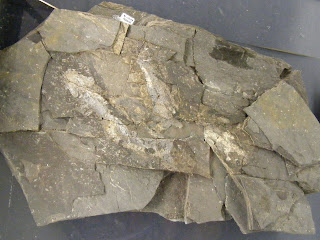
Casineria Casineria was a tetrapod which lived 340 million years ago in the Mississippian epoch. Casineria was a small animal with a total length estimated to have been 15 centimeters. It lived in what was then a fairly dry environment in Scotland. It is noted for its mix of primitive (amphibian) and advanced (reptilian) characters, putting it at or very near the origin of the amniotes. The sole find is lacking key elements (most of the skull and the whole lower body is missing), making exact analysis is difficult. Its name, Casineria, is a latinization of Cheese Bay, the site near Edinburgh, where it was found. While retaining a general build like those found in the amphibian reptiliomorph groups like Seymouriamorpha and Diadectomorpha, Casineria also shows features that ties it in with early reptiles, notably a generally gracile build with light leg-bones, unfused ankles and toes terminating in claws. This would enable the animal to use their feet actively in traction, rather than as holdfasts, and indication of a primarily terrestrial lifestyle. These traits shows it was more closely related to amniotes than to other known reptiliomorph amphibians. With its advanced features, Casineria may have been one of the very first true amniotes, and thus the first reptile under traditional classification. In phylogenetic parlance it would have been a stem amniote, close to, but outside the crown group Amniota (a group containing the last common ancestor of synapsids and sauropsids and all its descendants). Casineria pushes back the origin of amniote lineages much farther than was previously realized. Casineria was an insectivore. This earliest amniote had five fingers with claws on each hand, and marks the earliest clawed foot. Claws being an intimately bound to the formation of keratinous scales in reptiles, Casineria would in life in all likelihood bear scaly, reptilian type skin. In life, it would resemble a small lizard. Likely being among the first amniotes in the biological sense, it would have laid amniotic egg not dependent on being laid in water to survive, possibly hiding them in damp vegetation or hollowed out tree stumps. This has been inferred from the fact that Casineria was found in rocks showing a rather dry environment. In the early Carboniferous period before the appearance of Casineria, vertebrates were primarily aquatic, only spending part of their time on land. Casineria and its relatives were the first vertebrates to live and reproduce on land.
Ископаемые останки:
Tags: Вымершие амфибии, Вымершие рептилии, Карбон |








| Previous Day | 2011/10/08 [Archive] |
Next Day |